Many English learners get confused by timber and timbre because these two words sound exactly the same in most varieties of English. When people hear them in conversation, it can be difficult to know which word is being used.
This type of word is called a homophone. Homophones are words that have the same pronunciation but different spellings and meanings.
English has many examples, such as their and there or flower and flour. Timber and timbre belong to the same group.
Understanding the difference is important because these words are used in completely different situations.
One word is connected to wood and trees, while the other is related to music and sound. Using the wrong one can make your writing look incorrect and may confuse your reader.
Many students see these words in books, songs, school lessons, or online articles and wonder which spelling is correct. The answer depends entirely on the meaning you want to express.
After reading this guide, you will clearly understand what each word means, when to use it, how to avoid common mistakes, and how to remember the difference easily.
You will also find plenty of examples, grammar tips, and practice exercises to help you feel confident when using these words in everyday English.
What Does “Timber” Mean?
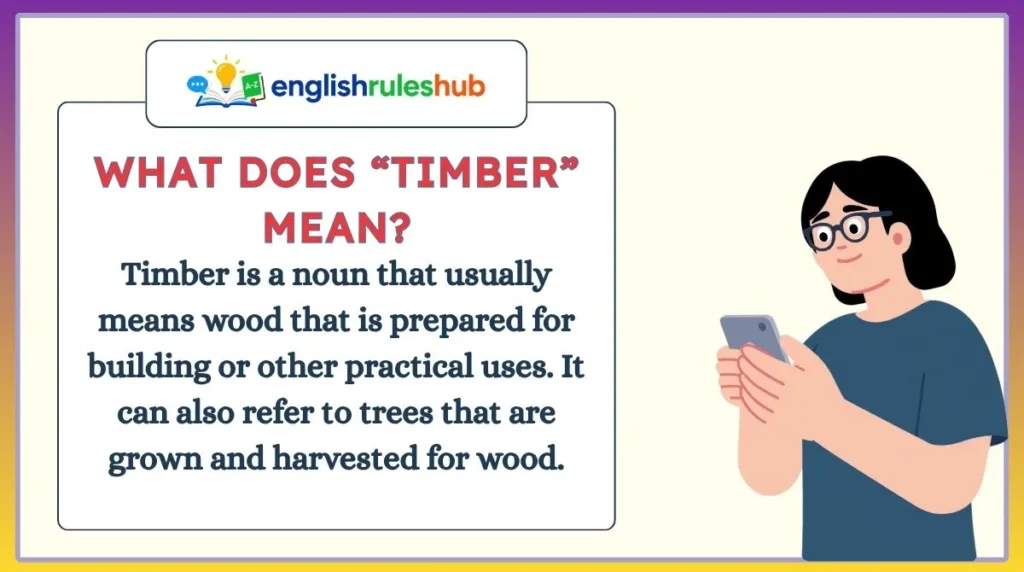
Timber is a noun that usually means wood that is prepared for building or other practical uses. It can also refer to trees that are grown and harvested for wood.
In everyday English, timber is commonly connected with construction, furniture making, forests, and woodworking.
When to Use Timber
Use timber when talking about:
- Wood used for building
- Trees grown for wood
- The logging industry
- Wooden structures
- Forest resources
Grammar Rule
Timber is most commonly used as a noun.
Structure:
Timber + verb
Examples:
- The timber was delivered yesterday.
- This house is built from timber.
- The company sells timber across the country.
In some situations, timber! can also be used as an exclamation when a tree is falling.
Example Sentences with Timber
- The workers carried the timber to the construction site.
- This bridge was built using strong timber.
- The forest provides valuable timber for local businesses.
- We bought timber to make a garden fence.
- The cabin is made entirely of timber.
- The company exports timber to several countries.
- Heavy rain damaged some of the stored timber.
- The logger shouted “Timber!” before the tree fell.
Common Learner Confusion
Many learners accidentally write timbre when discussing wood or building materials because the pronunciation is the same.
Incorrect:
- The house is made of timbre.
Correct:
- The house is made of timber.
A simple rule is that whenever the meaning relates to wood, trees, forests, furniture, or construction, the correct spelling is timber.
What Does “Timbre” Mean?
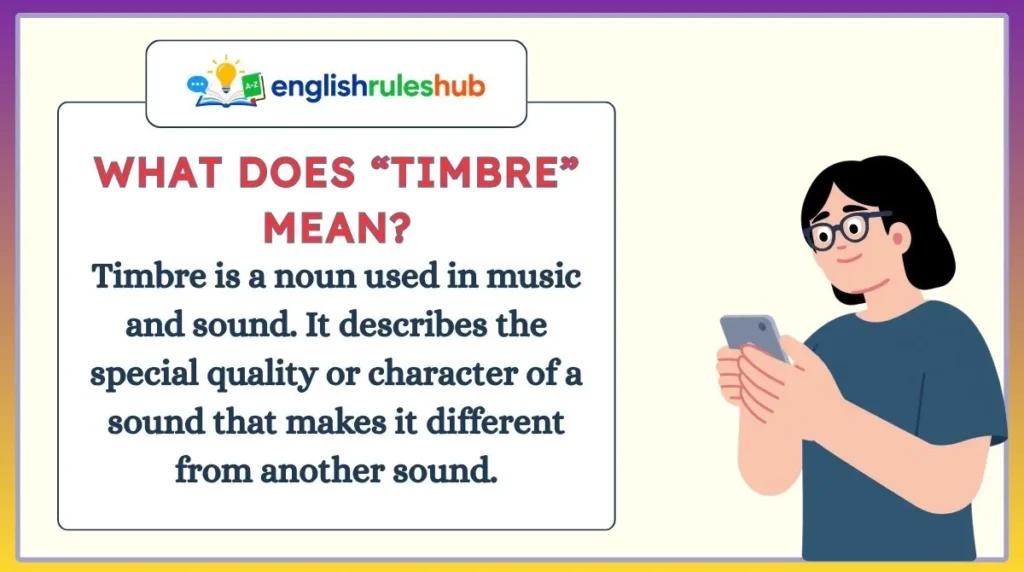
Timbre is a noun used in music and sound. It describes the special quality or character of a sound that makes it different from another sound.
For example, a piano and a guitar can play the same note at the same volume, but they still sound different. That unique sound quality is called timbre.
When to Use Timbre
Use timbre when talking about:
- Music
- Singing
- Musical instruments
- Voice quality
- Sound characteristics
Grammar Rule
Timbre is almost always used as a noun.
Structure:
Timbre + verb
Examples:
- The timbre of her voice is beautiful.
- The instrument has a warm timbre.
Example Sentences with Timbre
- The singer’s rich timbre impressed the audience.
- Her voice has a soft and calming timbre.
- The violin produces a unique timbre.
- Musicians often study timbre carefully.
- The timbre of the trumpet changed during the performance.
- Every instrument has its own timbre.
- His deep timbre made him a great radio host.
- The teacher explained how timbre affects musical expression.
Common Learner Confusion
Students often think timbre is simply another word for volume or pitch. It is not.
- Pitch tells us how high or low a sound is.
- Volume tells us how loud or quiet a sound is.
- Timbre tells us the unique character of the sound.
For example, two singers may sing the same note at the same volume, but each voice still sounds different because of its timbre.
Difference Between Timber and Timbre
Although these words sound alike, their meanings are completely different.
| Feature | Timber | Timbre |
|---|---|---|
| Meaning | Wood prepared for use | Quality of a sound |
| Word Type | Noun | Noun |
| Topic | Trees, wood, construction | Music, voice, sound |
| Common Use | Building and forestry | Music and audio |
| Example | The timber arrived today. | The timbre was beautiful. |
| Pronunciation | Same as timbre | Same as timber |
Usage Difference
Timber belongs to the world of forests, carpentry, construction, and wood products.
Example:
- They used timber to build the roof.
Timbre belongs to music, speech, and sound.
Example:
- The singer’s timbre was warm and expressive.
Grammar Logic
Both words are nouns, but they appear in different contexts.
Timber usually appears with words such as:
- wood
- tree
- forest
- lumber
- construction
- building
Timbre usually appears with words such as:
- voice
- music
- sound
- singer
- instrument
- tone
These surrounding words often help you choose the correct spelling.
Sentence Structure Difference
Timber examples:
- The timber was expensive.
- We need more timber.
- The timber came from local forests.
Timbre examples:
- Her timbre is unique.
- The timbre sounds warm.
- Musicians study timbre carefully.
Meaning Comparison
Think of it this way:
- Timber = something you can touch.
- Timbre = something you can hear.
One exists in the physical world as wood.
The other exists in the world of sound.
That simple difference can help prevent many mistakes.
Grammar Rules You Must Remember
Rule #1: Use Timber for Wood and Trees
Whenever the meaning involves wood, forests, logging, or construction, choose timber.
Example:
- The carpenter ordered more timber for the project.
Not:
- The carpenter ordered more timbre for the project.
Rule #2: Use Timbre for Sound Quality
Whenever you discuss voices, music, or the character of a sound, use timbre.
Example:
- The timbre of her voice was unforgettable.
Not:
- The timber of her voice was unforgettable.
Rule #3: Both Words Are Usually Nouns
Neither word is commonly used as a verb in everyday English.
Correct:
- The timber is strong.
- The timbre is pleasant.
Rule #4: Look at the Context
Context often gives the answer immediately.
If the sentence contains words like:
- forest
- wood
- furniture
- tree
the answer is usually timber.
If the sentence contains words like:
- singer
- music
- voice
- instrument
the answer is usually timbre.
Example:
- The violin’s ______ was beautiful.
The context is music, so the answer is timbre.
Common Mistakes Students Make
Because these words sound the same, spelling mistakes are very common.
Mistake 1: Using Timbre for Wood
Wrong:
- We bought timbre to build a table.
Correct:
- We bought timber to build a table.
Why it happens:
Students hear the pronunciation and choose the wrong spelling.
Mistake 2: Using Timber for Voice Quality
Wrong:
- Her timber is very soothing.
Correct:
- Her timbre is very soothing.
Why it happens:
Many learners know the word timber but are unfamiliar with timbre.
Mistake 3: Guessing Without Looking at Context
Wrong:
- The musician admired the timber of the piano.
Correct:
- The musician admired the timbre of the piano.
Tip:
Always ask yourself:
Am I talking about wood or sound?
Mistake 4: Confusing Timbre with Tone
Although they are related, they are not exactly the same.
Tone often refers to emotional quality.
Timbre refers to the unique sound character.
Example:
- Her tone sounded angry.
- Her timbre sounded warm and deep.
Easy Correction Tips
- Wood = timber.
- Sound = timbre.
- Trees = timber.
- Music = timbre.
- Building = timber.
- Voice quality = timbre.
These quick checks can solve most mistakes instantly.
Easy Trick to Remember the Difference
Memory tricks can make learning easier.
Trick 1: Timber Has “B”
Think of the B in timber as standing for:
Building
Timber → Building → Wood
Example:
- Timber is used for building houses.
Trick 2: Timbre Has “RE”
The ending RE can remind you of:
Recording or Resonance
Both are connected to sound.
Timbre → Recording → Sound
Real-Life Logic
Imagine two rooms.
Room 1 contains:
- Trees
- Wooden chairs
- Wooden tables
- Construction materials
That room represents timber.
Room 2 contains:
- Singers
- Guitars
- Pianos
- Microphones
That room represents timbre.
Whenever you see the word, picture the correct room.
The meaning becomes much easier to remember.
Daily Life Examples
Here are some natural spoken-English examples.
- We need more timber to finish the fence.
- This old house was built from strong timber.
- The company sells timber to builders.
- My grandfather worked in the timber industry.
- I love the timbre of her singing voice.
- That guitar has a warm timbre.
- The actor’s deep timbre made him easy to recognize.
- Every musical instrument has its own timbre.
- The carpenter checked the quality of the timber.
- The music teacher explained timbre to the class.
Conversation Example 1
A: What are they carrying?
B: Timber for the new cabin.
Conversation Example 2
A: Why does that singer sound different?
B: She has a unique timbre.
Conversation Example 3
A: What material did they use for the roof?
B: Mostly timber.
Conversation Example 4
A: Why does a piano sound different from a guitar?
B: Because each instrument has a different timbre.
Practice Section
Choose the correct word: timber or timbre.
Question 1
The carpenter ordered more ______ for the project.
Question 2
The singer’s ______ was rich and powerful.
Question 3
The cabin was built from local ______.
Question 4
The violin has a beautiful ______.
Question 5
The company exports ______ to several countries.
Answers
- timber
- timbre
- timber
- timbre
- timber
Bonus Practice
Choose the correct option.
- The ______ of the piano sounded warm.
- We bought ______ to repair the deck.
- Her voice has a unique ______.
- The forest produces valuable ______.
- The musician studied sound and ______.
Answers:
- timbre
- timber
- timbre
- timber
- timbre
FAQs
What is the difference between timber and timbre?
Timber refers to wood or trees used for practical purposes such as construction. Timbre refers to the unique quality of a sound, voice, or musical instrument. Although they sound the same, their meanings are completely different.
Can we use timber and timbre in questions?
Yes. Both words can be used in questions.
Examples:
- Where did the timber come from?
- How would you describe the timbre of her voice?
The grammar remains the same as in regular sentences.
Is timber formal or informal?
Timber is used in both formal and informal English. Builders, carpenters, engineers, and everyday speakers use it regularly when discussing wood and construction materials.
Is timbre formal or informal?
Timbre is more common in music, education, and technical discussions about sound. However, musicians and music lovers also use it in everyday conversations.
Why do timber and timbre sound the same?
English contains many homophones. Timber and timbre developed from different language histories, but modern pronunciation makes them sound nearly identical in many accents.
How can I remember which spelling is correct?
Remember this simple rule:
- Building and wood = timber.
- Music and sound = timbre.
Checking the context before writing is often enough to choose the correct word.
Final Conclusion
Timber and timbre are classic examples of English homophones. They sound the same, but their meanings are completely different.
Timber is connected to wood, trees, forests, construction, and building materials. If you are talking about something made from wood or produced by trees, timber is usually the correct choice.
Timbre, on the other hand, belongs to the world of music and sound. It describes the special quality that makes one voice or instrument sound different from another.
The easiest way to remember the difference is simple: wood equals timber, sound equals timbre. Whenever you are unsure, look at the context of the sentence. The surrounding words will usually tell you which spelling you need.
Practice with real examples, pay attention when reading, and try using both words in your own sentences.
After a little practice, choosing between timber and timbre will become natural and easy.

I am Benjamin Clark, an English language writer passionate about simplifying grammar, vocabulary, and word meanings. I create clear, accurate, and practical content to help learners improve their English skills with confidence every day.