Many English learners get confused by any more and anymore because they look almost the same.
The only visible difference is a space. Because of that, many students think both forms mean exactly the same thing.
The truth is a little different.
In many situations, using the wrong form can make your sentence sound strange or even grammatically incorrect.
Native speakers often use these words in everyday conversations, text messages, emails, and writing. That is why understanding the difference is important.
You may hear someone say:
“I don’t live there anymore.”
But then you might see:
“Do you have any more coffee?”
Both expressions are common, but they do not have the same meaning. One talks about something that is no longer true, while the other means an additional amount of something.
The good news is that the difference is actually very simple once you learn the basic rule.
After reading this guide, you will clearly understand when to use any more and when to use anymore, how they work in sentences, the grammar rules behind them, common mistakes to avoid, and an easy trick that will help you remember the difference forever.
What Does “Any More” Mean?
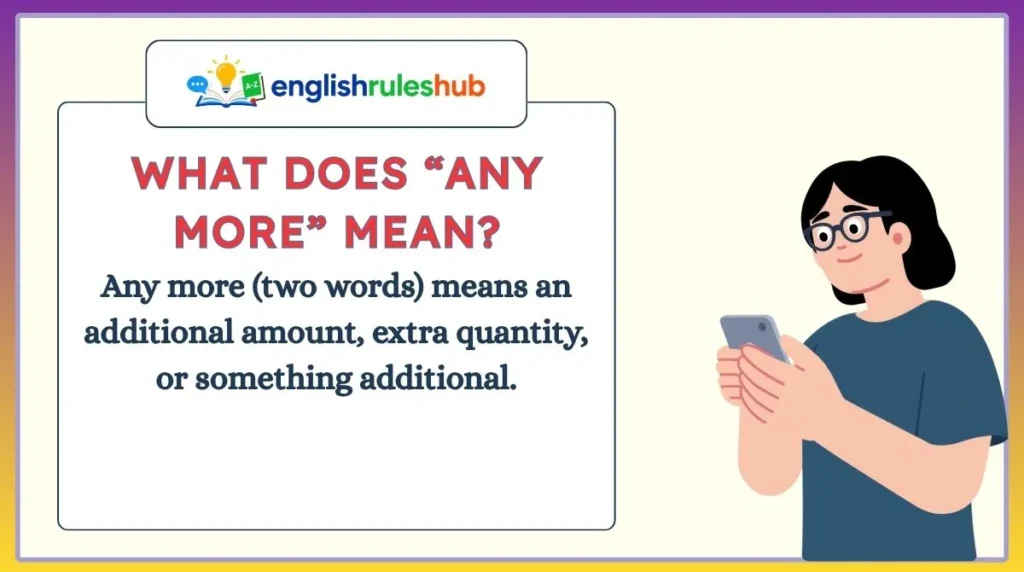
Any more (two words) means an additional amount, extra quantity, or something additional.
It is usually used when talking about things that can be counted or measured. In many cases, it refers to getting, having, wanting, or needing extra amounts of something.
When to Use Any More
Use any more when you mean:
- Additional quantity
- Extra amount
- Something else beyond what already exists
Grammar Rule
Any more is usually followed by a noun or used when talking about quantity.
Structure:
- any more + noun
- any more + of + noun
Examples of Any More
- Do you have any more water?
- I don’t need any more help.
- We don’t have any more tickets.
- Can I get any more information?
- She doesn’t want any more cake.
- Are there any more questions?
- We need any more evidence before making a decision.
- Do you have any more pencils?
Common Learner Confusion
Many learners see the word more and automatically write it together as anymore.
For example:
❌ Do you have anymore coffee?
✅ Do you have any more coffee?
The sentence talks about an extra amount of coffee, so the two-word form is correct.
A simple question can help:
Can I replace it with “additional”?
If yes, use any more.
Example:
Do you have any more coffee?
Do you have additional coffee?
Since the meaning works, any more is correct.
What Does “Anymore” Mean?
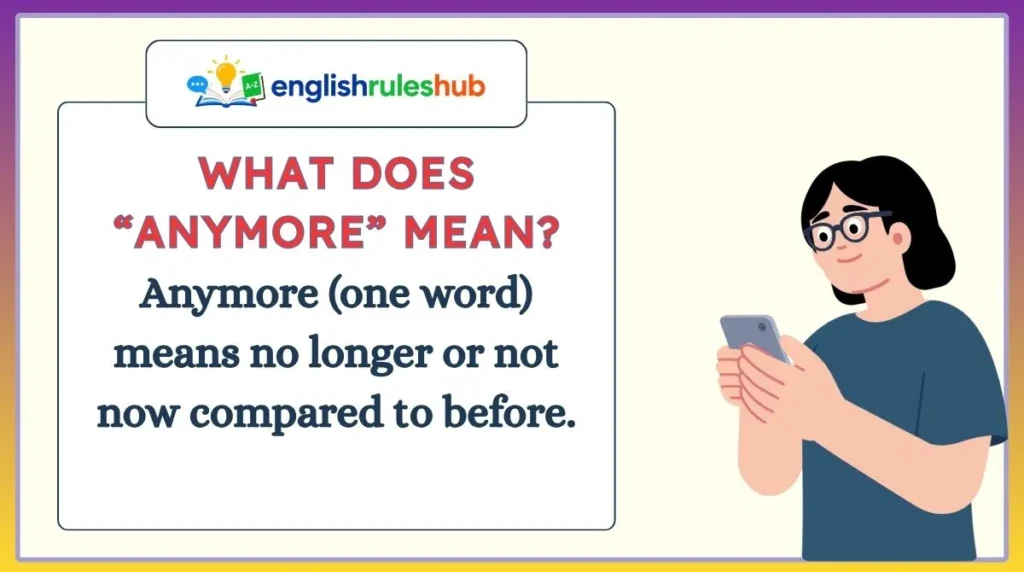
Anymore (one word) means no longer or not now compared to before.
It is an adverb that usually appears in negative sentences.
It describes a change over time. Something was true before, but it is not true now.
When to Use Anymore
Use anymore when talking about:
- Something that stopped happening
- A situation that changed
- A condition that is no longer true
Grammar Rule
Anymore is most commonly used in negative sentences.
Structure:
- subject + do/does/did not + verb + anymore
Examples of Anymore
- I don’t play football anymore.
- She doesn’t work here anymore.
- We aren’t friends anymore.
- He doesn’t smoke anymore.
- They don’t live in London anymore.
- My phone doesn’t work anymore.
- I don’t watch that show anymore.
- The store isn’t open anymore.
Common Learner Confusion
Students often use any more when they should use anymore.
Example:
❌ I don’t work here any more.
In modern American English, many grammar guides prefer:
✅ I don’t work here anymore.
This sentence means “I no longer work here.”
The focus is not quantity. The focus is a change in time.
Difference Between Any More and Anymore
The main difference is simple:
| Any More | Anymore |
|---|---|
| Two words | One word |
| Means additional amount | Means no longer |
| Related to quantity | Related to time |
| Usually followed by a noun | Usually acts as an adverb |
| Can mean extra or additional | Means something has stopped |
| Answers “How much more?” | Answers “Still true or not?” |
Usage Difference
Any more deals with quantity.
Example:
- Do you have any more milk?
The speaker wants additional milk.
Anymore deals with time.
Example:
- I don’t drink milk anymore.
The speaker drank milk before but does not drink it now.
Grammar Logic
Think about the job each expression performs.
Any more acts like a quantity expression.
Example:
- We don’t need any more chairs.
The word chairs is a noun.
Anymore acts as an adverb.
Example:
- We don’t use those chairs anymore.
It describes the entire action.
Sentence Structure Difference
Any More
Subject + Verb + Any More + Noun
Examples:
- We need any more details.
- Do you have any more sugar?
- They don’t want any more problems.
Anymore
Subject + Negative Verb + Anymore
Examples:
- I don’t drive anymore.
- She doesn’t teach anymore.
- They don’t travel anymore.
Meaning Comparison
Compare these sentences:
Do you want any more tea?
Meaning: Do you want an additional amount of tea?
I don’t drink tea anymore.
Meaning: I used to drink tea, but now I do not.
One sentence talks about quantity.
The other talks about time.
That is the key difference.
Grammar Rules You Must Remember
Rule #1: Use “Any More” for Extra Amounts
When talking about additional quantity, use two words.
Example:
- We don’t need any more paper.
The sentence refers to extra paper.
Rule #2: Use “Anymore” for Something That Stopped
When something is no longer true, use one word.
Example:
- He doesn’t study French anymore.
He studied French before, but not now.
Rule #3: Anymore Usually Appears in Negative Sentences
Most of the time, anymore comes with words like:
- don’t
- doesn’t
- didn’t
- isn’t
- aren’t
- wasn’t
Example:
- She isn’t upset anymore.
Rule #4: Check Whether a Noun Follows
If a noun comes after the expression, you probably need any more.
Example:
- Do you have any more cookies?
The noun is cookies.
Therefore, the correct choice is any more.
Common Mistakes Students Make
Many English learners make the same mistakes because these words look almost identical.
Mistake 1: Using Anymore for Quantity
❌ Do you have anymore books?
✅ Do you have any more books?
Why?
Because books are a quantity.
Mistake 2: Using Any More for Time
❌ I don’t live there any more.
✅ I don’t live there anymore.
Why?
The meaning is “no longer.”
Mistake 3: Ignoring the Meaning
Some learners focus only on spelling.
Instead, focus on the meaning first.
Ask yourself:
- Am I talking about extra quantity?
- Am I talking about something that stopped?
The answer tells you which form to choose.
Mistake 4: Translating Directly from Another Language
Many languages do not make this distinction.
As a result, learners often guess.
A better method is to look at the sentence’s purpose.
Quantity = any more
No longer = anymore
Easy Correction Tips
- See a noun after it? → any more
- Means extra amount? → any more
- Means no longer? → anymore
- Refers to a past situation that changed? → anymore
Easy Trick to Remember the Difference
A simple memory trick can save you a lot of confusion.
Remember This:
More = Quantity
If you can point to something and count it, use any more.
Examples:
- any more apples
- any more money
- any more chairs
- any more questions
Now think about anymore as meaning:
“No longer.”
Examples:
- I don’t smoke anymore.
- She doesn’t sing anymore.
- We don’t travel anymore.
Quick Test
Ask yourself:
Can I replace it with “additional”?
If yes:
Use any more.
Example:
- Do you need any more help?
Do you need additional help?
Yes.
Therefore, any more is correct.
Now try:
- I don’t need help anymore.
Can we say:
- I don’t need help additional?
No.
Therefore, anymore is correct.
Daily Life Examples
Here are some common spoken English examples.
- Do you have any more rice?
- I don’t watch television anymore.
- Can I borrow any more notebooks?
- She doesn’t call me anymore.
- Are there any more seats available?
- My grandfather doesn’t drive anymore.
- We don’t need any more chairs.
- They don’t sell that product anymore.
- Do you want any more juice?
- I don’t use that app anymore.
Short Conversation Examples
At Dinner
A: Do you want any more soup?
B: No thanks. I’m full.
At School
A: Are there any more worksheets?
B: Yes, there are three left.
Talking About a Hobby
A: Do you still play tennis?
B: No, I don’t play anymore.
At Work
A: Does Mark work here?
B: No, he doesn’t work here anymore.
These examples show how often both forms appear in daily conversations.
Practice Section
Choose the correct option.
1.
I don’t live in New York (any more / anymore).
2.
Do you have (any more / anymore) pencils?
3.
She doesn’t study Spanish (any more / anymore).
4.
We don’t need (any more / anymore) information.
5.
They don’t visit us (any more / anymore).
Answers
- anymore
- any more
- anymore
- any more
- anymore
Bonus Practice
Choose the correct form.
- Are there any more tickets available?
- I don’t eat fast food anymore.
- We don’t need any more boxes.
- My old computer doesn’t work anymore.
- Would you like any more coffee?
Answers:
- any more
- anymore
- any more
- anymore
- any more
FAQs
What is the difference between any more and anymore?
Any more means an additional amount of something. Anymore means no longer or not now. The first relates to quantity, while the second relates to time.
Can we use anymore in questions?
Usually, anymore appears in negative sentences. However, some regional varieties of English may occasionally use it differently. For learners, it is safest to use it mainly in negative sentences.
Can we use any more in questions?
Yes. This is very common. When asking about extra amounts, use any more.
Example:
- Do you have any more bread?
Is anymore formal or informal?
Anymore is accepted in both formal and informal English. It appears in books, newspapers, business writing, and everyday conversation.
Why do native speakers sometimes write any more instead of anymore?
Different style guides and regional preferences exist. However, modern English generally uses any more for quantity and anymore for meaning “no longer.”
How can I quickly know which one is correct?
Ask yourself one question:
Are you talking about extra quantity or something that stopped?
Extra quantity = any more
Something stopped = anymore
Final Conclusion
The difference between any more and anymore becomes much easier when you focus on meaning instead of spelling.
Use any more when talking about an additional amount of something. It usually appears before a noun and refers to quantity. Examples include extra food, extra money, extra questions, or extra time.
Use anymore when something is no longer true. It describes a change over time and often appears in negative sentences. It tells us that a past situation has stopped.
A simple way to remember the rule is this:
Quantity = any more
No longer = anymore
The more examples you read and use in daily conversations, the more natural the difference will feel. Pay attention when reading English books, articles, and messages. Soon, choosing the correct form will become automatic.
Keep practicing with real sentences, and this common grammar confusion will disappear quickly.

I am Benjamin Clark, an English language writer passionate about simplifying grammar, vocabulary, and word meanings. I create clear, accurate, and practical content to help learners improve their English skills with confidence every day.