If you have ever written disc and wondered whether it should be disk, you are not alone. English learners often see both spellings and ask the same question: Are they different words, or are they simply two spellings of the same word?
The answer is a little more interesting than a simple yes or no.
In many situations, disc and disk have the same meaning. Both can describe a flat, round object.
Both can also refer to things used for storing or playing information. However, the spelling you choose can depend on British or American English, the type of object you are talking about, and the expression you are using.
For example, British English commonly uses disc for many general meanings, while American English often uses disk. In computer-related expressions, disk is especially common in American English, while British English also uses disc in some contexts.
This can make things confusing for students. You may see hard disk, compact disc, disc brake, and disc golf in different places. Why do some expressions prefer one spelling?
The good news is that you do not need to memorize hundreds of rules.
By the end of this guide, you will understand the meaning of disc and disk, when each spelling is normally used, how British and American English differ, which common expressions use each form, and how to choose the correct spelling when you are writing.
What Does “Disc” Mean?
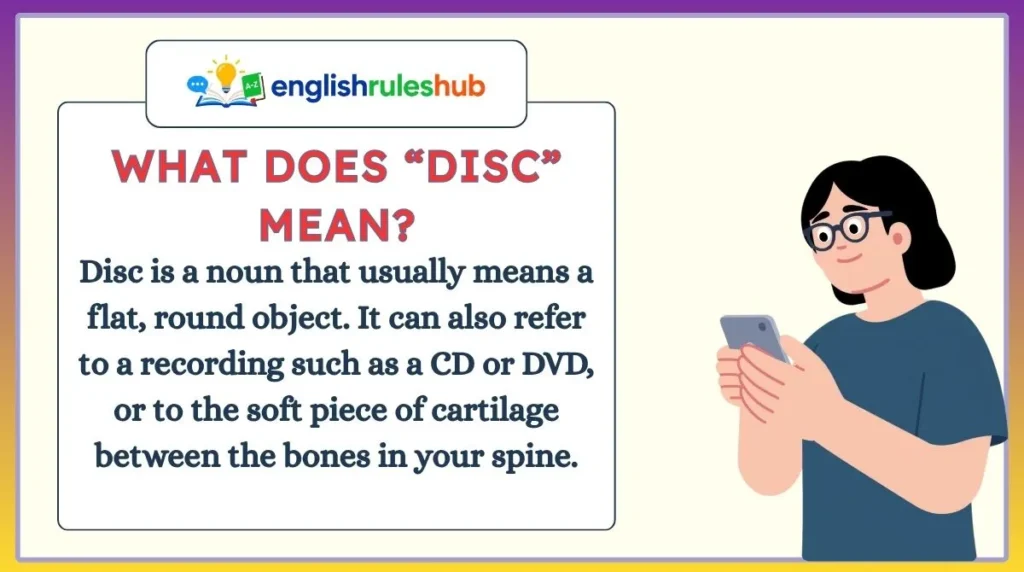
Disc is a noun that usually means a flat, round object. It can also refer to a recording such as a CD or DVD, or to the soft piece of cartilage between the bones in your spine.
The word is pronounced /dɪsk/. Notice that disc and disk have the same pronunciation. The difference is in the spelling, not the sound.
In British English, disc is generally the more common spelling for a flat, circular object. Cambridge Dictionary also notes that American English usually uses disk for this general meaning.
When do we use “disc”?
We can use disc when talking about a round, flat object.
For example:
- The machine has a metal disc inside it.
- The artist released a new disc last month.
- I bought a DVD disc for my children.
- The doctor said that he had a problem with a spinal disc.
- The brake disc needs to be replaced.
- She threw the plastic disc across the garden.
- The old computer came with several discs.
- The name was written on a small metal disc.
The exact meaning comes from the context.
Disc as a round object
The simplest meaning is something that is flat and circular.
Imagine a coin, a round piece of metal, or a flat piece of plastic. If its shape is important, you may describe it as a disc.
For example:
The children were given a small plastic disc.
Here, disc simply describes the shape of the object.
Disc for music and video
Disc can also refer to a recording, especially a CD or DVD.
For example:
I found an old music disc in my room.
You can also say:
The movie is available on disc.
This use is common because CDs and DVDs are round and flat.
Cambridge Dictionary lists a disc as a musical record or compact disc and gives DVD as another example of this meaning.
Disc in the human body
Another important use is in anatomy.
A disc is a piece of cartilage between the bones of the spine.
For example:
The doctor said that the patient had a damaged spinal disc.
You may hear phrases such as:
- spinal disc
- slipped disc
- herniated disc
- intervertebral disc
The spelling disk is also possible in American English for this meaning.
A simple grammar point
Disc is a countable noun.
You can say:
- a disc
- one disc
- two discs
- several discs
The plural form is discs.
For example:
I bought three discs.
You normally need an article or another determiner when you use a singular countable noun.
Correct:
I found a disc.
Incorrect:
I found disc.
This grammar rule has nothing to do with the difference between disc and disk. It is simply the normal grammar of a singular countable noun.
What Does “Disk” Mean?
Disk is another spelling of disc, but it is especially common in American English and in computer-related language.
The word is pronounced exactly the same way as disc: /dɪsk/.
In American English, disk is commonly used for a flat, circular object and for computer storage. In British English, disc is often preferred for the general meaning, while disk is strongly associated with computing in many expressions.
When do we use “disk”?
The word disk is very common when talking about computers and digital storage.
For example:
- hard disk
- disk drive
- disk space
- floppy disk
- disk storage
- backup disk
- magnetic disk
Consider this sentence:
My computer has very little disk space.
Here, disk refers to computer storage.
You would normally not change this to disc space in standard modern computer English.
Disk as computer storage
A disk can be a device or medium used to store information.
For example:
I saved the files to a disk.
Or:
The computer has a large hard disk.
Cambridge Dictionary specifically defines disk in computing as a flat, circular device used for storing information and gives expressions such as hard disk, floppy disk, and disk space.
Examples with “disk”
Here are some simple examples:
- My computer has a large hard disk.
- We need more disk space.
- The old disk contains important files.
- He saved the photos on a disk.
- The computer cannot read the disk.
- I found an old floppy disk in the office.
- The program is stored on the disk.
- The technician replaced the damaged disk.
Disk outside computers
Do not think that disk can only be used for computers.
American English can use disk for a general flat, circular object too.
For example:
The dog’s name was written on a metal disk.
In this sentence, disk simply means a round, flat piece of metal.
So, the main point is this: disk is not a completely different object from disc. In many cases, the two spellings refer to the same basic idea. The preferred spelling often depends on regional English and the particular expression.
Difference Between Disc and Disk
The most important thing to understand is that disc and disk are often spelling variants, not two completely different words.
Their pronunciation is the same, and their basic meaning can be the same.
The main difference comes from English variety and usage tradition.
Comparison Table
| Point | Disc | Disk |
|---|---|---|
| Pronunciation | /dɪsk/ | /dɪsk/ |
| Basic meaning | Flat, round object | Flat, round object |
| British English | Very common | Used in some technical contexts |
| American English | Used in some expressions | Very common |
| Computer storage | Possible, depending on variety | Very common |
| CD/DVD | Very common | Also possible, especially in American English |
| Spinal meaning | Very common | Also used, especially in American English |
| Common phrase | disc brake | hard disk |
| Plural | discs | disks |
The table shows why students can become confused. Neither spelling is simply “wrong.”
The right choice depends on what you are writing and which form of English you are following.
British English vs American English
This is one of the biggest differences.
British English tends to use disc for the general meaning of a flat, circular object.
American English often uses disk for the same meaning.
For example:
British English:
The dog has a metal disc on its collar.
American English:
The dog has a metal disk on its collar.
Both sentences are understandable, and both can be correct in their respective varieties.
Computer English
Computing is where disk becomes especially common.
Expressions such as these are standard:
- hard disk
- disk drive
- disk space
- floppy disk
- disk storage
- disk image
For example:
My laptop is running out of disk space.
This is a very natural sentence in modern English.
You should not assume that every computer expression must use disc. In fact, disk is the normal spelling in many computer terms.
CDs and DVDs
When talking about CDs and DVDs, disc is extremely common.
For example:
I bought a new Blu-ray disc.
The movie is available on DVD disc.
However, American English may also use disk in general descriptions.
The key is not to worry too much when you see a different spelling. The object itself has not changed.
Special expressions
Some expressions have developed a strong preference for one spelling.
For example:
- disc brake
- disc golf
- compact disc
- hard disk
- floppy disk
- disk space
This is why replacing every disc with disk, or every disk with disc, can make your English sound unnatural.
The best approach is to learn common expressions as complete phrases.
Grammar Rules You Must Remember
Rule #1: Disc and disk are nouns
Both disc and disk are normally used as nouns.
They name an object or thing.
For example:
The disc is damaged.
The disk is full.
You can use them as singular or plural nouns.
Singular:
I found a disk.
Plural:
I found several disks.
For disc:
I found a disc.
I found several discs.
Rule #2: The pronunciation is the same
Do not try to pronounce the spelling difference.
Both words are pronounced:
disc = /dɪsk/
disk = /dɪsk/
So if someone says disk, you cannot normally tell from the sound whether they would spell it disc or disk.
Example:
I need a new disk.
and
I need a new disc.
Sound the same.
Rule #3: Follow the English variety you are using
If you are writing British English, disc is often the better choice for general meanings.
If you are writing American English, disk is often preferred.
For example:
British: The dog has a metal disc.
American: The dog has a metal disk.
Both forms are accepted in English. The important thing is to be consistent.
Rule #4: Learn fixed technical expressions
Some expressions have a strong spelling preference.
You will usually see:
hard disk
disk space
disk drive
But you will often see:
compact disc
disc brake
disc golf
These combinations are worth learning as vocabulary rather than trying to create a new spelling every time.
Common Mistakes Students Make
Learners usually make mistakes with these words for one simple reason: both spellings look correct.
And in many situations, they actually are.
Mistake 1: Thinking one spelling is always wrong
A student may think:
“Disk is American, so it must be wrong in British English.”
That is too simple.
British English uses disc widely, but disk also appears in technical and computing contexts.
Likewise, American English uses disk widely but also uses disc in established expressions.
So do not treat the two spellings as completely separate words.
Mistake 2: Writing “hard disc” in a computer context without checking the variety
You may sometimes see hard disc, especially in British usage, but hard disk is the very common computer term.
For everyday computer English, learning hard disk is a safe choice.
Correct and common:
My hard disk is almost full.
Mistake 3: Changing every “disc” to “disk”
This can create unnatural expressions.
For example:
compact disk
is possible in some usage, but compact disc is the established term.
Similarly:
disc golf
is a familiar expression.
The lesson is simple: common word combinations matter.
Mistake 4: Thinking “disc” and “disk” have different pronunciations
They do not.
A student might read disc as if it were a different word.
Remember:
disc → disk
Same sound.
Mistake 5: Mixing styles in formal writing
Suppose you are writing an American English computer manual. If you use disk throughout the document and suddenly write disc space, the spelling may look inconsistent.
Choose your style and keep it consistent.
Easy correction tip
When you are unsure, ask yourself two questions:
Question 1: Am I writing British or American English?
Question 2: Is this a familiar expression such as hard disk or compact disc?
Those two questions solve most problems.
Easy Trick to Remember the Difference
Here is a simple trick.
Think:
DISC = often general, British, music, or physical object
DISK = often American or computer-related
This is not a perfect rule, but it is a useful learner’s shortcut.
For example:
Music:
compact disc
Computer:
hard disk
Computer storage:
disk space
Car:
disc brake
You can also remember the spelling by thinking about familiar phrases.
If you have used a computer for a long time, you probably already know:
hard disk
disk space
disk drive
These phrases are much easier to remember as chunks.
A classroom memory trick
Imagine two boxes.
In the first box, put:
CD → disc
DVD → disc
brake → disc
golf → disc
In the second box, put:
hard → disk
space → disk
drive → disk
floppy → disk
Again, this is only a memory aid, not an absolute grammar law. English has exceptions and regional differences.
The safest method is to notice how native speakers use the word in the expression you need.
Daily Life Examples
Here are some natural examples that you might hear or use in everyday English.
Example 1: Talking about a computer
A: Why is my computer so slow?
B: You may be running out of disk space.
Here, disk is the natural choice in the common computer expression disk space.
Example 2: Talking about an old movie
A: Do you still have that movie?
B: Yes. I have it on disc.
Here, disc refers to a physical recording.
Example 3: Talking about a car
A: Why are you taking your car to the garage?
B: The mechanic said I need new disc brakes.
Here, disc brake is a familiar expression.
Example 4: Talking about computer files
A: Where did you save the photos?
B: I saved them to the disk.
This is a computer-storage meaning.
Example 5: Talking about a CD
A: Did you buy the new album?
B: Yes, I bought the disc yesterday.
The word refers to a music recording.
Example 6: Talking about a medical problem
A: Why are you staying home from work?
B: I have a problem with a spinal disc.
The word refers to cartilage between bones in the spine.
Example 7: Talking about a computer upgrade
A: What did the technician change?
B: He replaced the old hard disk.
Here, disk is part of the common computer term hard disk.
Example 8: Talking about a round object
A: What is that metal disc?
B: It’s part of the machine.
The word simply describes the object’s shape.
Example 9: Talking about sports
A: What sport are they playing?
B: They are playing disc golf.
The spelling disc is standard in this familiar expression.
Example 10: Talking about a DVD
A: Can I borrow the movie?
B: Sure. I’ll give you the DVD disc tomorrow.
The word refers to the physical recording.
Practice Section
Choose disc or disk in each sentence.
1. My computer is almost out of ______ space.
A. disc
B. disk
2. I bought a music ______ yesterday.
A. disc
B. disk
3. The mechanic replaced the brake ______.
A. disc
B. disk
4. The computer has a large hard ______.
A. disc
B. disk
5. The doctor examined the damaged spinal ______.
A. disc
B. disk
Answers
1. Disk — disk space is the common computer expression.
2. Disc — music disc commonly uses disc, although disk can occur in American English.
3. Disc — disc brake is a familiar expression.
4. Disk — hard disk is the standard computer term.
5. Disc — spinal disc is a very common spelling, especially in British English, although spinal disk is also used in American English.
Do not worry if you missed one. The goal is not to memorize every answer immediately. Pay attention to the word combinations and the type of English you are using.
FAQs
What is the difference between disc and disk?
In many situations, disc and disk have the same basic meaning and pronunciation. The main difference is spelling preference.
British English often uses disc, while American English often uses disk. Computer expressions such as hard disk and disk space strongly favor disk.
Is “disk” American English?
Yes, disk is very common in American English.
American English often uses disk for a flat, circular object and for computer storage. However, American English also uses disc in established expressions such as compact disc and disc golf.
Is “disc” British English?
Disc is very common in British English, especially for general meanings involving a flat, round object.
British English also uses disc in expressions such as disc brake and compact disc. However, technical computer vocabulary may use disk as well.
Is “hard disc” or “hard disk” correct?
Both spellings can be found, especially across different varieties of English, but hard disk is the very common modern computer term.
If you are talking about computer storage, hard disk is a safe and widely recognized choice.
Is it “compact disc” or “compact disk”?
Compact disc is the established expression and is especially familiar from the abbreviation CD.
You may see compact disk in some American usage, but compact disc is the standard form to learn for general English.
Are disc and disk pronounced differently?
No. They are normally pronounced exactly the same way: /dɪsk/.
The difference is in spelling and usage, not pronunciation. This is one reason learners can easily confuse them when they hear the words in conversation.
Which one should I use in an English exam?
The best choice depends on the English variety your course or exam follows.
If you are studying British English, disc is often preferred for general meanings. If you are studying American English, disk is often preferred.
For fixed expressions, follow the standard spelling of the expression you have learned.
Can “disc” and “disk” be used for the same object?
Yes, in many cases.
For example, a flat, round piece of metal can be called a disc or a disk, depending on the variety of English and context.
However, some expressions have a strong preference for one spelling, so it is better to learn common phrases individually.
Which is correct: disc space or disk space?
Disk space is the standard and very common computer expression.
For example:
My laptop does not have enough disk space.
If you are talking about computer storage, disk space is the form you should normally use.
Which is correct: disc brake or disk brake?
Both forms can be found, but disc brake is a very common established expression.
If you are following British English, disc brake is a particularly natural choice.
Final Conclusion
The difference between disc and disk is much easier once you understand that they are often two spellings of the same basic word.
Both words describe a flat, round object, and both are pronounced /dɪsk/. The main difference comes from regional English and common word combinations.
As a simple guide, remember that disc is very common in British English and in expressions such as compact disc, disc brake, and disc golf.
Disk is especially common in American English and in computer terms such as hard disk, disk space, and disk drive.
You do not need to panic when you see the other spelling. It does not automatically mean that the writer made a mistake.
The best way to improve is to learn these words in common phrases, not in isolation. Notice whether the English around you is British or American, and try to stay consistent in your own writing.
Once you get used to phrases like hard disk and compact disc, choosing the right spelling will become much more natural.

I am Benjamin Clark, an English language writer passionate about simplifying grammar, vocabulary, and word meanings. I create clear, accurate, and practical content to help learners improve their English skills with confidence every day.