English has many words that look almost the same but have different spellings. One common example is skilful and skillful.
If you have seen both words in books, websites, or emails, you may wonder which one is correct.
The good news is that both spellings are correct. The real difference is not in the meaning but in where the spelling is used.
This small spelling difference often confuses English learners. Some students think one spelling is wrong because their dictionary only shows one version.
Others believe the two words have different meanings. Neither idea is true. They both describe someone who has a lot of skill or does something very well.
Knowing the difference is important because English is used around the world. British English and American English sometimes spell words differently.
If you understand these spelling patterns, your writing will look more natural and professional.
By the end of this guide, you will clearly know when to use “skilful” and when to use “skillful.”
You will also learn the grammar rules, common mistakes, real-life examples, and simple memory tips that make this topic easy to remember.
Whether you are writing an essay, an email, a school assignment, or a business message, you will feel more confident about choosing the correct spelling.
What Does “Skilful” Mean?
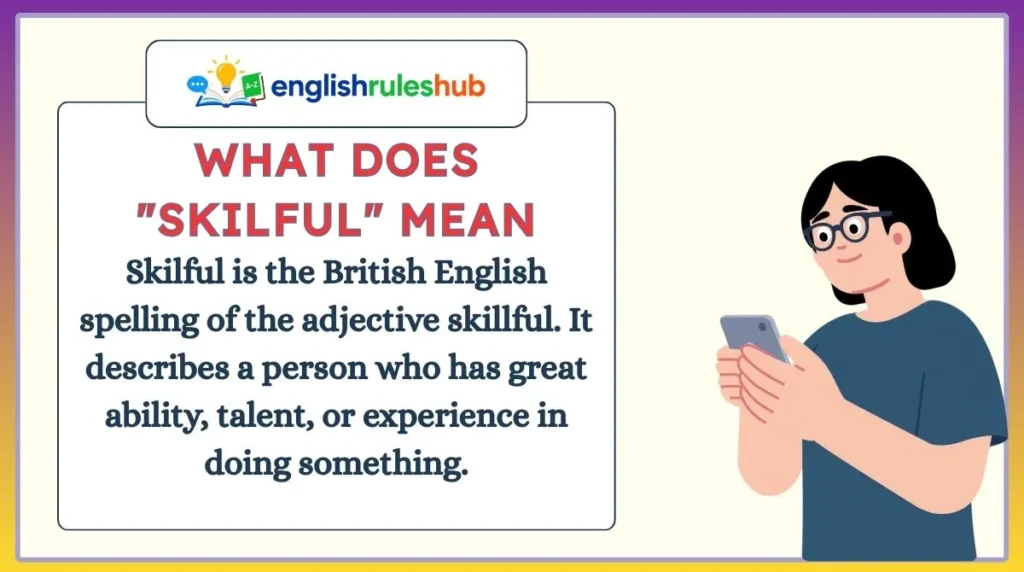
Skilful is the British English spelling of the adjective skillful. It describes a person who has great ability, talent, or experience in doing something. A skilful person performs a task carefully, successfully, and with confidence.
You will often see skilful in books, newspapers, schools, and websites that follow British English, including countries such as the United Kingdom, Australia, New Zealand, and many Commonwealth nations.
Simple Definition
Skilful means:
- Having a high level of skill.
- Doing something very well.
- Showing ability through practice and experience.
When to Use “Skilful”
Use skilful when you are writing in British English or when your school, company, or client prefers British spelling.
For example:
- British newspapers usually write skilful.
- Many UK schools teach the spelling skilful.
- British publishers normally prefer skilful in books and magazines.
If you are writing for a British audience, using skilful helps your writing stay consistent.
Grammar Rule
Skilful is an adjective.
An adjective describes a noun or pronoun by giving more information about it.
Structure:
Subject + be verb + skilful
Examples:
- She is skilful.
- The artist is skilful.
- Our coach is skilful.
It can also come before a noun.
Structure:
Skilful + noun
Examples:
- a skilful doctor
- a skilful painter
- a skilful driver
Example Sentences
Here are some easy examples to help you understand how skilful is used.
- Sarah is a skilful piano player.
- The skilful doctor completed the operation successfully.
- We watched a skilful football player score two goals.
- My grandfather is skilful at fixing old clocks.
- The chef prepared a skilful meal for the guests.
- She gave a skilful presentation during the meeting.
- A skilful teacher knows how to explain difficult lessons simply.
- The skilful carpenter built a beautiful wooden table.
Common Learner Confusion
Many learners think skilful is a spelling mistake because they are used to seeing skillful online or in American movies. This is a common misunderstanding.
Remember this important point:
- Skilful is correct in British English.
- It has exactly the same meaning as skillful.
The only real difference is the spelling style.
For example:
- The skilful surgeon saved the patient’s life. ✅
- The skillful surgeon saved the patient’s life. ✅
Both sentences are correct. The first follows British English, while the second follows American English.
Words Commonly Used with “Skilful”
Some words naturally appear with skilful.
Examples include:
- skilful artist
- skilful engineer
- skilful teacher
- skilful writer
- skilful player
- skilful speaker
- skilful leader
- skilful craftsman
- highly skilful
- extremely skilful
These combinations are very common in British English writing.
Everyday Situations
Imagine these real-life situations.
A student solves a difficult math problem in seconds. His teacher says,
“You are a skilful problem solver.”
A football commentator in the UK says,
“That was a skilful pass into the penalty area.”
A cooking competition judge says,
“The winner showed skilful cooking techniques.”
In each case, skilful describes someone who performs an activity with ability and experience.
Quick Reminder
Keep these points in mind:
- Skilful is an adjective.
- It means having great skill or ability.
- It is the British English spelling.
- The meaning is exactly the same as skillful.
- Choose it when following British English spelling rules.
What Does “Skillful” Mean?
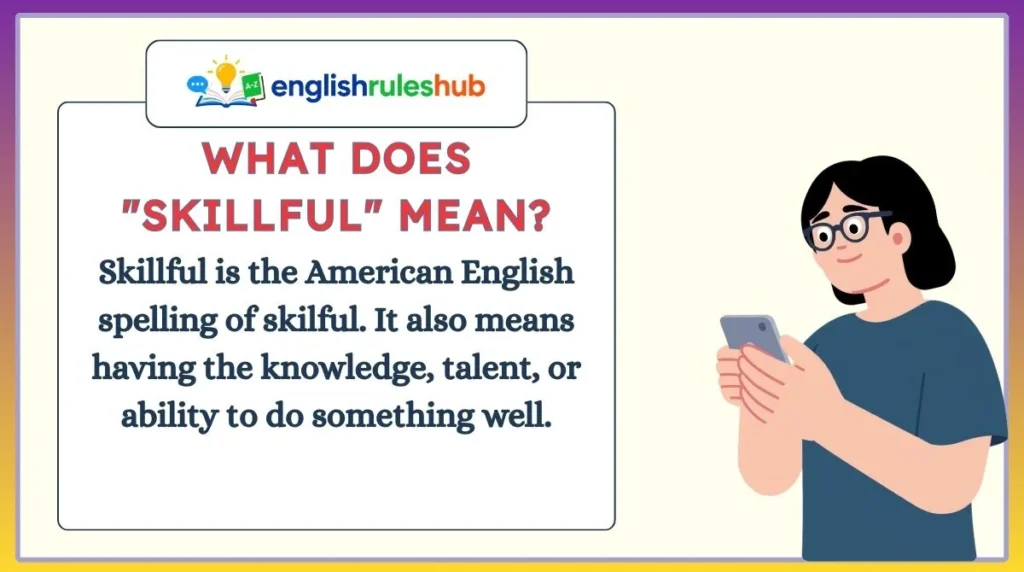
Skillful is the American English spelling of skilful. It also means having the knowledge, talent, or ability to do something well. A skillful person performs tasks with care, confidence, and experience.
You will commonly see skillful in the United States. American schools, newspapers, companies, and publishers almost always use this spelling.
Although the spelling is different, the meaning is exactly the same as skilful. The only difference is the variety of English being used.
Simple Definition
Skillful means:
- Having a lot of skill.
- Being talented or experienced.
- Doing something successfully and efficiently.
When to Use “Skillful”
Use skillful when you are writing in American English.
This spelling is preferred in:
- American schools
- American newspapers
- US business writing
- American websites
- Most publications based in the United States
If your audience is mainly American, skillful is the better choice.
Grammar Rule
Like skilful, skillful is also an adjective.
It can appear after a linking verb.
Examples:
- She is skillful.
- They are skillful.
- Our mechanic is skillful.
It can also describe a noun.
Examples:
- a skillful designer
- a skillful engineer
- a skillful speaker
The grammar is exactly the same as skilful because they are simply different spellings of the same adjective.
Example Sentences
Here are several examples.
- Maria is a skillful dancer.
- The skillful lawyer won the case.
- Our coach is a skillful leader.
- The mechanic made a skillful repair.
- She gave a skillful performance on stage.
- The skillful pilot landed the plane safely.
- He is skillful at solving computer problems.
- A skillful writer keeps readers interested from beginning to end.
Common Learner Confusion
Many English learners ask whether skillful is more correct than skilful.
The answer is no.
Both spellings are correct.
The choice depends on the English style you are using.
For example:
American English:
- She is a skillful engineer. ✅
British English:
- She is a skilful engineer. ✅
Neither sentence is better than the other. They simply follow different spelling conventions.
Words Commonly Used with “Skillful”
Here are some common word combinations.
- skillful doctor
- skillful player
- skillful writer
- skillful artist
- skillful leader
- skillful negotiator
- highly skillful
- extremely skillful
- skillful performance
- skillful worker
These collocations appear frequently in American English.
Everyday Situations
Here are a few real-life examples.
A basketball commentator in the United States says,
“What a skillful move by the point guard!”
A manager tells an employee,
“You are a skillful communicator.”
A customer writes in a review,
“The skillful technician fixed my computer in less than an hour.”
These examples show how naturally skillful is used in everyday American English.
Quick Reminder
Remember these key points:
- Skillful is an adjective.
- It means having great skill or ability.
- It is the American English spelling.
- It has the same meaning as skilful.
- Use it when writing for an American audience or following American English conventions.
Difference Between Skilful and Skillful (Detailed)
Many learners spend a lot of time trying to find the difference between skilful and skillful. The surprising answer is that there is no difference in meaning. Both words describe someone or something that shows great skill, ability, or expertise.
The only difference is spelling, and that depends on the variety of English you are using.
- Skilful is the preferred spelling in British English.
- Skillful is the preferred spelling in American English.
If you keep your spelling consistent, both words are completely correct.
Comparison Table
| Feature | Skilful | Skillful |
|---|---|---|
| Meaning | Having great skill or ability | Having great skill or ability |
| Part of Speech | Adjective | Adjective |
| British English | ✅ Preferred spelling | Sometimes seen, but less common |
| American English | Rare | ✅ Preferred spelling |
| Formal Writing | Correct in British English | Correct in American English |
| Informal Writing | Correct | Correct |
| Pronunciation | Same | Same |
| Grammar | Same | Same |
| Meaning Difference | None | None |
Usage Difference
The biggest difference is the audience you are writing for.
If your teacher, school, company, or readers follow British English, choose skilful.
Examples:
- She is a skilful doctor.
- He is a skilful football player.
- The police officer handled the case in a skilful way.
If your readers use American English, choose skillful.
Examples:
- She is a skillful doctor.
- He is a skillful football player.
- The police officer handled the case in a skillful way.
Notice that every sentence means exactly the same thing.
Grammar Logic
Both words come from the noun skill.
They become adjectives by adding the suffix -ful, which means “full of” or “having.”
Examples:
- beauty → beautiful
- care → careful
- hope → hopeful
- skill → skilful / skillful
The spelling changed over time because British and American English developed different spelling traditions.
British English often simplifies some words by using one “l” before -ful.
American English often keeps both “l” letters in words like skillful.
This is simply a spelling convention, not a grammar rule that changes meaning.
Sentence Structure Difference
There is no sentence structure difference between the two words.
Both follow exactly the same patterns.
Structure 1: Before a Noun
Adjective + Noun
Examples:
- a skilful teacher
- a skillful teacher
- a skilful engineer
- a skillful engineer
Structure 2: After a Linking Verb
Subject + be + adjective
Examples:
- She is skilful.
- She is skillful.
- They became skilful.
- They became skillful.
Structure 3: With “Very”
Examples:
- He is very skilful.
- He is very skillful.
Structure 4: With “Quite”
Examples:
- The child is quite skilful.
- The child is quite skillful.
The grammar never changes.
Meaning Comparison
Both words express the same ideas.
They describe:
- talent
- ability
- experience
- expertise
- competence
- good performance
Examples:
- a skilful artist
- a skillful artist
- a skilful pilot
- a skillful pilot
- a skilful writer
- a skillful writer
The meaning is identical.
Which Spelling Should You Choose?
A simple rule is to match your audience.
Choose skilful if you write:
- British English
- Australian English
- New Zealand English
- Many Commonwealth countries
Choose skillful if you write:
- American English
- Most American schools
- American companies
- American websites
If you are unsure, ask yourself:
Who will read my writing?
That answer usually tells you which spelling to use.
Can You Mix Both Spellings?
It is better not to mix them in one piece of writing.
For example:
❌ She is a skilful teacher, and her skillful lessons help everyone.
This looks inconsistent.
Instead, choose one style.
British English:
✅ She is a skilful teacher, and her skilful lessons help everyone.
American English:
✅ She is a skillful teacher, and her skillful lessons help everyone.
Consistency makes your writing look more professional.
Grammar Rules You Must Remember
Although skilful and skillful are easy words, a few grammar rules will help you use them correctly every time.
Rule #1: Both Words Are Adjectives
These words describe nouns.
They do not name people or actions.
Correct:
- She is a skilful artist.
- He is a skillful engineer.
Wrong:
- She has many skilfuls. ❌
Remember, adjectives describe things. They do not usually become plural.
Rule #2: Use the Spelling That Matches Your English Style
Do not switch between British and American spelling in the same article.
British English:
- a skilful driver
- a skilful teacher
- a skilful player
American English:
- a skillful driver
- a skillful teacher
- a skillful player
Consistency is more important than choosing one spelling over the other.
Rule #3: Put the Adjective Before the Noun or After a Linking Verb
Correct:
- A skilful doctor helped us.
- A skillful lawyer won the case.
- She is skilful.
- He is skillful.
These are the most common sentence patterns.
Rule #4: Do Not Confuse “Skilful/Skillful” with “Skilled”
Many students think these words always mean the same thing.
They are similar, but they are not always used in the same way.
Compare:
- She is a skilful painter.
- She is a skilled painter.
Both are correct.
However, skilful/skillful often highlights how well someone performs a task, while skilled usually emphasizes that a person has learned and developed an ability through training or experience.
Examples:
- He is a skilled mechanic.
- He made a skillful repair.
The first describes the person.
The second describes the action.
Sometimes both words work, but choosing the more natural one makes your English sound smoother.
Common Mistakes Students Make
Even advanced learners sometimes make mistakes with these spellings. Here are the most common ones.
Mistake 1: Thinking One Spelling Is Wrong
Many students believe only one spelling is correct.
Wrong idea:
❌ Skilful is incorrect.
Correct:
✅ Skilful is British English.
✅ Skillful is American English.
Both are accepted.
Mistake 2: Mixing British and American English
Wrong:
❌ The skilful player made a skillful pass.
Correct (British):
✅ The skilful player made a skilful pass.
Correct (American):
✅ The skillful player made a skillful pass.
Choose one spelling style and use it throughout your writing.
Mistake 3: Using the Wrong Word Form
Wrong:
❌ She skillfully is teacher.
Correct:
✅ She is a skillful teacher.
Correct:
✅ She teaches skillfully.
Notice the difference.
- skillful/skilful = adjective
- skillfully/skilfully = adverb
The adverb describes how an action is done.
Examples:
- He answered skillfully.
- She painted skilfully.
Mistake 4: Thinking Pronunciation Is Different
Some learners try to pronounce them differently.
That is unnecessary.
Both words are pronounced the same way.
Only the spelling changes.
Mistake 5: Forgetting the Audience
Students often copy the spelling they first see online.
Instead, think about your readers.
If you are writing for an American university, use skillful.
If you are writing for a British school, use skilful.
That small choice makes your writing look polished and professional.
Easy Tips to Avoid These Mistakes
- Decide whether you are using British or American English before you start writing.
- Keep the same spelling throughout your work.
- Remember that both words mean the same thing.
- Use skilled only when it fits the sentence naturally.
- Proofread your work before submitting it to catch mixed spellings.
Easy Trick to Remember the Difference
A simple memory trick can save you from confusion.
Think about where you are writing, not what the word means.
The Memory Trick
British = Skilful
Think of British English as liking the shorter-looking spelling with one l before -ful.
American = Skillful
Think of American English as keeping both l letters from the word skill.
So remember this easy sentence:
Britain prefers “skilful.” America prefers “skillful.” The meaning never changes.
Real-Life Logic
Imagine you are sending two emails.
One goes to a company in London.
Write:
- Our team has many skilful workers.
The other goes to a company in New York.
Write:
- Our team has many skillful workers.
Both readers understand exactly the same message. The only difference is the spelling they expect to see.
One More Simple Reminder
If you remember these three points, you will rarely make a mistake:
- Same meaning
- Different spelling
- Match your audience
That is all you need to remember.
Daily Life Examples (Very Important)
The best way to remember the difference between skilful and skillful is to see the words in everyday situations. Since the meaning is the same, the examples below include both spellings. Just remember to use the one that matches the type of English you are writing.
Everyday Conversation Examples
- My sister is a skilful cook. Everyone loves her homemade meals. (British English)
- My brother is a skillful basketball player. He practices every evening. (American English)
- The teacher gave a skilful explanation that helped the whole class understand the lesson.
- The doctor made a skillful decision during the operation.
- Our neighbor is a skilful carpenter who built this beautiful table.
- She is a skillful photographer, and her pictures always look amazing.
- The bus driver made a skilful turn on the narrow road.
- A skillful mechanic fixed my car in less than an hour.
- The little girl has become more skilful at playing the piano after months of practice.
- The manager handled the customer’s complaint in a skillful way.
More Real-Life Examples
- A skilful nurse can make patients feel comfortable.
- A skillful pilot stays calm during bad weather.
- The football player made a skilful pass that led to a goal.
- The artist created a skillful painting with amazing detail.
- She is becoming more skilful every day because she practices regularly.
- His skillful communication solved the problem quickly.
- A skilful speaker knows how to keep the audience interested.
- The engineer gave a skillful solution to a difficult problem.
Short Dialogue Examples
Example 1
Ali: Who repaired your bike?
Hamza: A very skilful mechanic did. He fixed it in thirty minutes.
Example 2
Emma: Your presentation was excellent.
David: Thank you. I tried to give a skillful explanation.
Example 3
Teacher: Who painted this picture?
Student: Sara did. She is a very skilful artist.
Example 4
Father: Your coach says you’re improving.
Son: Yes! He says I’m becoming a more skillful player every week.
These everyday examples show that both words fit naturally into conversations. The only thing you need to decide is whether you are writing in British English or American English.
Practice Section
Now it’s your turn. Choose the correct option in each sentence.
Choose the Correct Answer
1. She is a very ________ surgeon.
a) skilful
b) skillful
2. If you are writing in American English, which spelling is usually preferred?
a) skilful
b) skillful
3. The ________ pilot landed the plane safely.
a) skilful
b) skillful
(Assume you are writing in British English.)
4. Which statement is correct?
a) Skilful and skillful have different meanings.
b) Skilful and skillful have the same meaning.
5. Which sentence is better?
a) The skilful player made a skillful pass.
b) The skilful player made a skilful pass.
(Assume you are writing in British English.)
Answers
1. Both a and b are correct.
- Choose skilful for British English.
- Choose skillful for American English.
2. b) skillful
American English prefers skillful.
3. a) skilful
Because the sentence is written in British English.
4. b) Skilful and skillful have the same meaning.
The only difference is the spelling.
5. b) The skilful player made a skilful pass.
When using British English, keep the spelling consistent throughout your writing.
FAQs
What is the difference between skilful and skillful?
There is no difference in meaning. Both words describe someone who has great ability or talent. The only difference is the spelling. Skilful is the preferred spelling in British English, while skillful is preferred in American English.
Which spelling is correct: skilful or skillful?
Both spellings are correct. Your choice depends on the variety of English you are using. If you follow British English, use skilful. If you follow American English, use skillful.
Can I use skilful and skillful in the same document?
It is better not to. Mixing British and American spellings can make your writing look inconsistent. Choose one style and use it throughout the entire document.
Is skilful more formal than skillful?
No. Neither spelling is more formal than the other. Both are suitable for formal and informal writing. The important thing is to match the spelling with your audience.
Can skilful and skillful be used in questions?
Yes. They work just like any other adjective.
Examples:
- Is she a skilful musician?
- Is he a skillful engineer?
The grammar does not change in questions.
Is skilled the same as skilful or skillful?
The words are closely related, but they are not always used in exactly the same way. Skilled usually describes someone who has learned an ability through training or experience. Skilful and skillful often emphasize how well a person performs a task. In many sentences, either word may be correct, but one may sound more natural depending on the context.
Final Conclusion
Many English learners worry about choosing between skilful and skillful, but the answer is much simpler than it first appears.
Both spellings are correct, and both have exactly the same meaning. The only real difference is the variety of English you are using.
If you write in British English, the preferred spelling is skilful. If you write in American English, the preferred spelling is skillful.
Once you choose one style, stay consistent throughout your writing. This small habit will make your work look more polished and professional.
Remember that both words are adjectives used to describe someone who has great skill, talent, or expertise.
Whether you are talking about a skilful teacher, a skillful doctor, or a talented athlete, the meaning remains the same.
The easiest way to master these spellings is through regular reading, writing, and practice.
Pay attention to the type of English you are using, and soon choosing the correct spelling will become a natural part of your everyday English.

I am Benjamin Clark, an English language writer passionate about simplifying grammar, vocabulary, and word meanings. I create clear, accurate, and practical content to help learners improve their English skills with confidence every day.