Many English learners get confused by pour, pore, and poor because they sound almost the same when spoken.
These words are called homophones or near-homophones. They have different spellings, different meanings, and different uses, but they can easily cause mistakes in speaking and writing.
If someone says, “Please pour the juice,” and another person writes, “Please poor the juice,” the sentence becomes incorrect.
In the same way, saying “I like to pore over books” is very different from saying “I like to pour over books.” One small spelling change can completely change the meaning.
This confusion is common for beginners, students, and even some native speakers. That is why learning these words carefully is so important.
Good spelling and correct word choice make your English clearer and more professional.
By the end of this guide, you will know what each word means, when to use it, how to remember the difference, and how to avoid common mistakes.
You will also see plenty of simple examples that you can use in real conversations and writing.
Whether you are preparing for an English exam, improving your grammar, or simply trying to speak more naturally, understanding these three words will make your English much stronger.
What Does “Pour” Mean?
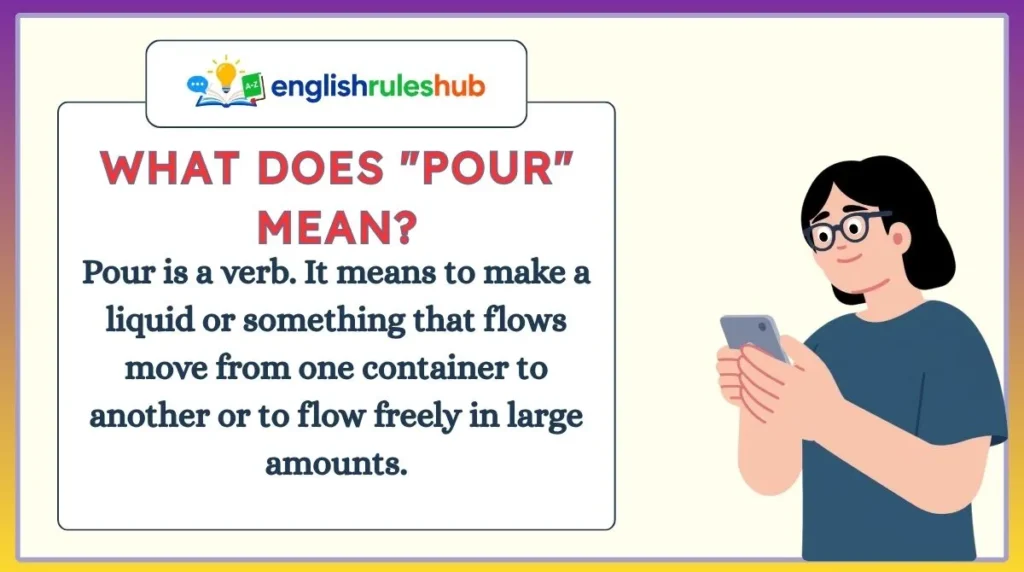
Pour is a verb. It means to make a liquid or something that flows move from one container to another or to flow freely in large amounts.
You usually use pour when talking about water, milk, tea, coffee, juice, rain, sand, or even sunlight flowing in a steady stream.
When to Use “Pour”
Use pour when someone or something causes a liquid or another flowing substance to move.
Examples include:
- Pouring water into a glass
- Pouring coffee into a mug
- Rain pouring from the sky
- Tears pouring down someone’s face
The word can also be used figuratively, meaning something happens in large amounts.
For example:
- Messages poured in after the announcement.
- Tourists poured into the city during the festival.
Grammar Rule for “Pour”
Pour is almost always used as a verb.
Basic structure:
- Subject + pour + object
- Subject + pour + liquid + into + container
Examples:
- She poured the milk into the bowl.
- Please pour some water for me.
- The waiter poured coffee into my cup.
- He poured juice into the bottle.
Verb forms:
| Form | Word |
|---|---|
| Base verb | pour |
| Past tense | poured |
| Past participle | poured |
| Present participle | pouring |
Example Sentences with “Pour”
- Please pour me a glass of water.
- She poured hot tea into the cup.
- The children poured sand into the bucket.
- Rain began to pour in the afternoon.
- He carefully poured the soup into bowls.
- Tears poured down her face.
- Customers poured into the new shopping mall.
- The sunlight poured through the window.
Common Learner Confusion
Many students accidentally write poor instead of pour because both words sound alike.
❌ Please poor the milk.
✅ Please pour the milk.
Another mistake is confusing pour with pore.
❌ She pored water into the glass.
✅ She poured water into the glass.
Remember this simple idea:
If something flows, the correct word is usually “pour.”
What Does “Pore” Mean?

Pore is mainly a noun, but it can also be used as a verb.
As a noun, a pore is a tiny opening on the surface of your skin, leaves, or other materials.
As a verb, pore over means to study or read something very carefully for a long time.
These are two completely different meanings, but both use the same spelling.
Meaning 1: Pore (Noun)
A pore is a very small hole.
Examples:
- Skin has thousands of tiny pores.
- Plants have pores that help them exchange gases.
Meaning 2: Pore (Verb)
When you pore over something, you examine it very carefully.
People often:
- pore over books
- pore over maps
- pore over reports
- pore over documents
- pore over homework
Grammar Rule for “Pore”
As a noun:
- Subject + has + pores
Example:
- My skin has small pores.
As a verb:
The verb is almost always followed by over.
Structure:
Subject + pore + over + something
Examples:
- She pored over her notes.
- They pored over the report.
Verb forms:
| Form | Word |
|---|---|
| Base verb | pore |
| Past tense | pored |
| Past participle | pored |
| Present participle | poring |
Example Sentences with “Pore”
- My skin has very small pores.
- Warm water helps clean your pores.
- Scientists studied the leaf’s tiny pores.
- She spent hours poring over her textbook.
- The lawyer pored over every document.
- We pored over the travel map before our trip.
- The students pored over their exam notes.
- He likes to pore over old family photographs.
Common Learner Confusion
Many learners write pour over when they actually mean study carefully.
❌ I spent two hours pouring over the report.
✅ I spent two hours poring over the report.
The phrase is always:
pore over
not
pour over
Remember:
- Pore over = study carefully
- Pour = make liquid flow
What Does “Poor” Mean?
Poor is an adjective.
It describes someone who has little money, something of low quality, or someone who deserves sympathy.
Unlike pour and pore, poor does not describe an action. Instead, it describes a person, thing, or situation.
When to Use “Poor”
Use poor to describe:
- Lack of money
- Bad quality
- Weak performance
- Bad condition
- Someone you feel sorry for
Grammar Rule for “Poor”
Poor comes before a noun or after a linking verb.
Examples:
- a poor family
- poor health
- poor service
- The family is poor.
- The food was poor.
Structure:
Subject + be + poor
or
Poor + noun
Example Sentences with “Poor”
- The family was very poor.
- He grew up in a poor village.
- The hotel gave us poor service.
- My internet connection is poor today.
- She received poor grades this semester.
- The weather caused poor road conditions.
- I feel sorry for that poor little dog.
- The movie received poor reviews.
Different Meanings of “Poor”
Poor = Not rich
- Many poor families need support.
Poor = Bad quality
- The food was poor.
Poor = Weak or not good
- His English pronunciation is poor.
Poor = Deserving sympathy
- Poor Emma lost her keys again.
Common Learner Confusion
Students often spell pour as poor because they sound alike.
❌ Can you poor some juice?
✅ Can you pour some juice?
Also remember:
Poor is usually an adjective.
Pour is usually a verb.
That difference alone helps you choose the correct spelling.
Difference Between Pour, Pore, and Poor (Detailed)
Although these three words sound very similar, they have completely different meanings and grammar roles.
| Word | Part of Speech | Meaning | Example |
|---|---|---|---|
| Pour | Verb | To make a liquid or something flow | Pour the milk into the glass. |
| Pore | Noun / Verb | Tiny opening; study carefully | She pored over the report. |
| Poor | Adjective | Having little money or not good | They live in a poor neighborhood. |
Meaning Comparison
The easiest way to understand these words is by remembering what each one talks about.
Pour is connected with flowing.
If water, coffee, juice, rain, or another liquid is moving from one place to another, you almost always need pour.
Examples:
- Pour the coffee.
- Rain poured all night.
- She poured oil into the pan.
Pore is connected with tiny openings or careful studying.
Examples:
- Clean your pores.
- He pored over the contract.
Poor is connected with money, quality, health, or sympathy.
Examples:
- A poor family
- Poor service
- Poor health
- Poor child
Usage Difference
Think about the job each word does.
- Pour shows an action.
- Pore names something or describes careful reading.
- Poor describes a person or thing.
Compare these sentences:
- Please pour the water.
- My skin has large pores.
- The restaurant has poor service.
Each sentence uses a completely different meaning, even though the words sound alike.
Grammar Logic
A quick grammar check can often help you choose the correct spelling.
If the word shows an action involving liquid, choose pour.
If it means tiny holes or carefully studying something, choose pore.
If it describes a noun, choose poor.
For example:
- She will pour the tea.
- The doctor checked my skin pores.
- They received poor results.
Sentence Structure Difference
Here are the common sentence patterns:
Pour
- Subject + pour + object
- Subject + pour + liquid + into + container
Examples:
- Please pour the milk.
- She poured soup into the bowl.
Pore
- Subject + pore over + object
- Subject + has + pores
Examples:
- We pored over the map.
- My face has small pores.
Poor
- Poor + noun
- Subject + be + poor
Examples:
- Poor weather delayed the game.
- The family is poor.
Grammar Rules You Must Remember
Learning the meanings of pour, pore, and poor is the first step. The next step is knowing the grammar rules. These simple rules will help you choose the correct word every time.
Rule #1: Use “pour” only for actions involving flowing liquids or things that move like a liquid
Pour is almost always a verb. It tells us that someone or something is causing a liquid or another flowing substance to move.
Examples:
- Please pour the milk into the glass.
- Dad poured coffee for everyone.
- She poured water on the plants.
- Heavy rain poured all afternoon.
Remember: If you can ask, “What is flowing?” the answer is probably pour.
Rule #2: Use “pore” for tiny openings or the phrase “pore over”
When pore means a tiny opening, it is a noun.
Examples:
- Your skin has many tiny pores.
- Dirt can block your pores.
When pore means to study carefully, it is a verb and is usually followed by over.
Examples:
- She pored over her science book.
- We pored over the travel guide before our trip.
Never write pour over when you mean study carefully.
✅ He pored over the report.
❌ He poured over the report.
Rule #3: Use “poor” as an adjective
Poor describes a noun. It never shows the action of moving liquid.
It can describe:
- People
- Places
- Health
- Quality
- Performance
- Conditions
Examples:
- They come from a poor family.
- The food was poor.
- She has poor eyesight.
- The team gave a poor performance.
A quick grammar check can help.
If the word is describing a noun, poor is usually the correct choice.
Rule #4: Check the meaning before checking the spelling
These words sound almost the same, so pronunciation alone cannot help you.
Instead, ask yourself one simple question.
Is it about flowing?
→ Use pour.
Is it about tiny holes or careful reading?
→ Use pore.
Is it describing someone or something?
→ Use poor.
This small habit will prevent most spelling mistakes.
Common Mistakes Students Make
Because these words have similar pronunciation, students often choose the wrong spelling. Here are the mistakes you should avoid.
Mistake 1: Writing “poor” instead of “pour”
This is the most common error.
❌ Please poor some water.
✅ Please pour some water.
Why is it wrong?
The sentence talks about moving water. That is an action, so the correct word is pour.
Mistake 2: Using “pour over” instead of “pore over”
Many learners hear the phrase but never see it written.
❌ I poured over my homework.
✅ I pored over my homework.
Why is it wrong?
The sentence means “studied carefully,” not “made a liquid flow.”
Mistake 3: Using “pore” when talking about money
❌ They are a pore family.
✅ They are a poor family.
Why is it wrong?
The sentence describes the family’s financial condition.
Mistake 4: Thinking all three words can replace each other
Some students believe these words are simply different spellings.
They are not.
Compare these sentences.
- Please pour the juice.
- My face has large pores.
- The restaurant gives poor service.
Each sentence has a completely different meaning.
Mistake 5: Forgetting the part of speech
Many spelling mistakes disappear if you first identify the grammar.
Ask yourself:
- Is it a verb showing movement?
- Is it a noun?
- Is it an adjective?
Once you know that, choosing the correct word becomes much easier.
Easy Correction Tips
Whenever you write one of these words, stop for a few seconds and ask:
- Is something flowing?
- Am I talking about skin or careful reading?
- Am I describing a person, place, or thing?
This quick check only takes a moment but saves many mistakes.
Easy Trick to Remember the Difference
You do not have to memorize long grammar rules every time.
Try these simple memory tricks.
Trick for “Pour”
Think of a pitcher pouring water.
Whenever liquid moves from one container to another, remember pour.
Picture yourself pouring tea into a cup.
Trick for “Pore”
Think of pores on your face.
They are tiny little holes.
For the verb, imagine someone sitting at a desk with books open for hours.
That person is poring over their homework.
Trick for “Poor”
Think about the phrase:
“Poor people need help.”
Now also remember that poor can describe anything that is not very good.
Examples:
- poor service
- poor health
- poor weather
- poor grades
One Easy Sentence
Remember this funny sentence:
A poor student poured water before poring over his books.
This one sentence uses all three words correctly.
- poor = describes the student
- poured = moved water
- poring over = studied carefully
Reading this sentence a few times makes the difference much easier to remember.
Daily Life Examples (Very Important)
These examples sound natural and are similar to everyday conversations.
- Can you pour me a cup of coffee, please?
- The rain started to pour just before we reached home.
- She spent all evening poring over her exam notes.
- The detective pored over every clue.
- This cream helps keep your pores clean.
- He comes from a poor family but works very hard.
- The restaurant had poor customer service.
- Please don’t pour oil down the sink.
- My little sister spent hours poring over her coloring book.
- Poor Tom forgot his wallet again.
These examples show how different the meanings are, even though the words sound almost the same.
Practice Section
Choose the correct word.
Question 1
Please ______ the orange juice into the glass.
A. pore
B. poor
C. pour
Question 2
She spent hours ______ over the history book.
A. pouring
B. poring
C. pooring
Question 3
The family was very ______.
A. pour
B. pore
C. poor
Question 4
The doctor examined the tiny skin ______.
A. pours
B. pores
C. poors
Question 5
Heavy rain began to ______ during the football match.
A. pore
B. poor
C. pour
Answers
- ✅ C. pour
- ✅ B. poring
- ✅ C. poor
- ✅ B. pores
- ✅ C. pour
If you answered all five correctly, you are already becoming more confident with these commonly confused words.
FAQs
What is the difference between pour, pore, and poor?
Pour means to make a liquid flow. Pore means a tiny opening or to study something very carefully. Poor describes someone with little money or something of low quality. Although they sound alike, they have completely different meanings.
Can we use pour in questions?
Yes. Pour is a normal verb and is often used in questions.
Examples:
- Can you pour some tea?
- Will you pour me a glass of water?
What does pore over mean?
Pore over means to read, study, or examine something very carefully for a long time.
Example:
- She pored over the report before the meeting.
Is poor only about money?
No. Besides meaning “not rich,” poor can also describe bad quality, weak performance, poor health, poor weather, or someone who deserves sympathy.
Example:
- The hotel gave poor service.
- Poor Jack lost his phone.
Why do learners confuse these words?
They are confused because they have almost the same pronunciation. When speaking, they sound very similar, but their spellings, meanings, and grammar are completely different.
How can I remember which word to use?
Think about the meaning first.
- Pour = liquid flows.
- Pore = tiny holes or careful study.
- Poor = not rich or not good.
This simple rule helps you choose the correct spelling every time.
Final Conclusion
The words pour, pore, and poor may sound alike, but they are used in very different ways. Pour is a verb that means to make a liquid flow. Pore can be a noun meaning a tiny opening or a verb in the phrase pore over, which means to study something carefully. Poor is an adjective that describes someone with little money or something that is not of good quality.
The best way to master these words is to focus on their meaning, not just their pronunciation. Every time you write one of them, ask yourself whether you are talking about flowing, tiny openings or careful reading, or describing a person or thing. This quick check will help you avoid common mistakes.
Practice by reading, writing, and speaking these words in everyday situations. The more often you use them correctly, the more natural they will become. With regular practice, you will soon be able to choose pour, pore, and poor with confidence in both spoken and written English.

I am Benjamin Clark, an English language writer passionate about simplifying grammar, vocabulary, and word meanings. I create clear, accurate, and practical content to help learners improve their English skills with confidence every day.