While and whilst are two words that often confuse English learners. They look almost the same, and in many sentences they can have the same meaning.
This makes students wonder: Are they really different? Can I use either one? Which one sounds more natural?
The good news is that the difference is much easier than it first appears.
Both words can be used as conjunctions to connect two parts of a sentence. They can show that two things happen at the same time.
For example, you can say, “I listened to music while I was cooking.” You can also say, “I listened to music whilst I was cooking.” The basic meaning stays the same.
However, there is an important difference in style and frequency. While is much more common in modern English, especially in everyday conversation.
Whilst is also correct, but it is more common in British English and can sound more formal or traditional.
There are also other uses of while, including the meaning “although” and the noun phrase “a while.” These uses can make the topic even more confusing for beginners.
By the end of this guide, you will know when to use while, when to use whilst, how their grammar works, and which word sounds more natural in everyday English.
You will also see simple examples and practice questions so you can use these words with confidence.
What Does “While” Mean?
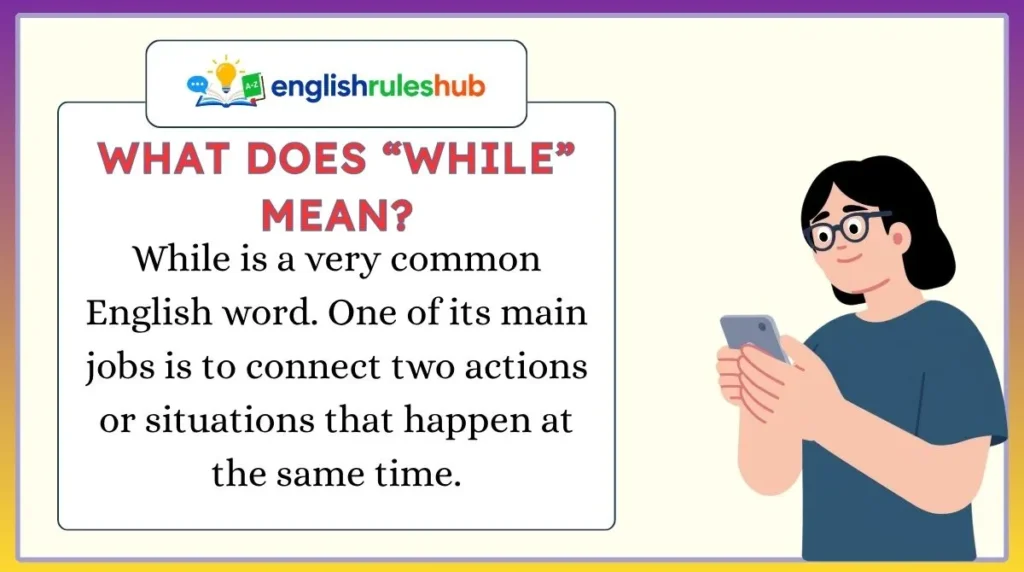
While is a very common English word. One of its main jobs is to connect two actions or situations that happen at the same time.
For example:
I read a book while I was waiting for the bus.
Here, reading and waiting happen during the same period.
The word while can introduce a time clause. It tells us that one action happens during the time of another action.
While for two actions happening at the same time
A common structure is:
while + subject + verb
For example:
She called me while I was eating dinner.
The first action is “called,” and the second situation is “I was eating dinner.” The call happened during that time.
You can also put the while-clause first:
While I was eating dinner, she called me.
The meaning is the same. The only difference is the order of the clauses.
Examples with “while”
Here are some simple examples:
- I listened to music while I was cleaning my room.
- Tom fell asleep while he was watching television.
- She smiled while she talked to her friend.
- Please don’t use your phone while you are driving.
- I met an old friend while I was shopping.
- He hurt his hand while he was playing football.
- We talked while we waited for the train.
- My mother cooked dinner while I did my homework.
In all these examples, while connects two actions or situations that overlap in time.
While can also mean “although”
There is another important use of while.
Sometimes it means something similar to although or even though.
For example:
While I understand your point, I don’t agree with you.
This means:
Although I understand your point, I don’t agree with you.
Another example:
While the hotel was expensive, we enjoyed our stay.
Here, while does not mean that two things happened at exactly the same time. Instead, it introduces a contrast.
So while can have more than one meaning depending on the sentence.
While as a noun
You may also see while used as a noun.
The common expression is:
I haven’t seen him for a while.
Here, a while means a period of time.
You can also say:
Wait here for a while.
This use is different from the conjunction discussed above.
Common learner confusion with “while”
Beginners sometimes think that while always means “during the same time.” That is not true.
Compare:
I listened to music while I studied.
Here, while refers to time.
But:
While I like the house, I don’t want to buy it.
Here, while shows contrast.
The meaning comes from the context.
Another common mistake is using while when the learner actually needs during.
For example:
I fell asleep while the movie.
This is incorrect because while normally needs a clause after it.
You can say:
I fell asleep while I was watching the movie.
Or:
I fell asleep during the movie.
That small grammar difference is useful to remember.
What Does “Whilst” Mean?
Whilst has almost the same basic meaning as while.
It can be used to show that something happens during the same period as another action.
For example:
She listened to music whilst she was working.
This means:
She listened to music while she was working.
The main difference is not usually meaning. It is style, frequency, and regional preference.
Whilst for actions happening at the same time
Like while, whilst can introduce a time clause.
The basic structure is:
whilst + subject + verb
For example:
He hurt his leg whilst he was playing football.
This tells us that the injury happened during the time he was playing.
Examples with “whilst”
- I listened to the radio whilst I was driving.
- She called me whilst I was having lunch.
- He learned a lot whilst he was working abroad.
- We talked whilst we waited for the bus.
- They stayed inside whilst it was raining.
- She read the instructions whilst her brother prepared the machine.
- I met several interesting people whilst I was travelling.
- He checked his email whilst he was waiting for the meeting.
The grammar is very similar to the examples with while.
Is “whilst” correct English?
Yes. Whilst is a correct English word.
You may sometimes hear learners say that whilst is wrong or old-fashioned English. That is too strong.
It is a standard word, especially associated with British English. However, it is much less common than while in everyday modern English.
In casual conversation, most speakers will naturally choose:
I called him while I was driving.
rather than:
I called him whilst I was driving.
The second sentence is grammatical, but it can sound more formal or slightly old-fashioned depending on the speaker and context.
Whilst can also show contrast
Just like while, whilst can sometimes introduce a contrast.
For example:
Whilst I agree with some of your ideas, I have a few concerns.
This is similar to:
While I agree with some of your ideas, I have a few concerns.
Again, the basic meaning is not the main difference.
Common learner confusion with “whilst”
The biggest problem is usually not grammar. It is knowing when it sounds natural.
A learner may use whilst in every sentence because it seems more advanced. But using a more formal word does not automatically make English better.
For everyday conversation, while is usually the safer choice.
For formal British writing, academic-style writing, official language, or a context where British usage is expected, whilst may fit well.
The important point is simple: whilst is correct, but it is less common than while.
Difference Between While and Whilst (Detailed)
The easiest way to understand the difference is to separate meaning from style.
In many sentences, there is no important difference in meaning at all.
Compare:
I listened to music while I was working.
and:
I listened to music whilst I was working.
Both sentences tell us that listening to music happened during the time of working.
The difference is mainly how the sentence sounds.
Comparison table
| Point | While | Whilst |
|---|---|---|
| Basic meaning | During the time that | During the time that |
| Shows two actions at the same time | Yes | Yes |
| Can show contrast | Yes | Yes |
| Common in everyday speech | Very common | Less common |
| British English | Very common | Common but less frequent |
| American English | Very common | Rare |
| Formal feeling | Neutral | Often more formal |
| Traditional feeling | Neutral | Can sound traditional |
| Beginner-friendly | Yes | Yes, but less common |
1. While is much more common
This is probably the most useful difference for learners.
If you are speaking with friends, writing a simple message, or having an everyday conversation, while is normally the natural choice.
For example:
I fell asleep while I was watching TV.
This sounds completely normal.
You could replace while with whilst, but many speakers would find the second version more formal than necessary.
2. Whilst is strongly associated with British English
Whilst is especially common in British English.
That does not mean every British person prefers it. Many British speakers use while most of the time.
It simply means that whilst has a stronger place in British usage than it does in American English.
If you are learning international English, while is usually the best default choice.
3. The grammar is almost identical
There is no major grammar rule that says one word must be followed by a different type of clause.
Both can be followed by a subject and verb:
She sang while I played the guitar.
She sang whilst I played the guitar.
Both are grammatically correct.
You can also move the clause:
While I was cooking, he cleaned the kitchen.
Whilst I was cooking, he cleaned the kitchen.
Again, the basic structure remains the same.
4. Their meanings can be the same
When they introduce a time clause, both words can mean during the time that.
For example:
I met Sarah while I was studying at university.
and:
I met Sarah whilst I was studying at university.
The meaning is essentially the same.
When they introduce contrast, both can sometimes mean something close to although:
While he is young, he is very responsible.
Whilst he is young, he is very responsible.
The choice depends more on style than on grammar.
5. “While” is usually safer for learners
If you are unsure which word to choose, use while.
It is common, natural, and widely understood.
You do not need to use whilst just because you want your English to sound advanced.
Good English is not about choosing the longest or most formal word. It is about choosing the word that fits the situation.
Grammar Rules You Must Remember
Rule #1: Use “while” or “whilst” before a clause
Both words can introduce a clause containing a subject and a verb.
Correct:
I listened to music while I was studying.
Correct:
I listened to music whilst I was studying.
The structure is:
while/whilst + subject + verb
For example:
while she was sleeping
whilst they were eating
Remember that a complete clause normally follows the conjunction.
Rule #2: “While” is the normal everyday choice
When you are speaking casually, while is usually more natural.
For example:
I saw him while I was walking home.
This sounds simple and normal.
You can say:
I saw him whilst I was walking home.
It is not wrong, but it may sound more formal or less conversational.
So if you are writing a basic email, sending a message, or speaking with friends, while is usually the best choice.
Rule #3: “Whilst” is especially common in British English
Whilst is not incorrect. It is simply less common than while.
It can appear in British English, particularly in more formal or traditional styles.
For example:
Whilst the plan looks good, we need more information.
This sounds more formal than:
While the plan looks good, we need more information.
Both are possible.
Do not think that whilst automatically means “very formal.” Its tone depends on the context and the speaker.
Rule #4: “While” can have several meanings
Do not learn only one meaning.
It can show time:
I cooked while my sister washed the dishes.
It can show contrast:
While I like the colour, I don’t like the design.
It can also appear in expressions involving a period of time:
I haven’t spoken to him for a while.
Knowing these different uses will help you understand real English more easily.
Common Mistakes Students Make
Mistake 1: Thinking “whilst” is wrong
Some students avoid whilst because they have been told it is incorrect.
That is not true.
Whilst is grammatically correct. It is simply less common than while and is strongly associated with British English.
Think of it as a valid alternative rather than a completely different grammar word.
Mistake 2: Using “whilst” everywhere to sound intelligent
This is another common problem.
A learner may write:
I went to the supermarket whilst I was walking home.
There is nothing grammatically wrong with it, but the choice may sound unnecessarily formal in an everyday sentence.
A more natural everyday version is:
I went to the supermarket while I was walking home.
Remember: simple English is often better English.
Mistake 3: Confusing “while” with “during”
These words are related, but their grammar is different.
Use while before a clause:
I listened to music while I was working.
Use during before a noun or noun phrase:
I listened to music during the lesson.
Do not say:
I listened to music while the lesson.
Instead, say:
I listened to music during the lesson.
Mistake 4: Forgetting that “while” can show contrast
Look at this sentence:
While I like the car, I don’t want to buy it.
A learner may think the sentence means that liking and buying happen at the same time.
They do not.
Here, while introduces a contrast. The meaning is close to:
Although I like the car, I don’t want to buy it.
Mistake 5: Thinking the two words always have exactly the same style
Although the meanings can be the same, the feeling of the sentence can change.
Compare:
Please wait while I check your details.
with:
Please wait whilst I check your details.
The first sounds more neutral and natural for most speakers.
The second can sound more formal or traditionally British.
Easy Trick to Remember the Difference
Here is a very simple trick:
Think “while = everyday.”
When you are not sure, choose while.
It works in everyday speech, general writing, British English, American English, school writing, and many formal situations.
Then remember:
“Whilst = a less common British-style alternative.”
This does not mean that whilst is always formal or that it is old-fashioned. It simply helps you remember that it appears less often in everyday English.
Imagine that you are talking to a friend:
I watched TV while I ate dinner.
That sounds natural.
Now imagine a formal British document:
Whilst the company understands the concern, further checks are required.
The second version has a more formal feel.
You can also remember this:
Same basic job, different style.
That is the key idea.
Do not spend too much time trying to find a completely different meaning between while and whilst. In many sentences, there isn’t one.
The bigger difference is how often people use them and how they sound.
Daily Life Examples
The best way to learn these words is to see them in situations you might actually experience.
Example 1: Cooking
A: What were you doing when I called?
B: I was cooking while my brother was watching TV.
This is a very natural everyday use of while.
Example 2: Driving
Don’t text while you are driving.
Here, while means during the time that you are driving.
Example 3: Studying
I usually listen to quiet music while I study.
The two activities happen during the same period.
Example 4: Waiting
I checked my messages while I was waiting for the bus.
This is common spoken English.
Example 5: Working
She drinks coffee while she works.
The coffee drinking happens during her work time.
Example 6: Travelling
I met some great people whilst I was travelling around Scotland.
Here, whilst works perfectly. The sentence has a slightly more British feel.
Example 7: Formal discussion
Whilst I understand your concern, I think we need more time.
Here, whilst introduces a contrast.
A more neutral version would be:
While I understand your concern, I think we need more time.
Example 8: Watching television
A: Why didn’t you answer your phone?
B: I was watching a movie while my phone was charging.
This sounds natural in everyday conversation.
Example 9: School
The students talked quietly whilst the teacher prepared the lesson.
This is grammatically correct and has a slightly more formal or British style.
Example 10: Cleaning
A: How did you finish so quickly?
B: I listened to a podcast while I cleaned the house.
This is a natural use of while in casual conversation.
Practice Section
Choose while or whilst in each sentence.
1. I listened to music _____ I was cleaning my room.
2. _____ I understand your problem, I don’t think this is the best solution.
3. She called me _____ I was having dinner.
4. He met several new people _____ he was travelling abroad.
5. _____ the idea sounds interesting, we need to think about the cost.
Answers
1. while
I listened to music while I was cleaning my room.
Whilst is also grammatically possible, but while is the more natural everyday choice.
2. while / whilst
While I understand your problem, I don’t think this is the best solution.
You could also use whilst. It would give the sentence a slightly more formal or British feel.
3. while / whilst
She called me while I was having dinner.
Both are grammatically correct.
4. while / whilst
He met several new people while he was travelling abroad.
Again, both can work, but while is more common.
5. while / whilst
While the idea sounds interesting, we need to think about the cost.
Whilst is also possible, especially in British formal writing.
Frequently Asked Questions
What is the difference between while and whilst?
In many sentences, there is no major difference in meaning. Both can mean “during the time that” and can connect two actions or situations.
The main difference is usage and style. While is much more common, especially in everyday English. Whilst is more strongly associated with British English and can sound more formal or traditional.
Is “whilst” correct English?
Yes, whilst is correct English.
It is a standard conjunction and can be used in many of the same places as while. It is particularly common in British English.
However, it is less common in everyday conversation than while, so learners will usually find while more useful as their default choice.
Can I use “while” in formal English?
Yes. While is perfectly acceptable in formal English.
You do not need to replace it with whilst just because you are writing something formal. For example, “While we appreciate your help, we need more information” is completely natural.
The choice between the two is often about style rather than correctness.
Is “whilst” more formal than “while”?
Often, whilst can sound more formal, traditional, or distinctly British, but this is not an absolute rule.
Some British speakers use whilst naturally without intending to sound formal.
If you want a neutral word that works well in almost every situation, choose while.
Can “while” and “whilst” be used in questions?
Yes.
For example:
What do you do while you are waiting?
You can also say:
What do you do whilst you are waiting?
The second sentence is grammatically fine, but while is much more natural for most everyday speakers.
The same general difference in style applies in questions as in statements.
Can “while” mean “although”?
Yes. While can introduce a contrast, with a meaning similar to “although” or “even though.”
For example:
While I like the apartment, I don’t want to rent it.
This means that you like the apartment, but that fact does not change your decision.
Whilst can sometimes be used in the same way:
Whilst I like the apartment, I don’t want to rent it.
The difference is mainly style and frequency.
Final Conclusion
While and whilst are very close in meaning, and in many sentences you can use either one. Both can connect two actions that happen during the same period, and both can sometimes introduce a contrast.
The most important thing to remember is that while is much more common. It is natural in everyday conversation and works well in both casual and formal English. It is also widely used in British and American English.
Whilst is also correct, but it is more strongly linked with British English and may sound more formal, traditional, or less conversational in some situations.
If you are a beginner, do not worry about using whilst. Start with while and become comfortable with its different uses. Later, you can recognize and use whilst when the style or context makes it suitable.
The simple rule is:
Use “while” as your normal choice. Use “whilst” when you want or need its particular British-style feel.
Once you notice these words in real conversations, books, and writing, the difference will become much easier to understand.

I am Benjamin Clark, an English language writer passionate about simplifying grammar, vocabulary, and word meanings. I create clear, accurate, and practical content to help learners improve their English skills with confidence every day.