Many English learners become confused when they see the expressions “any information” and “some information.”
Both expressions are grammatically correct, but they are not always used in the same situations. The small words any and some can change the meaning and feeling of a sentence.
This is especially important because information is an uncountable noun. We normally say “some information” or “some useful information,” not “some informations.” We also say “any information,” not “any informations.”
You may hear these expressions in everyday conversations, emails, questions, instructions, and formal situations. For example, someone may ask, “Do you have any information about the meeting?”
Another person may say, “I have some information for you.” Both sentences are correct, but the speakers are expressing slightly different ideas.
The good news is that the difference becomes much easier once you understand how some and any work.
In simple terms, some information usually means an unspecified amount of information that exists or is expected to be available.
Any information often appears in questions, negative sentences, and conditional sentences. It can also mean information of whatever kind or amount when it is used in an affirmative sentence.
By the end of this guide, you will know when to use any information, when to use some information, how to use them in questions and negative sentences, and which common mistakes to avoid.
What Does “Any Information” Mean?
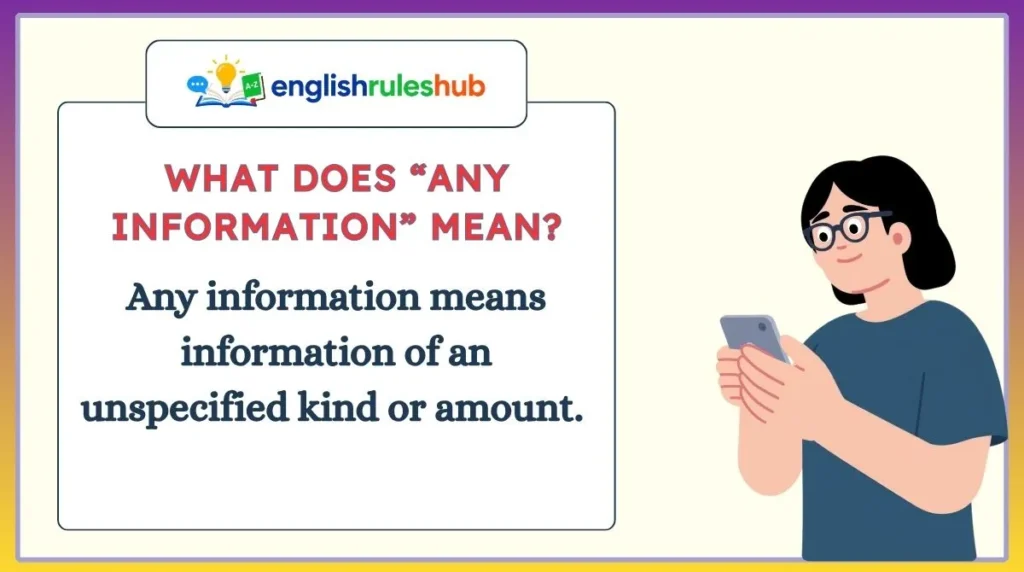
Any information means information of an unspecified kind or amount. The word any is often used when the speaker does not know whether information is available, when the sentence is negative, or when the speaker is talking about whatever information may be available.
The noun information is uncountable, so “any information” refers to an amount of information without giving a specific quantity.
For example:
Do you have any information about the new course?
Here, the speaker does not know whether the other person has information. The question is open.
Another example is:
I don’t have any information about the accident.
This means the speaker has no information about the accident.
When Do We Use “Any Information”?
There are several common situations where any information is natural.
The first is in questions when we are asking whether information exists or is available.
Do you have any information about the exam?
The second is in negative sentences.
We don’t have any information about the problem.
The third is in conditional sentences.
If you get any information, please call me.
The fourth is when any means “whatever” or “no matter which.”
Any information you can provide will be helpful.
In this sentence, the speaker is saying that whatever information is available will be useful.
Grammar Rule for “Any Information”
A simple rule is:
Any + uncountable noun can be used when the meaning is open, uncertain, negative, or conditional.
Because information is uncountable, we say:
- any information
- any useful information
- any additional information
- any new information
- any information about the meeting
We do not normally say:
- any informations
- any informationS
The noun stays in its uncountable form.
Examples of “Any Information”
Here are some everyday examples:
- Do you have any information about the job?
- I don’t have any information about the new policy.
- Did the teacher give you any information about the test?
- If you receive any information, let me know.
- We couldn’t find any information about the company.
- Please contact us if you need any information.
- Is there any information about the next meeting?
- Any information you can give me will be useful.
Notice that most examples use any in questions, negative sentences, or conditional sentences.
A Common Confusion About “Any Information”
Some learners think any can only be used in negative sentences and questions. That is not completely true.
For example:
If you have any information, please send it to me.
This is a conditional sentence, and any is perfectly natural.
We can also say:
Any information you provide will be kept confidential.
Here, any has the idea of whatever information.
So, do not memorize the rule as “any is only for questions and negatives.” That rule is too simple and can cause mistakes.
What Does “Some Information” Mean?
Some information means an unspecified amount of information that the speaker considers to exist or be available.
We use some when we are talking about information without saying exactly how much.
For example:
I have some information for you.
The speaker knows that information exists and is about to share it.
Another example is:
She gave me some information about the course.
The amount is not stated. It could be a few facts, several details, or a larger amount.
When Do We Use “Some Information”?
Some information is especially common in affirmative sentences.
I found some information online.
He gave me some information about the hotel.
We need some information before we make a decision.
It can also be used in questions, especially when the speaker expects or wants the answer to be positive, or when making a request or offer.
For example:
Could you give me some information about the course?
This is a polite request. The speaker is not simply asking whether information exists. The speaker is asking the listener to provide information.
Similarly:
Would you like some information about our services?
This is an offer.
Grammar Rule for “Some Information”
The basic structure is:
some + uncountable noun
Because information is uncountable, we say:
- some information
- some useful information
- some important information
- some new information
- some additional information
We do not say:
- some informations
- some informationS
If you want to count pieces of information, use a countable expression such as:
- a piece of information
- two pieces of information
- several pieces of information
- three useful pieces of information
Examples of “Some Information”
Here are eight simple examples:
- I have some information for you.
- She gave me some information about the school.
- We need some information before we start.
- He found some useful information in the book.
- The manager shared some information with the staff.
- Could you give me some information about the course?
- Would you like some information about our services?
- I received some important information this morning.
In these examples, some usually suggests that information is available or expected.
A Common Confusion About “Some Information”
Learners sometimes believe that some cannot be used in questions.
That is incorrect.
We can certainly say:
Can I get some information about the program?
Could you give me some information?
Would you like some information?
These questions are natural because they are often requests or offers, not simple questions about whether something exists.
Compare:
Do you have any information about the program?
This asks whether information is available.
With:
Could you give me some information about the program?
This is a request for information.
Both are correct, but the purpose is different.
Difference Between “Any Information” and “Some Information”
The main difference is not the noun information. The difference comes from any and some.
Both expressions refer to an unspecified amount of information, but the speaker’s attitude and the sentence structure can be different.
| Expression | Common Use | Basic Meaning | Example |
|---|---|---|---|
| any information | Questions | Information of an unknown amount; asking if it exists | Do you have any information? |
| any information | Negative sentences | No information | I don’t have any information. |
| any information | Conditionals | Whatever information becomes available | If you get any information, tell me. |
| some information | Affirmative sentences | An unspecified amount that exists | I have some information. |
| some information | Requests | A desired amount of information | Could you give me some information? |
| some information | Offers | An offered amount of information | Would you like some information? |
“Any Information” in Questions
When you ask:
Do you have any information about the meeting?
you are asking whether the person has information at all.
The speaker does not know the answer.
The person may have information, or may have none.
That is why any works very naturally here.
“Some Information” in Requests
Now look at:
Could you give me some information about the meeting?
The speaker wants information.
The sentence is not mainly asking whether information exists. It is a request for information.
That is why some sounds natural.
You can think of the difference this way:
Any often asks, “Is there information at all?”
Some often asks, “Can I have information?”
Compare These Two Sentences
Do you have any information about the job?
Can you give me some information about the job?
The first question checks availability.
The second question makes a request.
This is one of the most useful differences for English learners.
Any Information in Negative Sentences
With a negative verb, any is very common.
I don’t have any information.
This means:
I have no information.
Similarly:
She didn’t give me any information.
This means she gave me no information.
We generally do not use some in these ordinary negative sentences.
We would not normally say:
I don’t have some information.
That sentence can have a special meaning in unusual contexts, but it is not the normal way to say that you have no information.
Some Information in Affirmative Sentences
In positive statements, some is very common.
I have some information.
We received some information.
He gave us some information.
The speaker presents the information as something that exists.
Any Information in Conditional Sentences
Any is also very natural after if.
If you get any information, please call me.
If you find any information about the address, let me know.
Here, the speaker does not know whether information will become available.
The meaning is close to:
“If you get information of any kind…”
Any Can Mean “Whatever”
There is another important use:
Any information you can provide will help us.
Here, any does not mean “none.”
It means whatever information you can provide.
This is a more flexible meaning of any.
For example:
Any information about the missing document would be useful.
This means even a small amount or any useful detail could help.
Grammar Rules You Must Remember
Rule #1: Use “any information” in many questions
When you simply want to know whether information is available, any information is usually the natural choice.
Do you have any information about the exam?
Is there any information on the website?
Did you receive any information from the office?
The question is open. You do not know if the person has information.
Rule #2: Use “any information” in negative sentences
With negative verbs such as don’t, doesn’t, didn’t, haven’t, hasn’t, can’t, any is commonly used.
I don’t have any information.
She didn’t receive any information.
We haven’t found any information.
A useful pattern is:
negative verb + any information
Rule #3: Use “some information” in normal positive statements
When you are saying that information exists, some is often the best choice.
I have some information for you.
He found some information about the problem.
We received some information yesterday.
The exact amount is not important.
Rule #4: Use “some information” for many requests and offers
When asking someone to provide information, some often sounds more natural and polite.
Could you give me some information?
Can I get some information about the course?
For an offer, we can also use some:
Would you like some information about our program?
Remember that questions do not always require any. The purpose of the question matters.
Common Mistakes Students Make
Mistake 1: Saying “informations”
One of the most common errors is adding -s to information.
Incorrect:
I need some informations.
Correct:
I need some information.
Information is an uncountable noun.
If you need to count individual facts, say:
I need two pieces of information.
Not:
I need two informations.
Mistake 2: Using “some” in every positive sentence
A learner may say:
I need any information about the course.
This can sound unnatural if the speaker simply wants an unspecified amount of information.
A more natural sentence is:
I need some information about the course.
However, any can become natural if it means whatever information is available:
I need any information you can give me.
The structure and meaning matter.
Mistake 3: Thinking “any” is only used in questions
This is another common problem.
Incorrect idea:
“Any” can only be used in questions.
Actually, we can say:
I don’t have any information.
and:
If you get any information, tell me.
We can also say:
Any information will help.
So, remember the broader pattern.
Mistake 4: Avoiding “some” in questions
Some students learn that questions use any, so they say:
Could you give me any information?
This sentence is grammatically possible, but it may not express the intended meaning.
For a normal request, this is more natural:
Could you give me some information?
The speaker wants the listener to provide information.
Mistake 5: Confusing “Do you have any?” with “Can you give me some?”
These questions have different purposes.
Do you have any information?
This checks availability.
Can you give me some information?
This requests information.
Knowing this difference will make your English sound much more natural.
Easy Trick to Remember the Difference
Here is a simple memory trick:
ANY = Is there anything available?
SOME = Give me an amount of it.
Imagine you walk into a school office.
You do not know whether the receptionist has information about a course.
You ask:
Do you have any information about the course?
You are checking.
Now imagine the receptionist says yes.
You want the information, so you say:
Could you give me some information about the course?
You are requesting it.
This simple situation can help you remember the difference.
Another easy trick is to connect any with uncertainty.
If you are unsure whether something exists, any is often useful.
Do you have any information?
I don’t have any information.
If you find any information, tell me.
Connect some with something that is available or wanted.
I have some information.
She gave me some information.
Could you give me some information?
This is not a rule for every possible sentence, but it is an excellent starting point for beginners.
Daily Life Examples
The difference becomes much clearer when you hear these expressions in normal conversations.
Example 1: At a School
Student: Do you have any information about the final exam?
Teacher: Yes. I have some information for you. The exam will be next Friday.
The student uses any because they are asking whether information is available.
The teacher uses some because information is available and is being given.
Example 2: At a Hotel
Guest: Is there any information about the breakfast time?
Receptionist: Yes. I can give you some information about it.
Again, any checks availability, while some introduces the information being provided.
Example 3: Talking to a Friend
Ali: Do you have any information about the new restaurant?
Sam: No, I don’t have any information yet.
Both uses of any are natural.
The first is a question. The second is negative.
Example 4: Asking for Help
Customer: Could you give me some information about this product?
Worker: Sure. What would you like to know?
The customer is making a direct request, so some sounds natural.
Example 5: A Future Situation
Sara: If you get any information about the job, please tell me.
Mina: Of course. I’ll let you know.
The speaker does not know whether information will become available, so any works well after if.
Example 6: An Office Conversation
Manager: Do you have any information from the client?
Employee: Yes, I received some information this morning.
The manager asks whether information exists. The employee confirms that some information exists.
Example 7: Asking About a Course
Student: Can I get some information about the English course?
Receptionist: Certainly. Here are the course details.
This is a polite request, so some is very natural.
Example 8: No Information Available
Tom: Did the company send you any information?
John: No, they didn’t send me any information.
Both expressions use any because the first is a question and the second is negative.
Example 9: Whatever Information Is Available
Police officer: Any information you can provide may help us.
Here, any means whatever information the person has.
Even a small detail may be useful.
Example 10: Offering Information
Staff member: Would you like some information about our services?
Customer: Yes, please.
This is an offer, so some is natural.
Practice Section
Choose any or some to complete each sentence.
1. Do you have ___ information about the meeting?
A. any
B. some
2. I have ___ information for you.
A. any
B. some
3. We don’t have ___ information about the problem.
A. any
B. some
4. Could you give me ___ information about the course?
A. any
B. some
5. If you get ___ information, please call me.
A. any
B. some
Answers
1. any
Do you have any information about the meeting?
This is a question asking whether information is available.
2. some
I have some information for you.
This is a positive statement.
3. any
We don’t have any information about the problem.
This is a negative sentence.
4. some
Could you give me some information about the course?
This is a request.
5. any
If you get any information, please call me.
This is a conditional sentence.
FAQs
What is the difference between “any information” and “some information”?
Some information usually refers to an unspecified amount of information that exists or is wanted. Any information is common in questions, negative sentences, and conditional sentences.
For example, “I have some information” is a positive statement, while “Do you have any information?” asks whether information is available.
Can we use “any information” in questions?
Yes. In fact, it is very common.
For example:
Do you have any information about the meeting?
This question asks whether the person has information at all. It does not assume that the person has information.
Can we use “some information” in questions?
Yes. Some information is very natural in requests and offers.
For example:
Could you give me some information?
Here, the speaker is asking the listener to provide information, rather than simply checking whether information exists.
Is “some information” grammatically correct?
Yes. It is completely correct.
Information is an uncountable noun, so “some information” is a standard expression.
For example:
She gave me some information about the school.
Is “any information” formal or informal?
Any information is used in both everyday and formal English.
You can use it in conversations, emails, business communication, school writing, and official situations.
For example:
Please contact us if you need any information.
This sounds natural and polite in formal communication.
Can I say “any informations” or “some informations”?
No. In standard English, information is uncountable, so it does not normally take -s.
Say:
some information
any information
If you want to count separate facts, say:
two pieces of information
several pieces of information
Which is correct: “I need some information” or “I need any information”?
Usually, I need some information is the natural choice when you simply mean that you want information.
However, “I need any information you can give me” is also possible when you mean whatever information is available.
So the full sentence and intended meaning matter.
Can “any” mean “whatever”?
Yes. This is an important use of any.
For example:
Any information you can provide will help.
Here, any means whatever information the person can provide.
It does not mean “no information.”
Final Conclusion
The difference between any information and some information is small, but understanding it can make your English much more natural.
Use some information when you are talking about an unspecified amount of information that exists, is wanted, or is being offered. It is especially common in positive statements, requests, and offers.
Use any information when you are asking whether information is available, saying that there is no information, or talking about information that may become available.
It is very common in questions, negative sentences, and conditional sentences. Any can also mean “whatever” in sentences such as “Any information you can provide will help.”
Most importantly, remember that information is uncountable. Do not say “informations.” Say “some information,” “any information,” or “two pieces of information.”
With a little practice, these expressions will start to feel natural. Pay attention to them when you hear people speak English, and try making your own sentences.
The more you use some and any in real situations, the easier the difference becomes.

I am Benjamin Clark, an English language writer passionate about simplifying grammar, vocabulary, and word meanings. I create clear, accurate, and practical content to help learners improve their English skills with confidence every day.