Baptised and baptized look almost the same, and they have exactly the same meaning. The only real difference is the spelling style used in different forms of English.
This small difference can be confusing, especially for students who read both British and American English.
If you see baptised in one book and baptized in another, you may wonder if one word is wrong. You may also wonder whether the two words are pronounced differently or used in different situations.
The good news is that you do not need to learn two different meanings.
Baptised is the spelling normally used in British English, while baptized is the spelling normally used in American English. Cambridge lists baptize as the American form and notes that the UK usually uses baptise.
Both forms are related to baptism, a Christian ceremony in which water is used as part of becoming a member of the Christian Church.
After reading this guide, you will know when to use baptised, when to use baptized, why the spelling changes, how to use both forms in sentences, and which spelling is best for British or American English.
What Does “Baptised” Mean?
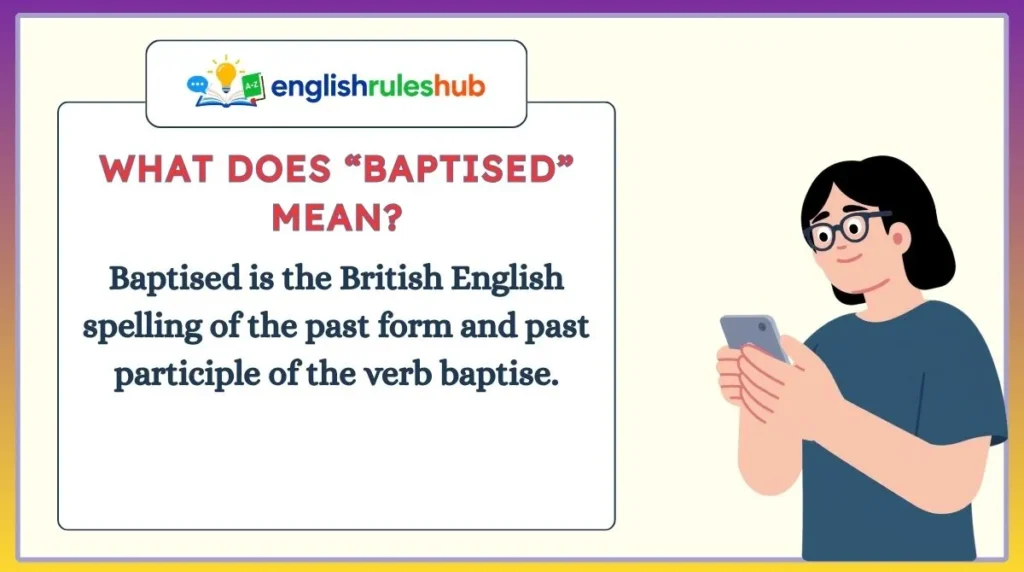
Baptised is the British English spelling of the past form and past participle of the verb baptise.
The verb baptise means to perform a baptism ceremony for someone or to officially make someone a member of the Christian Church through baptism. Cambridge gives baptize as the American spelling and notes that the UK usually uses baptise.
So, when you see baptised, it normally means that a person received baptism.
For example:
She was baptised when she was a baby.
This tells us that the person received baptism as a baby.
When should you use “baptised”?
Use baptised when you are writing in British English or following a British spelling system.
This spelling is common in British English and can also be seen in writing that follows British spelling conventions in other countries.
For example:
- He was baptised at the local church.
- Sarah was baptised as a child.
- Their son was baptised last Sunday.
- She was baptised when she was twenty.
- The baby was baptised in June.
- My grandmother was baptised in that church.
- They were baptised together.
- He had already been baptised before he moved abroad.
Notice the spelling:
baptise → baptised
The s stays in the word.
The grammar of “baptised”
Baptised is an -ed form of the regular verb baptise.
It can work as:
- a simple past form
- a past participle
- part of a passive construction
- part of a perfect tense
For example:
Simple past:
The priest baptised the child.
Here, baptised tells us about an action that happened in the past.
Passive voice:
The child was baptised last Sunday.
Here, the child received the action.
Present perfect:
She has been baptised.
Here, baptised is used with has been.
Past perfect:
He had been baptised before he joined the school.
Here, baptised is used with had been.
A common confusion about “baptised”
Some learners think baptised and baptized have different meanings.
They do not.
The difference is mainly spelling, not meaning.
Compare:
John was baptised in England.
and
John was baptized in the United States.
Both sentences can describe the same event.
The spelling simply reflects different English conventions.
What Does “Baptized” Mean?
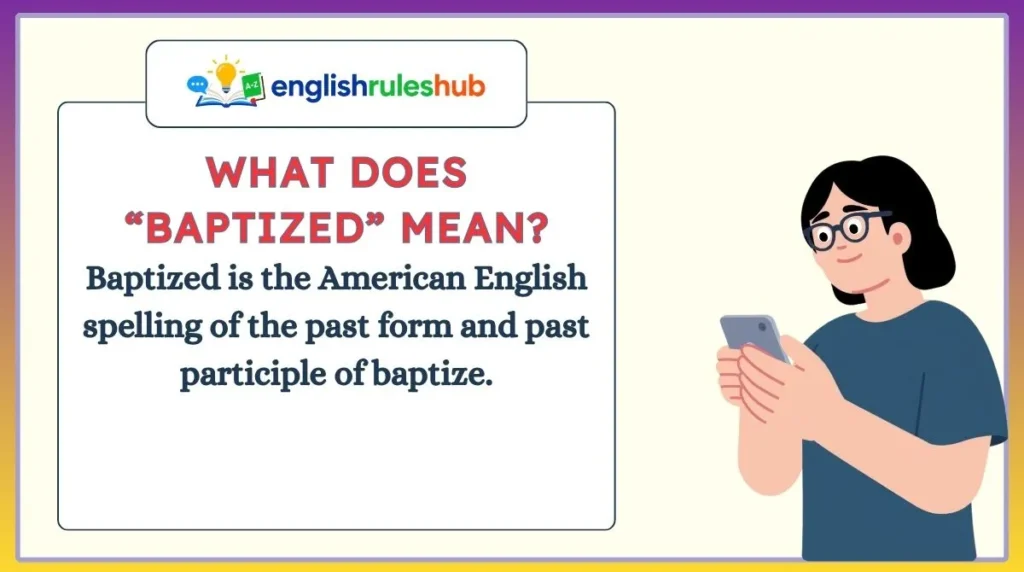
Baptized is the American English spelling of the past form and past participle of baptize.
It has the same meaning as baptised.
In simple terms, it means that someone received baptism or was formally baptized in a Christian ceremony.
For example:
She was baptized as a child.
The sentence means that she received baptism when she was a child.
When should you use “baptized”?
Use baptized when you are writing in American English or following American spelling conventions.
Examples include:
- He was baptized as a baby.
- She was baptized at the church.
- Their daughter was baptized last month.
- I was baptized when I was young.
- The child was baptized on Sunday.
- They were baptized together.
- He had been baptized before the ceremony.
- She has been baptized in the church.
The important spelling pattern is:
baptize → baptized
The z remains in the word.
The grammar of “baptized”
Just like baptised, baptized can be used as the simple past form and past participle.
For example:
The minister baptized the child.
This is a simple past sentence.
You can also use it in the passive voice:
The child was baptized last week.
You can use it with the perfect tense:
She has been baptized.
And you can use it with the past perfect:
He had been baptized before he moved to another city.
So, the grammar does not change because of the spelling.
Only the spelling changes.
Why does “baptized” have a “z”?
The word baptize uses z in the American spelling system. When -ed is added, the spelling becomes:
baptize → baptized
This is similar to other common American spellings:
- organize → organized
- realize → realized
- recognize → recognized
British English often uses s in these families:
- organise → organised
- realise → realised
- recognise → recognised
The baptise/baptised and baptize/baptized difference follows the same broad British-American spelling pattern. Cambridge’s British spelling guidance shows that British and American English have many spelling differences involving forms such as -ise/-ize.
Difference Between Baptised and Baptized
The easiest answer is this:
Baptised = British English
Baptized = American English
There is no important difference in meaning.
Both words are forms of the verb meaning to perform or receive baptism.
Comparison table
| Word | English variety | Meaning | Example |
|---|---|---|---|
| baptised | British English | received or performed baptism | She was baptised as a baby. |
| baptized | American English | received or performed baptism | She was baptized as a baby. |
| baptise | British English | present/base form | They plan to baptise the child. |
| baptize | American English | present/base form | They plan to baptize the child. |
| baptism | Both | the ceremony | The baptism was held on Sunday. |
The main usage difference
The main difference is regional spelling.
If your writing follows British English, choose:
baptised
If your writing follows American English, choose:
baptized
Do not switch between them randomly in the same piece of writing.
For example, if your website uses British English throughout an article, it is better to write:
The baby was baptised in the village church.
rather than:
The baby was baptized in the village church.
On the other hand, if you are writing for an American audience, use:
The baby was baptized in the village church.
The meaning stays the same
Consider these two sentences:
Maria was baptised when she was six.
Maria was baptized when she was six.
There is no meaningful difference in what happened.
Both say that Maria received baptism at the age of six.
The only difference is the spelling convention.
Grammar logic
The base verbs are:
British: baptise
American: baptize
Their past forms are:
British: baptised
American: baptized
Their past participles are also:
British: baptised
American: baptized
So you should not think of baptised and baptized as two separate verbs with separate grammar rules.
They are simply different regional spellings of the same verb form.
Sentence structure
The sentence structure is the same.
Compare:
The priest baptised the child.
The priest baptized the child.
The structure is:
Subject + verb + object
Another example:
The child was baptised.
The child was baptized.
The structure is:
Subject + was/were + past participle
Again, nothing changes except the spelling.
What about pronunciation?
In normal English speech, the two spellings are generally pronounced the same way.
So if you hear someone say the word, you usually cannot tell from pronunciation whether they would write baptised or baptized.
That is why this is mainly a writing and spelling question.
Grammar Rules You Must Remember
Rule #1: Use “baptised” in British English
When following British English spelling, use baptised.
Example:
The child was baptised at the local church.
British English commonly uses -ise spellings in words of this type, including baptise. Cambridge specifically identifies baptise as the usual UK form.
Easy reminder:
British → s
baptised
Rule #2: Use “baptized” in American English
When following American English spelling, use baptized.
Example:
The child was baptized at the local church.
American English uses -ize in this word.
Easy reminder:
American → z
baptized
Rule #3: Do not change the meaning
Never assume that one spelling describes a different kind of baptism.
For example:
He was baptised as a baby.
and
He was baptized as a baby.
Both sentences have the same basic meaning.
The difference is simply the English spelling convention.
Rule #4: Keep your spelling consistent
If you choose British English, keep using British spelling.
If you choose American English, keep using American spelling.
For example, avoid mixing styles like:
The child was baptised, but his parents organized the event.
If your website follows British English, you may prefer:
The child was baptised, but his parents organised the event.
Likewise, in American English:
The child was baptized, but his parents organized the event.
Consistency makes your writing look more polished and professional.
Common Mistakes Students Make
Learners often make mistakes with these words because English has many British-American spelling differences.
A student may learn baptized from an American website and later see baptised in a British book. It is easy to think that one of them is a spelling mistake.
It is not.
Mistake 1: Thinking “baptised” is wrong
Wrong idea:
“Baptised” must be incorrect because I learned “baptized.”
That is not true.
Baptised is a standard British spelling.
Correction:
British English: She was baptised.
American English: She was baptized.
Both are correct in the appropriate variety of English.
Mistake 2: Thinking “baptized” is always wrong
Some learners are taught British English and then see baptized in American writing.
They may assume the writer made a spelling mistake.
Again, that is not correct.
Baptized is a standard American spelling.
Mistake 3: Mixing spellings
A learner may write:
She was baptised in a church in America.
There is nothing grammatically wrong with this sentence. However, if the writer is trying to follow American English consistently, baptized would normally fit better.
The same idea works in reverse.
The best choice depends on the spelling style you are using.
Mistake 4: Changing the pronunciation
Some learners think the s in baptised means it must sound different from the z in baptized.
Usually, that is not the useful distinction to focus on.
These forms are pronounced essentially the same in ordinary English.
The important point is:
Different spelling, same basic word and meaning.
Mistake 5: Confusing “baptism” with “baptised”
These words are related, but they have different grammatical jobs.
Baptism is a noun.
The baptism was held on Sunday.
Baptised/baptized is a verb form.
The baby was baptised on Sunday.
So remember:
baptism = the ceremony
baptised/baptized = the verb form
Easy Trick to Remember the Difference
Here is a very simple trick:
British = S
Think:
British → baptised
American = Z
Think:
American → baptized
You can use the same memory idea with several other spelling pairs.
For example:
British:
- organise
- realise
- recognise
- baptise
American:
- organize
- realize
- recognize
- baptize
Their past forms follow the same pattern:
British:
- organised
- realised
- recognised
- baptised
American:
- organized
- realized
- recognized
- baptized
This does not mean every English word follows exactly the same rule, because English spelling has many exceptions and variations. But for this particular word, the memory trick is very useful.
Think about the letter
If you are writing for a British audience, picture the S in:
baptised
If you are writing for an American audience, picture the Z in:
baptized
That is really all you need to remember.
Daily Life Examples
Here are some natural examples you may see in conversations, family stories, church records, books, or general writing.
Example 1
A: When was your son baptised?
B: He was baptised last Sunday.
This example uses the British spelling.
Example 2
A: Was your daughter baptized as a baby?
B: Yes, she was baptized when she was six months old.
This uses the American spelling.
Example 3
My grandparents were baptised in the same church.
The writer is using British spelling.
Example 4
My grandparents were baptized in the same church.
This sentence has the same meaning but uses American spelling.
Example 5
A: Have you been baptised?
B: Yes, I was baptised when I was young.
Here, the British spelling is used consistently.
Example 6
A: Was your brother baptized in this church?
B: Yes. He was baptized here many years ago.
This is natural American English spelling.
Example 7
The baby will be baptised next month.
The sentence uses the British spelling.
Example 8
The baby will be baptized next month.
The sentence uses the American spelling.
Example 9
She told us that she had been baptised as a child.
The past participle baptised appears after had been.
Example 10
He told us that he had been baptized as a child.
Again, the grammar is the same. Only the spelling changes.
Practice Section
Choose the correct option according to the English variety mentioned.
1. British English
She was ________ as a baby.
a) baptized
b) baptised
2. American English
He was ________ last Sunday.
a) baptised
b) baptized
3. British English
They were ________ in the village church.
a) baptised
b) baptized
4. American English
My parents were ________ in 1990.
a) baptised
b) baptized
5. Both varieties
Which statement is correct?
a) The two forms have different meanings.
b) The two forms are different regional spellings of the same word.
Answers
1. b) baptised
British English normally uses baptised.
2. b) baptized
American English normally uses baptized.
3. a) baptised
The question asks for British English.
4. b) baptized
The question asks for American English.
5. b) The two forms are different regional spellings of the same word.
This is the most important point to remember.
FAQs About Baptised vs Baptized
What is the difference between baptised and baptized?
There is no important difference in meaning. Baptised is the usual British English spelling, while baptized is the usual American English spelling. Both are forms of the verb meaning to baptize someone or to receive baptism.
Is “baptised” British or American English?
Baptised is the British English spelling. British English generally uses baptise as the base verb and baptised as its past form and past participle. If you are following British spelling, choose baptised.
Is “baptized” British or American English?
Baptized is the American English spelling. American English uses baptize as the base verb and baptized as the past form and past participle. It is a standard American spelling, not a mistake.
Can I use “baptised” in American English?
Yes, a reader will understand it, but it follows a British spelling convention. If you are deliberately writing in standard American English, baptized is normally the better choice. The important thing is to keep your spelling style consistent.
Can I use “baptized” in British English?
Yes, readers will understand it, but baptised is the usual British spelling. If your writing follows British English, especially in a formal school or publishing context, it is better to use the British form consistently.
Are baptised and baptized pronounced differently?
Normally, no important pronunciation difference is intended. The main difference is spelling, not meaning. This is why learners often hear the word before they know which spelling the speaker uses.
Is “baptised” a verb?
Yes. Baptised is a form of the verb baptise. It can be used as a simple past form or a past participle. For example, “The priest baptised the child” uses the simple past, while “The child was baptised” uses the past participle in a passive structure.
Is “baptism” the same as “baptised”?
No. Baptism is a noun referring to the Christian ceremony. Baptised and baptized are verb forms. For example, “The baptism was beautiful” uses the noun, while “The baby was baptised” uses the verb form.
Which spelling should I use on an English-learning website?
Choose one English variety and use it consistently. If your website teaches British English, use baptised. If it teaches American English, use baptized. If your website covers both, explain both forms clearly.
Final Conclusion
The difference between baptised and baptized is much simpler than it first appears. They have the same basic meaning, the same pronunciation in normal use, and the same grammatical function.
The main difference is the English spelling system.
Baptised is the usual British English spelling.
Baptized is the usual American English spelling.
So, if you are writing British English, choose baptised. If you are writing American English, choose baptized. Neither spelling should automatically be called wrong.
The most useful habit is to stay consistent. Do not switch between British and American spelling without a reason.
And remember the quick trick:
British = S → baptised
American = Z → baptized
Once you remember that small difference, this confusing pair becomes easy. Keep reading English from different sources, notice the spelling choices, and you will become more comfortable with British and American English over time.

I am Benjamin Clark, an English language writer passionate about simplifying grammar, vocabulary, and word meanings. I create clear, accurate, and practical content to help learners improve their English skills with confidence every day.