Many English learners feel confused when they hear these two questions:
- What have you done?
- What did you do?
At first, they seem almost the same. Both questions ask about an action. Both use the word do. Because of this, many students use them in the wrong situation.
The confusion happens because these questions belong to different tenses. One uses the present perfect tense, while the other uses the simple past tense.
Even though they can sometimes talk about similar actions, the meaning behind them is not exactly the same.
Understanding this difference is very important in daily English. Native speakers use these questions all the time at school, work, home, and in conversations with friends.
Imagine someone asks you about your weekend, your homework, or a mistake that happened. Choosing the correct question can make your English sound natural and clear.
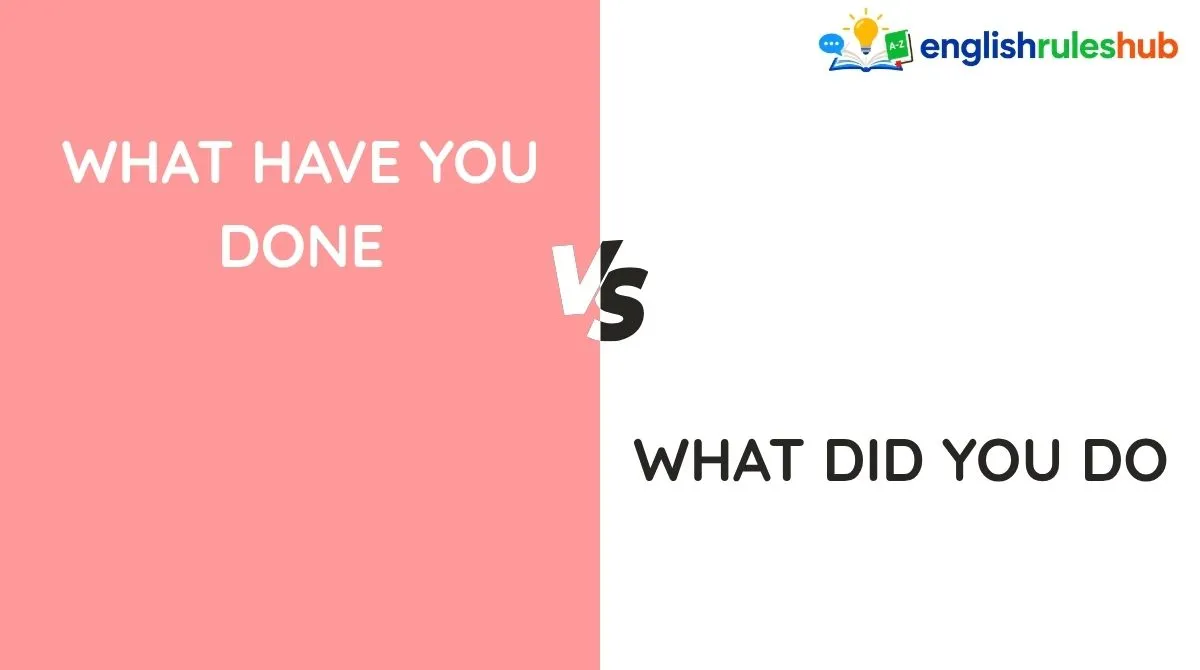
What have you done usually connects the past to the present. What did you do usually talks about a finished time in the past.
After reading this guide, you will clearly understand when to use each question, how their grammar works, common mistakes to avoid, and easy tricks that help you remember the difference forever.
What Does “What Have You Done” Mean?
Simple Definition
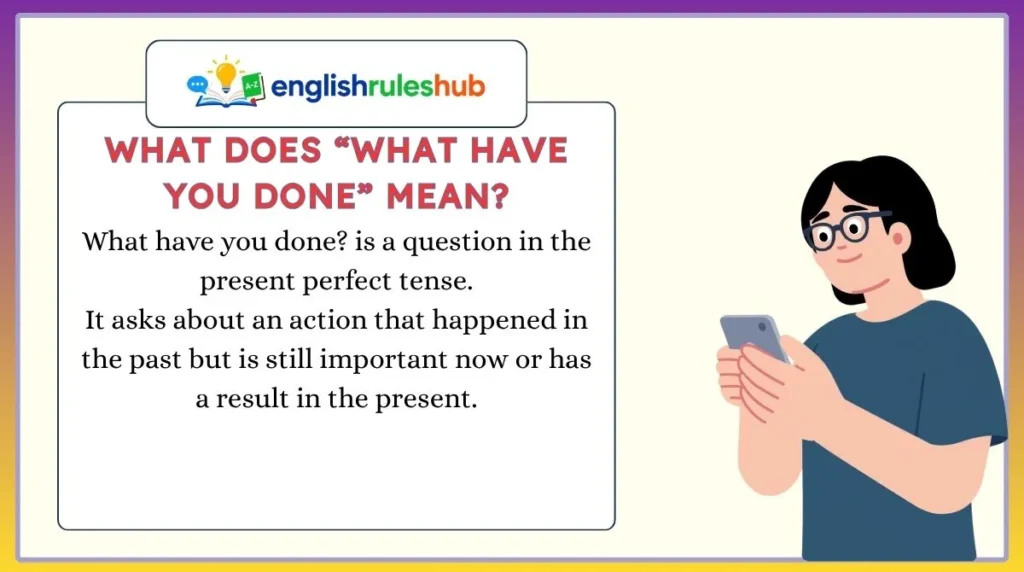
What have you done? is a question in the present perfect tense.
It asks about an action that happened in the past but is still important now or has a result in the present.
When to Use It
Use what have you done when:
- The exact time is not important.
- The action affects the present.
- You want to know about someone’s experience or recent action.
- The result can still be seen now.
Grammar Rule
What + have/has + subject + past participle?
Examples:
- What have you done?
- What has she done?
- What have they done?
The past participle of do is done.
Example Sentences
- What have you done with my keys?
- What have you done to your hair?
- What have you done today?
- What have you done for the project?
- What have you done since morning?
- What have you done to fix the problem?
- What have you done lately?
- What have you done with the documents?
Understanding the Meaning
Imagine you walk into a room and see paint all over the wall.
You ask:
“What have you done?”
The action happened before now, but you can see the result right now. The wall is still covered in paint.
Another example:
Your teacher asks:
“What have you done for your science project?”
The teacher wants to know the progress until now, not a specific past time.
Common Learner Confusion
Many learners think what have you done simply means “what did you do.”
That is not always true.
The key idea is that the action is connected to the present moment.
When you ask:
“What have you done today?”
The day is not finished yet. The period of time is still continuing.
What Does “What Did You Do” Mean?
Simple Definition
What did you do? is a question in the simple past tense.
It asks about an action that happened at a finished time in the past.
When to Use It
Use what did you do when:
- The action happened in the past.
- The time is known or understood.
- The event is finished.
- There is no strong connection to the present.
Grammar Rule
What + did + subject + base verb?
Examples:
- What did you do?
- What did she do?
- What did they do?
Notice that after did, we use the base verb do, not done.
Example Sentences
- What did you do yesterday?
- What did you do last weekend?
- What did you do after school?
- What did you do during the holidays?
- What did you do at the party?
- What did you do when the power went out?
- What did you do last night?
- What did you do on your birthday?
Understanding the Meaning
Suppose Monday is over.
On Tuesday, your friend asks:
“What did you do yesterday?”
Yesterday is finished. The time period ended. That is why the simple past tense is used.
Another example:
“What did you do during your vacation?”
The vacation is over. It belongs completely to the past.
Common Learner Confusion
Many students use what have you done yesterday?
This is incorrect.
Words like:
- yesterday
- last week
- last year
- in 2024
- two days ago
usually require the simple past tense.
Correct sentence:
“What did you do yesterday?”
Difference Between What Have You Done and What Did You Do
Understanding the difference becomes easier when you compare them side by side.
Comparison Table
| Feature | What Have You Done? | What Did You Do? |
|---|---|---|
| Tense | Present Perfect | Simple Past |
| Focus | Result or connection to present | Finished past action |
| Time Mentioned | Usually not specific | Often specific |
| Present Connection | Yes | No |
| Auxiliary Verb | Have/Has | Did |
| Verb Form | Done (past participle) | Do (base verb) |
Usage Difference
What have you done?
Focuses on actions that matter now.
Example:
“What have you done with my phone?”
The phone is missing right now.
What did you do?
Focuses on a finished event.
Example:
“What did you do with my phone yesterday?”
The speaker asks about a completed past situation.
Grammar Logic
Present perfect links the past and present.
Simple past talks about a completed past event.
Compare:
- What have you done today?
- What did you do yesterday?
The first sentence refers to a period that is still continuing.
The second sentence refers to a completed period.
Sentence Structure Difference
Present Perfect
What + have/has + subject + done?
Examples:
- What have you done?
- What has he done?
Simple Past
What + did + subject + do?
Examples:
- What did you do?
- What did he do?
Meaning Comparison
Look at these examples:
What have you done today?
Meaning: Tell me about your activities from the beginning of today until now.
What did you do yesterday?
Meaning: Tell me about your activities during yesterday, which is already finished.
Another pair:
What have you done to solve the problem?
Focus: Progress and results now.
What did you do to solve the problem?
Focus: Specific actions taken in the past.
Grammar Rules You Must Remember
Rule #1: Use Present Perfect for Unfinished Time
If the time period is still continuing, use present perfect.
Example:
✅ What have you done today?
Today is not finished.
Rule #2: Use Simple Past for Finished Time
If the time period is finished, use simple past.
Example:
✅ What did you do yesterday?
Yesterday is over.
Rule #3: Do Not Use Present Perfect with Specific Past Time
Avoid using present perfect with expressions such as:
- yesterday
- last week
- last month
- last year
- two days ago
Wrong:
❌ What have you done yesterday?
Correct:
✅ What did you do yesterday?
Rule #4: Remember the Verb Forms
Present Perfect:
✅ What have you done?
Simple Past:
✅ What did you do?
Never say:
❌ What did you done?
The verb after did must stay in its base form.
Common Mistakes Students Make
Mistake 1: Using Present Perfect with Yesterday
Wrong:
❌ What have you done yesterday?
Correct:
✅ What did you do yesterday?
Why It Happens
Students know that done is the past participle and think it sounds more advanced.
But “yesterday” requires the simple past tense.
Easy Tip
If you see yesterday, think did.
Mistake 2: Using Done After Did
Wrong:
❌ What did you done?
Correct:
✅ What did you do?
Why It Happens
Learners mix up past tense forms and past participles.
Easy Tip
After did, always use the base verb.
Mistake 3: Using Did for Unfinished Time
Wrong:
❌ What did you do today?
Sometimes this is possible, but not if the day is still continuing and you mean “until now.”
Better:
✅ What have you done today?
Easy Tip
Ask yourself:
Is the time finished?
If no, use present perfect.
Mistake 4: Ignoring the Present Result
Imagine your friend broke your laptop.
You see the broken screen and ask:
✅ What have you done?
This sounds natural because the result is visible now.
Many students incorrectly choose:
❌ What did you do?
The sentence is not always wrong, but it does not focus on the present result.
Easy Trick to Remember the Difference
Here is a simple memory trick.
Think About a Door
Imagine time as a door.
Door Open = Present Perfect
If the time period is still open, use:
What have you done?
Examples:
- today
- this week
- this month
- recently
The door is still open.
Example:
“What have you done this week?”
The week is not finished.
Door Closed = Simple Past
If the time period is finished, use:
What did you do?
Examples:
- yesterday
- last week
- last month
- last year
The door is closed.
Example:
“What did you do last week?”
The week ended already.
This simple image helps many students choose the correct tense quickly.
Daily Life Examples
These examples show how native speakers use these questions in everyday conversations.
Example 1
Mom: The kitchen is a mess!
Mom: What have you done?
Example 2
Friend: How was your weekend?
Friend: What did you do?
Example 3
Teacher: The project deadline is tomorrow.
Teacher: What have you done so far?
Example 4
Coworker: You look tired.
Coworker: What did you do last night?
Example 5
Parent: Your clothes are covered in mud.
Parent: What have you done?
Example 6
Friend: How did you spend your vacation?
Friend: What did you do during the trip?
Example 7
Manager: We need an update.
Manager: What have you done this week?
Example 8
Classmate: School was closed yesterday.
Classmate: What did you do at home?
Example 9
Brother: My game file is missing.
Brother: What have you done with it?
Example 10
Friend: You were absent on Friday.
Friend: What did you do instead of coming to class?
Practice Section
Choose the correct option.
1.
_____ yesterday?
A. What have you done
B. What did you do
2.
_____ today?
A. What have you done
B. What did you do
3.
_____ with my phone?
A. What have you done
B. What did you do
4.
_____ during the holidays?
A. What have you done
B. What did you do
5.
_____ this month?
A. What have you done
B. What did you do
Answers
- B — What did you do yesterday?
- A — What have you done today?
- A — What have you done with my phone?
- B — What did you do during the holidays?
- A — What have you done this month?
FAQs
What is the difference between what have you done and what did you do?
“What have you done” uses the present perfect tense and connects the action to the present. “What did you do” uses the simple past tense and refers to a finished action in the past.
Can we use what have you done in questions?
Yes. It is a very common question form in English. It is often used when the result of an action is important now or when the time is not specific.
Can we use what did you do with yesterday?
Yes. In fact, this is the correct choice. Because yesterday is a finished time, the simple past tense should be used.
Is what have you done formal or informal?
It can be used in both formal and informal situations. The meaning depends on the context. Teachers, managers, friends, and family members all use it.
Why can’t I say what did you done?
Because after did, the main verb must be in its base form. The correct sentence is What did you do? The word done is a past participle, not a base verb.
Which is more common in spoken English?
Both are very common. Native speakers use what did you do when talking about finished past events and what have you done when discussing actions connected to the present.
Final Conclusion
The difference between what have you done and what did you do becomes much easier once you focus on time.
Use what have you done when the action is connected to the present, when the result matters now, or when the time period is still continuing. This question belongs to the present perfect tense.
Use what did you do when talking about a finished action at a finished time in the past. This question belongs to the simple past tense.
A helpful way to remember the difference is to think about whether the time period is still open or already closed. Open time usually needs present perfect. Closed time usually needs simple past.
The more examples you read and hear, the more natural these grammar patterns will become.
Pay attention to words like today, yesterday, this week, and last week because they often tell you which tense to choose.
With regular practice, you will soon use both questions confidently in everyday English conversations.

I am Benjamin Clark, an English language writer passionate about simplifying grammar, vocabulary, and word meanings. I create clear, accurate, and practical content to help learners improve their English skills with confidence every day.