Many English learners feel confused when they see something and some thing. At first glance, they look almost the same.
The only visible difference is a space between the words. Because of this, many students think they mean exactly the same thing.
The truth is that they are not always used in the same way. In most situations, English speakers use something as one word. However, there are special cases where some thing as two separate words can appear.
Understanding this small difference can make your English sound much more natural. It can also help you avoid mistakes in writing, speaking, exams, and everyday conversations.
Many learners use some thing when they should use something. Others see some thing in a sentence and do not understand why the writer separated the words. This creates confusion, especially for beginners.
The good news is that the rule is easier than it looks.
By the end of this guide, you will clearly understand the meaning of both forms, when to use each one, common mistakes to avoid, and a simple trick that will help you remember the difference forever.
What Does “Something” Mean?
Simple Definition
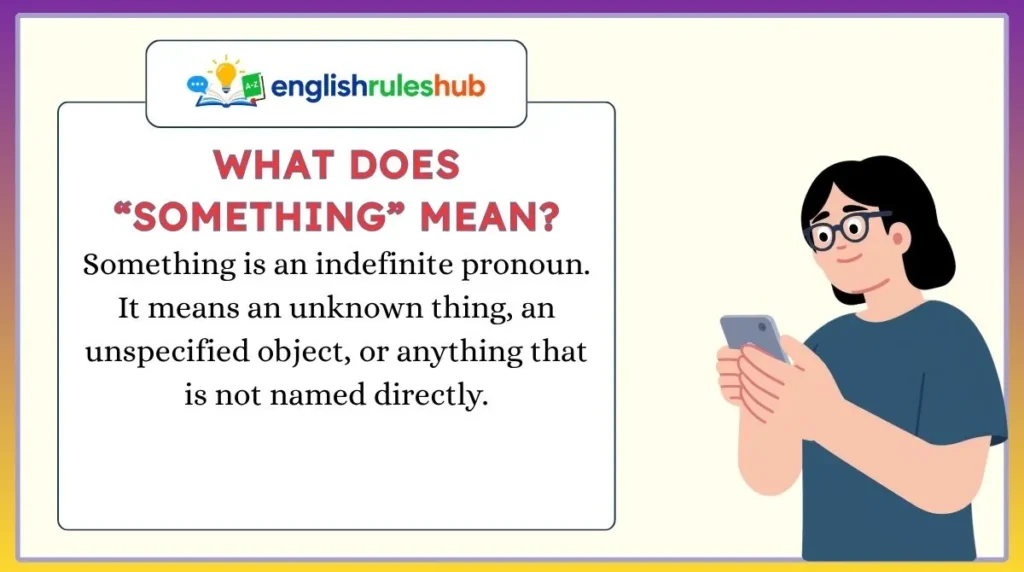
Something is an indefinite pronoun. It means an unknown thing, an unspecified object, or anything that is not named directly.
When we use something, we are talking about a thing, but we do not say exactly what it is.
When to Use It
Use something when:
- You do not know the exact thing.
- The thing is not important enough to name.
- You want to refer to an unspecified object, idea, action, or situation.
Grammar Rule
Something is a single word and functions as an indefinite pronoun.
Structure:
Something + verb
Examples:
- Something is wrong.
- Something happened.
- Something smells good.
Example Sentences
- I heard something outside.
- She wants something to eat.
- There is something in my bag.
- We need something for the party.
- Did you say something?
- Something strange happened yesterday.
- He found something interesting online.
- I feel like something is missing.
Common Learner Confusion
Many students think something means a specific object.
For example:
- I bought something.
This sentence does not tell us what was bought. It could be a book, a phone, a toy, or anything else.
The speaker knows or does not wish to mention the exact item.
That is why something is used.
What Does “Some Thing” Mean?
Simple Definition
Some thing is much less common.
In this form, some is a determiner and thing is a noun. They remain separate words because some describes the noun thing.
It usually means:
- A particular thing
- A certain thing
- One thing among many things
When to Use It
Use some thing only when you want to emphasize the word thing itself.
This structure is rare in modern everyday English but still appears in certain contexts.
Grammar Rule
Structure:
Some + thing
Here:
- some = determiner
- thing = noun
The words keep their separate grammatical roles.
Example Sentences
- Some thing in the box is making noise.
- Some thing must be causing the problem.
- Some thing or person damaged the fence.
- Some thing remained hidden under the table.
- Some thing inside the machine stopped working.
- Some thing from the old collection was missing.
- Some thing in the room felt unusual.
- Some thing among the items caught my attention.
Important Note
In modern English, many native speakers would naturally write something instead of some thing in many of these examples.
The two-word version mainly appears when a writer wants to stress that thing is functioning as a noun being modified by some.
Common Learner Confusion
Students often write:
❌ I need some thing to drink.
The correct form is:
✅ I need something to drink.
This is because the sentence refers to an unspecified item, not the noun thing being modified by some.
Difference Between Something and Some Thing
Understanding the difference becomes easier when you compare them side by side.
| Feature | Something | Some Thing |
|---|---|---|
| Word Type | Indefinite pronoun | Determiner + noun |
| Number of Words | One | Two |
| Common Usage | Very common | Rare |
| Meaning | An unspecified thing | A particular thing |
| Modern English | Standard form | Limited use |
| Everyday Conversations | Frequently used | Rarely used |
Usage Difference
Something refers to an unknown or unnamed thing.
Example:
- I saw something in the garden.
We do not know what it was.
Some thing refers to a thing that is being described by the word some.
Example:
- Some thing in the garden attracted the birds.
The focus is on a certain thing among possible things.
Grammar Logic
With something, the entire word acts as one pronoun.
Example:
- Something moved.
Here, something is the subject.
With some thing, the word some modifies the noun thing.
Example:
- Some thing moved.
Here, thing is the noun and some describes it.
Sentence Structure Difference
Using Something
- Something happened.
- Something changed.
- Something smells funny.
Using Some Thing
- Some thing in the machine broke.
- Some thing among the objects was valuable.
Meaning Comparison
Look at these examples:
Something is making that sound.
Meaning: An unknown source is making the sound.
Some thing is making that sound.
Meaning: A certain thing is making the sound.
The difference is very small, which is why modern English usually prefers something.
Grammar Rules You Must Remember
Rule #1: Use “Something” for Unknown Things
When you do not name the object, use something.
Example:
- I want something sweet.
Correct because the sweet item is not specified.
Rule #2: “Something” Is Usually One Word
In everyday English, something is almost always written as one word.
Example:
- Something is wrong with my phone.
Correct.
Rule #3: “Some Thing” Is Rare
Use some thing only when some modifies the noun thing.
Example:
- Some thing in the collection was missing.
This structure is uncommon.
Rule #4: Check Whether “Thing” Is a Real Noun
Ask yourself:
Can I replace thing with another noun?
Example:
- Some book was missing.
- Some toy was missing.
If yes, then some thing may be possible.
If not, use something.
Example:
- I need something to read.
Correct.
Common Mistakes Students Make
Mistake 1: Splitting “Something” into Two Words
Wrong:
❌ I need some thing to eat.
Correct:
✅ I need something to eat.
Why?
Because the speaker means an unspecified item.
Mistake 2: Thinking Both Forms Are Always Interchangeable
Wrong idea:
❌ Something and some thing are always the same.
Correct idea:
✅ They have different grammatical structures.
Mistake 3: Using “Some Thing” in Everyday Writing
Wrong:
❌ Did you hear some thing?
Correct:
✅ Did you hear something?
The one-word form is standard English.
Mistake 4: Overthinking the Rule
Many learners stop and wonder:
“Should I write something or some thing?”
A simple answer works most of the time:
If you are talking about an unknown thing, write something.
Easy Correction Tips
- Use something in normal conversation.
- Use something in emails.
- Use something in exams.
- Use something in daily writing.
- Only use some thing in special grammatical situations.
Easy Trick to Remember the Difference
Here is a simple memory trick.
Think About a Mystery Box
Imagine a closed box.
You know there is an item inside, but you do not know what it is.
You would say:
There is something in the box.
The item is unknown.
Now imagine a group of objects on a table.
You point to one object and say:
Some thing on the table belongs to me.
Here, you are focusing on one particular thing among several things.
Quick Memory Formula
- Unknown item = something
- Particular thing = some thing
Since most daily conversations involve unknown or unspecified items, something is usually the correct choice.
Daily Life Examples
These examples show how people naturally use the word in conversations.
Example 1
A: Are you hungry?
B: Yes, I want something to eat.
Example 2
A: What happened?
B: Something fell from the shelf.
Example 3
A: Why are you smiling?
B: Something funny happened.
Example 4
A: Did you buy anything?
B: Yes, I bought something for my sister.
Example 5
A: Is everything okay?
B: No, something feels wrong.
Example 6
A: What are you looking for?
B: I’m looking for something important.
Example 7
A: Can you smell that?
B: Yes, something is burning.
Example 8
A: Did the teacher say anything?
B: Yes, she said something about homework.
Example 9
A: Why did he call?
B: He wanted something from me.
Example 10
A: What was in the package?
B: Something expensive, I think.
Practice Section
Choose the correct option.
1.
I need (something / some thing) to drink.
2.
________ is making a strange noise.
a) Something
b) Some thing
3.
Did you hear (something / some thing)?
4.
There is (something / some thing) in my pocket.
5.
________ must have caused the problem.
a) Something
b) Some thing
Answers
- Something
- Something
- Something
- Something
- Something
In modern English, something is the correct answer in nearly all everyday situations.
FAQs
What is the difference between something and some thing?
Something is an indefinite pronoun meaning an unspecified thing. Some thing is a less common structure where some modifies the noun thing. Most daily English uses something.
Can we use something in questions?
Yes. It often appears in questions when the speaker expects the answer to be yes.
Example:
- Would you like something to drink?
Is something formal or informal?
It is both. You can use it in conversations, emails, academic writing, and professional communication.
Why is something written as one word?
English combines some indefinite pronouns into single words, such as someone, somebody, somewhere, and something.
Is some thing wrong grammar?
Not necessarily. It can be grammatically correct in certain situations. However, it is uncommon and often replaced by something in modern English.
Which form should English learners use?
Learners should generally use something. It is the standard form used by native speakers in most situations.
Final Conclusion
The difference between something and some thing may look small, but understanding it can improve both your grammar and your confidence in English.
The one-word form, something, is the version you will see and hear almost everywhere. It refers to an unknown, unnamed, or unspecified thing. It is used in conversations, writing, questions, and everyday situations.
The two-word form, some thing, is much less common. It appears when some acts as a determiner and thing remains a separate noun.
While it can be grammatically correct in certain contexts, most learners rarely need to use it.
A simple rule can help: if you mean an unknown item, choose something. In everyday English, that choice will usually be correct.
Keep reading, listening, and practicing. The more examples you see, the more natural this grammar point will become. Small differences like this often lead to big improvements in fluency.

I am Benjamin Clark, an English language writer passionate about simplifying grammar, vocabulary, and word meanings. I create clear, accurate, and practical content to help learners improve their English skills with confidence every day.