Many English learners feel confused about person and people. At first, the difference looks simple.
One word seems singular, and the other seems plural. However, when learners start reading books, listening to conversations, or writing English sentences, they often find situations that make them stop and think.
For example, should you say “one people” or “one person”? Why do we say “three people” instead of “three persons” in most situations? Can people refer to a group, a nation, or a community? These questions confuse many students.
Understanding these two words is important because they appear everywhere in daily English.
You hear them in conversations, news reports, movies, schools, workplaces, and social media. Using the correct word helps your English sound natural and clear.
The good news is that the difference is not difficult once you understand the basic grammar rules. A few simple ideas can help you avoid common mistakes and speak more confidently.
By the end of this guide, you will understand the meanings of person and people, know when to use each one, learn important grammar rules, avoid common errors, and see many real-life examples that make the topic easy to remember.
What Does “Person” Mean?
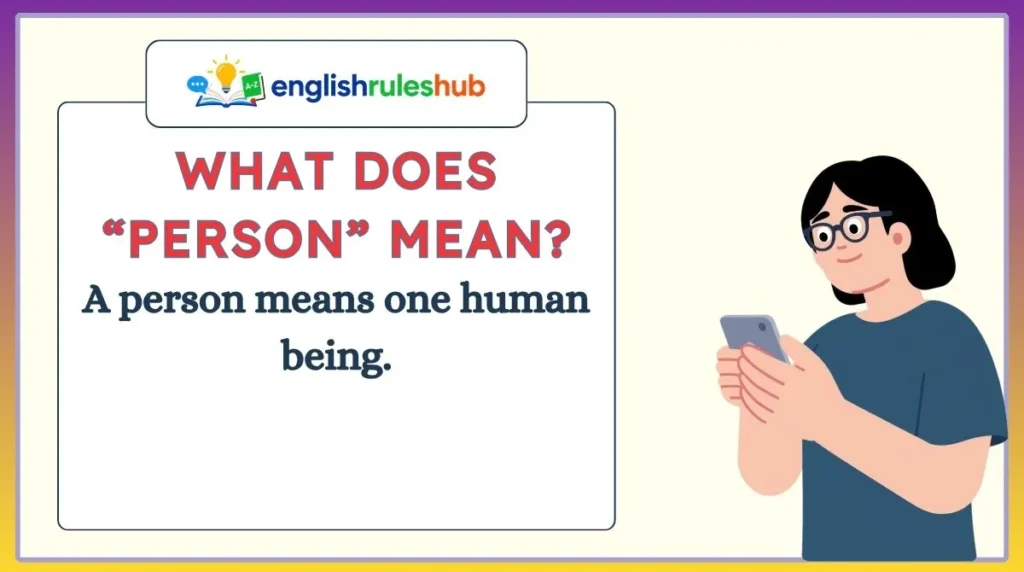
A person means one human being.
It is a singular noun, so it refers to only one individual.
When to Use “Person”
Use person when talking about a single human being.
Examples:
- That person is my teacher.
- I met a friendly person yesterday.
- One person called you this morning.
- The person at the door is waiting.
- She is a kind person.
- Every person has a different story.
- The person in the blue shirt is my brother.
- One person can make a difference.
Grammar Rule for “Person”
Person = Singular
Structure:
- One person
- A person
- This person
- That person
- Each person
- Every person
Examples:
- Every person needs water.
- That person looks happy.
- One person answered the question.
Common Learner Confusion
Many learners accidentally use people when they mean only one individual.
Wrong:
- A people is standing outside.
Correct:
- A person is standing outside.
Remember that person always refers to one human being.
Another confusion happens with counting.
Wrong:
- Two person are waiting.
Correct:
- Two people are waiting.
Once the number becomes more than one, English usually changes person to people.
What Does “People” Mean?
People is the most common plural form of person.
It means more than one human being.
When to Use “People”
Use people when talking about two or more individuals.
Examples:
- Many people came to the party.
- Three people are waiting outside.
- People enjoy listening to music.
- The room was full of people.
- Several people asked the same question.
- Young people often use social media.
- People like honest friends.
- Hundreds of people attended the event.
Grammar Rule for “People”
People = Plural
Structure:
- Two people
- Many people
- Some people
- Several people
- Few people
Examples:
- Many people work from home.
- Some people prefer tea.
- Five people joined the meeting.
Another Meaning of “People”
Sometimes people means a nation, community, or group with a shared culture.
Examples:
- The Japanese people are known for their rich culture.
- The people of the village celebrated together.
- The people of the country voted in the election.
In these examples, people refers to a larger group rather than just several individuals.
Common Learner Confusion
Some learners think the plural of person should always be persons.
While persons exists, it is much less common in everyday English.
Natural:
- Three people are waiting.
Less common:
- Three persons are waiting.
In normal conversation, people is almost always the best choice.
Difference Between Person and People
The biggest difference is the number of individuals being discussed.
| Feature | Person | People |
|---|---|---|
| Meaning | One human being | More than one human being |
| Number | Singular | Plural |
| Verb Form | Singular verb | Plural verb |
| Common Use | One individual | Groups of individuals |
| Everyday English | Very common | Very common |
| Example | One person is here. | Five people are here. |
Usage Difference
Use person for one individual.
Example:
- One person is sitting on the bench.
Use people for two or more individuals.
Example:
- Ten people are sitting on the bench.
Grammar Logic
English has singular and plural nouns.
- person = singular
- people = plural
Examples:
- The person is smiling.
- The people are smiling.
Notice that the verb changes too:
- Person is
- People are
Sentence Structure Difference
Singular Structure:
Subject + singular verb
Example:
- The person is waiting.
Plural Structure:
Subject + plural verb
Example:
- The people are waiting.
Meaning Comparison
Compare these sentences:
- One person entered the room.
- Twenty people entered the room.
The first sentence talks about one individual.
The second sentence talks about a group.
That is the key difference.
Grammar Rules You Must Remember
Rule #1: Use “Person” for One Individual
When talking about one human being, use person.
Examples:
- One person called me.
- That person is my neighbor.
Rule #2: Use “People” for More Than One Individual
When talking about two or more individuals, use people.
Examples:
- Two people were late.
- Many people enjoyed the show.
Rule #3: Match the Correct Verb
Because person is singular, use singular verbs.
Examples:
- The person is happy.
- A person has rights.
Because people is plural, use plural verbs.
Examples:
- People are happy.
- Many people have jobs.
Rule #4: “Persons” Is Rare in Everyday English
In formal, legal, or official writing, you may see persons.
Examples:
- Missing persons report.
- Authorized persons only.
However, in normal conversation, use people.
Natural:
- Five people entered the building.
Less natural in everyday English:
- Five persons entered the building.
Common Mistakes Students Make
Mistake 1: Using “Person” After Numbers Greater Than One
Wrong:
- Three person are here.
Correct:
- Three people are here.
Why it happens:
Many languages simply add a plural ending. English uses the irregular plural people.
Mistake 2: Using a Singular Verb with “People”
Wrong:
- People is waiting outside.
Correct:
- People are waiting outside.
Tip:
Whenever you see people, think plural.
Mistake 3: Using “People” for One Individual
Wrong:
- A people is knocking on the door.
Correct:
- A person is knocking on the door.
Tip:
One human being = person.
Mistake 4: Using “Persons” in Everyday Conversation
Less Natural:
- Four persons are sitting there.
Natural:
- Four people are sitting there.
Tip:
Choose people in most daily situations.
Mistake 5: Forgetting the Meaning of Collective “People”
Some learners think people only means several individuals.
However, it can also mean a nation or community.
Example:
- The people of the town welcomed the visitors.
Here, people refers to the community as a whole.
Easy Trick to Remember the Difference
A simple memory trick can help.
Think about counting.
If You Can Count Only One
Use person.
Examples:
- One person
- One person waiting
- One person speaking
If You Can Count Two or More
Use people.
Examples:
- Two people
- Five people
- Many people
A very easy formula is:
1 = Person
2+ = People
Imagine a classroom.
If only one student enters, you can say:
- One person entered the room.
If several students enter, you can say:
- Many people entered the room.
This simple counting trick works in almost every situation.
Daily Life Examples
These examples sound natural in everyday conversations.
- One person forgot their bag.
- Two people asked me the same question.
- Many people use smartphones every day.
- The person behind you is smiling.
- Several people are waiting for the bus.
- Young people enjoy online games.
- The person at the counter helped me.
- People often check their phones in the morning.
- One person can change a team.
- People love spending time with friends and family.
Short Conversation Examples
Conversation 1:
A: How many people came?
B: About twenty people.
Conversation 2:
A: Who called me?
B: A person from the bank.
Conversation 3:
A: Is someone waiting outside?
B: Yes, one person is waiting.
Conversation 4:
A: Was the concert crowded?
B: Yes, many people attended it.
Conversation 5:
A: Who lives next door?
B: The person in the yellow house.
These examples show how naturally both words appear in spoken English.
Practice Section
Choose the correct answer.
1.
Only one _____ knows the answer.
A. people
B. person
2.
Many _____ attended the meeting.
A. people
B. person
3.
The _____ at the desk is my teacher.
A. person
B. people
4.
Three _____ are waiting outside.
A. person
B. people
5.
The _____ of the village celebrated together.
A. person
B. people
Answers
- B — person
- A — people
- A — person
- B — people
- B — people
If you answered all five correctly, you already understand the main difference very well.
FAQs
What is the difference between person and people?
Person refers to one human being, while people refers to two or more human beings. Person is singular, and people is plural. This is the most important difference.
Can we use people in questions?
Yes. People is commonly used in questions.
Examples:
- How many people are coming?
- Why do people like this movie?
It works just like other plural nouns.
Is person singular or plural?
Person is singular. It refers to one individual.
Examples:
- One person arrived.
- That person is my friend.
Use a singular verb with it.
Is people singular or plural?
People is plural. It refers to multiple individuals.
Examples:
- People are waiting.
- Many people work here.
Use plural verbs such as are, have, and do.
Can we use persons instead of people?
Yes, but mainly in formal, legal, or official contexts.
Examples:
- Missing persons
- Authorized persons only
In everyday English, people is usually preferred.
Is people formal or informal?
People is acceptable in both formal and informal English. It is the standard plural form used in conversations, books, newspapers, and professional writing.
Final Conclusion
The difference between person and people becomes much easier when you remember one simple idea: person is singular, and people is plural.
Use person when talking about one human being. Use people when talking about two or more human beings. This rule works in most situations and helps your English sound natural.
It is also helpful to remember that people can sometimes refer to a community, nation, or group with a shared identity.
That is why you may see expressions such as “the people of a city” or “the people of a country.”
Many learners make mistakes because they try to use person after numbers greater than one or use the wrong verb with people. Regular practice can quickly fix these problems.
Keep reading English, listening to conversations, and creating your own example sentences.
The more often you use these words, the more natural they will feel. With a little practice, choosing between person and people will become automatic.

I am Benjamin Clark, an English language writer passionate about simplifying grammar, vocabulary, and word meanings. I create clear, accurate, and practical content to help learners improve their English skills with confidence every day.