Many English learners get confused when they see similar to and similarly to. At first glance, they look almost the same.
Both talk about things that are alike in some way. Because of this, students often use one when they should use the other.
This confusion is very common. You may hear someone say, “She speaks similarly to her mother” and then hear another person say, “She is similar to her mother.” Both sentences sound close in meaning, but the grammar is different.
Understanding the difference is important because these expressions appear in everyday conversations, school writing, business English, books, articles, and exams.
If you know when to use each one, your English will sound much more natural and accurate.
Similar to is far more common in daily English, while similarly to is usually used when comparing actions, methods, or ways of doing something. Knowing this small difference can prevent many grammar mistakes.
After reading this guide, you will understand the meaning of both expressions, learn their grammar patterns, see real-life examples, discover common mistakes, and gain an easy trick to remember which one to use.
What Does “Similar To” Mean?
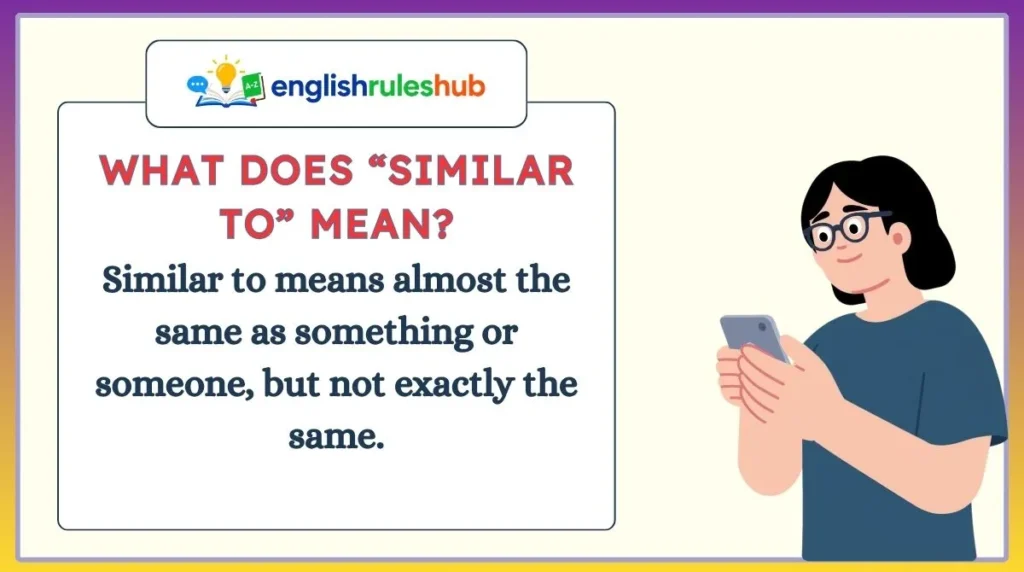
Similar to means almost the same as something or someone, but not exactly the same.
We use it to compare people, things, places, ideas, situations, or experiences that share important qualities.
Simple Definition
Similar to = alike in some way
When to Use It
Use similar to when comparing:
- People
- Objects
- Ideas
- Experiences
- Places
- Situations
Grammar Rule
The basic structure is:
Noun + be verb + similar to + noun/pronoun
Examples:
- My bag is similar to yours.
- This movie is similar to the one we watched yesterday.
- Her voice is similar to her sister’s voice.
The word similar is an adjective. Because it is an adjective, it usually follows a linking verb such as:
- is
- am
- are
- was
- were
- seems
- looks
Example Sentences
- This phone is similar to my old phone.
- Your handwriting is similar to mine.
- The weather here is similar to the weather in my hometown.
- Their house is similar to ours.
- His ideas are similar to those of his teacher.
- This game is similar to chess.
- The two dresses are similar to each other.
- Her experience was similar to mine.
Common Learner Confusion
Many students think similar to means exactly the same as.
That is not correct.
Look at these examples:
- My car is similar to yours. ✅
- My car is the same as yours. ✅
The first sentence means the cars share many features.
The second sentence means they are exactly alike.
So, similar to shows resemblance, not complete equality.
What Does “Similarly To” Mean?
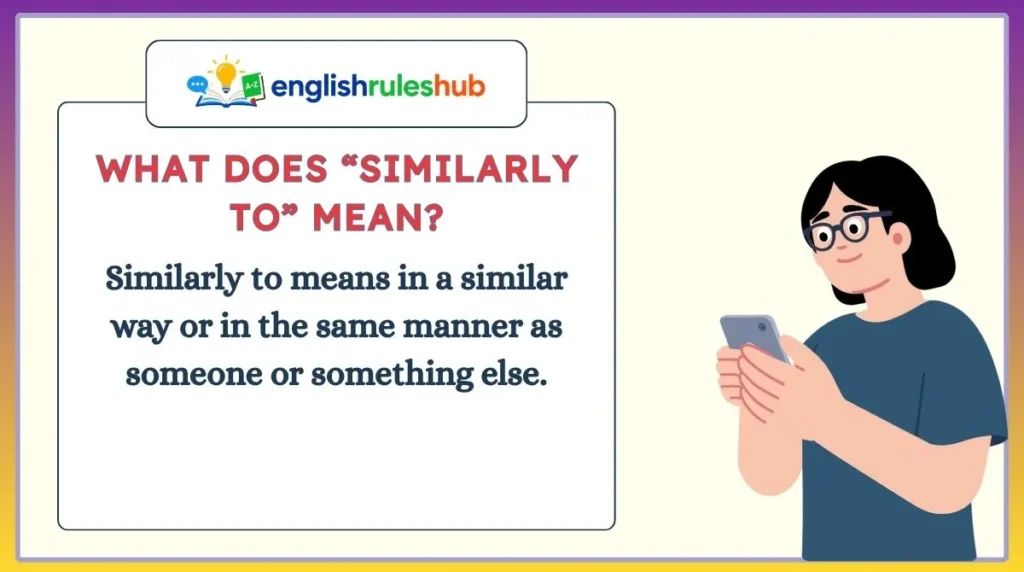
Similarly to means in a similar way or in the same manner as someone or something else.
It focuses on how an action happens, not on whether two things are alike.
Simple Definition
Similarly to = in a similar way to
When to Use It
Use similarly to when comparing:
- Actions
- Behavior
- Methods
- Processes
- Ways of doing things
Grammar Rule
The structure is usually:
Verb + similarly to + noun/pronoun
or
Clause + similarly to + clause
The word similarly is an adverb. Adverbs describe actions, verbs, or entire clauses.
Example Sentences
- She speaks similarly to her mother.
- The machine works similarly to the older model.
- He reacted similarly to the other students.
- Birds migrate similarly to many sea animals.
- The new system operates similarly to the previous one.
- They solved the problem similarly to their teacher.
- Children often behave similarly to their parents.
- The company handled the issue similarly to its competitors.
Common Learner Confusion
Many learners use similarly to when they should use similar to.
Incorrect:
- My car is similarly to yours. ❌
Correct:
- My car is similar to yours. ✅
Why?
Because car is a thing being described. We need an adjective (similar), not an adverb (similarly).
Remember:
- similar describes things
- similarly describes actions
Difference Between Similar To and Similarly To
Although these expressions have related meanings, they do different grammar jobs.
Comparison Table
| Feature | Similar To | Similarly To |
|---|---|---|
| Word Type | Adjective phrase | Adverb phrase |
| Main Purpose | Compare things | Compare actions |
| Focus | What something is like | How something happens |
| Common Usage | Very common | Less common |
| Follows | Be verbs and linking verbs | Action verbs |
| Example | My phone is similar to yours. | It works similarly to yours. |
Usage Difference
Similar to compares people or things.
Example:
- This restaurant is similar to the one near my house.
The focus is on the restaurant itself.
Similarly to compares actions or behavior.
Example:
- This restaurant operates similarly to the one near my house.
The focus is on how the restaurant operates.
Grammar Logic
Think about the parts of speech.
Similar = adjective
Adjectives describe nouns.
Example:
- The car is similar to mine.
The adjective describes car.
Similarly = adverb
Adverbs describe verbs.
Example:
- The car performs similarly to mine.
The adverb describes performs.
Sentence Structure Difference
Similar To
Subject + be verb + similar to + noun
Examples:
- The building is similar to the old one.
- Her style is similar to her mother’s.
Similarly To
Subject + action verb + similarly to + noun
Examples:
- The building functions similarly to the old one.
- She dresses similarly to her mother.
Meaning Comparison
Compare these two sentences:
- Sarah is similar to her sister.
- Sarah dresses similarly to her sister.
The first sentence compares Sarah and her sister as people.
The second sentence compares the way they dress.
That small grammar change creates a different focus.
Grammar Rules You Must Remember
Rule #1: Use “Similar To” After Linking Verbs
When describing a noun, use similar to.
Examples:
- This book is similar to that book.
- His opinion seems similar to mine.
Correct:
- The city is similar to my hometown. ✅
Incorrect:
- The city is similarly to my hometown. ❌
Rule #2: Use “Similarly To” With Actions
When comparing how something happens, use similarly to.
Examples:
- She behaves similarly to her sister.
- The software operates similarly to the old version.
Correct:
- The child reacted similarly to his brother. ✅
Incorrect:
- The child reacted similar to his brother. ❌
Rule #3: “Similar To” Is Much More Common
Native speakers use similar to very frequently.
Examples:
- This design is similar to ours.
- Your idea is similar to mine.
In many situations, speakers choose:
- in a similar way to
instead of:
- similarly to
Example:
- She teaches in a similar way to her mother.
This often sounds more natural.
Rule #4: Check What You Are Comparing
Ask yourself a simple question:
Am I comparing a thing or an action?
Thing:
- The houses are similar to each other.
Action:
- The houses were built similarly to those in Spain.
This question helps you choose the correct expression quickly.
Common Mistakes Students Make
Many mistakes happen because the words look nearly identical.
Mistake 1: Using “Similarly To” After a Be Verb
Wrong:
- My laptop is similarly to yours. ❌
Correct:
- My laptop is similar to yours. ✅
Why It Happens
Students see the word similar inside similarly and think both forms work everywhere.
Tip
After is, am, are, was, were, choose similar to.
Mistake 2: Using “Similar To” With an Action Verb
Wrong:
- She sings similar to her mother. ❌
Correct:
- She sings similarly to her mother. ✅
Why It Happens
Learners forget that singing is an action.
Tip
If there is an action verb, check whether you need an adverb.
Mistake 3: Thinking Both Mean Exactly the Same Thing
Wrong Understanding:
- Similar to = similarly to
Not always.
Compare:
- Tom is similar to his father.
- Tom behaves similarly to his father.
The meaning changes slightly because the focus changes.
Mistake 4: Confusing “Similar To” With “Same As”
Wrong:
- My phone is same as yours. ❌
Correct:
- My phone is the same as yours. ✅
- My phone is similar to yours. ✅
Remember:
- same as = identical
- similar to = alike but not identical
Easy Trick to Remember the Difference
A simple memory trick can help.
Think About the Ending
Similar ends like many adjectives:
- popular
- beautiful
- useful
Adjectives describe things.
Example:
- The shoes are similar to mine.
Similarly ends in -ly.
Many adverbs end in -ly:
- slowly
- quickly
- carefully
Adverbs describe actions.
Example:
- She walks similarly to her sister.
Real-Life Logic
Imagine two bicycles.
If you say:
- The bicycles are similar to each other.
You are comparing the bicycles.
If you say:
- The cyclists ride similarly to each other.
You are comparing the riding style.
The first compares things.
The second compares actions.
That difference will help you remember the correct choice.
Daily Life Examples
These examples sound natural in everyday conversations.
- Your jacket is similar to mine.
- This coffee tastes similar to the coffee I had yesterday.
- My brother looks similar to our father.
- She speaks similarly to her teacher.
- The new phone works similarly to the older model.
- Our neighbors decorate their house similarly to us.
- This restaurant is similar to the one downtown.
- He responds similarly to his older brother during stressful situations.
- Their living room is similar to ours.
- The students answered the questions similarly to the previous class.
Short Conversation Examples
Conversation 1
A: Your bag looks nice.
B: Thanks. It’s similar to my sister’s bag.
Conversation 2
A: Does the new machine work well?
B: Yes. It works similarly to the old one.
Conversation 3
A: Your son looks familiar.
B: Many people say he is similar to me.
Conversation 4
A: How does she teach?
B: She teaches similarly to her father.
These examples show how both expressions appear naturally in spoken English.
Practice Section
Choose the correct option.
1.
My house is ________ yours.
A. similar to
B. similarly to
2.
She dances ________ her sister.
A. similar to
B. similarly to
3.
The two paintings are ________ each other.
A. similar to
B. similarly to
4.
The new software works ________ the previous version.
A. similar to
B. similarly to
5.
His voice is ________ his father’s voice.
A. similar to
B. similarly to
Answers
- A — similar to
- B — similarly to
- A — similar to
- B — similarly to
- A — similar to
FAQs
What is the difference between similar to and similarly to?
Similar to compares people, things, or ideas. Similarly to compares actions, behavior, or methods. The first is an adjective phrase, while the second is an adverb phrase.
Can we use similarly to in questions?
Yes. It can be used in questions when comparing actions or methods.
Example:
- Does this machine operate similarly to the old one?
This sentence compares the way the machine operates.
Is similar to more common than similarly to?
Yes. Similar to is much more common in everyday English. Native speakers use it frequently when describing people, objects, and situations.
Can similar to and same as be used interchangeably?
No. Similar to means almost alike. Same as means exactly alike. The meanings are related but not identical.
Is similarly to formal or informal?
It can be used in both formal and informal English. However, many speakers often choose phrases such as in a similar way to because they sound more natural in conversation.
Can I say “looks similarly to”?
Usually no. Since looks is often a linking verb in this structure, native speakers normally say:
- She looks similar to her mother. ✅
Using similarly to here sounds unnatural.
Final Conclusion
Understanding similar to and similarly to becomes much easier when you focus on one simple idea: things versus actions.
Use similar to when comparing people, objects, places, ideas, or situations. It describes how alike two things are. Because similar is an adjective, it usually follows a linking verb such as is, are, was, or seems.
Use similarly to when comparing actions, behavior, methods, or processes. Because similarly is an adverb, it explains how something happens.
A helpful way to remember this is to look for the -ly ending. Many adverbs end in -ly, and adverbs often describe actions.
The more examples you read and use, the more natural these expressions will feel. Try creating your own sentences about friends, family members, school subjects, movies, or daily routines.
With regular practice, choosing between similar to and similarly to will soon become automatic.

I am Benjamin Clark, an English language writer passionate about simplifying grammar, vocabulary, and word meanings. I create clear, accurate, and practical content to help learners improve their English skills with confidence every day.