Many English learners get confused by anyone and any one because they look almost the same. The only visible difference is a space. Because of that, many students think they mean exactly the same thing. They do not.
This small difference can completely change the meaning of a sentence. If you use the wrong form, your sentence may sound strange or even give a different message.
That is why understanding this grammar point is important for both writing and speaking.
The good news is that the rule is much easier than most learners expect. Once you understand what each expression refers to, choosing the correct one becomes simple. You do not have to memorize dozens of grammar rules. A few clear ideas are enough.
Whether you are writing an email, answering an exam question, talking with friends, or improving your English for work, knowing the difference will help you sound more natural. Native speakers use both expressions regularly, but they use them in different situations.
By the end of this guide, you will clearly understand when to use anyone, when to use any one, how to avoid common mistakes, and how to remember the difference with confidence.
What Does “Anyone” Mean?
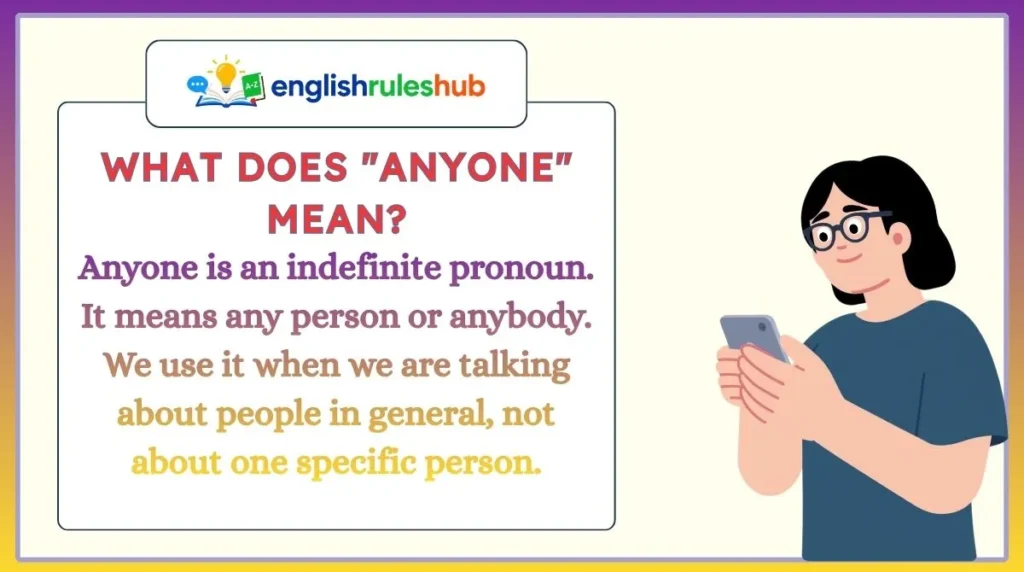
Anyone is an indefinite pronoun. It means any person or anybody. We use it when we are talking about people in general, not about one specific person.
You can think of anyone as another way to say any person at all.
When to Use “Anyone”
Use anyone when you are talking about people without naming a particular person.
It is commonly used in:
- Questions
- Negative sentences
- Positive sentences with a general meaning
- Conditional sentences
- Offers and requests
Grammar Rule
Anyone always refers to people.
It cannot refer to objects, places, or ideas.
Correct:
- Anyone can learn English.
- Does anyone know the answer?
- I didn’t tell anyone.
Incorrect:
- ❌ Anyone of these books is interesting.
- ❌ Anyone on the shelf is mine.
In these sentences, we are talking about books, not people, so anyone is incorrect.
Examples of “Anyone”
Here are some simple examples.
- Anyone can join this class.
- Did anyone call me today?
- I don’t know anyone in this city.
- If anyone needs help, please ask.
- Has anyone seen my glasses?
- Anyone who works hard can improve.
- Don’t tell anyone about the surprise.
- Is anyone sitting here?
Notice that every sentence talks about people, not things.
Common Learner Confusion
Many students believe anyone always means “everyone.”
That is not true.
Compare these sentences.
- Anyone can enter the park.
- Everyone entered the park.
The first sentence means every person has permission, but it does not mean every person actually entered.
The second sentence means all people entered.
That is an important difference.
Anyone in Positive Sentences
Some learners think anyone is only used in questions and negative sentences.
Actually, it can also be used in positive sentences.
Examples:
- Anyone is welcome here.
- Anyone can make mistakes.
- Anyone may apply for the job.
These sentences express a general idea about all possible people.
Anyone After “If”
One of the most common patterns is if anyone.
Examples:
- If anyone calls, tell them I’m busy.
- If anyone asks, I’ll explain later.
- If anyone needs water, there are bottles outside.
This pattern is very common in everyday English.
Anyone with Relative Clauses
You can also add more information after anyone.
Examples:
- Anyone who studies regularly will improve.
- Anyone that wants extra practice can stay after class.
- Anyone interested in science should visit the museum.
These sentences describe a group of possible people.
What Does “Any One” Mean?
Unlike anyone, any one is two separate words.
This expression does not simply mean “any person.”
Instead, it means one single thing or one single person from a particular group.
The important idea is choice from a known group.
Whenever you use any one, there is usually a group that has already been mentioned or is clearly understood.
When to Use “Any One”
Use any one when choosing one item, one person, or one member from a group.
Very often, any one is followed by of.
Examples:
- Any one of these books is helpful.
- Any one of the students can answer.
- Any one of the doors will take you outside.
Here, we already know which books, students, and doors we are talking about.
Grammar Rule
Any one usually follows this pattern:
Any one + of + plural noun
Structure:
Any one of + these/those/the/my/our + plural noun
Examples:
- Any one of these cookies.
- Any one of those houses.
- Any one of my friends.
- Any one of the players.
This structure is extremely common.
Examples of “Any One”
- Any one of these shirts will look nice.
- You may choose any one of the prizes.
- Any one of the answers could be correct.
- Any one of the children can help.
- She can borrow any one of my pens.
- Any one of those movies is worth watching.
- Any one of the cakes tastes delicious.
- Pick any one of the cards.
Notice something important.
Each sentence talks about one member of a group, not people in general.
Common Learner Confusion
Many students write:
❌ Anyone of these books…
This is incorrect.
Because the sentence refers to books, not people.
The correct sentence is:
✅ Any one of these books is useful.
Likewise:
❌ Anyone of the apples
✅ Any one of the apples
Remember that anyone cannot replace any one when talking about objects.
“Any One” Can Also Refer to People
Although anyone refers only to people, any one can also refer to people when you mean one person from a specific group.
Examples:
- Any one of the teachers can help you.
- Any one of the players deserves the award.
- Any one of our guests may speak first.
These examples are about people, but the speaker is choosing one person from a known group, not talking about people in general.
The Main Idea
A simple way to understand any one is this:
Imagine five apples on a table.
If someone says,
“Take any one.”
They mean:
Choose one apple from these five apples.
The focus is one choice from a group.
That is the key meaning of any one.
Difference Between Anyone and Any One (Detailed)
Now that you know the meaning of each expression, it is much easier to see why they are not interchangeable. The biggest difference is that anyone is a single pronoun meaning any person, while any one is a two-word phrase that means one member of a specific group.
Many learners make mistakes because both expressions sound the same when spoken. In writing, however, the space between any and one changes the meaning.
Comparison Table
| Feature | Anyone | Any One |
|---|---|---|
| Word type | Indefinite pronoun | Determiner + number |
| Meaning | Any person | One person or thing from a group |
| Refers to | People only | People or things |
| Usually followed by of | No | Yes, very often |
| Talks about | People in general | One member of a known group |
| Example | Anyone can help. | Any one of these books is useful. |
Usage Difference
Think about these two sentences.
Anyone can answer the question.
This means every person has the chance to answer.
Now compare it with:
Any one of the students can answer the question.
This means you are talking about one student from a particular class. You are not talking about all people in general.
Here is another pair.
- Anyone may enter the building.
- Any one of these keys will open the door.
The first sentence is about people.
The second sentence is about choosing one key from several keys.
Grammar Logic
The easiest way to understand the difference is to ask yourself one question.
Am I talking about people in general or choosing one from a group?
If you are talking about people in general, use anyone.
If you are selecting one member of a group, use any one.
Examples:
- Anyone is welcome.
- Any one of the guests may sit here.
- Anyone can become a good writer.
- Any one of these notebooks will work.
Sentence Structure Difference
The structure of anyone is simple.
Anyone + verb
Examples:
- Anyone knows the answer.
- Anyone can apply.
- Anyone may join us.
The structure of any one is usually:
Any one + of + plural noun
Examples:
- Any one of the books.
- Any one of the players.
- Any one of these phones.
Although any one can sometimes appear without of, the phrase any one of is much more common in everyday English.
Meaning Comparison
Read these examples carefully.
Sentence 1
Anyone can win.
Meaning:
Every person has a chance.
Sentence 2
Any one of the players can win.
Meaning:
One player from this particular group could win.
Now look at another example.
Anyone may ask questions.
This includes all people.
Any one of these questions is difficult.
Here you are talking about one question chosen from several questions.
Side-by-Side Examples
| Anyone | Any One |
|---|---|
| Anyone can learn English. | Any one of these lessons is helpful. |
| Did anyone call? | Any one of the phones will work. |
| I don’t know anyone here. | Any one of my friends can drive. |
| Anyone is welcome. | Any one of those chairs is fine. |
| If anyone comes, call me. | Any one of the answers could be correct. |
Notice how anyone always refers to people in general, while any one always points to a single member of a known group.
Grammar Rules You Must Remember
These four rules will help you avoid almost every mistake.
Rule #1: Use Anyone Only for People
If your sentence means any person, use anyone.
Examples:
- Anyone can make mistakes.
- Has anyone seen my wallet?
- I didn’t invite anyone.
These sentences are all about people.
Rule #2: Use Any One When Choosing from a Group
If you mean one member of a group, use any one.
Examples:
- Any one of these bags is good.
- Any one of the players can score.
- Any one of the roads leads to the station.
The group is already known.
Rule #3: “Any One Of” Is a Very Common Pattern
When you see of after the expression, the correct choice is almost always any one.
Examples:
- Any one of my brothers can help.
- Any one of those restaurants is excellent.
- Any one of the books is worth reading.
Do not write:
❌ Anyone of my brothers
Always write:
✅ Any one of my brothers
Rule #4: Don’t Replace One with the Other
Although they sound alike, they do different jobs.
Correct:
- Anyone may enter.
- Any one of these doors is unlocked.
Incorrect:
- ❌ Anyone of these doors
- ❌ Any one can help everyone here. (This changes the meaning unless you truly mean one specific person from a group.)
Always think about the meaning before choosing.
Common Mistakes Students Make
Even advanced learners sometimes confuse these two expressions because the pronunciation is almost identical.
Here are the mistakes you should avoid.
Mistake 1: Using “Anyone Of”
Wrong:
❌ Anyone of these cars is fast.
Correct:
✅ Any one of these cars is fast.
Why?
Cars are things, not people.
Mistake 2: Using “Any One” for General People
Wrong:
❌ Any one can learn English.
Correct:
✅ Anyone can learn English.
Why?
You are talking about people in general, not choosing one person.
Mistake 3: Forgetting the Group
Some learners write:
❌ Any one is welcome.
The better sentence is:
✅ Anyone is welcome.
If there is no specific group, use anyone.
Mistake 4: Thinking They Always Mean the Same
Compare these.
Anyone may answer.
This means every person has permission.
Any one of the students may answer.
This means one student from the class may answer.
The meanings are close, but they are not identical.
Mistake 5: Ignoring Context
Always read the whole sentence.
Example:
________ of these dresses looks beautiful.
The correct answer is:
✅ Any one
Why?
Because you are choosing one dress from several dresses.
Easy Correction Tips
Whenever you feel confused, ask yourself these questions.
- Am I talking about people in general?
- Am I choosing one from a group?
- Is of coming after the expression?
- Does the sentence mention books, cars, students, houses, or other items?
If the answer is people in general, choose anyone.
If the answer is one member of a group, choose any one.
These simple questions can save you from most grammar mistakes.
Easy Trick to Remember the Difference
You do not need a long grammar lesson every time you write.
Here is a simple trick.
Remember This Sentence
Anyone = Any person
Any one = One from many
That’s it.
Now picture two situations.
Situation 1
A teacher says:
“Anyone can answer.”
The teacher is inviting every student to answer.
Situation 2
The teacher puts five books on the table.
She says:
“Choose any one.”
Now you must pick one book from the group.
The meaning changes because the focus changes.
Another memory trick is to look for the word of.
If you see of, there is a very good chance you need any one.
Example:
- Any one of these apples.
- Any one of my cousins.
- Any one of the questions.
If there is no group and you simply mean any person, use anyone.
Once you remember “person” versus “one from many,” choosing the correct form becomes much easier.
Daily Life Examples (Very Important)
The best way to understand anyone and any one is to see how they are used in real conversations. These examples are simple and natural, just like the English you hear every day.
Everyday Conversation Examples
- Anyone can use this free Wi-Fi.
- Did anyone call while I was out?
- I don’t know anyone at the party.
- If anyone needs help, I’m here.
- You can choose any one of these sandwiches.
- Any one of the buses will take you to the city center.
- Any one of my cousins can pick you up from the airport.
- Has anyone seen my phone charger?
- Anyone is welcome to join our football game.
- Any one of these jackets will keep you warm.
At School
- Anyone can ask a question during the lesson.
- Any one of these books is good for your project.
- If anyone finishes early, they can read quietly.
- Any one of the students can read the next paragraph.
At Work
- Has anyone replied to the email?
- Anyone with experience may apply for the job.
- Any one of these meeting rooms is available.
- Any one of our team members can help you.
At Home
- Did anyone eat the last piece of cake?
- Anyone can help set the table.
- You may borrow any one of my DVDs.
- Any one of these cups is clean.
Notice how anyone is used when talking about people in general, while any one is used when selecting one person or thing from a group.
Practice Section
Choose the correct answer: anyone or any one.
1.
________ can learn a new language with practice.
A. Anyone
B. Any one
2.
You may choose ________ of these pencils.
A. Anyone
B. Any one
3.
Did ________ knock on the door?
A. Anyone
B. Any one
4.
________ of the cakes would be perfect for the party.
A. Anyone
B. Any one
5.
If ________ has a question, please raise your hand.
A. Anyone
B. Any one
Answers
- A. Anyone
- B. Any one
- A. Anyone
- B. Any one
- A. Anyone
If you answered all five correctly, you’re already using these expressions much more confidently.
Frequently Asked Questions (FAQs)
What is the difference between anyone and any one?
Anyone means any person and is used when talking about people in general. Any one means one person or one thing from a specific group. The difference depends on whether you are speaking generally or choosing from a group.
Can we use anyone in questions?
Yes. In fact, anyone is very common in questions.
Examples:
- Did anyone call?
- Has anyone seen my notebook?
- Does anyone know the answer?
These questions ask whether any person did something.
Can any one be used for people?
Yes. It can refer to people when you mean one person from a known group.
Examples:
- Any one of the players can win.
- Any one of the teachers can explain it.
The focus is on selecting one person from that group.
Is anyone formal or informal?
Anyone is suitable for both formal and informal English. You can use it in conversations, emails, reports, school assignments, and business writing.
Why do many learners confuse these two expressions?
They sound almost exactly the same when spoken. The only visible difference is the space between any and one, but that small space changes the meaning. Paying attention to the context helps you choose the correct form.
How can I remember the correct choice?
Use this simple rule:
- Anyone = any person
- Any one = one from a group
If you remember this idea, you’ll make the right choice most of the time.
Final Conclusion
Although anyone and any one look very similar, they have different meanings and grammar rules.
Anyone is an indefinite pronoun that means any person, while any one refers to one person or one thing chosen from a specific group.
A quick way to decide is to ask yourself what your sentence is talking about. If it means any person at all, use anyone.
If it means one member of several people or things, use any one. Also remember that any one is often followed by of, such as any one of these books or any one of the students.
Like many grammar topics, the difference becomes easier with practice. Read English every day, pay attention to real examples, and try writing your own sentences. The more you use these expressions, the more natural they will feel.
Keep practicing a little every day, and soon you’ll choose anyone and any one correctly without even thinking about it.
Small grammar improvements like this can make your English sound much clearer and more confident.

I am Benjamin Clark, an English language writer passionate about simplifying grammar, vocabulary, and word meanings. I create clear, accurate, and practical content to help learners improve their English skills with confidence every day.