English learners often get confused when two short expressions look or sound similar but have very different meanings.
“Never to” and “too late” are a good example. The confusion becomes even greater because people often hear the natural expression “never too late” and wonder whether “never to” or “too late” should be used instead.
The important point is that these expressions do not normally do the same job in a sentence. “Never” talks about something that does not happen at any time.
“Too late” talks about time and means that something cannot be done because the right time has already passed.
For example:
- It is never too late to learn English.
- He decided never to return.
- She arrived too late to catch the bus.
Notice that the first sentence contains both expressions, but they have different roles. “Never” means at no time, while “too late” means after the suitable time.
This small difference matters in everyday English, writing, schoolwork, and conversations. By understanding the grammar behind these expressions, you can avoid common mistakes such as “never to late” or using “never to” when you really mean “never too late.”
What Does “Never To” Mean?
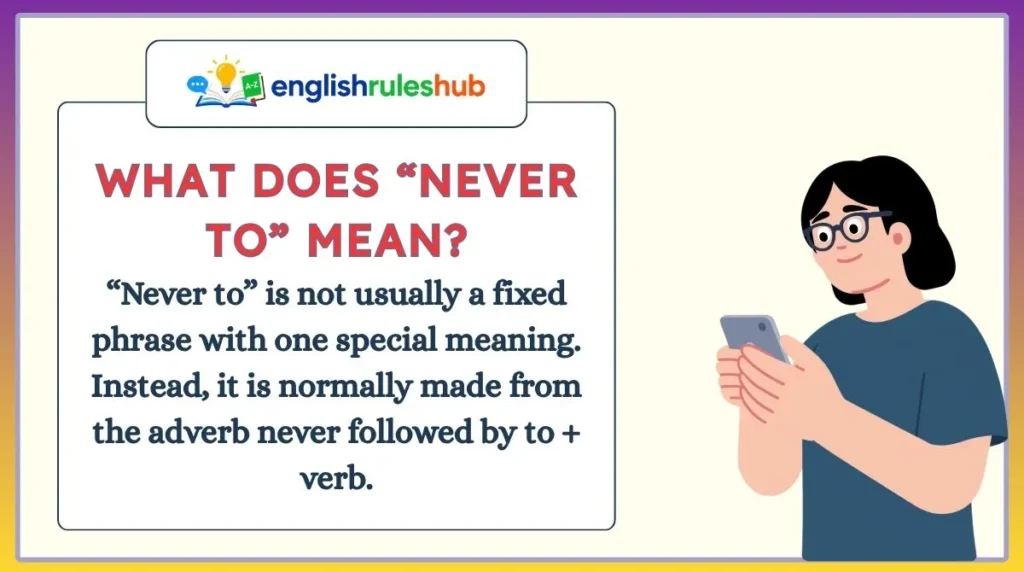
“Never to” is not usually a fixed phrase with one special meaning. Instead, it is normally made from the adverb never followed by to + verb.
The word never means at no time or not ever. The word to can introduce an infinitive verb, such as to go, to speak, to eat, or to return.
So, when you see never to + verb, it usually means that someone does not do something at any time, or that someone decides not to do something again.
For example:
- He promised never to lie again.
- She decided never to drive at night.
- I hope never to make that mistake again.
Here, “never” gives a negative meaning to the action that follows.
When Should You Use “Never To”?
Use never to + base verb when the meaning is connected to an action.
The basic pattern is:
Subject + verb + never + to + base verb
For example:
He promised + never + to + complain.
Another common pattern is:
Subject + never + to + base verb
For example:
I want never to forget your kindness.
However, in everyday English, some structures sound more natural than others. For example, instead of saying:
I decided never to go there again.
You could also say:
I decided that I would never go there again.
Both are correct, but the first version is shorter and very common.
Examples of “Never To”
- He promised never to tell anyone my secret.
This means he promised that he would not tell anyone at any time.
- She decided never to speak to him again.
She made a decision that she would not speak to him again.
- I hope never to see that movie again.
The speaker strongly hopes not to see it again.
- They agreed never to discuss the matter again.
They agreed that the subject would not be discussed again.
- He tried never to lose his temper.
He made an effort not to become angry.
- She told herself never to give up.
She reminded herself that she should not give up.
- I promised never to forget your help.
The speaker promises to remember the help forever.
- He chose never to return to his old job.
He made the choice not to return.
A Common Confusion
Learners sometimes see never to and think that it is the same as never too.
It is not.
Compare these sentences:
He decided never to leave.
Here, to leave is an infinitive verb.
But:
It is never too late to leave.
Here, too means more than is suitable or acceptable, and late describes the time.
The two structures have completely different grammar.
What Does “Too Late” Mean?
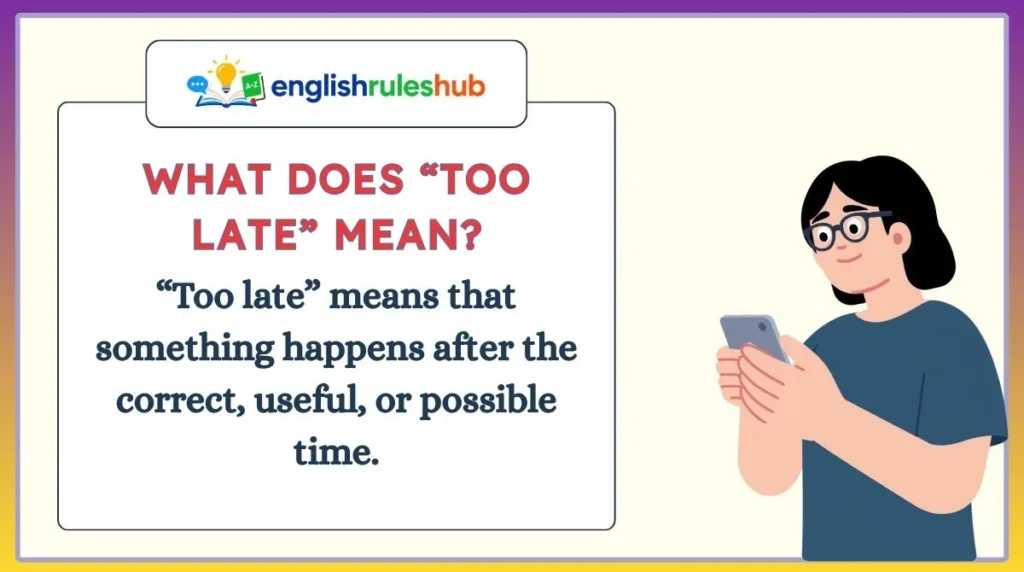
“Too late” means that something happens after the correct, useful, or possible time.
The word too can mean more than necessary or more than is acceptable. The word late means after the expected, planned, or suitable time.
Together, too late means that the time has passed or that something happened later than it should have.
For example:
I arrived too late for the meeting.
This means I arrived after the suitable time and could not properly join the meeting.
Another example is:
It is too late to call him now.
This means the current time is so late that calling him is not appropriate or useful.
When Should You Use “Too Late”?
Use too late when you are talking about time, timing, deadlines, opportunities, or actions that cannot happen because the right moment has passed.
Common patterns include:
too late + to + verb
Example:
It is too late to change the plan.
You can also use:
too late + for + noun
Example:
We are too late for the train.
And:
arrive + too late
Example:
She arrived too late to see the doctor.
Examples of “Too Late”
- I got to the station too late.
The speaker arrived after the useful time.
- It is too late to buy the tickets.
The opportunity to buy them has passed.
- He came too late for dinner.
He arrived after the suitable dinner time.
- She was too late to catch the bus.
The bus had already left or was no longer possible to catch.
- We realized our mistake too late.
We understood the mistake after the useful time to correct it.
- It may be too late to change his mind.
There may no longer be enough time to change his decision.
- You are never too late to learn something new.
There is no point in life when learning something new becomes impossible simply because of age or time.
- I called him, but it was too late.
The call came after the necessary moment.
“Too Late” Does Not Always Mean Very Late
This is an important point for beginners.
Too late does not simply mean very late.
For example:
The bus arrived very late.
This means the bus arrived much later than expected.
But:
The bus arrived too late.
This usually suggests that its late arrival caused a problem.
Perhaps the passengers had already left, the shop had closed, or the person missed an appointment.
So too late often carries the idea of an unwanted result.
Difference Between “Never To” and “Too Late” (Detailed)
The easiest way to understand the difference is to remember that “never to” usually introduces an action, while “too late” describes timing.
| Expression | Main meaning | Grammar | Example |
|---|---|---|---|
| never to | Not at any time doing an action | never + to + base verb | He decided never to return. |
| too late | Later than the suitable or possible time | too + adjective | It is too late. |
| too late to | So late that an action is no longer possible or useful | too + late + to + verb | It is too late to call. |
| never too late | There is always a suitable opportunity | never + too + adjective | It is never too late to learn. |
The Grammar Difference
Look closely at these two sentences:
She promised never to complain.
The word to belongs to the infinitive to complain.
Now look at:
It is never too late to complain.
Here, too late is the main expression. The words to complain come afterward and explain the action that is still possible.
That is why removing or changing too can completely change the sentence.
“Never To” Talks About an Action
Consider:
He decided never to smoke again.
The important action is smoke.
The structure is:
never + to + verb
The sentence means he decided that smoking would not happen again.
“Too Late” Talks About Time
Now consider:
He arrived too late.
There is no infinitive after “too late.” The expression describes his arrival time.
It tells us that he arrived after the useful or expected time.
“Never Too Late” Is a Special and Common Combination
The expression that often causes the confusion is:
never too late
This is correct.
For example:
It is never too late to start learning English.
The meaning is that you can start learning at any age or at any point in your life.
The structure is:
never + too + adjective
Here, late is an adjective, and too modifies it.
Then to start introduces the action that remains possible.
“Never to Late” Is Incorrect
A very common mistake is:
❌ It is never to late to learn.
The correct sentence is:
✅ It is never too late to learn.
Why?
Because too is needed to mean more than expected or beyond the suitable time.
The word to cannot replace too here.
Remember:
- to → often comes before a verb: to learn
- too → means also or more than necessary: too late
- two → the number 2
Grammar Rules You Must Remember
Rule #1: Use “Never To” Before a Base Verb
When never to is followed by a verb, use the base form of that verb.
Examples:
He promised never to lie.
She decided never to return.
Do not change the verb into a past form after to.
❌ He promised never to lied.
✅ He promised never to lie.
The word to is followed by the base form of the verb.
Rule #2: Use “Too Late” When the Timing Causes a Problem
Use too late when something happens after the useful or suitable time.
For example:
We arrived too late to get seats.
The problem is not simply that we arrived late. We arrived so late that getting seats was no longer possible.
Another example:
I submitted my application too late.
The timing caused a problem.
Rule #3: Use “Never Too Late” for Opportunities
Never too late is commonly used when encouraging someone.
Examples:
It is never too late to learn.
It is never too late to say sorry.
It is never too late to start again.
This expression gives a positive message. It means that an opportunity may still be available.
Rule #4: Remember the Difference Between “To” and “Too”
This small spelling difference causes many mistakes.
To is commonly used before a verb:
- to go
- to eat
- to learn
- to study
Too can mean “also” or “more than necessary”:
- I want to come too.
- It is too late.
- The bag is too heavy.
So:
❌ never to late
is wrong when you mean that the time has not passed.
The correct form is:
✅ never too late
Common Mistakes Students Make
Many learners make these mistakes because to and too sound almost the same in normal speech. When people listen rather than read, it can be difficult to notice the spelling difference.
Mistake 1: Writing “Never to Late”
❌ It is never to late to start.
✅ It is never too late to start.
The first sentence uses to, but the meaning requires too.
A simple correction trick is to ask:
Am I talking about time being beyond the right point?
If yes, you probably need too late.
Mistake 2: Thinking “Never To” Means “Never Too Late”
❌ It is never to late to learn English.
This is not a case where never to is being used correctly.
The intended expression is:
✅ It is never too late to learn English.
The words too late work together as an adjective phrase.
Mistake 3: Using “Too” Before Every Verb
Some learners see “too” and think it can replace “to.”
That is not correct.
❌ I want too go home.
✅ I want to go home.
But:
I want to go home too.
Here, too means “also.”
Mistake 4: Confusing “Very Late” and “Too Late”
Compare:
She arrived very late.
This tells us she arrived much later than expected.
She arrived too late to help.
This tells us that her late arrival prevented her from helping.
The second sentence gives us a stronger result.
Mistake 5: Using the Wrong Verb Form After “To”
❌ He decided never to went back.
✅ He decided never to go back.
After infinitive to, use the base verb.
This is one of the most useful grammar rules to remember.
Easy Trick to Remember the Difference
Here is a simple memory trick.
Think: “TO = action”
When you see to + verb, think about an action.
- to eat
- to study
- to leave
- to return
So:
never to leave
means the person will never perform the action of leaving.
Think: “TOO = extra”
The word too often gives the idea of extra or more than needed.
For example:
too hot = more hot than comfortable
too expensive = more expensive than acceptable
too late = later than the suitable time
So when you see:
never too late
think:
There is no time that is “too late.”
That gives you the meaning:
It is always possible to do it.
A Simple Question to Ask Yourself
When you are unsure between to and too, ask:
Does a verb come immediately after it?
If yes, to is often correct.
Example:
to learn
to go
to help
If you are describing something as more than suitable or necessary, too may be correct.
Example:
too late
too expensive
too difficult
This trick will not solve every use of “to” and “too,” but it works very well for this particular confusion.
Daily Life Examples (Very Important)
The best way to remember grammar is to hear it in normal situations. Here are some examples you might actually use in daily conversation.
1. Talking About Learning
Ali: “I’m 40. Is it too late to learn English?”
Sara: “No. It’s never too late to learn.”
The first speaker asks about timing. The second gives encouragement.
2. Talking About an Opportunity
A: “I want to apply for that course, but I’m worried I’m too old.”
B: “Go for it. It’s never too late to learn something new.”
Here, never too late means the opportunity is still worth taking.
3. Making a Promise
A: “Will you tell anyone what happened?”
B: “No. I promise never to tell anyone.”
Here, never to tell describes an action that the speaker promises not to perform.
4. Missing a Bus
A: “Where’s the bus?”
B: “It just left.”
A: “Oh no! I came too late.”
The speaker arrived after the useful time.
5. Missing a Meeting
Manager: “Why weren’t you at the meeting?”
Employee: “I arrived too late. The meeting had already started.”
Again, too late describes the timing.
6. Talking About Regret
A: “I should have apologized earlier.”
B: “You can still say sorry. It’s never too late.”
The second person is encouraging the first person.
7. Making a Personal Decision
A: “Are you going back to that restaurant?”
B: “No. I decided never to eat there again.”
The phrase never to eat describes a decision about future action.
8. Calling Someone at Night
A: “Should I call Ahmed now?”
B: “No, it’s too late to call him.”
Here, the current time is considered unsuitable for the action.
9. Starting Something New
A: “I wish I had learned to play the guitar when I was young.”
B: “Don’t worry. It’s never too late to start.”
This is a very natural use of the expression.
10. Talking About a Mistake
A: “When did you notice the error?”
B: “I noticed it too late to fix it.”
The mistake was discovered after the useful time for correcting it.
Practice Section
Choose the correct option in each sentence.
1. It is ______ late to learn a new skill.
A. never to
B. never too
2. She promised ______ tell anyone about the secret.
A. never to
B. never too
3. We arrived ______ late to get a table.
A. too
B. to
4. He decided ______ go back there.
A. never to
B. never too
5. It is ______ late to apologize.
A. never too
B. never to
Answers
1. B — never too
Correct sentence: It is never too late to learn a new skill.
2. A — never to
Correct sentence: She promised never to tell anyone about the secret.
3. A — too
Correct sentence: We arrived too late to get a table.
4. A — never to
Correct sentence: He decided never to go back there.
5. A — never too
Correct sentence: It is never too late to apologize.
If you got all five right, you understand the main difference very well.
FAQs About “Never To” and “Too Late”
What is the difference between “never to” and “too late”?
Never to usually appears before a base verb and means that an action does not or will not happen at any time. For example, “He promised never to lie.”
Too late describes timing. It means that something happens after the suitable or useful time.
Is “never to late” correct English?
No. “Never to late” is incorrect when you mean that something can still be done.
The correct expression is “never too late.”
For example:
It is never too late to start again.
Here, too is needed because it forms the expression too late.
Is “never too late” a correct expression?
Yes. “Never too late” is completely correct and very common.
It means that an opportunity is still possible, even if someone thinks they have waited for too long.
For example:
It is never too late to learn English.
Can “never to” be used in a question?
Yes, but it usually appears as part of a larger structure.
For example:
Did he promise never to do it again?
Here, never to do is grammatically correct.
However, if you are asking about whether the right time has passed, you would normally use too late, such as:
Is it too late to apply?
Is “too late” formal or informal?
Too late is natural in both spoken and written English.
You can use it in everyday conversation:
Sorry, I’m too late.
You can also use it in more formal writing:
The application was submitted too late to be considered.
So there is no need to avoid it in formal English.
Can I say “never too late to” before a verb?
Yes. This is a very common structure:
never too late to + base verb
Examples include:
It is never too late to learn.
It is never too late to change.
It is never too late to apologize.
Remember that the verb after to should be in its base form.
Does “too late” mean the same as “very late”?
Not always.
Very late simply tells us that something happened much later than expected.
Too late usually means the delay caused a problem or made something impossible or unsuitable.
For example:
He arrived very late.
But:
He arrived too late to catch the train.
The second sentence clearly shows a result.
What does “It is never too late to learn” mean?
It means that a person can begin learning at almost any point in life. The speaker is saying that age or delay does not automatically remove the opportunity.
For example, someone who starts learning English at 50 can still improve greatly.
What comes after “never to”?
Normally, a base verb comes after “to.”
Examples:
- never to lie
- never to forget
- never to return
- never to complain
Do not use a past-tense verb directly after infinitive to.
Final Conclusion
The difference between “never to” and “too late” becomes much easier when you look at their grammar instead of only their spelling.
Never to + verb usually talks about an action that someone does not want or plan to do. For example, “She decided never to return.”
Too late talks about time. It means that something happens after the suitable, useful, or possible moment. For example, “We arrived too late to catch the bus.”
The expression “never too late” is also correct and very common. It means that an opportunity is still possible. “It is never too late to learn English” is a perfect example.
The biggest spelling mistake to avoid is “never to late.” When you mean that something can still be done, write “never too late.”
Keep the simple trick in mind: “to” often goes with an action, while “too late” talks about timing.
Once you start noticing this difference in real conversations and writing, the correct form will feel much more natural.

I am Benjamin Clark, an English language writer passionate about simplifying grammar, vocabulary, and word meanings. I create clear, accurate, and practical content to help learners improve their English skills with confidence every day.