If you work with forms, websites, spreadsheets, databases, or other digital tools, you have probably seen phrases such as auto populate, autopopulate, and auto-populate. They all look almost the same, so it is easy to wonder which one is correct.
The confusion mainly comes from the fact that English does not always use the same spelling for new technology words.
Words that begin with auto- can sometimes be written as one word, while newer or less established combinations may appear with a hyphen. You may also see people write the two parts separately.
This is especially common in workplace English. Someone might say, “The system will auto populate the address,” while another person writes, “The system will autopopulate the address.” Both can be understood, but their spelling and style are not exactly the same.
The good news is that the meaning is simple. The verb refers to something being filled in automatically by a computer, system, form, or software.
By the end of this guide, you will understand the difference between auto populate, autopopulate, and auto-populate, when to use each form, how to use the verb correctly, and which spelling is the best choice when you are writing professional English.
What Does “Auto-Populate” Mean?
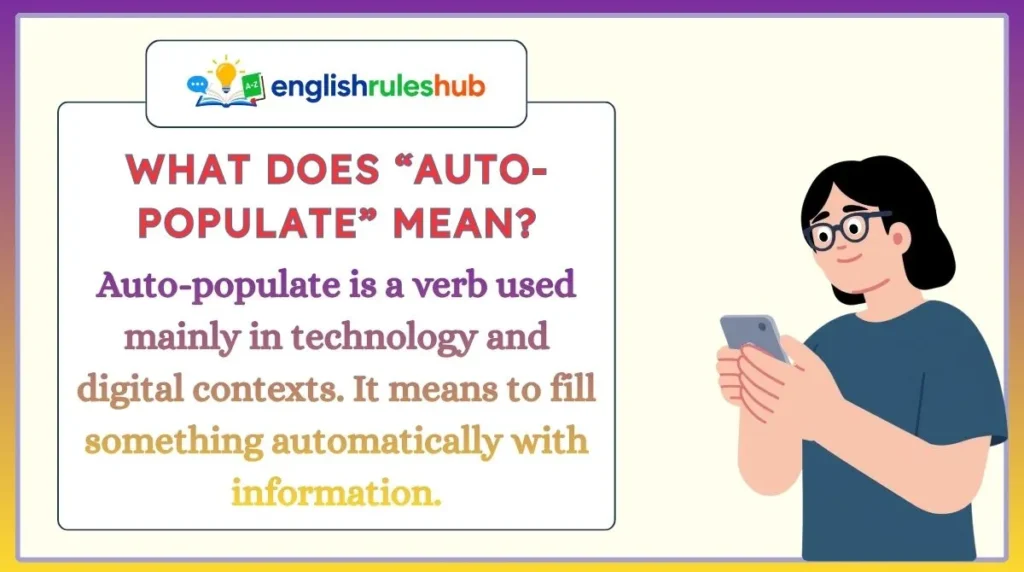
Auto-populate is a verb used mainly in technology and digital contexts. It means to fill something automatically with information.
For example, imagine that you enter your name into an online form. The website then fills your address into another box without asking you to type it again. You can say that the website auto-populates the address field.
The basic idea is:
auto-populate = fill automatically
The word auto- carries the idea of something happening automatically. Populate means to fill something with information or data in this digital use.
So, if a program fills a form field by itself, the field is being auto-populated.
When should you use “auto-populate”?
Use auto-populate when talking about software, websites, forms, databases, spreadsheets, applications, or other systems that automatically enter information.
For example:
- The website will auto-populate your address.
- The form auto-populates your email address.
- The software can auto-populate several fields.
- Your name will auto-populate after you log in.
- The system auto-populated the customer details.
- The application is auto-populating the required fields.
- The spreadsheet can auto-populate the dates.
- The new form will auto-populate information from your account.
Notice that the spelling auto-populate contains a hyphen.
Dictionary.com lists auto-populate as a verb and also gives autopopulate as an alternative spelling. It defines the word in the context of automatically filling a digital document.
Grammar rule for “auto-populate”
Auto-populate is a verb.
Like other verbs, it can change depending on the tense and the subject.
Present simple:
The system auto-populates the form.
After “will”:
The system will auto-populate the form.
After “can”:
The system can auto-populate the form.
Past simple:
The software auto-populated the fields.
Present continuous:
The program is auto-populating the form.
Past participle:
The form was auto-populated.
The important point is that auto-populate behaves like a normal verb.
Common confusion about “auto-populate”
Many learners think the word should always remain exactly the same.
For example, they may write:
The system auto populate the form.
That is incorrect in standard present-tense grammar when the system is the subject.
The correct sentence is:
The system auto-populates the form.
But after a modal verb such as will, can, may, or should, use the base form:
The system will auto-populate the form.
Not:
The system will auto-populates the form.
This is the same rule used with ordinary verbs.
What Does “Autopopulate” Mean?
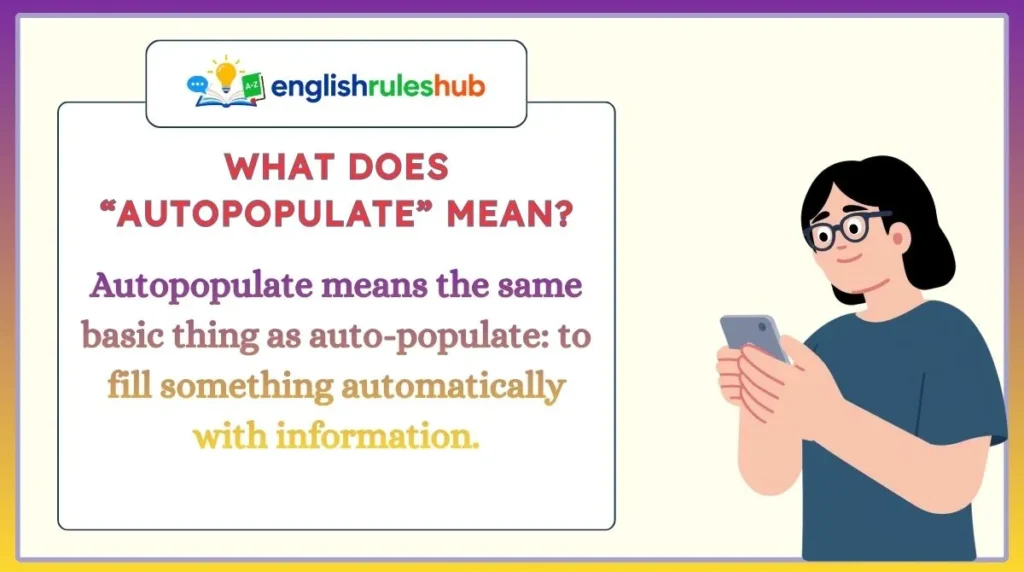
Autopopulate means the same basic thing as auto-populate: to fill something automatically with information.
The difference is mainly spelling, not meaning.
Here, auto- and populate are joined into one word:
autopopulate
This spelling is especially common in technology writing because digital products often create new compound words over time.
For example:
The software will autopopulate the customer’s details.
You can also use the word in different grammatical forms:
- autopopulates
- autopopulated
- autopopulating
- autopopulate
Wiktionary lists autopopulate as a computing verb meaning to populate a database, form, or similar item automatically.
When should you use “autopopulate”?
You can use autopopulate when you want the closed, one-word form.
It works naturally in sentences such as:
- The system will autopopulate your name.
- The form autopopulates your address.
- The software autopopulated the customer information.
- The app is autopopulating the fields.
- The database can autopopulate this section.
- Your contact details will autopopulate automatically.
- The program autopopulates the date.
- This field is autopopulated from your profile.
Grammar rule for “autopopulate”
Just like auto-populate, autopopulate is a verb.
It follows normal verb rules.
I autopopulate the report.
She autopopulates the form.
They autopopulated the fields.
We are autopopulating the database.
The system will autopopulate the information.
The fields were autopopulated.
The spelling changes when normal verb endings are added, but the basic meaning stays the same.
Is “autopopulate” correct English?
Yes. Autopopulate is an established English computing verb, although usage varies between writers, companies, and style systems.
That is an important point. English does not have one universal rule saying that every writer must use one spelling.
Some people prefer:
auto-populate
Others use:
autopopulate
You may also encounter:
auto populate
The first two forms are much easier to defend as a single verb. Dictionary.com specifically lists auto-populate and gives autopopulate as an alternative.
Difference Between “Auto Populate,” “Autopopulate,” and “Auto-Populate”
The biggest thing to understand is that these forms usually express the same idea.
They are not three completely different verbs.
The main difference is how the compound is written.
| Form | Meaning | Grammar | Best use |
|---|---|---|---|
| auto-populate | Fill automatically | Verb | Clear and widely understandable |
| autopopulate | Fill automatically | Verb | Modern one-word technology style |
| auto populate | Fill automatically | Intended as a verb | Common in informal writing, but less polished |
1. Auto-populate
This form uses a hyphen.
The system will auto-populate the form.
The hyphen makes it very clear that auto- belongs with populate to create one verb.
For many readers, this is the clearest form because they can immediately see how the word is built.
2. Autopopulate
This form uses no space and no hyphen.
The system will autopopulate the form.
This is also a valid modern spelling. It treats the word as one established compound.
As technology vocabulary becomes more familiar, compound words often move toward closed forms. This is not unusual in English.
3. Auto populate
This form has a space.
The system will auto populate the form.
You will see this frequently in everyday workplace writing, software instructions, support pages, and online discussions.
However, if you are aiming for careful, polished English, the closed form autopopulate or the hyphenated auto-populate is generally a better choice.
The spaced form can make the phrase look as if auto is an independent word modifying the verb. In this use, however, auto- functions as a prefix.
Which form should you choose?
If you want a simple practical answer, use:
auto-populate
or
autopopulate
Both are understandable and established.
If your workplace, company, software documentation, or style guide has a preferred spelling, follow that style consistently.
For general learner writing, auto-populate is a particularly clear choice because the hyphen shows the relationship between the two parts.
Is “Auto Populate” One Word or Two?
This is one of the most common questions.
When auto-populate is being used as a verb, many careful writers prefer either the hyphenated form auto-populate or the closed form autopopulate.
So instead of:
The system will auto populate the information.
you can write:
The system will auto-populate the information.
or:
The system will autopopulate the information.
The important point is consistency.
Do not switch between forms randomly in the same document.
For example, this looks untidy:
The system will auto-populate the form. Later, it will autopopulate the customer details. The report will auto populate the dates.
Choose one style and use it throughout the document.
Grammar Rules You Must Remember
Rule #1: Treat it as a verb
When auto-populate or autopopulate describes an action performed by a system, it works as a verb.
The website auto-populates the address.
Here, auto-populates is the main verb.
Do not forget the -s when the subject is singular in the present simple.
The system autopopulates the field.
Not:
The system autopopulate the field.
Rule #2: Use the base form after modal verbs
After words such as will, can, may, might, should, and must, use the base form.
Correct:
The form will auto-populate automatically.
Correct:
The software can autopopulate the fields.
Incorrect:
The software can autopopulates the fields.
The same rule applies to ordinary verbs:
She can complete the form.
Not:
She can completes the form.
Rule #3: Use “auto-populated” or “autopopulated” for completed actions
When something has already been filled automatically, use the past participle.
The form was auto-populated with your details.
You can also write:
The form was autopopulated with your details.
Both forms communicate the same idea.
Rule #4: “Auto-populate” already includes the idea of automatic action
Because auto- already suggests automatic action, you do not always need to add automatically.
For example:
The system will auto-populate your address.
This is perfectly clear.
You can say:
The system will automatically populate your address.
This is also correct and can sometimes sound more natural in formal writing.
But:
The system will auto-populate your address automatically.
is somewhat repetitive.
It is not necessarily grammatically wrong, but the sentence repeats the same idea.
Common Mistakes Students Make
Mistake 1: Writing “auto populate” in every situation
You may see:
The software will auto populate the form.
This is understandable, but for polished writing, consider:
The software will auto-populate the form.
or:
The software will autopopulate the form.
The correction is mainly about compound-word spelling.
Mistake 2: Adding “-s” after “will”
Incorrect:
The system will auto-populates the form.
Correct:
The system will auto-populate the form.
Remember the rule:
will + base verb
The same applies to the closed spelling:
The system will autopopulate the form.
Mistake 3: Forgetting “-s” with a singular subject
Incorrect:
The application auto-populate the fields.
Correct:
The application auto-populates the fields.
Why?
Because the application is singular, so the present-simple verb takes -s.
Mistake 4: Confusing “populate” with “auto-populate”
The verb populate can mean to fill something with information in a digital context.
Please populate the table with customer names.
Auto-populate adds the idea that the system does the work automatically.
The system will auto-populate the table with customer names.
So the difference is simple:
populate = fill
auto-populate = fill automatically
Mistake 5: Using “automatically auto-populate” without thinking
For example:
The application will automatically auto-populate the form.
The meaning is understandable, but it can sound repetitive.
A cleaner sentence is:
The application will auto-populate the form.
Or:
The application will automatically populate the form.
Choose one clear expression.
Easy Trick to Remember the Difference
Here is a simple trick.
Think of auto- as meaning:
by itself
And think of populate as meaning:
fill
Put them together:
auto + populate = fill by itself
That is the whole idea.
Imagine an online shopping form.
You type your name:
Ahmed Khan
Then the website already knows your saved address. The address box fills itself.
You can say:
The website auto-populates the address.
Or:
The website autopopulates the address.
The meaning does not change just because the spelling changes.
A second memory trick
Remember these three forms like this:
auto-populate → hyphen
autopopulate → one word
auto populate → two words
If you are unsure while writing something formal, choose auto-populate or autopopulate rather than the spaced form.
Think about the action, not the spelling
Students sometimes spend too much time worrying about the hyphen.
The more important grammar question is:
Who or what is doing the filling?
If a computer or system fills the information automatically, you need the idea of auto-populate.
The software auto-populates the field.
If a person fills it manually, simply use populate or fill in.
The employee fills in the field.
This difference is often more useful than memorising the spelling alone.
Daily Life Examples
These examples show how the word appears in normal workplace and technology conversations.
Example 1
A: Do I need to enter my address again?
B: No. The website will auto-populate it from your profile.
Example 2
A: Why is my name already in the form?
B: The system autopopulates it when you sign in.
Example 3
A: Do I have to type the date?
B: No. The software should auto-populate today’s date.
Example 4
A: The customer number is missing.
B: Try selecting the customer first. The system may autopopulate the number.
Example 5
A: Why did all these fields fill themselves?
B: The application auto-populated them using your account information.
Example 6
A: Can Excel fill these dates for me?
B: Yes, you can set it up so the values autopopulate.
Example 7
A: I entered the employee ID.
B: Good. The employee’s name should auto-populate now.
Example 8
A: The form is asking for my email again.
B: It should autopopulate after you log in.
Example 9
A: What happened to the address field?
B: It was auto-populated from your previous order.
Example 10
A: Do I need to enter all the customer details manually?
B: No. The new system can auto-populate most of them.
These examples show that the expression is especially useful when talking about forms, software, customer records, websites, spreadsheets, databases, and applications.
Practice Section
Choose the best answer for each sentence.
1. The website will ______ your address.
A. auto-populates
B. auto-populate
C. auto-populated
2. The software ______ the customer’s name when I enter the ID.
A. autopopulate
B. autopopulates
C. will autopopulates
3. The form was ______ with my contact details.
A. autopopulated
B. autopopulate
C. autopopulates
4. The application can ______ the required fields.
A. autopopulates
B. autopopulated
C. autopopulate
5. Which spelling is suitable for careful writing?
A. auto populate
B. auto-populate
C. auto populate and never use any other form
Answers
1. B — auto-populate
After will, use the base form.
2. B — autopopulates
The subject the software is singular, so the present-simple verb takes -s.
3. A — autopopulated
The sentence uses the passive structure was + past participle.
4. C — autopopulate
After can, use the base form.
5. B — auto-populate
The hyphenated form is a clear and well-established choice. Autopopulate is also an established alternative.
FAQs
What is the difference between auto-populate and autopopulate?
There is usually no difference in meaning. Both forms describe filling something automatically with information, especially in a digital system.
The main difference is spelling: auto-populate uses a hyphen, while autopopulate is written as one word.
Is “auto populate” correct English?
You may see auto populate in websites, software instructions, workplace messages, and informal writing.
However, if you want a more polished compound verb, auto-populate or autopopulate is a better choice. Dictionary.com lists auto-populate and also gives autopopulate as an alternative.
Is autopopulate one word?
Yes. Autopopulate is used as a one-word verb in computing and technology contexts.
For example:
The system will autopopulate the form.
The related forms include autopopulates, autopopulated, and autopopulating.
Is auto-populate formal or informal?
Auto-populate is common in technology and workplace English. It is not simply slang.
However, in very formal writing, you may sometimes prefer the clearer phrase automatically populate or automatically fill in, depending on your audience.
For example:
The system will automatically fill in your address.
This may be easier for a general audience to understand.
Can I use auto-populate in a question?
Yes.
For example:
Will the system auto-populate my address?
You can also ask:
Can the software auto-populate these fields?
The normal grammar rules still apply. After will or can, use the base form auto-populate.
Which is better: auto-populate or auto populate?
For careful writing, auto-populate is a clear choice.
Autopopulate is also an established form, so it should not automatically be treated as wrong. The main thing is to choose one spelling and use it consistently.
If you are following a company’s style guide or software documentation, use the form that the organisation has chosen.
Auto-Populate vs Automatically Populate
There is another useful comparison that English learners should know.
You can say:
The system will auto-populate the form.
You can also say:
The system will automatically populate the form.
Both sentences have almost the same meaning.
The second version uses the ordinary verb populate and the adverb automatically.
The first version uses the compound verb auto-populate.
For beginners, automatically populate may sometimes be easier to understand because it follows familiar grammar:
automatically + verb
For example:
The software automatically fills in the information.
This is very natural and clear.
But in technical writing, auto-populate is useful because it is shorter and directly describes a common software function.
Auto-Populated as an Adjective
You will often see auto-populated before a noun.
For example:
Check the auto-populated fields before submitting the form.
Here, auto-populated describes the fields.
It tells us that the fields were filled automatically.
Other examples include:
- auto-populated form
- auto-populated data
- auto-populated field
- auto-populated report
- auto-populated information
- auto-populated record
You may also see autopopulated written without the hyphen.
Check the autopopulated fields.
Both styles can appear in technology writing.
This is a useful reminder that compound words can behave differently depending on the style used by a particular organisation or publication.
Why Do People Spell It Differently?
English is full of words whose spelling changes over time.
New technology creates new words very quickly. Writers first need a way to describe a new idea, and different people may spell the new term differently.
A word may begin as two words, then become hyphenated, and later become a closed compound.
This happens because language develops through use.
The auto- prefix is already common in many established words, such as:
- automatic
- automobile
- autobiography
- autofocus
- antivirus
- autopilot
But not every newer auto- compound has exactly the same history or spelling convention.
That is why you may encounter multiple forms of newer technology terms.
The important lesson for English learners is this:
Do not assume that every new compound must follow one simple spelling rule.
Check accepted usage, follow your style guide, and stay consistent.
A Simple Style Guide for Writers
If you are writing a blog, report, instruction page, email, or software guide, this simple approach can help.
For general professional writing
Use:
auto-populate
It is visually clear and easy for readers to understand.
For technology documentation
Use:
autopopulate
if your organisation or product documentation uses the closed form.
For beginner-friendly writing
Consider:
automatically fill in
This is often the easiest phrase for someone who is not familiar with technical vocabulary.
For example:
The website will automatically fill in your address.
A beginner may understand this faster than:
The website will auto-populate your address.
For consistency
Do not change spelling without a reason.
If your document begins with:
The system will auto-populate the fields.
keep using auto-populate throughout the document.
Consistency makes writing look professional.
Final Conclusion
The expressions auto-populate, autopopulate, and auto populate can look confusing, but the basic idea is quite simple.
They are used to describe information being filled automatically by a computer system, website, form, application, or database.
The two strongest forms to remember are auto-populate and autopopulate. They have essentially the same meaning, although their spelling is different.
Dictionary sources recognise auto-populate, while autopopulate is also used as a computing verb.
For grammar, remember the normal verb rules. Say the system auto-populates, but the system will auto-populate. Use auto-populated when describing something that has already been filled automatically.
If you are unsure, choose auto-populate in careful general writing, or follow the spelling used by your organisation or software documentation.
Most importantly, focus on the meaning: auto-populate means fill automatically.
Once you understand that simple idea, using the word becomes much easier.

I am Benjamin Clark, an English language writer passionate about simplifying grammar, vocabulary, and word meanings. I create clear, accurate, and practical content to help learners improve their English skills with confidence every day.