Many English learners feel confused about in mind and on my mind because both expressions talk about thinking. At first, they may look almost the same. However, they do not have the same meaning.
Using the wrong one can make your English sound strange or even change what you want to say.
You may hear someone say, “Keep this in mind,” and another person say, “You have been on my mind all day.”
Both sentences are correct, but they are used in different situations. That is why many students wonder which one they should use.
The good news is that the difference is much easier than it seems. Once you understand the basic idea behind each expression, you will start using them naturally in both speaking and writing.
By the end of this guide, you will clearly understand when to use “in mind” and when to use “on my mind.” You will also learn simple grammar rules, common mistakes, useful examples, and an easy trick to remember the difference forever.
If you have ever stopped while writing or speaking because you were unsure which expression was correct, this guide will help you feel much more confident.
What Does “In Mind” Mean?
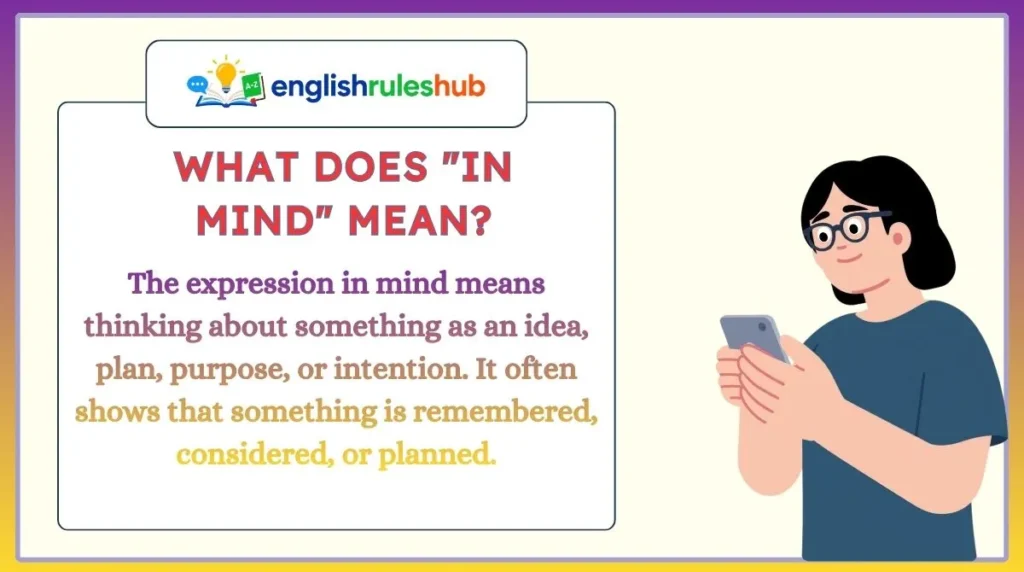
The expression in mind means thinking about something as an idea, plan, purpose, or intention. It often shows that something is remembered, considered, or planned.
When something is in your mind, it is part of your thoughts, plans, or decisions. It does not always mean you are thinking about it right now. Instead, it often means you have it as an idea or purpose.
When Do We Use “In Mind”?
We commonly use in mind when we talk about:
- Remembering something
- Having a plan
- Thinking about a purpose
- Considering someone or something
- Keeping information for future use
It often appears in phrases such as:
- keep in mind
- have something in mind
- bear in mind
- with someone in mind
Grammar Rule
The expression in mind usually comes after verbs like:
- keep
- have
- bear
- remember
- design
- choose
Common sentence patterns include:
- Keep + something + in mind
- Have + something + in mind
- With + someone/something + in mind
Examples of “In Mind”
- Please keep my advice in mind.
- I already have a job in mind.
- She designed the room with children in mind.
- Bear this rule in mind before the test.
- We have a special gift in mind for Grandma.
- I always keep your words in mind.
- Do you have any restaurant in mind?
- The teacher had the beginners in mind while making the lesson.
Common Learner Confusion
Many learners think in mind means thinking about something right now.
That is not always true.
Look at these examples:
✔ I have a movie in mind.
This means you already know which movie you want.
✔ Keep this rule in mind.
This means remember the rule for the future.
Neither sentence tells us that the speaker is actively thinking about the movie or rule at this moment.
Instead, they show an idea, memory, or plan.
Common Expressions with “In Mind”
English speakers use many fixed expressions with in mind.
Keep in Mind
This means remember something.
Examples:
- Keep my phone number in mind.
- Keep the weather in mind before traveling.
- Please keep these safety rules in mind.
Have Something in Mind
This means already have an idea or plan.
Examples:
- I have a dress in mind.
- We have a place in mind for the party.
- She has the perfect answer in mind.
Bear in Mind
This is a little more formal and means remember or consider.
Examples:
- Bear in mind that traffic may be heavy.
- Please bear this fact in mind.
- Bear our budget in mind.
With Someone in Mind
This means something was planned or made for a particular person or purpose.
Examples:
- This game was created with kids in mind.
- The hotel was built with families in mind.
- I bought this gift with you in mind.
Why Native Speakers Use “In Mind”
Native speakers often choose in mind because it sounds natural when talking about:
- ideas
- plans
- choices
- future actions
- remembering important information
Notice these everyday conversations:
A: Do you have any restaurant in mind?
B: Yes, I know a great Italian place.
A: Which color should we paint the room?
B: I already have blue in mind.
Teacher: Keep today’s lesson in mind because it will be on tomorrow’s quiz.
These conversations show that in mind is connected to ideas and plans, not emotions.
What Does “On My Mind” Mean?
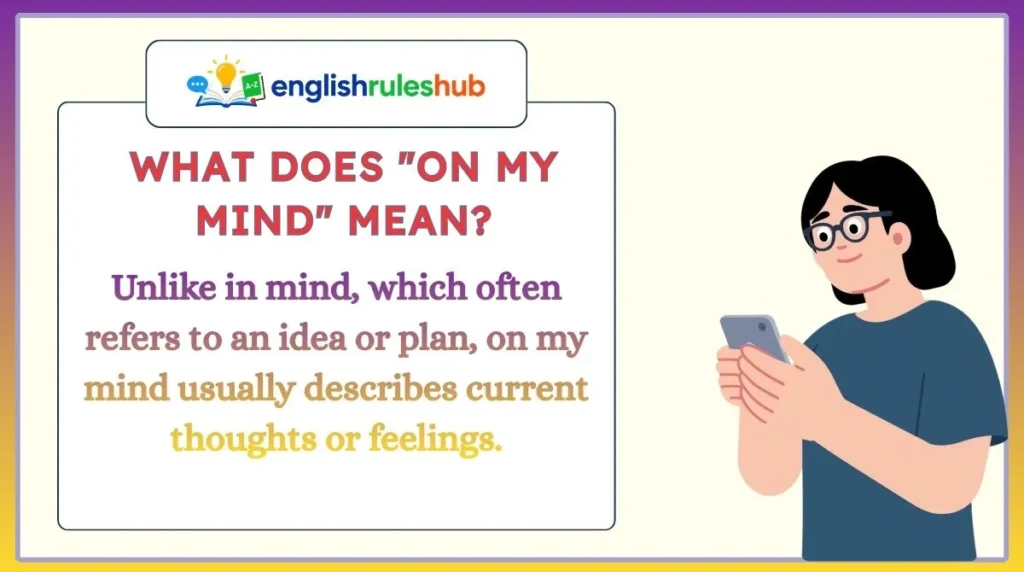
The expression on my mind means something is making you think about it a lot right now. It usually shows that a person is thinking about someone or something again and again.
Unlike in mind, which often refers to an idea or plan, on my mind usually describes current thoughts or feelings.
Sometimes those thoughts are happy.
Sometimes they are stressful.
Sometimes they simply stay in your head all day.
Simple Definition
On my mind = occupying my thoughts right now.
If something is on your mind, you cannot easily stop thinking about it.
When Do We Use “On My Mind”?
We use this expression when talking about:
- worries
- problems
- happy thoughts
- important decisions
- people we miss
- exciting events
It often appears with possessive words:
- on my mind
- on your mind
- on his mind
- on her mind
- on their minds
Grammar Rule
The basic structure is:
Subject + be + on + possessive adjective + mind
Examples:
- It is on my mind.
- She is on my mind.
- The exam is on his mind.
- What’s on your mind?
Examples of “On My Mind”
- You have been on my mind all day.
- The exam is on my mind.
- Money has been on her mind lately.
- My family is always on my mind.
- I cannot sleep because work is on my mind.
- The meeting is still on my mind.
- What’s on your mind today?
- Vacation is already on their minds.
Common Learner Confusion
Many students use on my mind when they actually mean have an idea.
For example:
❌ I have a restaurant on my mind.
This sounds like you cannot stop thinking about that restaurant.
✔ I have a restaurant in mind.
This means you already know which restaurant you want.
That is a big difference.
Everyday Expressions with “On My Mind”
What’s on your mind?
This is one of the most common English questions.
It means:
What are you thinking about?
Examples:
- You look worried. What’s on your mind?
- Tell me what’s on your mind.
- Is something on your mind?
On My Mind All Day
Examples:
- My interview has been on my mind all day.
- You were on my mind this morning.
- My vacation is on my mind already.
Heavy on My Mind
This means something is causing stress or emotional pressure.
Examples:
- Losing my job has been heavy on my mind.
- His health is heavy on her mind.
- The future is heavy on my mind.
Why Native Speakers Use “On My Mind”
Native speakers choose this expression when something is taking up their thoughts.
Notice these conversations.
Friend: You seem quiet today.
You: The exam is on my mind.
Mother: What’s on your mind?
Son: I’m worried about tomorrow’s match.
Friend: You were on my mind yesterday, so I called you.
These examples all show active thinking. The speaker is focused on something at that moment.
“On My Mind” Often Shows Feelings
Although it can describe ordinary thoughts, it is also very common when talking about emotions.
Examples:
- My grandparents are on my mind today.
- The accident has been on everyone’s mind.
- Graduation is on her mind.
- My future is on my mind.
These sentences sound very natural because they describe thoughts that stay with a person.
Difference Between “In Mind” and “On My Mind” (Detailed)
Now that you know the meaning of both expressions, it is time to compare them side by side. This is the easiest way to understand when each one should be used.
Although both expressions are related to thinking, they describe different kinds of thoughts.
- In mind usually refers to an idea, plan, purpose, or memory.
- On my mind refers to something you are actively thinking about, often because it is important, exciting, or worrying.
Once you remember this simple difference, choosing the correct expression becomes much easier.
Comparison Table
| In Mind | On My Mind |
|---|---|
| Means having an idea or plan | Means thinking about something right now |
| Often used for plans and intentions | Often used for thoughts and feelings |
| Shows consideration or purpose | Shows active mental attention |
| Common with keep, have, and bear | Common with be |
| Often about the future | Usually about the present |
| Does not always show emotion | Often shows emotion or concern |
Meaning Difference
The biggest difference is how the thought exists in your head.
If something is in your mind, it is stored as an idea or plan.
If something is on your mind, it is occupying your thoughts right now.
Compare these examples:
I have a vacation in mind.
This means you already know the vacation you want.
My vacation is on my mind.
This means you keep thinking about your upcoming vacation.
Both sentences are correct, but they express different ideas.
Grammar Difference
The grammar is also different.
“In Mind”
It usually follows verbs such as:
- have
- keep
- bear
- remember
Examples:
- I have a question in mind.
- Keep these rules in mind.
- Bear our budget in mind.
“On My Mind”
It usually follows the verb be.
Examples:
- The exam is on my mind.
- She has been on my mind.
- What’s on your mind?
Notice that we do not normally say:
❌ Keep this on mind.
Instead, we say:
✔ Keep this in mind.
Sentence Structure Difference
Structure with “In Mind”
Subject + have/keep/bear + object + in mind
Examples:
- I have a plan in mind.
- Keep this fact in mind.
- Bear my advice in mind.
Structure with “On My Mind”
Subject + be + on + possessive adjective + mind
Examples:
- It is on my mind.
- The meeting is on her mind.
- You have been on my mind.
Usage Difference
Imagine you are planning your birthday.
You already know which restaurant you want.
You say:
✔ I have a restaurant in mind.
Now imagine tomorrow is your birthday, and you cannot stop thinking about it.
You say:
✔ My birthday is on my mind.
The first sentence is about having a plan.
The second sentence is about thinking about something repeatedly.
More Comparison Examples
Example 1
✔ I have a gift in mind.
Meaning: I know which gift I want to buy.
✔ My friend’s birthday is on my mind.
Meaning: I keep thinking about my friend’s birthday.
Example 2
✔ Keep my advice in mind.
Meaning: Remember my advice.
✔ Your advice has been on my mind.
Meaning: I have been thinking about your advice.
Example 3
✔ We had children in mind when designing the park.
Meaning: The park was designed for children.
✔ My children are always on my mind.
Meaning: I think about my children often.
Quick Summary
Think of these expressions like this:
In mind = idea
On my mind = active thought
That simple rule works in most situations.
Grammar Rules You Must Remember
Learning a few grammar rules will help you avoid mistakes and sound more natural.
Rule #1: Use “Keep in Mind” to Mean “Remember”
This is one of the most common English expressions.
Correct:
- Keep this rule in mind.
- Keep our meeting in mind.
- Keep safety in mind.
Wrong:
- ❌ Keep this rule on mind.
Rule #2: Use “Have Something in Mind” for Ideas or Plans
When you already know what you want, use have…in mind.
Correct:
- I have a hotel in mind.
- She has a new project in mind.
- We have something special in mind.
Wrong:
- ❌ I have a hotel on my mind.
Rule #3: Use “On My Mind” After the Verb “Be”
This expression normally follows forms of be.
Correct:
- The exam is on my mind.
- You were on my mind.
- What’s on your mind?
Wrong:
- ❌ I keep you on my mind. (In most situations.)
Instead say:
- You have been on my mind.
Rule #4: Remember That “On My Mind” Often Shows Feelings
Many times, this expression suggests emotions such as worry, excitement, love, or concern.
Examples:
- My parents are on my mind.
- Money is on his mind.
- The future is on everyone’s mind.
It is not limited to negative feelings. It can also describe happy thoughts.
Example:
- Our vacation is on my mind already.
Common Mistakes Students Make
Even advanced learners sometimes confuse these two expressions because both involve thinking.
Here are the most common mistakes.
Mistake #1: Using “On Mind”
Wrong:
❌ This is on mind.
Correct:
✔ This is on my mind.
✔ This is on his mind.
✔ This is on her mind.
Always use a possessive adjective before mind.
Mistake #2: Saying “Keep on Mind”
Wrong:
❌ Keep this on mind.
Correct:
✔ Keep this in mind.
This is a fixed English expression.
Mistake #3: Using “On My Mind” for Plans
Wrong:
❌ I have a movie on my mind.
If you simply mean you already chose a movie, say:
✔ I have a movie in mind.
However, if you truly cannot stop thinking about the movie, then on my mind is correct.
Context matters.
Mistake #4: Thinking Both Expressions Mean Exactly the Same
Compare these:
✔ I have a job in mind.
Meaning: I already know which job I want.
✔ A new job is on my mind.
Meaning: I keep thinking about getting a new job.
The meanings are related but different.
Mistake #5: Translating Directly from Your First Language
Many languages use one expression for every kind of thought.
English does not.
That is why learning the fixed phrases is much more helpful than translating word by word.
Easy Correction Tips
Whenever you are unsure, ask yourself these questions.
Am I talking about an idea or plan?
Use in mind.
Am I talking about something I keep thinking about?
Use on my mind.
This simple habit will help you choose the correct expression almost every time.
Easy Trick to Remember the Difference
Here is a simple memory trick that many students find helpful.
Think About a Notebook
Imagine your brain is a notebook.
In mind is like writing an idea inside the notebook.
The idea is stored there for later.
Examples:
- a vacation plan
- a birthday gift
- a restaurant
- a future goal
These are ideas waiting inside your notebook.
Now imagine one page is lying open on top of the notebook.
That page is on your mind.
It is the page you keep looking at.
Maybe it contains:
- tomorrow’s exam
- your best friend
- an important meeting
- a family problem
Those thoughts stay at the top of your attention.
One Easy Sentence to Remember
In mind = inside your plans.
On my mind = on top of your thoughts.
If you remember only this sentence, you will understand the difference most of the time.
Daily Life Examples (Very Important)
The best way to learn these expressions is by seeing how native speakers use them in everyday conversations. Read each example carefully and notice why in mind or on my mind is the correct choice.
Conversation 1
Sarah: Where should we eat tonight?
Ali: I already have an Italian restaurant in mind.
Why? Ali already has a plan.
Conversation 2
Mother: You look worried. What’s on your mind?
Son: I’m thinking about tomorrow’s math test.
Why? The test is occupying his thoughts right now.
Conversation 3
Teacher: Keep these grammar rules in mind during the exam.
Students: We will.
Why? The teacher is asking the students to remember the rules.
Conversation 4
Emma: You have been on my mind lately.
Lisa: That’s so kind of you to say.
Why? Emma has been thinking about Lisa.
Conversation 5
Manager: Do you have anyone in mind for this job?
Employee: Yes, I know the perfect person.
Why? The manager is asking if the employee already has an idea.
Conversation 6
Dad: Is something on your mind?
Daughter: I’m nervous about my first speech.
Why? She cannot stop thinking about the speech.
Conversation 7
Travel Agent: Do you have a destination in mind?
Customer: I’d like to visit Japan.
Why? The customer already has a travel plan.
Conversation 8
Friend: You seem quiet today.
You: Work has been on my mind all week.
Why? Work is taking up your thoughts.
Conversation 9
Coach: Keep teamwork in mind during the match.
Players: We will do our best.
Why? The coach wants them to remember an important idea.
Conversation 10
Grandmother: My grandchildren are always on my mind.
Why? She often thinks about them with love and care.
Practice Section
Choose the correct expression: in mind or on my mind.
1.
I already have a birthday gift ________.
a) in mind
b) on my mind
2.
The final exam has been ________ all week.
a) in mind
b) on my mind
3.
Please keep these safety rules ________.
a) in mind
b) on my mind
4.
Do you have a hotel ________ for our vacation?
a) in mind
b) on my mind
5.
You seem upset. What’s ________?
a) in mind
b) on your mind
Answers
- ✅ in mind
- ✅ on my mind
- ✅ in mind
- ✅ in mind
- ✅ on your mind
If you answered all five correctly, you have understood the main difference very well. If you missed one or two, don’t worry. Read the comparison section again and practice using both expressions in your own sentences.
FAQs
1. What is the difference between in mind and on my mind?
In mind is used for ideas, plans, or something you want to remember. On my mind means something is occupying your thoughts right now, often because it is important, exciting, or worrying.
2. Can I say “keep on mind”?
No. Keep on mind is not correct English.
The correct expression is keep in mind, which means remember or don’t forget.
Example:
- Keep my advice in mind.
3. Can on my mind be used in questions?
Yes. It is very common in questions.
Examples:
- What’s on your mind?
- Is something on your mind?
- Has work been on your mind lately?
These questions ask what someone is thinking about.
4. Is in mind formal or informal?
In mind is suitable for both formal and informal English.
You can use it in everyday conversations, emails, business meetings, classrooms, and writing.
Examples:
- Keep this in mind.
- We designed the program with students in mind.
5. Can on my mind express happy thoughts?
Yes. Although it often describes worries or concerns, it can also express pleasant thoughts.
Examples:
- Our vacation is on my mind.
- Your wedding has been on my mind all week.
- My grandchildren are always on my mind.
The expression simply means you are thinking about something a lot.
6. How can I remember the difference easily?
Think of this simple rule:
- In mind = an idea or plan.
- On my mind = something I keep thinking about.
If you remember this, you will choose the correct expression in most everyday situations.
Final Conclusion
The expressions in mind and on my mind may look similar, but they are used in different ways. In mind is usually connected with ideas, plans, intentions, or things you should remember.
It helps you talk about choices, future actions, and purposes. On my mind, on the other hand, describes thoughts that are filling your attention right now. These thoughts may be happy, exciting, stressful, or emotional.
A simple way to remember the difference is this: if you already have an idea or plan, use in mind.
If you cannot stop thinking about something, use on my mind. This small rule will help you speak and write more naturally.
Don’t worry if you mix them up at first. Even experienced learners need practice with common English expressions.
Read real examples, listen to native speakers, and try using both phrases in your own conversations.
With regular practice, choosing the correct expression will soon become easy and natural. Happy learning!

I am Benjamin Clark, an English language writer passionate about simplifying grammar, vocabulary, and word meanings. I create clear, accurate, and practical content to help learners improve their English skills with confidence every day.