
Last updated on September 25th, 2026 at 07:00 am
English learners often see pre and post in words, phrases, signs, emails, school lessons, and everyday conversations.
The problem is that both are small words, but they can change the meaning of a whole phrase. If you do not understand them, words such as prepaid, pre-school, postwar, and postgraduate can look confusing.
The good news is that the basic idea is quite simple. Pre usually means before, while post usually means after. Once you learn this basic meaning, many unfamiliar words become easier to understand.
For example, a pre-test happens before a test or main activity. A post-test happens after it. A pre-game meal is eaten before a game, while a post-game meal is eaten after the game.
You may also see these forms in more formal English. A prepaid service is paid for before you use it. A postgraduate student is studying after completing an earlier stage of higher education.
There is one important point, though: pre and post are not always used as separate words. They are often used as prefixes attached to another word.
This guide will show you how they work, when to use them, and how to avoid common mistakes.
By the end, you should be able to understand these useful prefixes without trying to memorize every word separately.
What Does “Pre” Mean?
Pre is a prefix that generally means before, earlier than, or in preparation for something that will happen later.
A prefix is a group of letters added to the beginning of a word to change or add to its meaning. When you see pre- at the beginning of a word, you can often think about something happening before the main event.
For example:
- pre-school = education before regular school
- pre-test = a test given before another test or activity
- prepaid = paid before something is used
- pre-game = happening before a game
- pre-order = ordering something before it is available
- preheat = heat something before cooking
- preview = a view shown before the full thing
- prearranged = arranged before the event
The exact meaning depends on the word that follows pre-, but the idea of “before” usually remains.
How “Pre” Is Used
In modern English, pre- is commonly attached to nouns, adjectives, and verbs.
For example, prepay is a verb. It means to pay before something is provided or used.
Prepaid is an adjective. It describes something that has already been paid for.
The prefix itself does not work like an ordinary verb or noun. You normally do not put pre anywhere you want in a sentence. Instead, it is usually connected to another word.
Examples With “Pre”
- Please preheat the oven before you bake the cake.
- I placed a pre-order for the new book.
- The teacher gave us a pre-test on Monday.
- You need to prepay for the service.
- We watched a short preview of the movie.
- She attended a pre-game meeting with her team.
- The school offers pre-school classes for young children.
- The two families had a prearranged meeting.
Notice that every example has a connection with something that happens before another event, action, or stage.
A Common Learner Confusion With “Pre”
One common mistake is thinking that pre can always be used as an independent word meaning “before.”
For example, a learner might write:
I arrived pre the meeting.
That is not standard English.
Instead, say:
I arrived before the meeting.
The prefix pre- is normally part of a larger word, such as pre-meeting, prearranged, or prepaid.
There are some contexts where pre may appear as a shortened informal form, especially in names or specialized language, but beginners should not treat it as a normal replacement for before.
The safest rule is simple: use “before” in an ordinary sentence, and use “pre-” when it forms a recognized word.
What Does “Post” Mean?
Post can have several meanings in English, but when it is used as a prefix, post- generally means after, later, or following a particular event or stage.
This meaning is the opposite of the common meaning of pre-.
For example:
- post-game = after a game
- post-test = a test given after something
- postwar = relating to the period after a war
- postgraduate = relating to study after graduation
- postnatal = relating to the period after childbirth
- postproduction = work done after filming or recording
- post-election = happening after an election
- post-match = happening after a match
Again, the exact meaning depends on the word, but the central idea is after.
How “Post” Is Used
Like pre-, post- is usually a prefix. It is attached to another word to create a new word.
For example, postgraduate combines post- with graduate. It describes study that comes after an earlier level of education.
Similarly, post-game interview refers to an interview that takes place after a game.
In some expressions, post can also appear as a separate word, but that does not mean the same thing as the prefix post-.
For example:
I will post the letter tomorrow.
Here, post is a verb related to sending something through the mail.
In:
The player gave a post-match interview.
post- is a prefix meaning after.
This difference is important because English learners sometimes see the word post and assume it always has the same meaning.
Examples With “Post”
- The players attended a post-game meeting.
- She is doing a postgraduate course.
- The doctor explained the postnatal care plan.
- We had a post-match discussion.
- The company released a post-election report.
- The film needs several weeks of postproduction work.
- The students completed a post-test after the lesson.
- He wrote a postwar history of the country.
In each example, post- connects the word to something that happened after another event or stage.
A Common Learner Confusion With “Post”
The biggest problem is confusing the prefix post- with the ordinary word post.
Compare these:
She posted a photo online.
Here, posted means she put or published a photo online.
Now compare:
She wrote a post-game report.
Here, post- means after the game.
So, always look at the sentence. The same spelling can have a completely different job.
Pre- and Post- in Academic and Professional English
The prefixes pre- and post- are especially useful in academic, medical, business, and workplace English. They help describe different stages of a process without using a longer phrase.
For example, universities commonly use words such as pre-registration, preliminary, and postgraduate. These words help identify what happens before or after a particular stage of education.
In business, you may see expressions such as pre-launch planning and post-launch review. The first refers to preparation before a product or service is launched, while the second refers to work done after the launch.
Medical English also uses these prefixes frequently:
The patient received preoperative instructions.
The doctor discussed postoperative care.
In these examples, pre- identifies something connected with the stage before an operation, while post- identifies something connected with the stage after it.
Learning these prefixes can therefore help you understand longer professional words without memorizing every word as completely separate vocabulary.
Difference Between Pre and Post (Detailed)
The easiest way to remember the difference is:
Pre = before
Post = after
They often describe the time or order of an activity.
| Point | Pre- | Post- |
|---|---|---|
| Basic meaning | Before | After |
| Main idea | Earlier than something | Later than something |
| Common use | Preparation or earlier stage | Follow-up or later stage |
| Example | pre-game | post-game |
| Meaning of example | Before the game | After the game |
| Another example | pre-test | post-test |
| Time relationship | Earlier | Later |
Usage Difference
Suppose your school gives you two tests.
The first test checks what you know before a lesson.
You can call it a pre-test.
The second test checks what you learned after the lesson.
You can call it a post-test.
So:
Pre-test → lesson → post-test
This simple timeline is one of the best ways to understand the two prefixes.
Another example is a sports event:
Pre-game activities → game → post-game activities
The word pre-game tells you that something happens before the game.
The word post-game tells you that it happens after the game.
Grammar Logic
Pre- and post- are normally prefixes, not ordinary standalone grammar words.
This means they are used to build or modify words.
For example:
pre + paid = prepaid
post + graduate = postgraduate
pre + view = preview
post + war = postwar
They help tell us where something is in a sequence of events.
This is why they are useful in academic English, business English, medical English, sports English, and everyday vocabulary.
Sentence Structure Difference
The structure depends on the word created with the prefix.
For example:
We had a pre-game meeting.
Here, pre-game describes the meeting.
After the game:
We had a post-game meeting.
Here, post-game also describes the meeting, but it tells us when the meeting happened.
Another pair:
The students took a pre-test.
The students took a post-test.
The basic sentence structure stays almost the same. The prefix changes the time relationship.
Meaning Comparison
Consider this pair:
prepaid phone
This means the payment was made before the service was used.
Now consider:
post-event survey
This is a survey completed after an event.
The two prefixes therefore help you understand a sequence:
pre → event → post
Think of the event as the center point.
Everything before it is pre-.
Everything after it is post-.
Pre- and Post- Can Describe Stages, Not Just Events
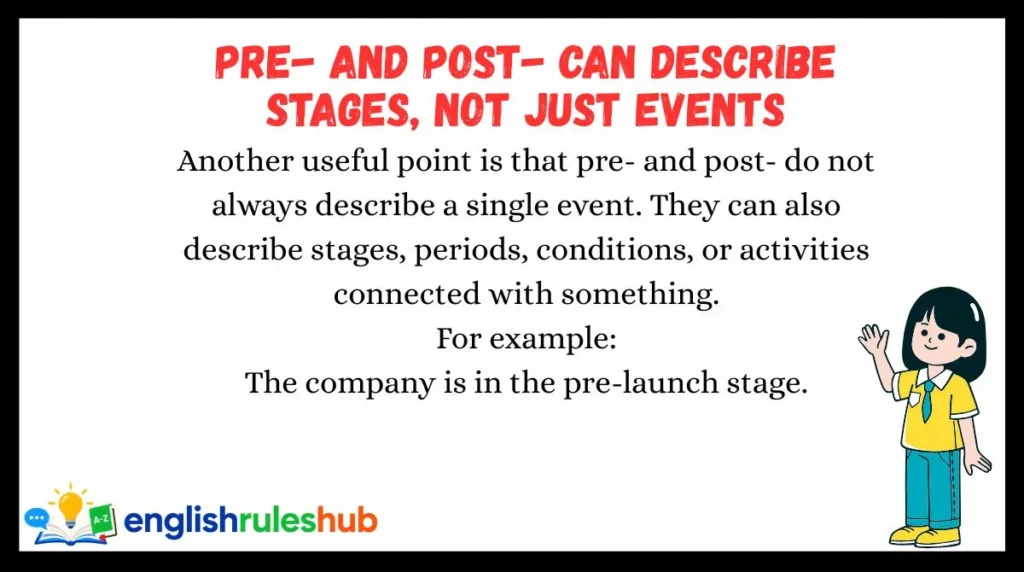
Another useful point is that pre- and post- do not always describe a single event. They can also describe stages, periods, conditions, or activities connected with something.
For example:
The company is in the pre-launch stage.
Here, pre-launch describes a period before the actual launch.
Now compare:
The company conducted a post-launch review.
This refers to a review carried out after the launch.
The same idea appears in other areas:
pre-production planning
post-production editing
pre-match training
post-match analysis
These expressions show that the prefixes can describe what belongs to an earlier or later stage of a larger process.
A useful way to think about them is:
pre- = the stage leading up to something
post- = the stage following something
This is slightly broader than simply thinking “before” and “after,” and it can make unfamiliar words much easier to understand.
Grammar Rules You Must Remember
Rule #1: Pre- Usually Means “Before”
When you see pre- at the beginning of a word, look for a meaning connected with something happening earlier.
Example:
We need to preheat the oven.
You heat the oven before you put the food inside.
Another example:
I bought a prepaid card.
The card was paid for before it was used.
Rule #2: Post- Usually Means “After”
When post- is used as a prefix, it normally points to something that happens later.
Example:
The team held a post-match meeting.
The meeting happened after the match.
Another example:
She is taking a postgraduate course.
The course comes after an earlier stage of university education.
Rule #3: Do Not Treat Pre- and Post- as Normal Substitutes for Before and After
You cannot simply replace before with pre- in every sentence.
Incorrect:
I called him pre dinner.
Better:
I called him before dinner.
You can use a recognized compound such as:
We had a pre-dinner meeting.
The same idea applies to post-.
Instead of:
I went post dinner.
say:
I went after dinner.
But you can say:
We had a post-dinner discussion.
The difference is whether the prefix is forming a proper word or compound expression.
Rule #4: Learn the Whole Word, Not Only the Prefix
Knowing that pre- means “before” does not mean you automatically know every word beginning with pre-.
For example, prejudice should not simply be understood by guessing that it means “before judgment.” Its modern meaning is more specific.
The same is true of post. Not every word beginning with the letters post is a simple example of the prefix meaning “after.”
So use the prefix as a helpful clue, not as a perfect dictionary.
Common Mistakes Students Make
Learners often make mistakes with these prefixes because they understand the basic meaning but use the forms in the wrong place.
Mistake 1: Using “Pre” Instead of “Before”
Incorrect:
I finished my work pre lunch.
Correct:
I finished my work before lunch.
Or, in a suitable compound:
I finished my pre-lunch work.
The first sentence uses pre as though it were a normal preposition. That is not the usual pattern.
Mistake 2: Using “Post” Instead of “After”
Incorrect:
We went home post the meeting.
Correct:
We went home after the meeting.
You could use a compound such as:
We had a post-meeting discussion.
But post does not normally replace after in ordinary sentences.
Mistake 3: Confusing “Post” With “Post-”
Compare:
I posted the letter.
and:
We had a post-meeting call.
The first post is a verb.
The second post- is a prefix meaning after.
Mistake 4: Assuming Every Pre- Word Means “Before”
As mentioned earlier, prefixes can have special meanings in individual words.
For example, simply seeing pre- does not give you permission to guess the complete definition without checking the context.
The same applies to post-.
Easy Correction Tip
When you see pre-, ask:
“Does this relate to something before?”
When you see post-, ask:
“Does this relate to something after?”
If the answer makes sense, you probably understand the basic meaning.
Easy Trick to Remember the Difference
Here is a very easy classroom trick:
PRE = PRIOR
Both ideas point to something that comes before.
You can also remember:
POST = AFTER
Think of a letter or message that is posted after it has been prepared. This is not the actual grammatical meaning of the prefix, but it can help some learners remember the word.
An even better trick is to picture a timeline:
PRE → EVENT → POST
Imagine a football match.
Before the match:
pre-match
During the match:
match
After the match:
post-match
Now imagine a school lesson.
Before the lesson:
pre-test
During or around the lesson:
lesson
After the lesson:
post-test
This timeline makes the difference much easier than trying to memorize a long definition.
When you are reading, stop for one second and ask, “Is this before or after?”
That tiny question can help you understand many unfamiliar words.
Daily Life Examples (Very Important)
Here are some natural examples you may hear or use in real life.
1. At a Restaurant
The chef needs to preheat the oven before cooking.
The oven is heated before the food goes inside.
2. At School
Our teacher gave us a pre-test before starting the new unit.
The test comes before the main lesson or unit.
3. After School
We had a post-class discussion about the homework.
The discussion happened after class.
4. Shopping Online
I placed a pre-order for the new phone.
The order was made before the product was officially available.
5. At a Sports Event
There was a pre-match interview with the captain.
The interview happened before the match.
6. After the Match
The coach gave a post-match interview.
The interview happened after the match.
7. Using a Phone
I bought a prepaid SIM card.
The payment is made before the service is used.
8. University
My brother is doing a postgraduate degree.
His studies come after an earlier stage of higher education.
9. Watching a Movie
I watched the preview before deciding to see the movie.
A preview gives you information before the full movie.
10. At Work
The manager sent a post-meeting email to everyone.
The email came after the meeting.
These examples show why the prefixes are useful. They let us describe the order of events in a short and clear way.
Practice Section
Choose the correct option in each sentence.
1. We need to ___ the oven before baking the bread.
(preheat / postheat)
2. The players attended a ___-match meeting after the game.
(pre / post)
3. I placed a ___-order for the new laptop.
(pre / post)
4. The university offers several ___graduate programs.
(pre / post)
5. The teacher gave the students a ___-test after the lesson.
(pre / post)
Answers
1. preheat — The oven is heated before cooking.
2. post — The meeting happened after the match.
3. pre — The order was made before the product became available.
4. post — Postgraduate study comes after an earlier stage of education.
5. post — The test happened after the lesson.
If you got all five right, you have understood the main idea very well.
FAQs
What is the difference between pre and post?
As prefixes, pre- generally means before, while post- generally means after.
For example, a pre-game meeting happens before a game, while a post-game meeting happens after it.
The easiest pattern to remember is pre → event → post.
Can I use pre instead of before in a sentence?
Usually, no. Pre- is mainly a prefix used to form words such as prepaid, preheat, and pre-game.
In an ordinary sentence, use before when you need the normal preposition.
Say, “I arrived before lunch,” rather than “I arrived pre lunch.”
Can I use post instead of after?
Usually, no. Post- normally works as a prefix in words and compounds.
For example, you can say post-match interview, but in an ordinary sentence you would normally say, “The interview happened after the match.”
Is pre- formal or informal?
The prefix pre- is common in both everyday and formal English.
You can hear words such as prepaid and preheat in daily life, while academic and professional English also uses words such as preliminary and preexisting.
Is post- formal or informal?
Post- is also used in both everyday and formal English.
Words such as post-game and post-match are common, while words such as postgraduate, postwar, and postoperative are more common in academic or professional contexts.
Are pre and post opposites?
In many cases, yes. When they are used as prefixes to show time or sequence, pre- means before and post- means after.
For example:
pre-test → lesson → post-test
However, remember that not every word beginning with pre or post can be understood simply by treating the letters as opposites.
Final Conclusion
Understanding pre- and post- becomes much easier when you stop thinking of them as difficult vocabulary and start thinking about time and order.
Pre- usually points to something that happens before another event. You can see this in words such as prepaid, preheat, pre-order, and pre-game.
Post- usually points to something that happens after an event. Examples include post-game, post-match, postgraduate, and postwar.
There is one important grammar point to keep in mind: these are usually prefixes, so you cannot simply use pre and post as replacements for the ordinary words before and after.
Whenever you meet a new word, use the simple question: “Does this happen before or after?” That will often give you a useful clue.
Keep noticing these prefixes in books, conversations, schoolwork, and online English. The more you see them in real sentences, the more natural they will feel.

I am Benjamin Clark, an English language writer passionate about simplifying grammar, vocabulary, and word meanings. I create clear, accurate, and practical content to help learners improve their English skills with confidence every day.

4 thoughts on ““Pre vs Post” What Is the Difference? Easy English Guide for 2026”