Many English learners get confused when they hear people say “dream of” and “dream about.” At first, they seem exactly the same. Both phrases talk about dreams, and both are very common in English.
The confusion becomes even bigger because native speakers sometimes use both expressions in similar situations.
You may hear someone say, “I dreamed about my school,” while another person says, “I dreamed of my school.” This makes learners wonder if there is any real difference.
The good news is that the difference is not difficult once you understand the basic idea.
Knowing when to use these expressions can make your English sound more natural and accurate. It also helps you understand movies, books, conversations, and everyday speech more easily.
Dream of often connects to wishes, hopes, and goals. Dream about is usually used when talking about the content of a sleeping dream. However, there are situations where both can be used.
By the end of this guide, you will clearly understand the meanings, grammar rules, sentence patterns, common mistakes, and easy memory tricks related to these two expressions. You will also see many real-life examples that show how native speakers use them in everyday English.
What Does “Dream of” Mean?
Simple Definition
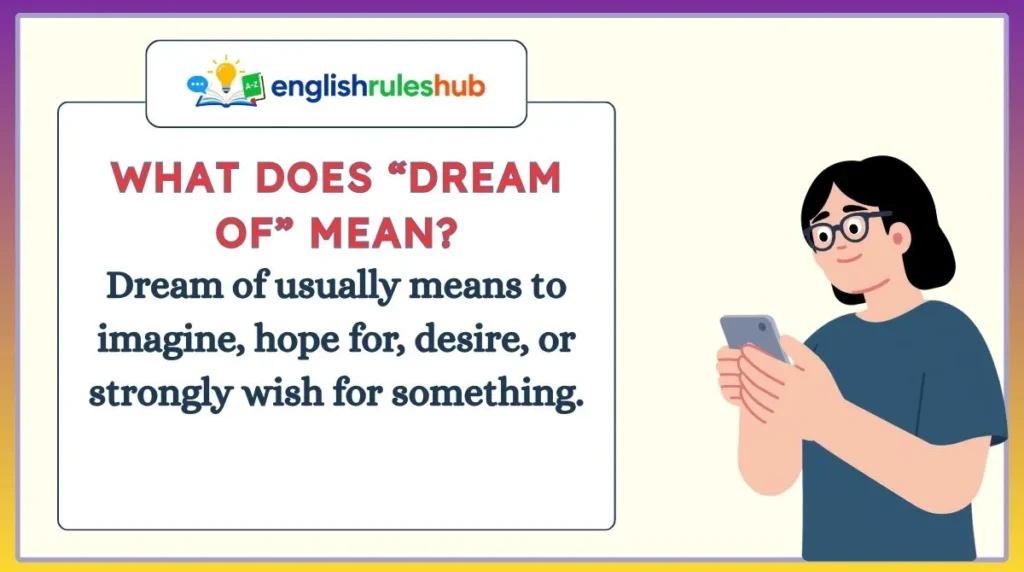
Dream of usually means to imagine, hope for, desire, or strongly wish for something.
It often talks about goals, ambitions, plans, and things people want in the future.
When to Use It
Use dream of when you are talking about:
- Future goals
- Wishes
- Ambitions
- Strong desires
- Imagined possibilities
It can also sometimes refer to sleeping dreams, but it is especially common when talking about hopes and aspirations.
Grammar Rule
Basic structure:
Subject + dream of + noun/pronoun
Examples:
- I dream of success.
- She dreams of becoming a doctor.
- They dream of a better future.
You can also use:
Subject + dream of + verb (-ing form)
Examples:
- I dream of traveling the world.
- He dreams of owning a large house.
Examples of “Dream of”
- I dream of becoming a pilot.
- She dreams of living near the beach.
- They dream of starting their own business.
- My brother dreams of playing professional football.
- We dream of a peaceful life.
- He dreams of helping people around the world.
- Sarah dreams of studying abroad.
- Many children dream of becoming famous singers.
Common Learner Confusion
Many students think dream of is only used for sleeping dreams. That is not true.
Look at this sentence:
I dream of becoming a teacher.
The speaker is not asleep. They are talking about a future goal.
This is one of the most common uses of dream of in modern English.
What Does “Dream About” Mean?
Simple Definition
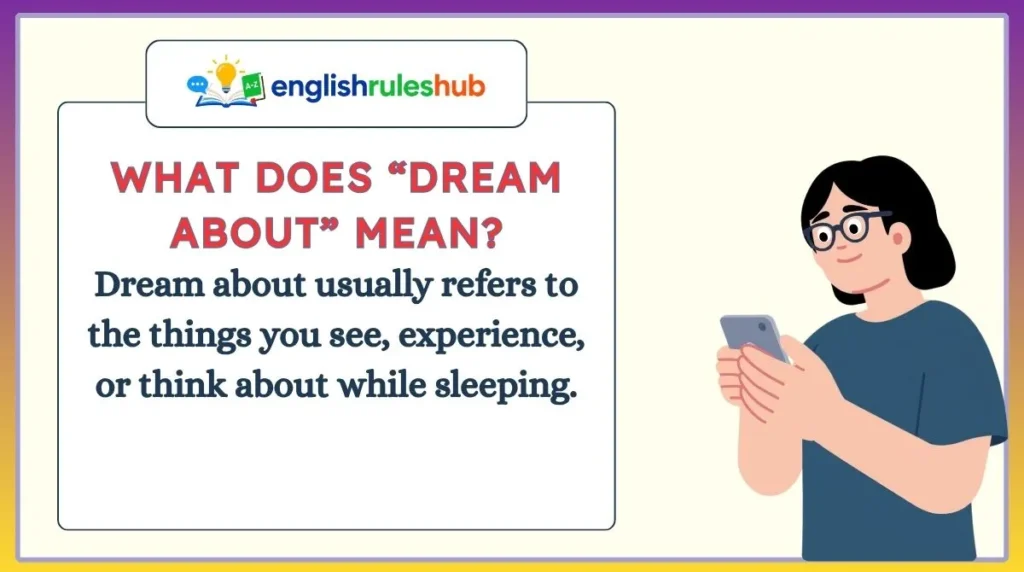
Dream about usually refers to the things you see, experience, or think about while sleeping.
It describes the subject or content of a dream.
When to Use It
Use dream about when discussing:
- Sleeping dreams
- Things seen during sleep
- Events that happened in a dream
- People who appeared in a dream
Grammar Rule
Basic structure:
Subject + dream about + noun/pronoun
Examples:
- I dreamed about my grandmother.
- She dreamed about a strange animal.
You can also use:
Subject + dream about + clause
Examples:
- I dreamed about how life would be different.
- She dreamed about what happened yesterday.
Examples of “Dream About”
- I dreamed about my old school last night.
- She dreamed about flying over mountains.
- We dreamed about a beautiful island.
- He dreamed about his childhood friend.
- My sister dreamed about a talking cat.
- They dreamed about winning the lottery.
- I often dream about my grandparents.
- She dreamed about getting lost in a city.
Common Learner Confusion
Some learners think dream about can only be used for sleeping dreams.
Although that is its most common use, people sometimes use it informally for thinking deeply about something.
Example:
I spend all day dreaming about my vacation.
Here, the person is awake. They are imagining and thinking about the vacation.
This usage is common in casual English.
Difference Between Dream of and Dream About
The main difference is connected to purpose and meaning.
| Dream of | Dream About |
|---|---|
| Usually expresses hopes and wishes | Usually describes sleeping dreams |
| Often future-focused | Often sleep-focused |
| Common for goals and ambitions | Common for dream content |
| Frequently used with achievements | Frequently used with people, places, and events |
| Can sound more emotional or inspirational | Usually sounds more neutral |
Usage Difference
Consider these sentences:
I dream of becoming a doctor.
This means becoming a doctor is a life goal.
I dreamed about a doctor last night.
This means a doctor appeared in a sleeping dream.
The meanings are completely different.
Grammar Logic
When talking about ambitions:
✅ I dream of owning a business.
❌ I dream about owning a business. (possible but less natural in many contexts)
When talking about sleep:
✅ I dreamed about my teacher.
✅ I dreamed of my teacher.
Both are possible, but dreamed about is more common.
Sentence Structure Difference
For goals:
- dream of success
- dream of becoming rich
- dream of traveling
For sleeping dreams:
- dream about your family
- dream about school
- dream about strange places
Meaning Comparison
Compare these examples:
She dreams of becoming an actress.
Meaning: She hopes to become an actress someday.
She dreamed about an actress.
Meaning: An actress appeared in her dream while sleeping.
Another example:
He dreams of owning a sports car.
Meaning: He wants one in the future.
He dreamed about a sports car.
Meaning: He saw one in a dream.
The difference is often the difference between hope and sleep.
Grammar Rules You Must Remember
Rule #1: Use “Dream of” for Goals and Ambitions
When talking about life goals, use dream of.
Example:
- I dream of opening a restaurant.
- She dreams of becoming a scientist.
These sentences express hopes for the future.
Rule #2: Use “Dream About” for Sleeping Dreams
When describing what happened during sleep, use dream about.
Example:
- I dreamed about a giant elephant.
- He dreamed about his childhood home.
These describe dream experiences.
Rule #3: Both Can Sometimes Be Used for Sleeping Dreams
English speakers occasionally use both expressions when talking about sleeping dreams.
Examples:
- I dreamed of my grandfather.
- I dreamed about my grandfather.
Both are acceptable.
However, dream about is often more common in everyday conversation.
Rule #4: “Dream of + -ing” Is Very Common
When discussing goals, use the -ing form after dream of.
Examples:
- dream of traveling
- dream of studying
- dream of winning
- dream of helping
Sentence:
She dreams of traveling around Europe.
This structure is extremely common.
Common Mistakes Students Make
Mistake 1: Using “Dream About” for Major Life Goals
Wrong:
❌ I dream about becoming a doctor.
More natural:
✅ I dream of becoming a doctor.
Why?
Because becoming a doctor is an ambition.
Mistake 2: Mixing Sleeping Dreams and Future Goals
Wrong:
❌ Last night I dreamed of becoming late for work.
Better:
✅ Last night I dreamed about being late for work.
The sentence describes a sleeping dream.
Mistake 3: Forgetting the -ing Form
Wrong:
❌ I dream of travel the world.
Correct:
✅ I dream of traveling the world.
After dream of, use a noun or -ing form.
Mistake 4: Translating Directly From Your Native Language
Many languages use one expression for all kinds of dreams.
English often separates:
- future hopes → dream of
- sleeping dreams → dream about
Learning this difference helps your English sound natural.
Easy Correction Tips
Ask yourself:
Am I talking about a goal?
Use dream of.
Am I talking about a sleeping dream?
Use dream about.
This simple question solves most mistakes.
Easy Trick to Remember the Difference
A simple memory trick can help.
Think of the word OF as standing for Objective Future.
Dream OF = Future Goal
Examples:
- dream of success
- dream of becoming a doctor
- dream of a better life
Now think of ABOUT as talking about a story.
Sleeping dreams are like stories in your mind.
Dream ABOUT = Dream Story
Examples:
- dream about a tiger
- dream about school
- dream about a friend
So remember:
OF = future goal
ABOUT = dream story
This trick is not a grammar rule, but it helps many students remember the difference quickly.
Daily Life Examples
These examples sound natural in everyday conversations.
Example 1
A: What do you want to do after college?
B: I dream of becoming an engineer.
Example 2
A: Did you sleep well?
B: Not really. I dreamed about a scary storm.
Example 3
A: Why are you studying so hard?
B: Because I dream of working for a big company.
Example 4
A: You look tired.
B: I kept dreaming about work all night.
Example 5
A: What is your biggest goal?
B: I dream of owning my own business.
Example 6
A: Why are you laughing?
B: I dreamed about a dancing monkey.
Example 7
A: Have you always wanted to travel?
B: Yes. I dream of visiting Japan someday.
Example 8
A: What did you dream about?
B: I dreamed about my old neighborhood.
Example 9
A: What motivates you?
B: I dream of giving my family a better life.
Example 10
A: Did anything strange happen last night?
B: Yes, I dreamed about flying over the ocean.
Practice Section
Choose the correct option.
1.
I ______ becoming a famous writer.
A. dream of
B. dream about
2.
Last night I ______ my old teacher.
A. dreamed of
B. dreamed about
3.
She dreams ______ living in another country.
A. of
B. about
4.
We dreamed ______ a huge castle while sleeping.
A. of
B. about
5.
My brother dreams ______ starting his own company.
A. of
B. about
Answers
- A — dream of
- B — dreamed about
- A — of
- B — about
- A — of
FAQs
What is the difference between dream of and dream about?
Dream of usually expresses hopes, goals, and ambitions. Dream about usually refers to things seen during sleep. Although both can sometimes describe sleeping dreams, their most common uses are different.
Can we use dream of for sleeping dreams?
Yes. Native speakers sometimes say things like, “I dreamed of my grandmother.” However, dream about is often more common when discussing the content of a sleeping dream.
Can we use dream about for future goals?
Sometimes people do, especially in informal conversation. However, dream of is usually the preferred choice when talking about ambitions and life goals.
Is dream of formal or informal?
It works in both formal and informal English. You can use it in everyday speech, academic writing, books, and professional communication.
Is dream about formal or informal?
It is common in both formal and informal situations. It is especially frequent in everyday conversation when people talk about what happened in their dreams.
Which expression is more common in spoken English?
Both are common. Dream of is very common for hopes and ambitions, while dream about is extremely common when discussing sleeping dreams and dream experiences.
Final Conclusion
The difference between dream of and dream about becomes much easier when you focus on the meaning behind each expression.
In most situations, dream of is connected to goals, wishes, ambitions, and the future. People use it when talking about something they strongly want to achieve.
On the other hand, dream about usually describes the people, places, and events that appear while sleeping.
There are a few situations where both expressions can be used, especially when talking about sleeping dreams. Even so, remembering the basic distinction will help you choose the right phrase most of the time.
A helpful shortcut is simple: dream of = future goal, dream about = sleeping dream.
The best way to master this topic is through regular practice. Pay attention to how native speakers use these expressions in conversations, movies, books, and podcasts.
The more examples you see, the more natural the difference will feel. Before long, choosing the correct expression will become automatic.

I am Benjamin Clark, an English language writer passionate about simplifying grammar, vocabulary, and word meanings. I create clear, accurate, and practical content to help learners improve their English skills with confidence every day.