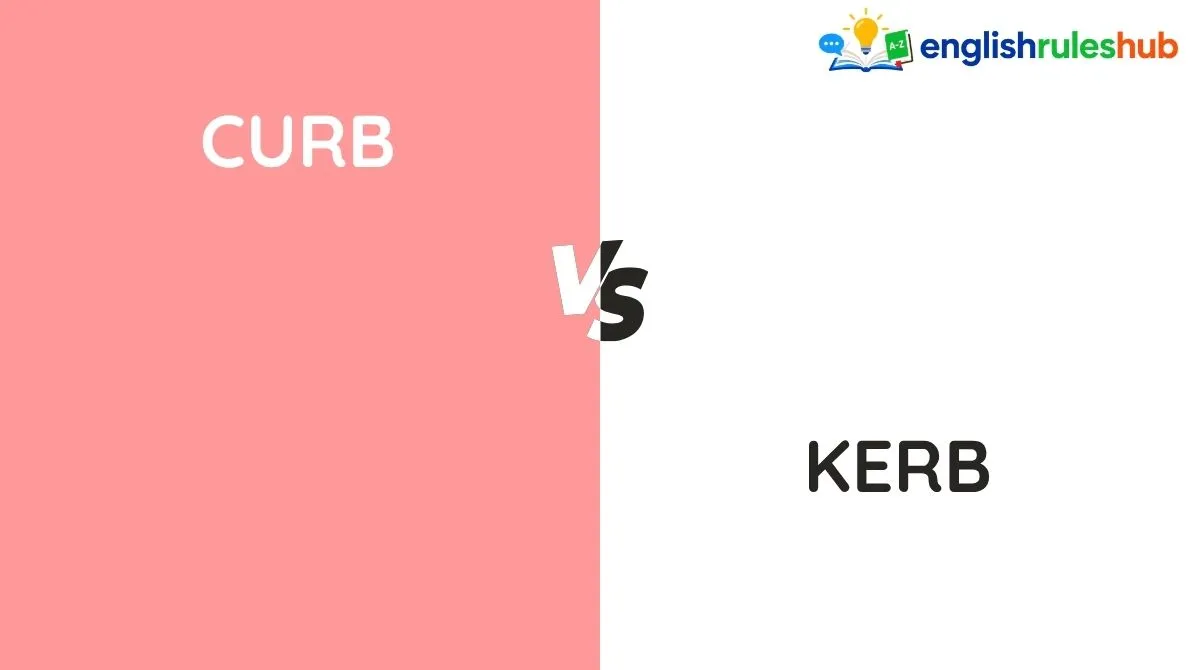
Curb and kerb are two words that often confuse English learners because they look different but usually have the same meaning. The difference is mainly connected to British English and American English.
If you see kerb in a British English text and curb in an American English text, you may wonder whether they describe two different things.
They do not. When talking about the raised edge between a road and a pavement or sidewalk, the two spellings refer to the same part of the street. Cambridge lists kerb as the UK spelling and curb as the US spelling.
There is another important point, though. Curb has an extra meaning and can also be a verb. It can mean to control, reduce, or limit something unwanted.
For example, The government wants to curb pollution. This meaning is not what kerb normally means.
So, the spelling can tell you something about the variety of English being used, while the meaning of the sentence tells you which sense of curb is intended.
By the end of this guide, you will know when to use curb, when to use kerb, why American and British writers spell the word differently, and how to avoid common mistakes.
You will also see simple examples from everyday English so the difference becomes easy to remember.
What Does “Curb” Mean?
Curb has more than one meaning, so context is important.
The most common meaning connected with streets is the raised edge along the side of a road. In American English, curb is the normal spelling for this meaning. British English normally uses kerb instead. Cambridge describes curb as the US spelling of the British kerb when referring to the edge of a raised path beside a road.
For example:
- The car stopped next to the curb.
- Please do not park on the curb.
- She waited at the curb before crossing the street.
- The driver pulled over near the curb.
- There was a bicycle leaning against the curb.
- He stepped off the curb and crossed the road.
- The city repaired the broken curb.
- The sidewalk meets the curb near the traffic light.
In these sentences, curb means the edge of the road beside the sidewalk.
Curb as a verb
There is another very common use of curb. As a verb, it means to control, limit, or reduce something.
For example:
- The city is trying to curb traffic problems.
- You should curb your spending.
- The new law may curb pollution.
- The company wants to curb unnecessary costs.
- He needs to curb his anger.
- The government introduced measures to curb crime.
This meaning is completely different from the road-related meaning.
Notice the grammar:
curb + noun
- curb pollution
- curb spending
- curb crime
- curb anger
- curb costs
You can also use curb as a noun when it means a limit or restriction:
- The new rules put a curb on spending.
- There should be a curb on unnecessary advertising.
Cambridge gives curb as a verb meaning to control or limit something unwanted and also as a noun meaning a limit or control.
Why does “curb” confuse learners?
The problem is that curb has two different jobs.
It can refer to a part of a street:
The car is parked beside the curb.
Or it can mean control:
The government wants to curb inflation.
The spelling is exactly the same, but the meaning comes from the sentence.
A useful question is:
Is the sentence talking about a road or controlling something?
If it is talking about a road edge, curb means the street feature in American English.
If it means control or limit, curb is being used in its wider English sense.
What Does “Kerb” Mean?
Kerb is the usual British English spelling of the word for the raised edge beside a road.
Cambridge defines kerb as the edge of a raised path next to the road and identifies it as the UK spelling of US curb.
For example:
- The car stopped beside the kerb.
- He stepped off the kerb carefully.
- Please do not park on the kerb.
- The council repaired the damaged kerb.
- She was standing near the kerb.
- The bus pulled up close to the kerb.
- There was a crack in the kerb.
- The cyclist moved away from the kerb.
In all of these examples, kerb refers to the edge of the pavement next to the road.
When should you use “kerb”?
Use kerb when you are writing in British English and you mean the edge of the road.
British English uses kerb in common expressions such as:
- kerbside
- kerb appeal
- dropped kerb
For example:
The house has good kerb appeal.
Here, kerb appeal means the attractiveness of a property when viewed from the street.
Another example is:
The council installed a dropped kerb.
A dropped kerb is a section where the raised edge is lowered, often to make it easier for people to cross or for wheelchair and pram access.
Is “kerb” a verb?
This is an important difference for learners.
Kerb is normally used as the British spelling for the road-related noun.
For the verb meaning control or limit, English uses curb, not kerb, even in British English in standard modern usage.
So:
The government wants to curb pollution.
is correct.
Do not change it to:
The government wants to kerb pollution.
The road-related noun has a British spelling difference, but the verb curb keeps its spelling.
Difference Between Curb and Kerb (Detailed)
The easiest way to understand curb vs kerb is to remember that they are usually regional spellings of the same road-related noun.
| Word | Main road meaning | Variety of English | Part of speech |
|---|---|---|---|
| curb | Raised edge beside a road | American English | Noun |
| kerb | Raised edge beside a road | British English | Noun |
| curb | Control or limit | British and American English | Verb |
| curb | A limit or restriction | British and American English | Noun |
So, if you are writing American English:
The car is next to the curb.
If you are writing British English:
The car is next to the kerb.
The meaning is the same.
Curb vs kerb: the spelling difference
The biggest difference is simply the letter u.
American English:
- curb
British English:
- kerb
The pronunciation is essentially the same in normal speech. Cambridge gives the same basic pronunciation for the road-related word, with the expected British and American pronunciation notation.
This means you usually cannot hear the spelling difference.
Someone may say:
The car is near the curb.
Another person may write:
The car is near the kerb.
They are talking about the same thing.
Curb vs kerb: grammar difference
Both words are nouns when they refer to the edge of a road.
They can appear after prepositions:
- near the curb
- beside the curb
- by the curb
- along the curb
- near the kerb
- beside the kerb
- by the kerb
- along the kerb
They can also be used with articles:
- a curb
- the curb
- a kerb
- the kerb
For example:
There is a car beside the curb.
There is a car beside the kerb.
The sentence structure is exactly the same. Only the spelling changes.
Curb has an extra meaning
This is the part learners should pay special attention to.
When curb means control or limit, it has nothing to do with a street.
Compare:
The driver stopped at the curb.
Here, curb = road edge.
The company needs to curb its expenses.
Here, curb = control or reduce.
The first sentence is about a place.
The second sentence is about an action.
This is why context matters.
Grammar Rules You Must Remember
Rule #1: Use “curb” for the road edge in American English
If you are following American English spelling, write curb when you mean the raised edge beside a road.
Example:
The taxi stopped at the curb.
This is the normal American spelling.
You will often see this spelling in American newspapers, websites, books, signs, and everyday writing.
Rule #2: Use “kerb” for the road edge in British English
If you are following British English spelling, use kerb.
Example:
The taxi stopped at the kerb.
The meaning has not changed. Only the regional spelling is different.
This same pattern appears in many other spelling differences between British and American English. The important thing is to choose one variety and stay consistent.
Rule #3: Use “curb” when the meaning is “control” or “limit”
When curb is a verb, it means to control, reduce, or limit something.
Examples:
We need to curb unnecessary spending.
The new policy may curb pollution.
He tried to curb his anger.
The noun after curb is usually the thing being controlled.
So a useful structure is:
curb + something
Examples:
- curb crime
- curb inflation
- curb spending
- curb pollution
- curb demand
- curb anger
Cambridge specifically defines this verb as meaning to control or limit something that is unwanted.
Rule #4: Do not use “kerb” for the verb meaning “control”
This is one of the easiest mistakes to avoid.
Correct:
The government wants to curb pollution.
Correct:
The company is trying to curb costs.
Not standard:
The government wants to kerb pollution.
The spelling kerb is used for the British road-related noun. The verb is curb.
Common Mistakes Students Make
Many learners make mistakes with these words because they learn English from different sources.
One student may study British English at school but watch American movies. Another may read American websites while using a British English dictionary.
As a result, both spellings can look familiar.
Mistake 1: Thinking curb and kerb have different road meanings
Some learners think curb is one part of the street and kerb is another.
That is not correct.
When they refer to the road edge, they are different regional spellings of the same word.
Wrong idea:
A curb is American, but a kerb is a different object in Britain.
Better understanding:
Curb is the American spelling; kerb is the British spelling.
Mistake 2: Mixing spelling styles in one piece of writing
Imagine you are writing a British English article:
The car stopped at the curb.
Then a few lines later:
He stepped off the kerb.
This may look inconsistent.
If you have chosen British English, kerb is the natural choice for the road-related noun.
If you have chosen American English, use curb.
Consistency makes your writing look cleaner and more professional.
Mistake 3: Using “kerb” as the verb
A learner may think:
kerb = British form of curb everywhere.
That is too simple.
For the road noun, yes, British English uses kerb. But the verb meaning control or limit is written curb.
Correct:
The law aims to curb pollution.
Mistake 4: Confusing curb with “sidewalk”
A curb/kerb is not the same thing as a sidewalk or pavement.
The sidewalk or pavement is the area where people walk.
The curb or kerb is the raised edge between that walking area and the road.
Think of a simple street scene:
building → sidewalk/pavement → curb/kerb → road
That picture makes the meaning much easier to remember.
Mistake 5: Assuming every use of “curb” is about a road
This is another common problem.
Consider:
The government introduced new measures to curb inflation.
There is no street here.
Curb means reduce or control.
So always look at the words around it.
Easy Trick to Remember the Difference
Here is a simple memory trick:
K = UK → kerb
When you see K in kerb, think of UK and British English.
So:
UK → kerb
And:
US → curb
This is not a grammar rule by itself, but it is a very useful memory trick.
There is another way to remember it.
Think about curb as the shorter, more common American spelling:
US → curb
Then remember that British English adds the e after the k:
UK → kerb
The most important thing is not to spend too much time worrying about the spelling when you are speaking. The words sound essentially the same in normal pronunciation.
Instead, ask yourself:
“Which English am I writing?”
If your website, school, workplace, or audience follows British English, use kerb for the road noun.
If your audience follows American English, use curb for the road noun.
If the meaning is control or limit, use curb.
That three-part rule solves most problems:
British road noun = kerb
American road noun = curb
Control/limit = curb
Daily Life Examples (Very Important)
Here are some natural examples that you might hear or use in everyday English.
Example 1: Waiting to cross
American English:
“Wait at the curb until the light changes.”
British English:
“Wait at the kerb until the light changes.”
Both sentences mean the same thing.
Example 2: Parking
“Please don’t park your car on the curb.”
Here, the speaker is talking about the edge of the road.
In British English, you would normally write:
“Please don’t park your car on the kerb.”
Example 3: Getting out of a taxi
“The driver stopped close to the curb.”
In British English:
“The driver stopped close to the kerb.”
Again, the meaning stays the same.
Example 4: Walking beside the road
“Stay away from the curb when the road is busy.”
The word refers to the raised edge next to the road.
Example 5: Controlling spending
“I need to curb my spending this month.”
Here, curb is a verb.
It means the speaker wants to control or reduce spending.
There is no street meaning in this sentence.
Example 6: Reducing pollution
“The city is taking steps to curb air pollution.”
The city wants to limit or reduce pollution.
This is another very common use of the verb.
Example 7: Controlling anger
“He needs to curb his temper.”
This means he needs to control his anger.
Example 8: Controlling costs
“The business needs to curb its costs.”
The company needs to reduce or control its expenses.
Example 9: A property’s appearance
“The house has excellent kerb appeal.”
This is common in British English.
In American English, the usual spelling is:
“The house has excellent curb appeal.”
Here, curb/kerb appeal refers to how attractive a property looks from the street.
Example 10: A dropped road edge
“The council installed a dropped kerb near the crossing.”
In American English, you would normally see:
“The city installed a dropped curb near the crossing.”
This kind of road feature is useful for easier access between the pavement or sidewalk and the road.
Practice Section
Choose the correct word: curb or kerb.
1. British English
The driver stopped beside the ______.
Answer: kerb
2. American English
The woman waited at the ______ before crossing the street.
Answer: curb
3. Control or limit
The government wants to ______ pollution.
Answer: curb
4. British English
The council repaired the broken ______.
Answer: kerb
5. Control spending
I need to ______ my spending.
Answer: curb
A quick check can help you remember the rule:
- Road edge + American English → curb
- Road edge + British English → kerb
- Control or limit → curb
FAQs
What is the difference between curb and kerb?
When they mean the raised edge beside a road, curb and kerb mean the same thing.
Curb is the usual American English spelling, while kerb is the usual British English spelling.
Is curb American or British English?
For the road-related noun, curb is the standard American spelling.
British English normally uses kerb for the same road feature. However, curb is also an English verb meaning to control or limit something, and that spelling is used in both British and American English.
Is kerb the British spelling of curb?
Yes, when you are talking about the raised edge beside a road.
For example:
American English:
The car is parked near the curb.
British English:
The car is parked near the kerb.
The object is the same.
Can I use curb in British English?
Yes, but you need to consider the meaning.
For the road-related noun, British English normally uses kerb.
But curb is used in British English when it means to control or limit something, such as curb spending or curb pollution.
Is curb a noun or a verb?
Curb can be both a noun and a verb.
As a road noun, it means the raised edge beside a street in American English.
As a verb, it means to control or limit something:
The company wants to curb costs.
It can also be a noun meaning a limit or restriction.
Do curb and kerb sound the same?
For the road-related meaning, they are pronounced essentially the same.
The main difference is spelling and regional usage, not the basic pronunciation.
This is why the difference can be confusing when you hear the word but do not see it written.
Final Conclusion
The difference between curb and kerb is much easier than it first appears.
When the word means the raised edge beside a road, American English normally uses curb, while British English normally uses kerb. The object and basic meaning are the same.
There is one important extra point: curb can also mean to control, reduce, or limit something.
You can curb spending, curb pollution, curb crime, or curb your anger. In this meaning, use curb, not kerb.
So remember the simple rule: US road noun = curb, UK road noun = kerb, control or limit = curb.
Do not worry if you sometimes see both spellings. English has many British and American spelling differences.
The best habit is to choose the variety of English you are using and stay consistent. Once you understand the pattern, curb vs kerb becomes a very easy distinction.

I am Benjamin Clark, an English language writer passionate about simplifying grammar, vocabulary, and word meanings. I create clear, accurate, and practical content to help learners improve their English skills with confidence every day.