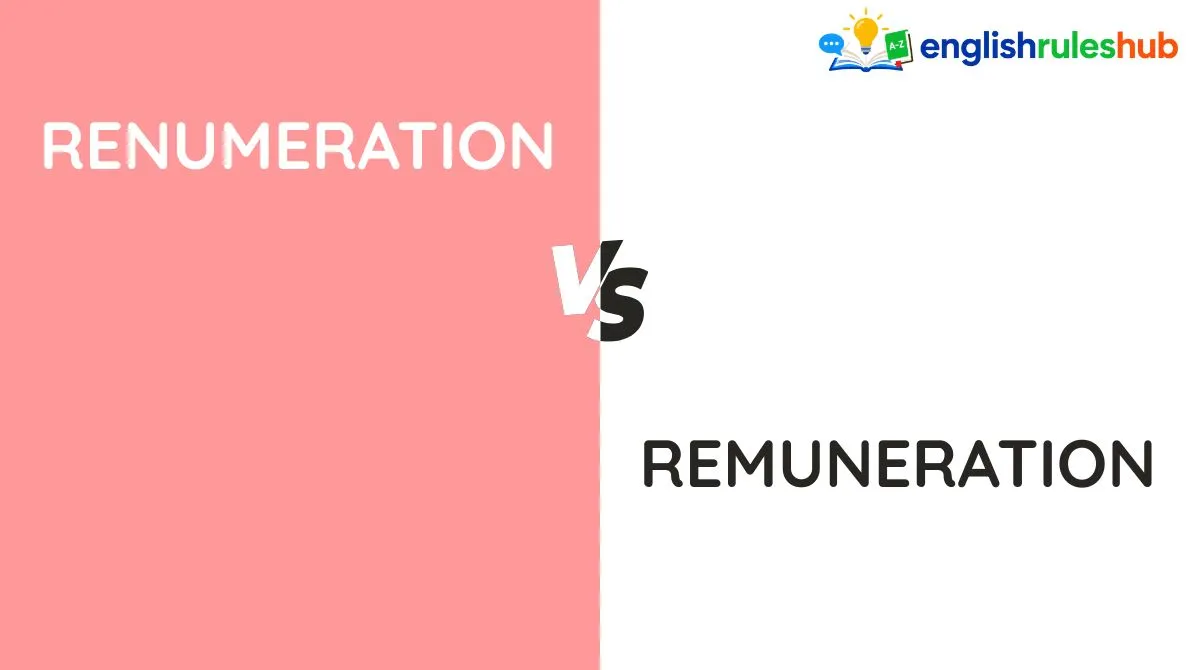
Many English learners get confused by renumeration and remuneration because the two words look very similar.
At first glance, they seem like different spellings of the same word. Because of this, many students, job seekers, and even native speakers sometimes use the wrong form in emails, resumes, reports, and workplace documents.
The confusion becomes even bigger because remuneration is a real English word, while renumeration is usually a spelling mistake.
When people hear the word spoken aloud, they may not notice the difference between the two spellings.
Understanding this topic is important because remuneration is commonly used in business English, employment contracts, salary discussions, and professional writing.
Using the wrong spelling can make your writing look less accurate and less professional.
By the end of this guide, you will clearly understand the meaning of both words, why people mix them up, how to use the correct word confidently, and several easy tricks to help you remember the difference forever.
You will also see many examples from everyday English so that the rule feels natural rather than difficult.
What Does “Renumeration” Mean?
The word renumeration is one of the most commonly misspelled words in business English.
Simple Definition
In modern English, renumeration is generally considered an incorrect spelling when someone actually means remuneration.
Many people accidentally write renumeration because they connect it with the word number or enumerate, which contains the letters “num.”
When to Use It
In standard English writing, you should usually avoid using renumeration.
If you see this word in a document, there is a strong chance that the writer intended to write remuneration.
Grammar Rule
- Renumeration is generally treated as a misspelling.
- Formal writing should use remuneration instead.
- Dictionaries and style guides recommend using remuneration when referring to payment or compensation.
Example Sentences
The following examples show incorrect usage that should be corrected.
- The company discussed employee renumeration. ❌
- Her renumeration package includes bonuses. ❌
- We reviewed the renumeration policy yesterday. ❌
- The manager explained the renumeration structure. ❌
- They offered attractive renumeration to new staff. ❌
- The job advertisement mentioned competitive renumeration. ❌
- Employees asked questions about renumeration. ❌
- The contract outlined renumeration details. ❌
Corrected Versions
- The company discussed employee remuneration. ✔
- Her remuneration package includes bonuses. ✔
- We reviewed the remuneration policy yesterday. ✔
- The manager explained the remuneration structure. ✔
- They offered attractive remuneration to new staff. ✔
- The job advertisement mentioned competitive remuneration. ✔
- Employees asked questions about remuneration. ✔
- The contract outlined remuneration details. ✔
Common Learner Confusion
Many learners think that renumeration is a variation of remuneration. However, in standard English, it is usually considered an error.
The mistake happens because:
- Both words sound similar.
- The spelling is nearly identical.
- The letters “m” and “n” are easy to mix up.
- People associate payment with numbers and accidentally write “numer.”
When writing professionally, always double-check the spelling.
What Does “Remuneration” Mean?
Simple Definition
Remuneration means payment, salary, wages, compensation, or reward for work or services.
In simple words, remuneration is the money or benefits a person receives for doing a job.
When to Use It
Use remuneration when talking about:
- Employee pay
- Salary packages
- Wages
- Bonuses
- Financial compensation
- Job benefits
The word is common in formal and professional English.
Grammar Rule
Remuneration is a noun.
It refers to payment or compensation received for work.
Structure:
- remuneration + for + work/services
- remuneration package
- employee remuneration
- remuneration policy
Example Sentences
- Her remuneration includes a monthly bonus.
- The company offers competitive remuneration.
- Employees are satisfied with their remuneration package.
- The manager discussed remuneration during the meeting.
- Good remuneration attracts skilled workers.
- The contract explains remuneration and benefits.
- His remuneration increased after the promotion.
- The organization reviewed employee remuneration policies.
Common Learner Confusion
Many students believe remuneration only means salary.
That is not completely true.
Remuneration can include:
- Basic salary
- Overtime pay
- Bonuses
- Commissions
- Health benefits
- Retirement benefits
- Other forms of compensation
So remuneration is often broader than just salary.
Difference Between Renumeration and Remuneration
The biggest difference is simple:
| Feature | Renumeration | Remuneration |
|---|---|---|
| Is it a standard English word? | Usually no | Yes |
| Correct spelling? | No | Yes |
| Meaning | Common misspelling | Payment or compensation |
| Used in professional writing? | No | Yes |
| Found in contracts? | Should not be | Frequently |
| Recommended by dictionaries? | No | Yes |
Usage Difference
Renumeration
- Usually appears because of a spelling error.
- Should be corrected in formal writing.
Remuneration
- Used correctly in business English.
- Refers to employee compensation.
- Common in contracts and workplace communication.
Grammar Logic
Since remuneration is a noun, it behaves like other nouns.
Examples:
- The remuneration was generous.
- Employee remuneration increased.
- We discussed remuneration.
Since renumeration is usually considered a misspelling, it should not be used in formal grammar.
Sentence Structure Difference
Incorrect:
- The company improved employee renumeration.
Correct:
- The company improved employee remuneration.
Incorrect:
- Renumeration packages vary across industries.
Correct:
- Remuneration packages vary across industries.
Meaning Comparison
There is no meaningful difference in intended meaning because people who write renumeration almost always mean remuneration.
The real difference is simply:
- One is incorrect.
- One is correct.
Grammar Rules You Must Remember
Rule #1: Use “Remuneration” for Payment
Whenever you mean compensation or salary, write remuneration.
Example:
- The remuneration package includes health insurance.
Rule #2: Remember That “Remuneration” Is a Noun
It names a thing, not an action.
Example:
- Her remuneration is higher this year.
Not:
- She remuneration the workers. ❌
Rule #3: Use It Mostly in Formal English
The word is common in business writing.
Example:
- The company announced a new remuneration policy.
In casual conversation, people often say:
- salary
- pay
- wages
Rule #4: Check the Spelling Carefully
Many writers accidentally replace the letter m with n.
Correct:
- remuneration
Incorrect:
- renumeration
Example:
- The HR department reviewed employee remuneration.
Common Mistakes Students Make
Mistake 1: Writing “Renumeration”
Wrong:
- The job offers excellent renumeration.
Correct:
- The job offers excellent remuneration.
Why It Happens
People connect the word with “number” and mistakenly insert “numer.”
Easy Tip
Remember that remuneration begins with remu, not renu.
Mistake 2: Thinking It Means Only Salary
Wrong Idea:
- Remuneration only means monthly salary.
Correct Idea:
- Remuneration can include salary, bonuses, and benefits.
Example:
- Her remuneration package includes paid leave and health insurance.
Mistake 3: Using It Like a Verb
Wrong:
- The company remunerations workers fairly.
Correct:
- The company provides fair remuneration.
Mistake 4: Mixing It With Compensation Terms
Although remuneration and compensation are similar, remuneration is usually more formal.
Example:
- The company increased employee remuneration.
- The company increased employee compensation.
Both are acceptable, but remuneration sounds more official.
Easy Trick to Remember the Difference
A simple memory trick can save you from making this mistake.
Look at the word:
Remuneration
Notice the beginning:
REMU
Think of:
REward + MUney = REMUneration
The spelling contains MU, which can remind you of money.
Since remuneration means money or compensation for work, linking it to money can help you remember the correct spelling.
Another easy trick:
Ask yourself:
“Am I talking about employee pay?”
If the answer is yes, write:
remuneration
Never write:
renumeration
The correct business word is remuneration.
Daily Life Examples
These examples show how the word appears in real conversations and workplace situations.
- What kind of remuneration does the company offer?
- The job has good remuneration and flexible hours.
- We discussed remuneration during the interview.
- Her remuneration increased after she became a manager.
- The company provides competitive remuneration for skilled workers.
- Employees are happy with their remuneration package.
- The manager explained the remuneration policy.
- Better remuneration helps companies keep talented staff.
- The organization reviewed staff remuneration this month.
- He accepted the offer because the remuneration was attractive.
These examples sound natural and are commonly used in professional settings.
Practice Section
Choose the correct option.
1.
The company reviewed employee ______.
A. renumeration
B. remuneration
2.
Her ______ package includes health benefits.
A. remuneration
B. renumeration
3.
The contract explains employee ______.
A. remuneration
B. renumeration
4.
Good ______ attracts qualified workers.
A. renumeration
B. remuneration
5.
The HR department updated the ______ policy.
A. remuneration
B. renumeration
Answers
- B. remuneration
- A. remuneration
- A. remuneration
- B. remuneration
- A. remuneration
If you selected remuneration for all five questions, great job. That means you understand the correct spelling.
FAQs
What is the difference between renumeration and remuneration?
The main difference is that remuneration is the correct English word meaning payment or compensation. Renumeration is usually a spelling mistake and should be avoided in formal writing.
Is renumeration a real word?
Some dictionaries may mention it because people frequently use it incorrectly. However, modern English style guides generally treat it as a misspelling of remuneration.
What does remuneration mean in simple English?
Remuneration means the money and benefits a person receives for doing a job. It can include salary, bonuses, commissions, and other rewards.
Can we use remuneration in questions?
Yes. It works naturally in questions.
Examples:
- What remuneration does the company offer?
- Is the remuneration package competitive?
Is remuneration formal or informal?
Remuneration is a formal word. In everyday conversation, people often use simpler words such as pay, salary, wages, or earnings.
Is remuneration the same as salary?
Not exactly. Salary is usually one part of remuneration. Remuneration can also include bonuses, commissions, insurance, retirement benefits, and other compensation.
Final Conclusion
The confusion between renumeration and remuneration is very common because the two spellings look almost identical.
However, the rule is actually simple. Remuneration is the correct word, and it means payment, compensation, salary, wages, or benefits received for work.
Renumeration is generally a spelling mistake that appears when people accidentally replace the letter “m” with “n.”
For students, job seekers, and professionals, learning the correct spelling is important because remuneration is widely used in contracts, job advertisements, business reports, and workplace discussions. A small spelling error can make professional writing look less polished.
The best way to remember the difference is to connect remuneration with money and rewards for work.
Practice using the word in sentences, read business English regularly, and pay attention to the spelling whenever you write.
With a little practice, choosing the correct word will become automatic, and you will never confuse these two spellings again.

I am Benjamin Clark, an English language writer passionate about simplifying grammar, vocabulary, and word meanings. I create clear, accurate, and practical content to help learners improve their English skills with confidence every day.