English has many words that look almost the same but have very different meanings. Annunciate and enunciate are two good examples.
They both contain the ending -nunciate, so it is easy to think they mean the same thing.
However, they are used for different ideas.
Enunciate is mainly about speaking words clearly. If your teacher tells you to enunciate, they want you to pronounce your words carefully so other people can understand you. For example, a student giving a speech may need to enunciate every word.
Annunciate, on the other hand, is connected with announcing, proclaiming, or making something known.
It is a much less common word in modern everyday English. In most normal conversations, native speakers usually choose announce instead.
This difference matters because using the wrong word can change the meaning of your sentence.
A person can enunciate a message without announcing anything new. Similarly, someone can announce news without speaking every word clearly.
The good news is that the difference becomes quite simple once you connect each word with its main idea.
By the end of this guide, you will understand what both words mean, how their grammar works, when to use them, what mistakes learners commonly make, and how to remember the difference easily.
What Does “Annunciate” Mean?
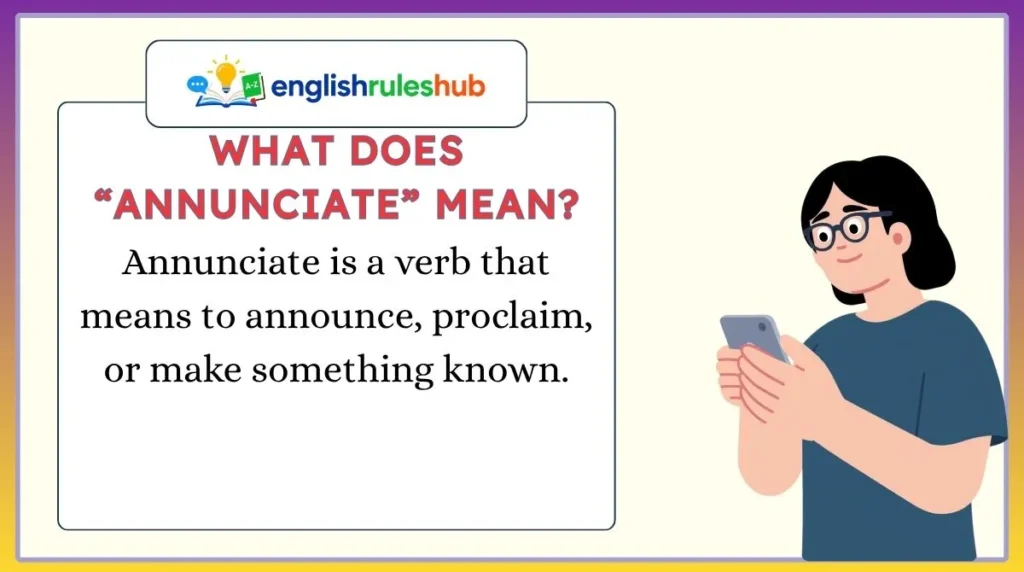
Annunciate is a verb that means to announce, proclaim, or make something known.
It is a real English word, but it is uncommon in modern everyday English. Most speakers would normally use announce instead.
For example:
The messenger annunciated the king’s arrival.
The sentence means that the messenger announced or proclaimed that the king had arrived.
The important point is that annunciate is about communicating or proclaiming information, not mainly about clear pronunciation.
When Should You Use “Annunciate”?
You may find annunciate in formal, historical, literary, religious, or older writing.
It can be used when someone officially declares something or makes information known.
For example:
The official annunciated the new policy.
This means the official announced or proclaimed the new policy.
In ordinary modern English, however, this sentence would sound more natural as:
The official announced the new policy.
So, although annunciate is grammatically possible, it is not usually the best choice for everyday speech.
Grammar Rule for “Annunciate”
Annunciate is a verb. It can take a direct object when the thing being announced is mentioned.
Common structure:
Subject + annunciate + something
Examples:
The speaker annunciated the decision.
The leader annunciated the new law.
It can also appear in forms such as annunciated and annunciating.
The past tense is:
annunciated
The -ing form is:
annunciating
Examples of “Annunciate”
- The messenger annunciated the arrival of the king.The messenger announced that the king had arrived.
- The official annunciated the new rule to the crowd.The official made the new rule known.
- The priest annunciated the important news to the congregation.The priest proclaimed the news.
- The leader annunciated his decision before the meeting ended.The leader formally announced his decision.
- The town’s herald annunciated the beginning of the festival.The herald proclaimed that the festival had begun.
- The document annunciated a major change in policy.The document formally stated or announced a major change.
- The speaker annunciated the result to everyone present.The speaker announced the result.
- The proclamation annunciated the new order.The proclamation made the new order known.
Notice something important in these examples: the focus is on making information known. The focus is not on how clearly the speaker pronounces each sound.
Why Does “Annunciate” Confuse Learners?
The confusion usually comes from its spelling.
Look at these two words:
annunciate
enunciate
They look extremely similar. Both have -nunciate, and both are related to communicating something through words.
But their main meanings are different.
Think of annunciate as being connected to announcement.
If you are announcing something, you are making information known.
That gives you this simple connection:
Annunciate → announce
Still, because the word is uncommon today, announce is usually the safer and more natural choice in everyday English.
What Does “Enunciate” Mean?
Enunciate is a verb that means to pronounce words clearly and distinctly.
It can also mean to state an idea, statement, or principle clearly.
This word is much more useful when talking about speech, pronunciation, and clear communication.
For example:
Please enunciate your words.
This means:
Please pronounce your words clearly.
A teacher might say this to a student who is speaking too quickly or not moving their mouth clearly enough.
When Should You Use “Enunciate”?
Use enunciate when you want to talk about clear pronunciation.
It is especially common when discussing:
- public speaking
- acting
- singing
- pronunciation
- presentations
- speeches
- language learning
- clear communication
For example:
She enunciates every word during her presentations.
This tells us that she speaks each word clearly.
You can also use the word when someone states an idea clearly:
The professor enunciated his main argument.
Here, the meaning is closer to stated clearly and precisely.
Grammar Rule for “Enunciate”
Enunciate is a verb.
A common structure is:
Subject + enunciate + words/sounds/a statement
For example:
The actor enunciated every line.
Another common structure is:
Please + enunciate + your words.
For example:
Please enunciate your words so everyone can hear you.
The word can also be used without a direct object when the context is already clear:
She speaks quickly, but she enunciates well.
Examples of “Enunciate”
- Please enunciate your words.Please pronounce your words clearly.
- The teacher asked the student to enunciate more carefully.The teacher wanted the student to speak more clearly.
- The actor enunciated every line perfectly.The actor pronounced each line clearly.
- Try to enunciate when you speak in front of a large audience.Speak clearly so people can understand you.
- She enunciates each word during the presentation.She says each word clearly.
- The newsreader enunciated the names carefully.The newsreader pronounced the names clearly.
- He needs to enunciate more clearly during phone calls.He needs to make his speech easier to understand.
- The professor enunciated his argument in simple language.The professor stated his argument clearly.
Enunciate Does Not Simply Mean “Speak Loudly”
This is an important point for English learners.
Enunciate does not mean simply to speak louder.
Someone can speak very loudly and still fail to enunciate clearly.
For example, imagine a person saying:
“Ineedtogotothemarketbeforeitcloses.”
They may be loud, but their words run together.
If they slow down and clearly separate the words, they are enunciating better.
So:
Loud = greater volume
Enunciated = clearer pronunciation
These are not the same thing.
Difference Between Annunciate and Enunciate
The easiest way to understand the difference is to focus on the main action.
Annunciate = announce or proclaim something.
Enunciate = pronounce or state something clearly.
Here is a quick comparison:
| Word | Main meaning | Main focus | Common use | Modern everyday use |
|---|---|---|---|---|
| Annunciate | Announce or proclaim | Making something known | Formal, literary, historical contexts | Rare |
| Enunciate | Speak or pronounce clearly | Clarity of speech or expression | Speaking, pronunciation, presentations | Common |
| Announce | Tell people about something | Giving information | Everyday communication | Very common |
Usage Difference
Suppose a manager tells the staff about a new holiday schedule.
The manager announces the schedule.
If the manager speaks every word very clearly, the manager also enunciates the schedule.
So these two actions can happen at the same time.
For example:
The manager announced the new schedule and enunciated every detail clearly.
The first part tells us what the manager did with the information.
The second part tells us how clearly the manager spoke.
That is the key difference.
Grammar Logic
Both words are verbs, but their meanings point to different actions.
With annunciate, the object is usually something being made known:
annunciate a decision
annunciate a policy
annunciate an announcement
annunciate a proclamation
With enunciate, the object is often something being spoken or stated clearly:
enunciate a word
enunciate a sound
enunciate a sentence
enunciate an idea
enunciate a statement
The exact nouns can vary depending on the context, but the basic idea stays the same.
Sentence Structure Difference
Compare these sentences:
The official annunciated the new policy.
The focus is on announcing the policy.
Now compare:
The official enunciated the new policy clearly.
The focus is on stating the policy clearly.
The same person can do both things.
Another example:
The presenter announced the results.
This tells us the presenter gave the results to the audience.
The presenter enunciated the results.
This tells us the presenter pronounced or stated the results clearly.
The second sentence does not necessarily mean that the presenter was the first person to announce the results.
Meaning Comparison
A useful question can help you choose the right word.
Ask yourself:
Am I talking about making information known?
If yes, the idea is related to annunciate, although announce will normally sound much more natural.
Ask:
Am I talking about saying something clearly?
If yes, use enunciate.
For example:
The teacher announced the exam date.
The teacher gave students the information.
The teacher enunciated the exam date.
The teacher said the date clearly.
Both sentences are grammatical, but they describe different aspects of the action.
Grammar Rules You Must Remember
Rule #1: Use “Enunciate” for Clear Pronunciation
When the main idea is clear speech, choose enunciate.
Please enunciate your words.
This means:
Please pronounce your words clearly.
It is especially useful when someone speaks too quickly, quietly, or unclearly.
Rule #2: “Annunciate” Is About Announcing or Proclaiming
When annunciate is used, it carries the idea of making something known or proclaiming it.
The herald annunciated the king’s arrival.
The herald announced the arrival.
Remember that this word is rare in modern English.
In most everyday situations, simply use:
The herald announced the king’s arrival.
That sounds much more natural.
Rule #3: Do Not Use “Annunciate” When You Mean “Pronounce Clearly”
This is one of the most common mistakes.
Incorrect for the intended meaning:
Please annunciate your words.
If you mean “say your words clearly,” the correct choice is:
Please enunciate your words.
The first sentence suggests announcing something rather than speaking clearly.
Rule #4: Enunciate Can Also Mean “State Clearly”
Enunciate is not limited to pronunciation.
It can also mean to express or state an idea clearly.
For example:
The scientist enunciated a clear theory.
Here, the focus is on presenting the idea clearly.
So the word can be used both for clear speech and clear expression of an idea.
Common Mistakes Students Make
These words are confusing because they look almost identical. Learners often remember the spelling but forget the meaning.
Here are some common mistakes.
Mistake #1: “Please Annunciate Your Words”
If you mean “pronounce your words clearly,” this is the wrong word.
Wrong:
Please annunciate your words.
Correct:
Please enunciate your words.
The correction is simple: clear pronunciation = enunciate.
Mistake #2: Thinking “Annunciate” Is Just a Fancy Version of “Enunciate”
It is not.
Although the words look alike, they have different meanings.
Annunciate is connected with announcing or proclaiming.
Enunciate is connected with clear pronunciation or clear expression.
They should not be treated as interchangeable words.
Mistake #3: Thinking “Enunciate” Means “Announce”
A learner might write:
The company enunciated its new product yesterday.
If the intended meaning is simply that the company told people about the product, announced is much more natural.
A better sentence is:
The company announced its new product yesterday.
You could use enunciated if the point is that the company stated or expressed the information clearly, but that is a different meaning.
Mistake #4: Using “Annunciate” in Everyday Conversation
Even when annunciate is technically understandable, it can sound unusual.
For example:
The teacher annunciated the homework instructions.
A modern speaker would usually say:
The teacher announced the homework instructions.
Or, if the meaning is about clear speech:
The teacher enunciated the homework instructions clearly.
Easy Correction Tip
When you see these two words, do not look only at their spelling.
Look at the purpose of the action.
If the purpose is:
“Tell people something new.”
Think announce / annunciate.
If the purpose is:
“Make the words clear.”
Think enunciate.
Easy Trick to Remember the Difference
Here is a simple memory trick:
Enunciate = ENunciate = make your words clear.
Think of a student standing in front of the class.
The teacher says:
“Slow down. Enunciate!”
The student needs to pronounce each word clearly.
Now think about an official making a public statement.
The official is announcing something.
That gives you:
Annunciate → announce
Enunciate → pronounce clearly
Another useful trick is to focus on the E in enunciate.
You can remember:
E = Easy to hear
It is not a perfect word-history rule, but it is a useful learner’s memory trick.
When you want someone to make their speech easy to hear and understand, think enunciate.
Real-Life Logic
Imagine a radio presenter.
First, the presenter may announce the winner of a competition.
Then the presenter may enunciate the winner’s name carefully.
For example:
“And the winner is Ahmed Khan!”
The act of giving the news is an announcement.
The act of saying “Ahmed Khan” clearly is enunciation.
Once you see the two actions together, the difference becomes much easier.
Daily Life Examples
Here are some natural situations that show how the words work.
Example 1: In a Classroom
Teacher: “I can’t understand the last sentence. Please enunciate.”
Student: “Sure. I’ll speak more slowly.”
Here, the teacher wants clear pronunciation.
Example 2: During a Presentation
Manager: “Your presentation is good, but try to enunciate the numbers.”
The manager wants the speaker to say the numbers clearly.
Example 3: On a Phone Call
Person A: “Could you repeat that?”
Person B: “Sure. I’ll enunciate each word.”
The problem is clear speech, so enunciate fits.
Example 4: A Public Announcement
Official: “The city has announced a change to the bus schedule.”
Here, announced is the natural modern word.
You could encounter annunciated in formal or older writing, but it would be unusual in normal conversation.
Example 5: Acting Practice
Director: “The audience needs to hear every line. Enunciate clearly.”
The actor needs to pronounce each word well.
Example 6: Giving Important News
Reporter: “The government announced the new policy this morning.”
This is a normal everyday use of announce.
Example 7: A Difficult Name
Teacher: “Please enunciate the student’s name carefully.”
The teacher wants the name to be pronounced clearly.
Example 8: A Formal Proclamation
Herald: “The royal herald annunciated the king’s arrival.”
This sounds formal and historical. In everyday English, announced would normally be preferred.
Example 9: A Speech
Speaker: “She announced the winner and then enunciated the winner’s name slowly.”
This sentence shows both ideas together.
She announced the information and enunciated the words clearly.
Example 10: Language Learning
Student: “My teacher says I need to enunciate better.”
This is a very natural use for English learners.
It means the student needs to make their pronunciation clearer.
Practice Section
Choose the correct word in each sentence.
1. Please ________ each word clearly during your speech.
A. annunciate
B. enunciate
2. The official ________ the new decision to the public.
A. annunciated
B. enunciated
3. The actor needs to ________ every line so the audience can understand him.
A. enunciate
B. annunciate
4. The historical document ________ the beginning of a new era.
A. annunciated
B. enunciated
5. I could hear her, but she did not ________ her words clearly.
A. annunciate
B. enunciate
Answers
1. B — enunciate
The sentence is about clear pronunciation.
2. A — annunciated
The sentence is about formally making a decision known. However, announced would be much more natural in modern everyday English.
3. A — enunciate
The actor needs to pronounce each line clearly.
4. A — annunciated
The sentence describes a formal or historical statement being made known.
5. B — enunciate
The problem is unclear pronunciation, so enunciate is correct.
Frequently Asked Questions
What is the difference between annunciate and enunciate?
Annunciate means to announce, proclaim, or make something known, and it is uncommon in modern everyday English.
Enunciate means to pronounce words clearly or express an idea clearly.
A simple memory aid is: annunciate = announce; enunciate = speak clearly.
Is “annunciate” a real English word?
Yes, annunciate is a real English verb. It carries the meaning of announcing or proclaiming something.
However, it is relatively rare in modern English. In normal conversation and most modern writing, announce is usually the better and more natural choice.
Is “enunciate” the same as “pronounce”?
They are closely related, but they are not exactly the same.
Pronounce means to say a word or sound in a particular way. Enunciate emphasizes saying words clearly and distinctly.
For example, you can pronounce a word correctly but still fail to enunciate clearly if you speak too quickly or run your words together.
Can I use “enunciate” for ideas?
Yes.
Enunciate can mean to state or express an idea clearly, not only to pronounce words clearly.
For example:
The professor enunciated his main argument clearly.
Here, the word means that the professor expressed his argument in a clear way.
Is “annunciate” formal or informal?
Annunciate is formal, uncommon, and sometimes literary or historical in tone.
It is not a word most people use in ordinary conversation.
If you simply want to tell someone that information was given to the public, announce is normally the best choice.
Can I say “Please annunciate”?
If you mean “Please speak more clearly,” use:
Please enunciate.
If you mean “Please announce something,” then announce is the normal modern verb.
So, for pronunciation practice, choose enunciate, not annunciate.
Final Conclusion
The difference between annunciate and enunciate is much easier when you stop focusing on their similar spelling.
Annunciate means to announce, proclaim, or make something known. It is a real word, but it is uncommon today, so announce is usually the more natural choice.
Enunciate means to pronounce words clearly and distinctly. It can also mean to express an idea or statement clearly. This word is much more useful in everyday English, especially when talking about speaking, pronunciation, presentations, acting, or public speaking.
Remember the simple connection:
Annunciate → announce
Enunciate → clear speech
If you are talking about someone speaking too quickly or unclearly, choose enunciate. If you are talking about giving people new information, announce will usually be the best word.
A little practice will make the difference feel natural. The next time you hear someone say, “Please speak more clearly,” remember: enunciate is the word you need.
Meta Description
Learn the difference between annunciate vs enunciate with simple meanings, clear examples, grammar rules, common mistakes, and an easy memory trick.

I am Benjamin Clark, an English language writer passionate about simplifying grammar, vocabulary, and word meanings. I create clear, accurate, and practical content to help learners improve their English skills with confidence every day.