
Last updated on September 24th, 2026 at 06:35 am
Mother tongue and native language are two expressions that English learners often see in books, schools, forms, and everyday conversations.
At first, they seem to mean exactly the same thing. In many situations, they do have almost the same meaning.
However, there can be a small difference depending on how a person learned the language and how they use the term.
This can be confusing because people sometimes use both expressions for the language they learned as a child.
For example, someone may say, “Urdu is my mother tongue,” while another person may say, “Urdu is my native language.” Both sentences can be perfectly natural.
So, are these expressions really the same? Usually, they are very close, but they are not always identical in every context.
Understanding this difference is useful when you are talking about your language background, filling out an application, describing your language skills, or speaking with someone from another country.
By the end of this guide, you will understand what mother tongue means, what native language means, how the two expressions are different, and when each one sounds more natural. You will also see simple examples from real-life conversations.
The most important thing to remember is that both terms usually refer to a language learned naturally from childhood, especially at home. The difference is mainly about emphasis and context.
What Does “Mother Tongue” Mean?
Mother tongue is the language a person first learns naturally as a child, usually through family members and the people around them.
The expression does not necessarily mean that the person’s mother literally taught the language. A child’s first language may come from a father, grandparents, siblings, relatives, neighbors, or the wider community.
For example, imagine a child whose parents speak Punjabi at home. The child hears Punjabi every day and naturally begins speaking it. Punjabi may be called the child’s mother tongue.
The phrase is especially common when talking about family, culture, community, and early childhood language.
When do we use “mother tongue”?
We use “mother tongue” when we want to talk about the language someone grew up with or learned first.
For example:
- My mother tongue is Punjabi.
- Urdu is my mother tongue.
- English is not my mother tongue.
- She speaks her mother tongue at home.
- He is proud of his mother tongue.
- What is your mother tongue?
- Children often learn their mother tongue naturally.
- I can read and write in my mother tongue.
The expression can also have a strong connection with identity and culture. A person may feel that their mother tongue is an important part of their background.
Is “mother tongue” always the first language?
Not necessarily.
This is one of the points that can confuse learners. In many cases, a person’s mother tongue is also their first language. But a person can grow up with more than one language.
Suppose a child has a Punjabi-speaking mother and an Urdu-speaking father. The child hears both languages from birth. It may be difficult to say that only one of them is the child’s mother tongue.
In such situations, a person might describe themselves as having two mother tongues or say that they grew up speaking two languages.
Is “mother tongue” a grammar term?
No. “Mother tongue” is mainly a language and social term, not a special grammar structure.
The phrase works as a noun phrase.
For example:
English is my mother tongue.
Here, “mother tongue” is the name of the language relationship being described.
You can also use it after words such as “my,” “your,” “his,” “her,” and “their.”
What is your mother tongue?
Her mother tongue is Sindhi.
Common confusion about “mother tongue”
Some learners think “mother tongue” must mean the language spoken by the mother. That is not the normal meaning.
For example, a child may have a mother who speaks English but grow up mainly speaking Urdu with grandparents and other family members. In that case, Urdu may be the child’s first or home language.
So, do not focus too much on the word mother. Think about the language a person naturally grew up with.
What Does “Native Language” Mean?
A native language is a language that a person learns naturally from early childhood and speaks as a first or home language.
The word native focuses more on the person’s natural language background than on a particular family member.
For example:
- English is her native language.
- Urdu is his native language.
- Punjabi is my native language.
- What is your native language?
- She is a native speaker of English.
- He grew up speaking Arabic as his native language.
- My native language is not English.
- I speak my native language with my family.
The expression is very common in discussions about language learning, education, translation, linguistics, and language ability.
When do we use “native language”?
“Native language” is useful when talking about someone’s natural language background.
For example, if a person learned English at school when they were seven years old but spoke Urdu at home from birth, they might say:
Urdu is my native language, but English is my second language.
This makes the person’s language history clear.
The term is also closely connected to native speaker.
For example:
She is a native English speaker.
This means she learned English naturally from childhood and has it as a native language.
Does native language always mean the language a person speaks best?
No.
This is another important point.
A person can have a native language but become more comfortable in another language later in life.
Imagine someone who grew up speaking Punjabi but then moved to an English-speaking country at age eight. After many years, that person might use English much more often and even feel more comfortable speaking English.
Punjabi can still be their native language, even if English becomes their stronger language in some situations.
Therefore, native language and strongest language are not always the same thing.
Can someone have more than one native language?
Yes.
A child can naturally learn two languages from an early age.
For example, one parent may speak Urdu and the other may speak English. If the child regularly hears and uses both languages from early childhood, the child may grow up bilingual.
Such a person may describe both Urdu and English as native languages.
This is especially common in multilingual families and communities.
Common confusion about “native language”
Some learners think “native language” means the language spoken by people who were born in a particular country.
That idea is too simple.
A person can be born in one country but have another native language. For example, a child may be born in Canada to a family that speaks Punjabi at home. The child’s native language could be Punjabi, English, or both, depending on the child’s language experience.
Birthplace alone does not decide a person’s native language.
Mother Tongue vs Native Language in Language Learning
The two expressions are also useful when talking about learning a second or foreign language. Teachers often need to distinguish between a learner’s natural childhood language and a language they learned later.
For example:
Urdu is my native language, and English is my second language.
This tells us that Urdu was part of the learner’s early language background, while English was learned later.
Similarly:
English is not my mother tongue, but I use it every day.
This does not mean the speaker cannot speak English well. It simply explains that English was not the language they naturally learned first or grew up with.
This distinction is useful because native language describes language background, not necessarily current ability. Someone may learn another language later and become highly fluent in it.
So, when discussing language learning, use these expressions to describe how and when a person acquired a language, rather than assuming they automatically describe the person’s strongest language today.
Difference Between Mother Tongue and Native Language (Detailed)
The easiest answer is this:
Mother tongue and native language usually mean the same basic thing: a language learned naturally from childhood.
However, the expressions can carry slightly different feelings or emphasis.
| Point | Mother Tongue | Native Language |
|---|---|---|
| Basic meaning | Language learned naturally in childhood | Language learned naturally in childhood |
| Main focus | Family, culture, childhood, identity | Natural language background |
| Common use | Personal and cultural conversations | Education and language discussions |
| Related term | Mother tongue speaker | Native speaker |
| Can be bilingual? | Yes | Yes |
| Must be mother’s language? | No | No |
| Must be strongest language? | No | No |
| Can be more than one? | Yes, in some cases | Yes |
1. The meaning is usually very similar
In ordinary conversation, you can often replace one with the other without changing the basic meaning.
For example:
Urdu is my mother tongue.
and
Urdu is my native language.
Both tell us that Urdu is a language the speaker grew up with naturally.
For a beginner, this is the most useful point to remember.
2. “Mother tongue” can sound more personal
The expression mother tongue often brings attention to family, culture, tradition, and identity.
For example:
I still speak my mother tongue with my grandparents.
This sentence feels connected to family and personal background.
Another example:
Children should not be ashamed of their mother tongue.
Here, the phrase has a cultural and emotional feeling.
3. “Native language” can sound more neutral
Native language is often used in more neutral language-learning situations.
For example:
What is your native language?
The form asks applicants to list their native language.
It can sound slightly more factual than “mother tongue.”
You may see the term in schools, language courses, surveys, research, and discussions about multilingual people.
4. Neither term is limited to one country
Both expressions can be used for many languages.
For example:
Arabic is her mother tongue.
Arabic is her native language.
Spanish is his mother tongue.
Spanish is his native language.
Punjabi is their mother tongue.
Punjabi is their native language.
The language itself does not change the grammar.
5. “Native language” connects naturally with “native speaker”
English has the very common expression native speaker.
For example:
He is a native speaker of English.
We do not normally say “mother-tongue speaker” in the same way in everyday English.
You may encounter mother-tongue speaker, especially in formal or academic writing, but native speaker is much more common.
6. The expressions can overlap in bilingual families
A person who grows up using two languages may say:
I have two native languages.
They might also say:
I grew up speaking two languages at home.
The same person might call both languages their mother tongues.
There is no universal rule saying that every person must choose exactly one language.
Mother Tongue vs Native Language in Multilingual Families
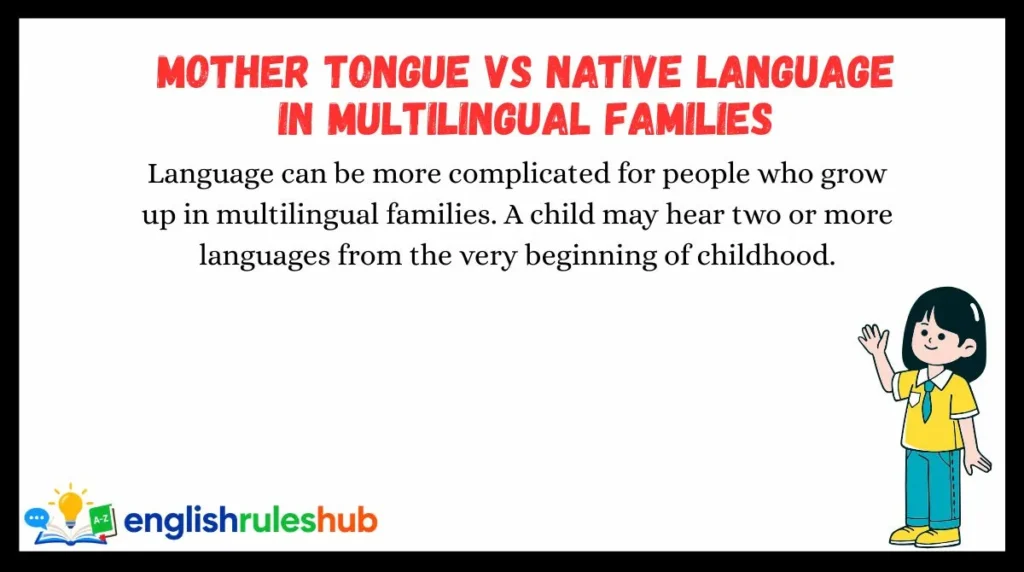
Language can be more complicated for people who grow up in multilingual families. A child may hear two or more languages from the very beginning of childhood.
For example, one parent may speak Urdu while the other speaks Punjabi. The child may naturally understand and speak both languages at home. In this situation, it may not make sense to force the person to choose only one language as their early language.
A person might say:
I grew up speaking Urdu and Punjabi.
They might also describe both as native languages or mother tongues, depending on how they understand their own language background.
This is why questions about someone’s mother tongue or native language do not always have only one simple answer. Personal language history matters.
The important point is that these expressions describe a person’s relationship with a language during childhood. They do not necessarily tell us how many languages the person speaks today, which language they use most often, or which language they consider easiest.
Grammar Rules You Must Remember
Rule #1: Use “my,” “your,” “his,” “her,” or “their” before the expressions when needed
Both expressions are countable noun phrases.
Examples:
English is my native language.
Urdu is her mother tongue.
What is your native language?
Punjabi is their mother tongue.
Do not say:
English is my native.
Instead, say:
English is my native language.
“Native” by itself is normally an adjective, so it needs a noun here.
Rule #2: “Mother tongue” does not mean “language spoken by my mother”
This is one of the easiest mistakes to make.
The phrase describes a person’s early language background. It does not require the person’s mother to be the teacher.
For example:
Punjabi is his mother tongue.
This does not tell us that his mother speaks Punjabi. It tells us that Punjabi is the language he naturally grew up with.
Rule #3: A person can have more than one native language
Do not assume that everyone has only one.
For example:
She has two native languages: Urdu and English.
This can be correct if she learned both languages naturally from early childhood.
The same idea can apply to mother tongue:
He grew up with two mother tongues.
The exact wording people choose may depend on their personal language history.
Rule #4: Native language does not always mean strongest language
A person’s language ability can change over time.
For example:
Arabic is my native language, but I use English more at work.
This is completely possible.
The language someone learned naturally as a child and the language they currently use most are two different ideas.
Common Mistakes Students Make
Learners often make mistakes because they try to understand these expressions word by word.
Mistake 1: Thinking “mother tongue” means the mother’s language
Wrong idea:
My mother speaks Urdu, so Urdu must be my mother tongue.
This is not necessarily true.
A person’s mother tongue depends on the language they naturally learned and used during childhood.
Better way to think:
Ask yourself:
“What language did I naturally grow up speaking?”
That question is more useful than asking which language your mother speaks.
Mistake 2: Thinking everyone has only one native language
Some children grow up speaking two or more languages naturally.
For example:
My father speaks Punjabi, and my mother speaks Urdu. I learned both languages as a child.
That person may reasonably describe both languages as native languages.
Mistake 3: Thinking native language means best language
This is not always true.
Consider:
Sara’s native language is Urdu, but she has worked in an English-speaking environment for 20 years.
Her English may now be stronger for professional situations.
That does not automatically change her native language.
Easy tip: Native language describes your early language background. Strongest language describes the language you use or handle best now.
Mistake 4: Using “native” as a noun
A learner might say:
Urdu is my native.
This sounds incomplete.
Say:
Urdu is my native language.
Or:
Urdu is my first language.
Mistake 5: Assuming “native language” means official language
A country can have an official language, a national language, and many native languages.
For example, a person can live in a country where English is widely used but have Punjabi as a native language.
Country language and personal native language are not automatically the same thing.
Easy Trick to Remember the Difference
Here is a simple memory trick:
Mother tongue = think “home and childhood.”
Native language = think “natural language background.”
When you hear mother tongue, imagine a child talking with family at home.
When you hear native language, think about the language a person naturally learned while growing up.
For example:
“I speak Punjabi with my family.”
This makes mother tongue feel natural.
Now imagine a language form asking:
“What is your native language?”
That sounds more like a factual question about your language background.
But remember one important point: the two expressions overlap a lot.
You do not need to worry that you will always be wrong if you choose one instead of the other. In most normal situations, both can describe the same language.
A useful classroom shortcut is:
Mother tongue → childhood and culture
Native language → childhood and natural language
This is not a strict grammar rule. It is simply a helpful way to remember the usual difference in emphasis.
Daily Life Examples (Very Important)
Here are some natural examples you may hear in real conversations.
Example 1: Meeting a new person
Ali: What is your native language?
Sara: Urdu is my native language, but I also speak English.
Example 2: Talking about family
Ahmed: Do you speak Punjabi at home?
Bilal: Yes. Punjabi is my mother tongue, so I speak it with my family.
Example 3: Talking about school
Teacher: Which language did you learn first?
Student: Urdu was my first language and my mother tongue.
Example 4: Talking about bilingual children
Ayesha: Your children speak English very well.
Maryam: Yes. They grew up speaking English and Urdu, so both languages are part of their early language background.
Example 5: Talking about work
Manager: Is English your native language?
Employee: No. My native language is Punjabi, but I use English every day at work.
Example 6: Talking about culture
Friend: Why do you speak your mother tongue when you visit your grandparents?
You: Because they are more comfortable speaking it, and it is an important part of our family.
Example 7: Filling out a form
Form: Native language:
Answer: Urdu
This is a normal use of “native language” in a formal setting.
Example 8: Discussing language learning
Student: English is difficult for me.
Teacher: That is normal. English is not your native language, so you need regular practice.
Example 9: Talking about language ability
Friend: Is English your first language?
You: No. Punjabi is my mother tongue, but I have studied English for many years.
Example 10: Talking about two languages
Person A: Which language did you grow up speaking?
Person B: I grew up speaking both Urdu and Punjabi. I consider both languages part of my native language background.
Practice Section
Choose the better answer in each sentence.
1. Which sentence is correct?
A. English is my native.
B. English is my native language.
2. Which expression can refer to a language learned naturally during childhood?
A. Mother tongue
B. Both mother tongue and native language
3. Choose the natural sentence.
A. What is your mother tongue?
B. What is your mother language?
4. Choose the correct sentence.
A. Urdu is my native language, but I use English at work.
B. Urdu is my native language, so English cannot be stronger for me.
5. Which statement is possible?
A. A person can grow up with two native languages.
B. A person can never have two native languages.
Answers
1. B — English is my native language.
“Native” is an adjective here, so “language” completes the noun phrase.
2. B — Both mother tongue and native language.
The two expressions usually refer to a language learned naturally from childhood.
3. A — What is your mother tongue?
“Mother tongue” is the standard expression.
4. A — Urdu is my native language, but I use English at work.
A person’s native language does not have to be the language they currently use most.
5. A — A person can grow up with two native languages.
Bilingual children can naturally learn two languages from an early age.
FAQs
What is the difference between mother tongue and native language?
The two expressions usually have almost the same meaning. Both can describe a language a person learned naturally during childhood.
“Mother tongue” can sound more connected to family, culture, and identity, while “native language” often sounds more neutral and factual.
Is mother tongue the same as first language?
Often, yes, but the terms are not always perfectly identical.
A first language usually means the language learned first. Mother tongue often refers to the language connected to a person’s early home or cultural background.
In many everyday situations, people use the terms interchangeably.
Can I use “native language” in a question?
Yes. It is very common.
For example:
What is your native language?
You can also ask:
What is your mother tongue?
Both questions are natural when you want to know someone’s early language background.
Is “mother tongue” formal or informal?
“Mother tongue” is a normal expression and can be used in both everyday and formal contexts.
It is common when people talk about culture, family, education, and language identity. However, “native language” may sound more neutral in forms, research, and professional language discussions.
Can a person have two mother tongues?
Yes, especially if they naturally grow up with two languages.
For example, a child may regularly use Urdu with one parent and Punjabi with another parent from early childhood. That child may consider both languages their mother tongues.
Language backgrounds are not always simple or limited to one language.
Is my native language always the language I speak best?
No.
A person may learn one language naturally as a child and later become more skilled or comfortable in another language.
For example, someone may have Punjabi as a native language but use English more often at work. Their strongest language in a particular situation can change over time.
Is “mother tongue” the language my mother speaks?
Not necessarily.
The phrase does not literally mean “my mother’s language.” It normally refers to a language learned naturally during childhood, often in the home or community.
Your mother may speak one language while you grow up learning another language or several languages.
Final Conclusion
Mother tongue and native language are very close in meaning. Both commonly describe a language that a person learns naturally during childhood.
The main difference is usually one of emphasis. “Mother tongue” can feel more personal and may bring ideas of family, culture, and childhood. “Native language” often sounds more neutral and focuses on a person’s natural language background.
Remember that neither term must mean the language a person speaks best today. A person can grow up with one language and later become stronger in another. A child can also naturally grow up with two languages.
If you are unsure which expression to use, do not worry. In most everyday situations, mother tongue and native language can communicate the same basic idea.
The best way to remember them is simple: mother tongue connects with childhood and culture, while native language connects with natural language background.
Keep practicing these expressions in real sentences, and they will soon feel completely natural.

I am Benjamin Clark, an English language writer passionate about simplifying grammar, vocabulary, and word meanings. I create clear, accurate, and practical content to help learners improve their English skills with confidence every day.


3 thoughts on ““Mother Tongue vs Native Language” What Is the Difference in 2026?”