English has many word pairs that look almost the same but make learners stop and think. Extensible and extendible are a good example.
Both words come from the verb extend, and both can describe something that can be extended. That makes the difference seem difficult at first.
The good news is that you do not need to learn two completely different meanings. In most situations, extensible and extendible have very similar meanings.
Merriam-Webster defines extensible as “capable of being extended,” while Collins lists extendible as a synonym of extensible.
So why do people use one word instead of the other?
The main difference is usage and preference, not a major difference in meaning. Extensible is especially common in technical and computer-related English.
For example, we often talk about an extensible software system, extensible language, or extensible architecture.
Cambridge specifically uses extensible for computer programs and languages that can be changed or adapted for users’ needs.
Extendible is also a real English word. It can mean that something can be made longer, larger, broader, or continued for a longer time. However, it is generally less common than extensible in many modern contexts.
After reading this guide, you will understand extensible vs extendible, when each word sounds natural, how they work grammatically, and which one you should choose in everyday and technical English.
What Does “Extensible” Mean?
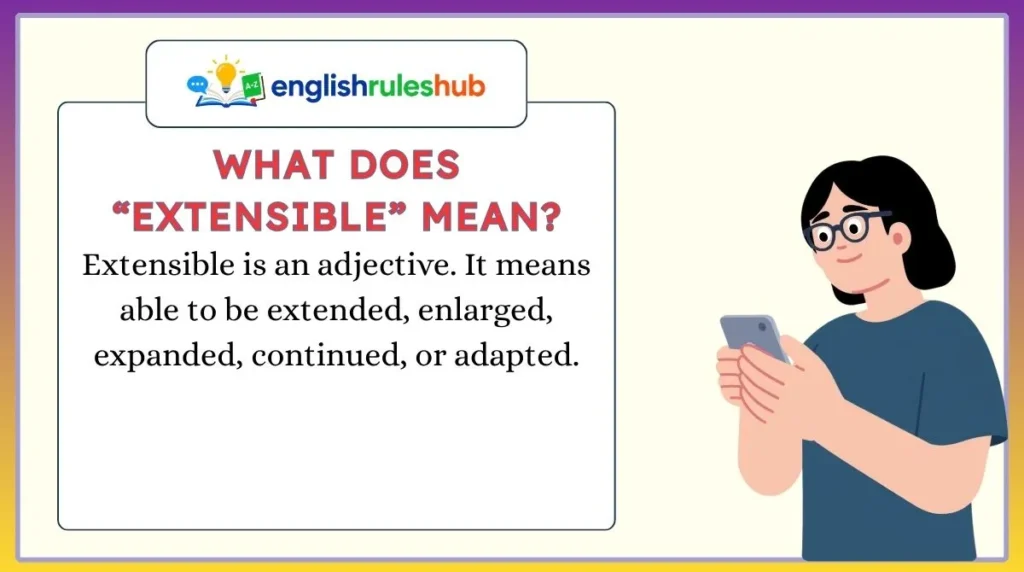
Extensible is an adjective. It means able to be extended, enlarged, expanded, continued, or adapted.
Merriam-Webster gives the simple meaning “capable of being extended.”
The word comes from the verb extend, which means to make something longer, larger, wider, broader, or greater in scope. Depending on the situation, extend can also mean to continue something for a longer period.
For example:
- We can extend the building.
- We can extend the deadline.
- We can extend the road.
- We can extend the program with new features.
When we turn the idea into an adjective, we can say:
- The building is extensible.
- The deadline is extensible.
- The system is extensible.
However, not every sentence with extend naturally uses extensible. The word is especially useful when you want to describe something that was designed or expected to allow future extension.
When should you use “extensible”?
Use extensible when something can be extended or adapted without being completely replaced.
This is very common in technology, software, engineering, systems, design, and academic writing.
For example, a software system may allow programmers to add new features later. We can call that system extensible.
Cambridge gives extensible a specific IT meaning: a computer program or language that users can change to make it suitable for their needs. Its examples also include extensible systems, libraries, records, and frameworks.
Examples of “extensible”
- The software has an extensible design.This means developers can add new features or functions later.
- We need an extensible system.The system should be able to grow as our needs change.
- The platform is highly extensible.Users or developers can add more functions to it.
- This language is extensible through plugins.New capabilities can be added through plugins.
- The framework has an extensible architecture.Its basic design allows developers to add more parts.
- The list is extensible.More items can be added to the list.
- The model is extensible to other situations.The model can be applied or developed for other situations.
- The system was designed to be extensible.Future changes and additions were considered when the system was created.
A common learner confusion
Many students see extensible and think it must mean exactly the same thing as extendable.
The meanings are closely related, but usage can differ.
For example, if you are talking about a ladder that can physically become longer, extendable ladder is the natural everyday expression:
I bought an extendable ladder.
Cambridge defines extendable as something that can be made longer and gives examples such as an extendable ladder and an extendable lease.
But if you are talking about a computer system that can receive new functions, extensible is much more natural:
The software has an extensible architecture.
This distinction is useful because learners sometimes try to use extensible everywhere simply because it means “capable of being extended.”
What Does “Extendible” Mean?
Extendible is also an adjective. It means capable of being extended.
In other words, something described as extendible can be made longer, continued, expanded, or extended in some way.
Collins lists extendible as meaning extensible, with extendable also given as a related form.
Oxford also treats extendible as another form of extendable. Its dictionary definition describes something that can be made longer or made valid for a longer time.
So, the basic meaning is not a mystery:
extendible = capable of being extended
When should you use “extendible”?
You can use extendible when something can be made longer, continued, or expanded.
It can appear in technical, legal, business, financial, and general contexts.
For example:
- an extendible contract
- an extendible lease
- an extendible period
- an extendible structure
- an extendible model
The word is correct English, but it is less common in many situations than extensible or extendable.
This is an important point for learners. If you find extendible in a dictionary, do not assume it is the most common choice in every situation.
Examples of “extendible”
- The contract is extendible for another year.The contract can continue for another year.
- The lease is extendible by mutual agreement.The lease can be continued if both sides agree.
- The deadline is extendible in special cases.The deadline can be made later in certain situations.
- The table has an extendible section.The table can be made longer.
- The model is extendible to other cases.The model can be applied to additional cases.
- The loan has an extendible repayment period.The repayment period can be made longer.
- The structure is extendible if more space is needed.More parts can be added to the structure.
- The agreement contains an extendible term.The term can continue for a longer period.
A common learner confusion
One common mistake is thinking that extendible is incorrect because extendable looks more natural.
That is not true.
Extendible is a legitimate English adjective. Major dictionaries recognize it. Merriam-Webster, for example, lists extendible as a less common form of extendable.
The better question is not:
“Is extendible correct?”
It is:
“Is extendible the most natural word in this particular sentence?”
That is a much better way to think about word choice.
Difference Between Extensible and Extendible (Detailed)
The easiest answer is this:
Extensible and extendible can both mean “capable of being extended.”
There is no large difference in their basic dictionary meaning.
However, they are not equally common in every context.
Extensible is particularly common when talking about systems, software, programs, languages, frameworks, architecture, and things that can be expanded by adding new functions or parts. Cambridge specifically associates the word with adaptable computer programs and languages.
Extendible is also correct, but it is less common in many modern uses. It may appear when something can be made longer or continued, especially in formal, technical, legal, or business contexts.
Quick comparison table
| Point | Extensible | Extendible |
|---|---|---|
| Part of speech | Adjective | Adjective |
| Basic meaning | Able to be extended | Able to be extended |
| Root word | Extend | Extend |
| Common in technology | Very common | Less common |
| Common with software | Yes | Possible, but less natural |
| Common with systems | Very common | Possible |
| Can describe physical extension | Yes | Yes |
| Can describe future expansion | Yes | Yes |
| Can describe continuation | Yes | Yes |
| Everyday frequency | Moderate | Less common |
| Is it correct? | Yes | Yes |
Usage difference
The biggest practical difference is what sounds natural to modern English speakers.
Compare:
This software is extensible.
This sounds very natural in technology.
Now compare:
This software is extendible.
This is understandable and can be grammatically correct, but it is not usually the first choice for many technical writers.
Now consider a physical object:
The table is extendable.
That is very natural.
The table is extendible.
This is possible, but many speakers would prefer extendable.
So remember that there are actually three related adjectives:
- extensible
- extendible
- extendable
All can relate to the idea of being capable of extension, but their usual contexts are different.
Grammar logic
Both extensible and extendible are adjectives.
They can come before a noun:
an extensible system
an extendible contract
They can also come after a linking verb:
The system is extensible.
The contract is extendible.
They can also be modified by adverbs:
The system is highly extensible.
The agreement is easily extendible.
The grammar is therefore almost identical.
Sentence structure
You can use either word in common adjective patterns.
Before a noun:
We need an extensible platform.
We need an extendible agreement.
After “be”:
The platform is extensible.
The agreement is extendible.
With “can be”:
The system can be extended.
Notice something important here: sometimes the safest choice is simply to use the verb.
Instead of:
The system is extensible.
You can say:
The system can be extended.
This is often easier for beginners and can make your meaning clearer.
Meaning comparison
In most cases:
extensible ≈ extendible
Neither word automatically means “better,” “stronger,” or “easier to extend.”
They simply describe something that can be extended.
The context decides what “extended” means.
It might mean:
- made longer
- made larger
- continued
- expanded
- broadened
- adapted
- given additional functions
- applied to new situations
That is why the two words can appear in several different types of writing.
Grammar Rules You Must Remember
Rule #1: Both words are adjectives
Extensible and extendible describe nouns.
For example:
We need an extensible platform.
The agreement is extendible.
Do not treat them as verbs.
You cannot normally say:
We extensible the system.
That is incorrect.
Use the verb extend:
We extend the system.
Rule #2: “Extensible” is especially useful for systems and technology
When talking about software, programming languages, frameworks, platforms, or architectures, extensible is often the better choice.
For example:
The software was built with an extensible architecture.
This tells us that developers can add new functions or parts.
Cambridge’s IT definition strongly supports this kind of use.
Another example:
We need an extensible API.
The idea is that developers should be able to add or support more capabilities later.
Rule #3: “Extendible” is correct, but it is often less common
Do not mark extendible as wrong just because another word sounds more familiar.
For example:
The contract is extendible.
This is correct.
But in some situations, extendable or another construction may sound more natural:
The contract is extendable.
Or:
The contract can be extended.
The exact choice depends on the type of writing and the noun being described.
Rule #4: Use “can be extended” when you want maximum clarity
For beginners, this is a very useful rule.
If you are unsure whether extensible or extendible sounds natural, use:
can be extended
For example:
The deadline can be extended.
The system can be extended.
The contract can be extended.
The building can be extended.
This structure is simple, clear, and grammatically safe.
You do not always need a special adjective.
Common Mistakes Students Make
Mistake 1: Thinking “extendible” is wrong
Some learners see extensible more often and assume extendible must be a spelling mistake.
That is incorrect.
Extendible is a real English word. Dictionaries recognize it as a form related to extendable and extensible.
Wrong idea:
“Extendible is not a real word.”
Better understanding:
“Extendible is correct, but it may not be the most common choice in every context.”
Mistake 2: Using “extensible” for every physical object
A learner may write:
I bought an extensible ladder.
The sentence may be understood, but extendable ladder is much more natural in ordinary English.
Cambridge uses extendable for things such as ladders and leases.
A better sentence is:
I bought an extendable ladder.
Mistake 3: Using “extendible” for software when “extensible” is more natural
For example:
This application has an extendible architecture.
It is understandable, but extensible architecture is a much more established technical expression.
Better:
This application has an extensible architecture.
Mistake 4: Confusing “extensible” with “expandable”
These words are related, but they are not always interchangeable.
Expandable usually focuses on becoming larger or having more capacity.
The phone has expandable storage.
Extensible often focuses on adding functions, features, scope, or new parts.
The software has an extensible design.
There can be overlap, but the focus is different.
Mistake 5: Thinking the spelling tells you the whole meaning
The endings -ible and -able can confuse learners.
English has many adjectives ending in both forms, and spelling alone does not always tell you which word is most natural.
Instead of trying to create a rule from spelling, learn the common expression.
For example:
extensible architecture
extensible software
extendable ladder
extendible contract
This is a much more useful strategy.
Easy Trick to Remember the Difference
Here is a simple memory trick:
Extensible = think “extra features.”
Extendible = think “extension is possible.”
When you see extensible, imagine a system that can grow by adding things.
For example, imagine a basic app.
Today it has five features. Next year, developers add ten more features.
That app is extensible.
Now imagine a contract.
The contract ends on December 31, but the two sides can continue it for another year.
The contract is extendible.
This does not mean that extensible cannot describe a contract or that extendible cannot describe a system. The meanings overlap.
The trick simply helps you remember the common feel of each word.
A second easy trick
Think about the nouns around the words.
Extensible:
- software
- platform
- framework
- architecture
- language
- system
- library
- design
Extendible:
- contract
- agreement
- period
- term
- lease
- repayment period
- structure
Again, these are tendencies, not strict grammar rules.
If you remember that extensible is especially common in technical English, you will already avoid many word-choice problems.
Daily Life Examples (Very Important)
Here are some natural examples to help you see how these words work.
Example 1: Talking about software
A: Can we add new features later?
B: Yes. The platform is highly extensible.
The speaker means that new functions can be added in the future.
Example 2: Talking about a computer system
A: Will this system work if our company grows?
B: Yes. It has an extensible design.
The design can support future additions or changes.
Example 3: Talking about a contract
A: Does the agreement end this month?
B: Yes, but it is extendible for another six months.
Here, extendible means the agreement can continue for a longer period.
Example 4: Talking about a ladder
A: How can you reach that window?
B: I have an extendable ladder.
Here, extendable is the natural everyday choice.
Example 5: Talking about a website
A: Can we add more tools to the website later?
B: Sure. The system is extensible.
The system was designed so new functions can be added.
Example 6: Talking about a business agreement
A: Can we keep the agreement after December?
B: Yes. The agreement is extendible.
The agreement can continue beyond its original period.
Example 7: Talking about a framework
A: Why did you choose this framework?
B: Because it is flexible and extensible.
The developer can add new functions without rebuilding everything from scratch.
Example 8: Talking about a deadline
A: The project deadline is tomorrow. Can we get more time?
B: The deadline may be extendible if the manager approves it.
The meaning is that the time limit may be extended.
Example 9: Talking about a list
A: Is this list complete?
B: No. It is extensible, so we can add more items.
Here, extensible means that more items can be added.
Example 10: Using the clearest alternative
A: Can we change the system later?
B: Yes. It can be extended.
This is a very useful sentence pattern because it avoids any uncertainty about which adjective to choose.
Practice Section
Choose the best answer for each sentence.
1. The software has an ______ design that allows developers to add new features.
a) extensible
b) extendible
2. The contract is ______ for another year.
a) extensible
b) extendible
3. We bought an ______ ladder for the house.
a) extensible
b) extendable
4. This programming framework is highly ______.
a) extensible
b) extendible
5. The agreement can be ______ if both parties agree.
a) extensible
b) extended
Answers
1. a) extensible
Software and programming systems commonly use extensible.
2. b) extendible
Extendible can describe something that can continue for a longer period.
3. b) extendable
Extendable ladder is the natural everyday expression.
4. a) extensible
Extensible framework is a common technical expression.
5. b) extended
“Can be extended” is simple, clear, and natural.
FAQs
What is the difference between extensible and extendible?
Both words can mean capable of being extended. The main difference is their usual usage and frequency.
Extensible is especially common in technical English, particularly for software, systems, languages, and architecture. Extendible is correct but is generally less common in many contexts.
Is “extendible” a correct English word?
Yes. Extendible is a correct English adjective.
Major dictionaries recognize it. Merriam-Webster lists extendible as a less common form of extendable, while Collins gives it as a synonym of extensible.
So you should not treat extendible as a spelling error.
Is extensible more common than extendible?
In many modern technical contexts, yes.
Extensible is widely used for software, computer languages, platforms, frameworks, and systems. Cambridge specifically gives an IT meaning for the word.
However, frequency can depend on the subject and type of writing.
Should I say “extensible software” or “extendible software”?
Extensible software is normally the better choice.
It clearly suggests software that can be changed, customized, or given additional functions. This is a well-established technical use of extensible.
“Extendible software” is understandable, but it is less natural for many technical readers.
Is an extensible ladder correct?
It may be understandable, but extendable ladder is the more natural everyday phrase.
Cambridge uses extendable for a ladder that can be made longer.
For physical objects, extendable is often a better choice than extensible.
Is “extensible” formal or informal?
Extensible is neutral to formal, but it is particularly common in technical and professional writing.
You may see it in software documentation, engineering discussions, academic work, and business technology writing.
In everyday conversation, people may simply say can be extended instead.
Can extensible and extendible be used interchangeably?
Sometimes, yes.
Because both words can mean “capable of being extended,” they can overlap in meaning. But interchangeable does not always mean equally natural.
For example, extensible architecture sounds more natural than extendible architecture in many software contexts.
Which is better: extensible or extendible?
There is no single answer for every sentence.
For software, systems, frameworks, programming languages, and architecture, choose extensible in most cases.
For something that can simply be continued or made longer, extendible may be possible, although extendable or can be extended may sound more natural.
Final Conclusion
The difference between extensible and extendible is much smaller than it first appears. Both words can describe something that is capable of being extended. The main issue is not grammar but natural usage and context.
Extensible is the word you are more likely to see in technical English. It works especially well with software, systems, frameworks, programming languages, platforms, and architecture.
Extendible is also correct English. It can describe something that can be made longer or continued, but it is generally less common in many modern contexts. Dictionaries recognize it as a valid form.
If you are unsure, remember this simple idea: extensible often sounds natural when something can grow by adding new features or functions.
For a physical object or a period of time, extendable or can be extended may be clearer.
The best way to learn the difference is to notice these words in real sentences and practice using them yourself. Once you see the common patterns, the choice becomes much easier.

I am Benjamin Clark, an English language writer passionate about simplifying grammar, vocabulary, and word meanings. I create clear, accurate, and practical content to help learners improve their English skills with confidence every day.