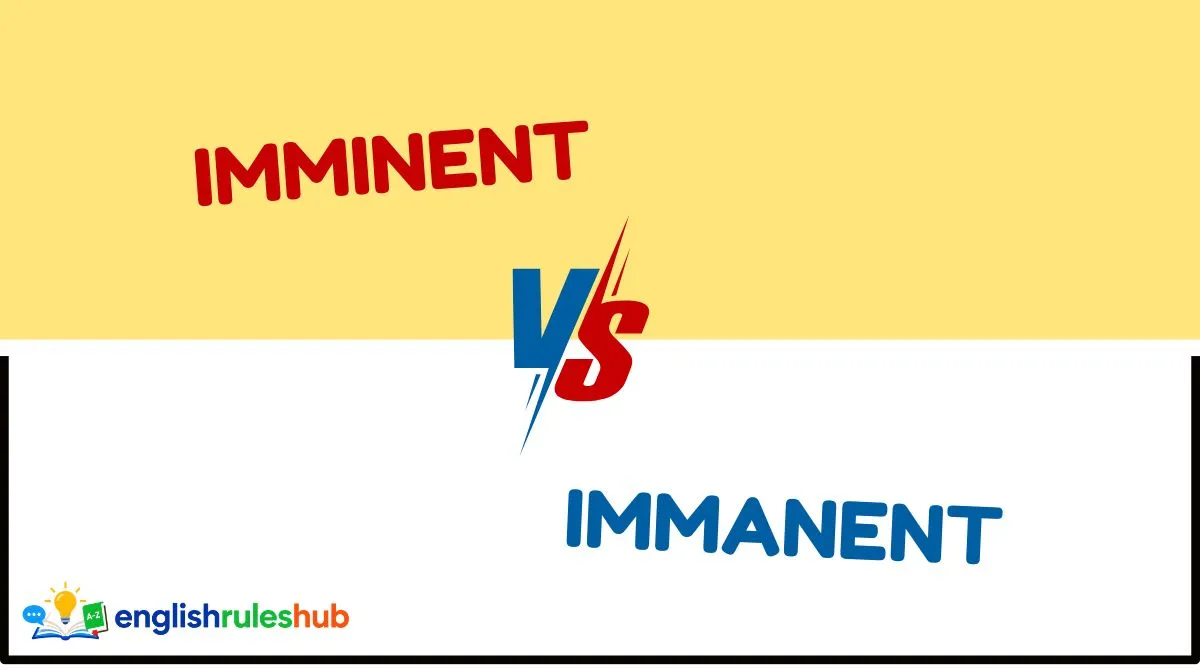
Some English words look almost the same but have very different meanings. Imminent and immanent are a perfect example.
They differ by only one letter, yet they are used in completely different situations. Because their spelling and pronunciation are so similar, many students mix them up when speaking or writing.
This confusion is common, especially for beginners and non-native English speakers. You may see these words in books, news reports, essays, religious writing, or even classroom discussions.
If you choose the wrong word, your sentence may sound strange or give the wrong meaning.
The good news is that the difference is not difficult once you understand the basic idea behind each word.
One word is about something that is about to happen, while the other describes something that exists within or is naturally present. After you learn this simple idea, remembering the correct word becomes much easier.
By the end of this guide, you will clearly understand when to use imminent and immanent, how their meanings differ, the grammar rules behind them, and how to avoid common mistakes.
You will also find plenty of easy examples that show how these words are used in real English.
What Does “Imminent” Mean?
Imminent is an adjective. It means something is going to happen very soon. It describes an event or situation that is close in time and expected to happen shortly.
Think of imminent as another way of saying about to happen, coming soon, or close at hand.
When Do We Use “Imminent”?
Use imminent when talking about:
- Events that will happen very soon
- Danger that is close
- Changes that are expected shortly
- Future situations that are almost here
The word often appears in news reports, weather forecasts, emergency warnings, business writing, and formal English.
Grammar Rule for “Imminent”
Imminent is an adjective, so it comes:
- Before a noun
- After a linking verb such as is, was, seems, becomes, appears
Structure:
- Imminent + noun
- Subject + be + imminent
Examples:
- An imminent storm forced people indoors.
- The exam is imminent.
- Everyone prepared for the imminent arrival of the guests.
Example Sentences with “Imminent”
- The heavy clouds showed that rain was imminent.
- Doctors warned that surgery was imminent.
- The company expected imminent changes.
- Police believed an attack was imminent.
- Her birthday is imminent, so we are planning a party.
- The school announced the imminent opening of the new library.
- We packed our bags because our departure was imminent.
- The teacher reminded us that the final test was imminent.
Common Words Used with “Imminent”
Many words naturally go with imminent. These combinations are called collocations.
Some common ones are:
- imminent danger
- imminent threat
- imminent arrival
- imminent death
- imminent change
- imminent risk
- imminent launch
- imminent collapse
- imminent decision
- imminent release
These word pairs sound natural because native speakers use them often.
Common Learner Confusion
Many learners think imminent means something that is important or powerful. That is not correct.
It only tells us that something is very close to happening.
Correct:
- The volcano showed signs of an imminent eruption.
Incorrect:
- She has an imminent personality.
The second sentence is wrong because a personality cannot be “about to happen.”
What Does “Immanent” Mean?
Immanent is also an adjective, but its meaning is completely different.
It means existing within something or naturally present inside it. It describes a quality, force, or spirit that is part of something instead of coming from outside.
This word is much less common than imminent. You will usually find it in philosophy, religion, literature, or formal academic writing.
When Do We Use “Immanent”?
Use immanent when talking about:
- A quality that naturally exists within something
- Religious ideas
- Philosophical discussions
- Natural characteristics
- Inner forces or principles
Grammar Rule for “Immanent”
Like imminent, immanent is an adjective.
It usually comes:
- Before a noun
- After linking verbs
Structure:
- Immanent + noun
- Subject + be + immanent
Example Sentences with “Immanent”
- Some religions believe that God is immanent in nature.
- Justice is immanent in every fair society.
- Many philosophers discuss the immanent order of the universe.
- Love is an immanent part of family life.
- The writer believed that beauty was immanent in art.
- Hope remained immanent throughout the community.
- The idea of peace was immanent in his message.
- Many scholars study the concept of immanent truth.
Common Words Used with “Immanent”
Some natural combinations include:
- immanent force
- immanent presence
- immanent nature
- immanent reality
- immanent principle
- immanent power
- immanent truth
- immanent quality
These expressions are mostly found in formal English rather than everyday conversations.
Common Learner Confusion
Because immanent and imminent look almost identical, students often use one instead of the other.
For example:
❌ The storm is immanent.
✅ The storm is imminent.
A storm is something that is about to happen, so imminent is correct.
Now look at another example:
❌ Kindness is imminent in every child.
✅ Kindness is immanent in every child.
Here, kindness is a quality that exists within someone, so immanent is the correct choice.
Difference Between Imminent and Immanent (Detailed)
Although these two words differ by only one letter, they express completely different ideas.
| Feature | Imminent | Immanent |
|---|---|---|
| Meaning | About to happen very soon | Existing within something |
| Part of Speech | Adjective | Adjective |
| Time Related? | Yes | No |
| Everyday Use | Common | Rare |
| Used In | News, conversations, business, school | Philosophy, religion, literature |
| Main Idea | Near in time | Existing inside |
| Easy Meaning | Coming soon | Present within |
Meaning Difference
The biggest difference is their meaning.
Imminent focuses on time. It tells us that something is very close to happening.
Examples:
- The train’s arrival is imminent.
- An economic crisis seems imminent.
- Victory looked imminent.
Immanent focuses on existence within something.
Examples:
- Peace is immanent in true understanding.
- Compassion is immanent in human nature.
- The author described an immanent sense of justice.
One word is about the future, while the other is about inner existence.
Usage Difference
Use imminent whenever you mean:
- coming soon
- expected shortly
- nearly happening
Examples:
- Snow is imminent.
- The meeting is imminent.
- A decision is imminent.
Use immanent whenever you mean:
- naturally inside
- existing within
- inherent
Examples:
- Wisdom is immanent in experience.
- Truth is immanent in the story.
- Love is immanent in a caring family.
Grammar Logic
Both words are adjectives, so they follow the same grammar pattern.
Examples:
- The danger is imminent.
- Their arrival is imminent.
- The power is immanent.
- The value is immanent.
Even though the grammar is the same, the meanings are never interchangeable.
Sentence Structure Difference
The sentence structure stays the same.
Subject + be + adjective
Examples:
- The attack is imminent.
- The beauty is immanent.
You can also place each adjective before a noun.
Examples:
- an imminent threat
- an immanent quality
The grammar pattern does not help you choose the correct word. You must think about the meaning.
Ask yourself:
- Is something about to happen? → Use imminent.
- Does something exist within? → Use immanent.
Meaning Comparison
Think of these simple ideas:
- Imminent = Soon
- Immanent = Inside
That small difference can save you from many mistakes.
For example:
- The company’s bankruptcy is imminent. (It may happen soon.)
- Creativity is immanent in every child. (It exists naturally within them.)
Notice how changing just one letter completely changes the meaning of the sentence.
A helpful habit is to pause before writing either word. Ask yourself whether you are talking about time or inner existence. If it is about something that will happen shortly, choose imminent. If it is about a quality or presence that already exists within something, choose immanent.
With enough practice, this choice will become natural, and you will rarely confuse these two similar-looking words again.
Grammar Rules You Must Remember
Even though imminent and immanent have different meanings, they follow the same grammar rules because both are adjectives. The real challenge is choosing the correct word for the meaning you want.
Here are four important grammar rules that will help you use them correctly.
Rule #1: Both Words Are Adjectives
Neither imminent nor immanent is a verb or a noun. They describe a noun or come after a linking verb.
Examples:
- The imminent storm worried everyone.
- The storm is imminent.
- The immanent beauty of nature inspired the artist.
- Beauty is immanent in nature.
If you need a word to describe something, either of these adjectives may fit—but only if the meaning is correct.
Rule #2: Use “Imminent” for Events That Are About to Happen
Choose imminent only when talking about something that is expected very soon.
Examples:
- The train’s arrival is imminent.
- An announcement is imminent.
- The company expects imminent growth.
- The rescue team prepared for imminent danger.
Ask yourself:
“Will this happen soon?”
If the answer is yes, imminent is probably the correct word.
Rule #3: Use “Immanent” for Qualities That Exist Within
Choose immanent when something naturally exists inside a person, object, idea, or system.
Examples:
- Kindness is immanent in her character.
- Wisdom is immanent in experience.
- Balance is immanent in nature.
- Hope remained immanent throughout the community.
Ask yourself:
“Does this already exist within something?”
If yes, use immanent.
Rule #4: Similar Spelling Does Not Mean Similar Meaning
Many learners rely only on spelling. That causes mistakes.
Remember:
- Imminent → about to happen
- Immanent → existing within
Compare these sentences:
✅ The earthquake is imminent.
❌ The earthquake is immanent.
An earthquake is an event, not a quality inside something.
Now compare another pair:
✅ Love is immanent in every caring family.
❌ Love is imminent in every caring family.
Love is a quality that exists within people, so immanent is the correct choice.
Common Mistakes Students Make
Because these words look and sound alike, students often confuse them. Here are the most common mistakes and simple ways to avoid them.
Mistake 1: Using “Immanent” for Future Events
Wrong:
- The meeting is immanent.
Correct:
- The meeting is imminent.
Why?
A meeting is something that will happen soon.
Tip: Think about time.
Mistake 2: Using “Imminent” for Inner Qualities
Wrong:
- Honesty is imminent in good leaders.
Correct:
- Honesty is immanent in good leaders.
Why?
Honesty is a quality, not a future event.
Mistake 3: Choosing the Word Based Only on Spelling
Some learners simply guess because both words begin with imm-.
That usually leads to errors.
Instead, ask two simple questions:
- Is it coming soon?
- Does it exist within?
The answer tells you which word to use.
Mistake 4: Thinking Both Words Are Interchangeable
They are not.
Compare these examples.
Correct:
- The team’s victory seems imminent.
Correct:
- Confidence is immanent in her personality.
Changing one word changes the meaning completely.
Easy Correction Tips
Whenever you write one of these words, pause for a second.
Remember this quick checklist:
- Soon? → Imminent
- Inside? → Immanent
This habit will help you avoid almost every mistake.
Easy Trick to Remember the Difference
A small memory trick can make these words much easier to remember.
Remember the Letter “E” in Imminent
Think of E as standing for Event.
Imminent = Event is coming soon.
Examples:
- An imminent exam.
- An imminent storm.
- An imminent announcement.
Every example describes something that has not happened yet but will happen very soon.
Remember the Letter “A” in Immanent
Think of A as standing for Already inside.
Immanent = Already exists within.
Examples:
- Kindness is immanent in her nature.
- Beauty is immanent in art.
- Wisdom is immanent in experience.
Real-Life Logic
Imagine you hear thunder outside.
You say:
“The storm is imminent.”
The storm has not started yet, but it is very close.
Now imagine you are talking about kindness.
You say:
“Kindness is immanent in her character.”
Kindness already exists inside her.
This simple picture makes the meanings much easier to remember.
Daily Life Examples (Very Important)
These examples show how the words are used in real conversations and everyday English.
- Be careful. The rain looks imminent.
- The teacher said the test is imminent, so we should study tonight.
- Everyone knew the announcement was imminent.
- The airport warned travelers of an imminent weather delay.
- My parents believe kindness is immanent in every child.
- The writer said hope is immanent in every good story.
- The doctor felt that recovery was imminent.
- Many people believe peace is immanent in human nature.
- We left early because heavy traffic seemed imminent.
- The artist believed beauty was immanent in simple things.
Notice that imminent appears much more often in daily English. Immanent is mostly used in formal writing, philosophy, religion, and literature.
Practice Section
Choose the correct word: imminent or immanent.
Questions
- The heavy clouds showed that rain was ________.
- Many people believe goodness is ________ in human nature.
- The company’s new product launch is ________.
- Justice is ________ in a fair legal system.
- The teacher said our final exam is ________.
Answers
- imminent
- immanent
- imminent
- immanent
- imminent
If you answered all five correctly, you have a solid understanding of these two confusing words.
FAQs
What is the difference between imminent and immanent?
Imminent means something is about to happen very soon. Immanent means something already exists within a person, object, idea, or system. One refers to time, while the other refers to inner existence.
Can we use imminent in questions?
Yes. You can use imminent in questions just like any other adjective.
Examples:
- Is the meeting imminent?
- Do you think rain is imminent?
Can we use immanent in everyday conversation?
You can, but it is not very common. Most people use immanent in discussions about philosophy, religion, literature, or academic topics. In everyday speech, imminent appears much more often.
Is imminent formal or informal?
Imminent is considered a standard English word that is common in both formal and neutral writing. It often appears in news reports, business communication, and official announcements.
Why do people confuse imminent and immanent?
People confuse them because they have almost identical spelling and similar pronunciation. However, their meanings are completely different. Learning the simple idea of “soon” versus “within” makes them much easier to remember.
How can I remember which word to use?
Use this easy trick:
- Imminent = Event coming soon.
- Immanent = Already inside.
Before choosing the word, ask yourself whether you are talking about time or something that exists within. The answer will guide you to the correct choice.
Final Conclusion
Learning the difference between imminent and immanent may seem difficult at first because the words look and sound so similar. However, once you understand their meanings, the confusion quickly disappears.
Remember the main idea. Imminent describes something that is about to happen. It is used for future events, warnings, changes, and situations that are very close in time.
Immanent, on the other hand, describes something that already exists within a person, object, idea, or system. It is most common in philosophy, religion, literature, and formal writing.
A simple way to remember them is this: imminent means “coming soon,” while immanent means “existing within.” Whenever you are unsure, ask yourself whether you are talking about time or inner existence.
Keep reading, writing, and practicing these words in real sentences. The more examples you see, the more natural they will become.
With regular practice, you will use imminent and immanent correctly and confidently in both speaking and writing.

I am Benjamin Clark, an English language writer passionate about simplifying grammar, vocabulary, and word meanings. I create clear, accurate, and practical content to help learners improve their English skills with confidence every day.