Aural and oral look and sound quite similar, so it is easy to mix them up. Both words are connected with language and communication, but they focus on different parts of communication. This small difference can cause big confusion for English learners.
The word aural is mainly connected with hearing. If something is aural, it is related to what we hear through our ears. For example, an aural exercise may ask students to listen carefully and understand sounds or spoken words.
The word oral, on the other hand, is mainly connected with speaking or the mouth. An oral exam is an exam in which a student answers questions by speaking instead of writing. Oral communication means communication through spoken words.
The confusing part is that both words can be used when talking about spoken English. When someone speaks, another person hears that speech. So, the same situation can involve both oral and aural skills.
Think about a classroom. A teacher asks a question, and a student answers it aloud. The student’s answer is oral because it is spoken. When another student listens to that answer, the listening activity is aural.
Once you understand this simple direction—mouth to speak, ears to hear—the difference becomes much easier.
This guide explains the meanings, grammar, common mistakes, everyday examples, and an easy way to remember when to use each word.
What Does “Aural” Mean?
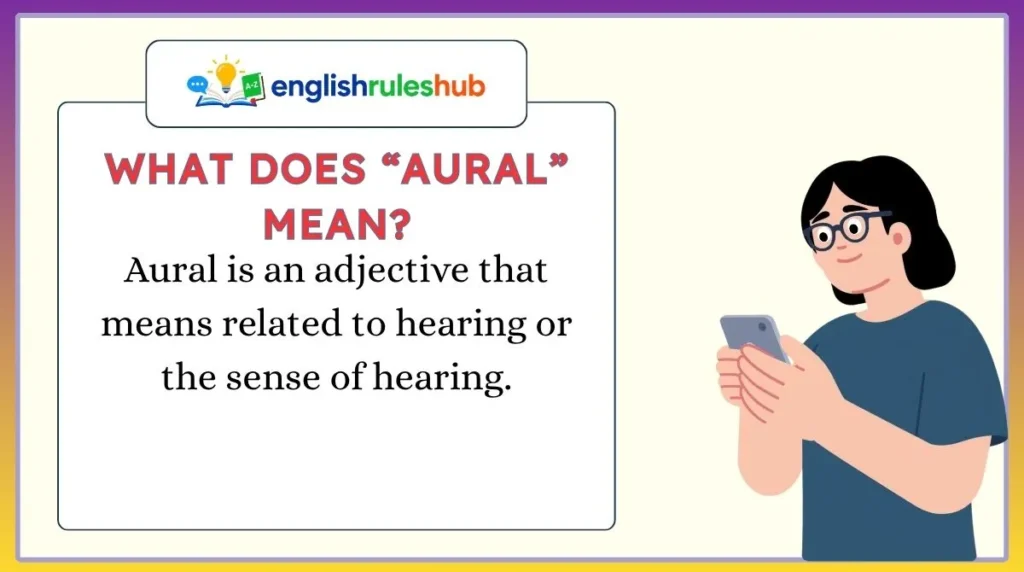
Aural is an adjective that means related to hearing or the sense of hearing.
It comes from a word connected with the ear. We use it when we are talking about something that is heard, especially sounds, spoken language, music, or listening activities.
For example:
- The students completed an aural exercise in English class.
- The test includes an aural section.
- Good aural skills help language learners understand spoken English.
- The teacher gave us an aural comprehension task.
- The course includes both written and aural activities.
- She has excellent aural awareness.
- The students listened to an aural recording.
- The lesson focuses on aural recognition of English sounds.
The key idea is simple: aural = connected with hearing.
When Do We Use “Aural”?
We often use aural in education, language learning, music, and situations involving sounds.
For example, English teachers may talk about aural comprehension. This means the ability to understand what you hear.
A student might read a sentence easily but have trouble understanding the same sentence when a native speaker says it quickly. The student may need more aural practice.
You may also hear the word in music. Aural skills can involve recognizing musical notes, rhythms, melodies, or differences in sounds by listening.
The word can also describe something experienced through hearing rather than seeing.
Aural in English Learning
In language learning, aural skills are closely related to listening.
Suppose your teacher plays this recording:
“Could you send me the report by Friday?”
You listen and understand the sentence. That listening process is aural.
You are using your ears to recognize sounds, words, stress, rhythm, and meaning.
This is why learners may see phrases such as:
- aural comprehension
- aural practice
- aural skills
- aural training
- aural recognition
- aural exercises
A Common Confusion About “Aural”
Many learners think aural simply means “spoken.” That is not quite right.
Something spoken is oral because it comes from speech. Something heard is aural because it is received through hearing.
Consider this example:
The teacher gave an oral presentation.
The teacher is speaking, so the presentation is oral.
Now consider:
The students completed an aural exercise.
The students are listening, so the exercise is aural.
The same classroom activity can sometimes involve both.
Aural Does Not Mean “Only About Language”
Another useful point is that aural is not limited to English or speech.
Music can be aural. Sounds can be aural. Listening tests can be aural. Any situation connected with hearing can potentially be described as aural.
For example:
The concert created a powerful aural experience.
Here, the focus is on what people hear.
So remember:
Aural → ears → hearing → listening
That is the main idea.
What Does “Oral” Mean?
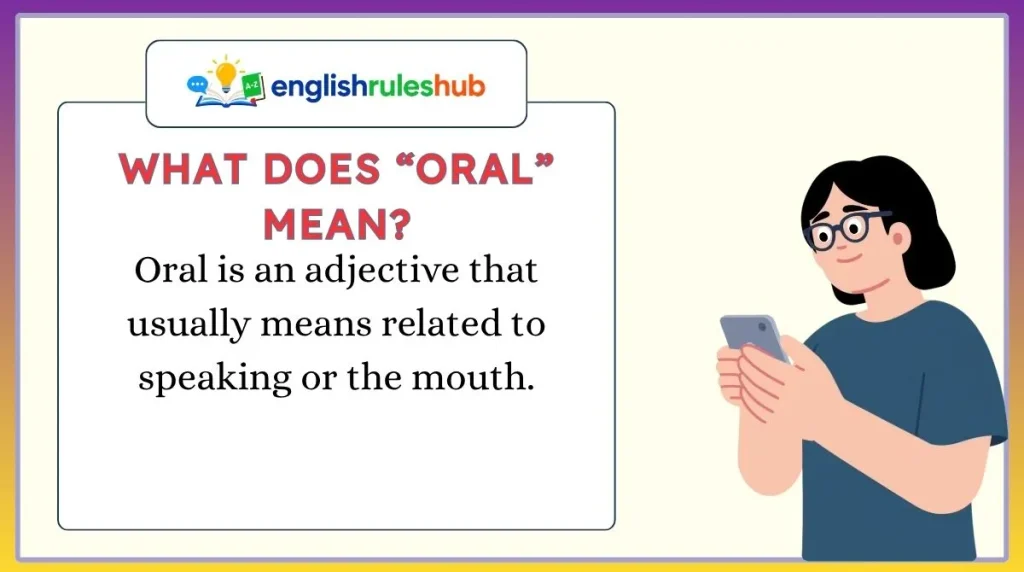
Oral is an adjective that usually means related to speaking or the mouth.
When we use oral to talk about communication, it normally means spoken rather than written.
For example:
- We had an oral exam yesterday.
- The teacher asked for an oral presentation.
- English learners need both written and oral practice.
- She gave an oral answer.
- The meeting included an oral report.
- They agreed to the plan through oral communication.
- The student gave an oral presentation to the class.
- The doctor asked about his oral health.
The meaning depends on the context. In communication, oral usually means spoken. In medical or physical contexts, it can mean related to the mouth.
When Do We Use “Oral”?
We commonly use oral when talking about speaking, spoken communication, examinations, presentations, and language skills.
For example:
I have an oral exam tomorrow.
This means the student will answer questions by speaking.
An oral exam is different from a written exam because the student gives answers with speech instead of writing them down.
We can also say:
She has strong oral communication skills.
This means she communicates effectively through speaking.
Oral Communication
Oral communication means communication through spoken language.
Imagine two friends talking about their weekend:
“What did you do on Saturday?”
“I visited my uncle.”
That is oral communication because the information is exchanged through speech.
A phone call is also a good example. You speak to another person, and they respond by speaking.
Oral Can Also Relate to the Mouth
This is an important meaning that learners sometimes forget.
Oral can also mean connected with the mouth.
For example:
- oral hygiene
- oral health
- oral care
- oral medicine
- oral cavity
In these examples, oral is not talking about speaking.
Oral hygiene means keeping your mouth and teeth clean and healthy.
So oral has two major ideas:
Oral → speaking
and
Oral → mouth
The correct meaning comes from the context.
A Common Confusion About “Oral”
A common mistake is to use oral whenever something involves sound.
But oral does not mean “heard.”
For example, if you say:
The students listened to an oral exercise.
The sentence may be understandable, but if you want to focus specifically on the listening part, aural may be the better word:
The students completed an aural exercise.
The word oral focuses on speech or the mouth.
The word aural focuses on hearing.
This distinction is especially useful in English-learning contexts.
Difference Between Aural and Oral: Detailed Explanation
The easiest way to understand the difference is to ask one question:
Are we focusing on speaking or hearing?
If the focus is speaking, use oral.
If the focus is hearing or listening, use aural.
| Word | Main meaning | Main connection | Simple question |
|---|---|---|---|
| Aural | Related to hearing | Ear | What do you hear? |
| Oral | Related to speaking or the mouth | Mouth/speech | What do you say? |
Aural = What You Hear
Imagine your English teacher plays a recording.
You listen to:
“Please open your books.”
Your task is to understand the words.
This is an aural activity because your attention is on hearing and understanding sound.
You are not producing the speech. You are receiving it.
Oral = What You Say
Now imagine the teacher asks:
“What did you do yesterday?”
You answer:
“I stayed at home and watched a movie.”
Your answer is oral because you are speaking.
The focus is on producing spoken language.
The Direction Helps
A useful way to picture the difference is:
Speaker → listener
The speaker produces an oral message.
The listener receives an aural message.
Of course, real communication is more complicated because both people usually speak and listen. Still, this simple picture is very helpful for beginners.
Grammar Logic
Both aural and oral are adjectives.
That means they normally describe nouns.
For example:
- aural skills
- aural test
- aural training
- oral skills
- oral exam
- oral presentation
We do not normally use them as verbs.
For example, we do not say:
“I aural the recording.”
or
“She oral the answer.”
Instead, use normal verbs such as hear, listen, speak, say, answer, and communicate.
Sentence Structure
Because both words are adjectives, they can appear before a noun:
an aural exercise
an oral exam
They can also appear after linking verbs in suitable sentences:
The activity was mainly aural.
The assessment was partly oral.
The word itself does not change the basic grammar of the sentence. The important difference is its meaning.
Meaning Comparison
Consider these two sentences:
The students took an oral test.
The test required students to speak.
The students took an aural test.
The test required students to listen and understand sounds or spoken language.
The difference is only one letter in spelling, but the meaning changes.
Can Something Be Both Aural and Oral?
Yes.
This is one of the most useful points to remember.
Suppose two people have a conversation.
One person speaks. That part is oral.
The other person listens. That part is aural.
If a language class asks students to listen to a recording and then answer questions aloud, the activity has both aural and oral elements.
So these words are not always opposites. They describe different parts of communication.
Grammar Rules You Must Remember
Rule #1: Use “Aural” for Hearing and Listening
Use aural when the main idea is hearing, listening, or sound received through the ears.
Example:
The students completed an aural comprehension test.
The students had to listen and understand what they heard.
A quick test is to replace aural with related to hearing. If the sentence still makes sense, aural may be correct.
Rule #2: Use “Oral” for Speaking
Use oral when something is spoken rather than written.
Example:
She has an oral presentation on Monday.
She will speak to the class instead of simply submitting a written report.
Another example:
The teacher gave the students an oral exam.
The students answer questions by speaking.
Rule #3: “Oral” Can Also Mean “Related to the Mouth”
Do not assume oral always means speaking.
Example:
Regular brushing is important for good oral health.
Here, oral means related to the mouth.
This is a different meaning from oral communication.
The context tells you which meaning is intended.
Rule #4: Both Words Are Adjectives
Remember that aural and oral normally describe nouns.
For example:
- aural training
- aural ability
- oral answer
- oral examination
You should not treat them like ordinary action verbs.
If you want to describe the action, choose a suitable verb:
listen, hear, speak, say, or answer.
This makes your English more natural and grammatically correct.
Common Mistakes Students Make
Learners often confuse these words because they look almost the same. They also appear in similar language-learning situations.
The best solution is not to memorize long definitions. Instead, focus on the direction of communication.
Mistake 1: Using Oral for Listening
Wrong:
The teacher gave us an oral listening test.
The sentence is not always impossible, but it can be confusing because oral focuses on speaking, while listening focuses on hearing.
Better:
The teacher gave us an aural test.
or simply:
The teacher gave us a listening test.
The second version is often clearer in everyday English.
Mistake 2: Using Aural for Speaking
Wrong:
I have an aural presentation tomorrow.
If you mean that you will stand in front of the class and speak, oral is the natural choice.
Correct:
I have an oral presentation tomorrow.
The presentation is spoken.
Mistake 3: Thinking Oral and Aural Are Opposites
They are different, but they are not exact opposites.
A conversation can be both oral and aural.
The speaking part is oral.
The listening part is aural.
This is why both words may appear in descriptions of language courses.
Mistake 4: Thinking Aural Means “Audio”
The words are related, but they are not always interchangeable.
Aural focuses on hearing.
Audio is a broader word commonly used for sound recordings, sound systems, and sound content.
For everyday English, people often say:
audio recording
rather than:
aural recording
So do not replace every use of “audio” with “aural.”
Mistake 5: Forgetting the Second Meaning of Oral
A learner may see:
oral health
and think it means “spoken health.”
Of course, that is not the meaning.
Here, oral means related to the mouth.
The same word can have different meanings depending on context.
Easy Trick to Remember the Difference
Here is a very simple memory trick:
Aural = Ears
Oral = Mouth
Look at the first letters:
Aural → A → Audio → Ears
This is not a perfect spelling rule, but it can help you remember the idea.
For oral, think of oratory or speaking. An oral presentation is something you give by speaking.
You can also use this little classroom picture:
Mouth → ORAL → SPEAK
Ears → AURAL → HEAR
That is enough for most everyday situations.
Use the “Speaker or Listener?” Trick
When you are unsure, ask yourself:
“Am I talking about the person speaking or the person listening?”
If the focus is the speaker, choose oral.
If the focus is the listener, choose aural.
For example:
I gave an oral answer.
You spoke.
I listened to an aural exercise.
You heard something.
This trick is especially useful when writing about English classes.
One More Easy Example
Imagine your friend calls you.
Your friend says:
“Are you free tonight?”
Your friend is using oral communication.
You hear the question.
Your listening is aural.
Then you answer:
“Yes, I am.”
Your answer is oral too.
So one short conversation can contain both types of communication.
Daily Life Examples
Here are some natural examples that show how these words work in real situations.
Example 1: English Class
Teacher: “Today, we are doing an aural exercise.”
Student: “Do we need to write anything?”
Teacher: “First, listen to the recording. Then answer the questions.”
The exercise is aural because the students must listen.
Example 2: Oral Exam
Student: “Are you nervous?”
Friend: “A little. I have an oral exam this afternoon.”
The exam is oral because the student must answer by speaking.
Example 3: Listening Practice
Teacher: “You need more aural practice.”
Student: “Should I listen to English podcasts?”
Teacher: “Yes. Listen to natural conversations every day.”
The focus is on hearing and understanding spoken English.
Example 4: Class Presentation
Student: “When is your presentation?”
Friend: “Mine is tomorrow. It is an oral presentation.”
The student will speak to the class.
Example 5: Phone Conversation
Person A: “Did you understand what he said?”
Person B: “Not really. His accent was difficult for me to understand.”
This situation involves aural understanding because the listener is trying to understand what was heard.
Example 6: Oral Communication
Manager: “Please explain the problem.”
Employee: “The computer stopped working this morning.”
The employee is communicating orally by speaking.
Example 7: Oral Health
Dentist: “How often do you brush your teeth?”
Patient: “Twice a day.”
Here, oral means related to the mouth, not speaking.
The phrase oral health is about the health of the mouth and teeth.
Example 8: Music
Teacher: “This activity will test your aural skills.”
Student: “Will I need to identify the notes by listening?”
Teacher: “Exactly.”
The students use their ears to recognize sounds.
Example 9: Language Course
Student: “Does the course include speaking practice?”
Teacher: “Yes. It includes both oral and aural activities.”
Students practice speaking as well as listening.
Example 10: Interview Practice
Teacher: “Your written work is good, but your oral English needs more practice.”
Student: “I understand. I need to speak more often.”
Here, oral English means spoken English.
Practice Section
Choose aural or oral in each sentence.
1. We have an ______ exam tomorrow.
aural / oral
2. The students listened to an ______ recording.
aural / oral
3. She gave an ______ presentation to the class.
aural / oral
4. Good ______ skills can help you understand native speakers.
aural / oral
5. Regular brushing is important for good ______ health.
aural / oral
Answers
1. Oral — An oral exam requires spoken answers.
2. Aural — The students are listening to a recording.
3. Oral — A presentation that is given by speaking is oral.
4. Aural — The focus is on hearing and understanding spoken language.
5. Oral — Oral health means the health of the mouth and teeth.
Quick Challenge
Try this sentence:
The course helps students improve their ______ communication and ______ listening skills.
The answer is:
oral communication and aural listening skills.
The first focuses on speaking. The second focuses on hearing.
FAQs
What is the main difference between aural and oral?
Aural means related to hearing or listening. Oral usually means related to speaking or spoken communication.
Aural is connected with the ears, while oral is connected with the mouth or speech.
A simple memory trick is: aural = hear, oral = speak.
Is an oral exam the same as an aural exam?
No. An oral exam normally requires students to answer questions by speaking.
An aural exam focuses on listening and understanding what is heard.
For example, a listening comprehension test can be described as an aural test.
Can aural and oral be used together?
Yes. A communication activity can contain both aural and oral parts.
For example, students may listen to a recording and then answer questions aloud.
The listening part is aural, while the spoken answers are oral.
Is oral formal or informal?
Oral is a normal and fairly formal English word, especially in phrases such as oral examination, oral presentation, and oral communication.
In everyday conversation, however, people often simply say spoken.
For example, “spoken English” is more common in ordinary conversation than “oral English.”
Does oral always mean speaking?
No. Oral can also mean related to the mouth.
For example, oral health and oral hygiene are about the mouth.
When oral is used in communication, it generally means spoken or related to speaking.
Does aural mean the same as audio?
Not exactly.
Aural means related to hearing or the sense of hearing. Audio is a common word for sound or sound recordings.
For example, audio file is a very common expression, while aural is more often used when describing hearing, listening, or the experience of sound.
Is “aural English” correct?
Yes, aural can be used in English-learning contexts when the focus is on hearing and listening.
For example, a teacher may discuss aural comprehension or aural skills.
However, in everyday English, listening skills is often simpler and more natural.
Which word should I use for speaking skills?
Use oral when you mean skills connected with speaking.
For example:
She has strong oral communication skills.
You can also simply say:
She has strong speaking skills.
Both can be correct, but “speaking skills” is often more natural for general learners.
Final Conclusion
The difference between aural and oral becomes much easier when you focus on one simple idea: hearing versus speaking.
Aural is connected with the ears, hearing, and listening. You may see it in phrases such as aural skills, aural comprehension, and aural training.
Oral is mainly connected with speaking or spoken communication. It appears in phrases such as oral exam, oral presentation, and oral communication. Remember that oral can also mean related to the mouth, as in oral health.
When you are unsure, ask yourself: “Am I talking about what someone says or what someone hears?” If it is about speaking, think oral. If it is about hearing, think aural.
Do not worry if these words seem confusing at first. They look almost identical, and even experienced learners can pause over them. With a few real examples, the difference becomes natural.
Aural = ears and hearing.
Oral = mouth and speaking.
Keep that simple rule in mind, and you will be much less likely to confuse these two words.

I am Benjamin Clark, an English language writer passionate about simplifying grammar, vocabulary, and word meanings. I create clear, accurate, and practical content to help learners improve their English skills with confidence every day.