English has many words that look almost the same but have completely different meanings. Device and devise are a good example.
They have nearly the same letters, but they do different jobs in a sentence. This small spelling difference can cause big problems for English learners.
The word device is usually a noun. It often means a piece of equipment or a tool, such as a phone, tablet, computer, or medical machine.
The word devise, on the other hand, is a verb. It means to create, plan, or think of something carefully, especially a method or solution.
This difference is important because you cannot freely replace one word with the other.
For example, you can say, “I bought a new device,” but you cannot say, “I bought a new devise.” You can say, “They devised a new plan,” but “They deviced a new plan” is incorrect.
The two words also sound different, which can make the confusion even harder when you hear them in conversation.
Once you understand their meaning, pronunciation, word type, and sentence use, the difference becomes quite easy.
You will also learn simple examples, common mistakes, a memory trick, and practice questions to help you use both words correctly in everyday English.
What Does “Device” Mean?
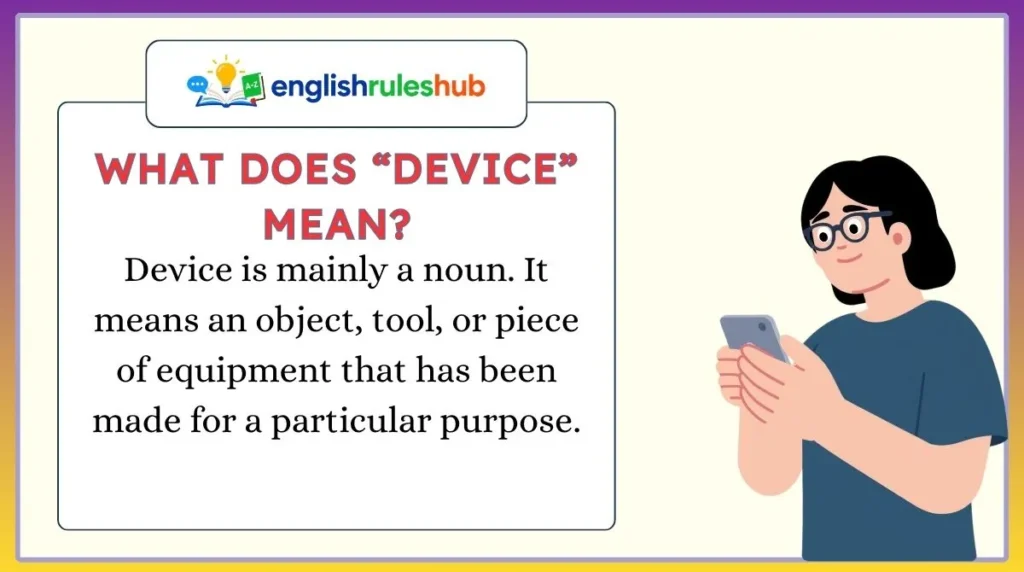
Device is mainly a noun. It means an object, tool, or piece of equipment that has been made for a particular purpose.
In modern everyday English, we often use device for electronic equipment. A smartphone, laptop, tablet, smartwatch, camera, printer, or GPS unit can all be called devices.
For example:
- I bought a new device for my office.
- Please turn off your mobile device.
- This device can measure your heart rate.
- My laptop is my most useful electronic device.
- The doctor used a special device during the examination.
- This small device helps people save energy.
- You should keep your device away from water.
- The company designed a new safety device.
The word can also have a wider meaning. A device does not always have to be electronic. A simple tool or piece of equipment designed for a particular purpose may also be called a device.
For example, a smoke detector is a device. A measuring instrument can be a device. A machine that performs a special task can also be described as a device.
Device as a noun
The most important grammar point is simple:
Device = noun
It can be used as a subject or object in a sentence.
For example:
The device is broken.
Here, device is the subject.
I repaired the device.
Here, device is the object.
You can also use common noun phrases such as:
- a device
- the device
- this device
- that device
- my device
- your device
- electronic device
- medical device
- safety device
- mobile device
Device can have another meaning
There is another meaning of device that learners sometimes miss. In writing, literature, or communication, a device can mean a method or technique used to achieve a particular effect.
For example:
Repetition is a common literary device.
Here, device does not mean a phone or machine. It means a writing technique.
Another example is:
The writer used humor as a device to make the story more interesting.
So, depending on the context, device can mean either a physical tool/equipment or a method/technique.
Common confusion with device
Many learners confuse device with devise because the spelling is very similar.
Remember that device is normally a thing.
If you can put “a,” “the,” “my,” or “this” before the word, device may be the correct choice.
For example:
- a device
- my device
- this device
- the device
You would not normally say:
- a devise
- my devise
- this devise
Those forms are incorrect when you mean a tool or piece of equipment.
What Does “Devise” Mean?
Devise is a verb. It means to create, develop, or think of a plan, method, system, or solution.
The idea is usually that someone thinks carefully about something and creates a way to deal with a problem or reach a goal.
For example:
- We need to devise a better plan.
- The team devised a new way to save money.
- She devised a simple solution to the problem.
- They are trying to devise a new system.
- The teacher devised an interesting activity for the students.
- Engineers devised a safer method.
- The company must devise a way to reduce costs.
- Scientists devised a new method for testing the product.
The word is often used when a person or group uses thought and planning to create something useful.
Devise as a verb
The most important grammar point is:
Devise = verb
It can be used in different verb forms.
Present:
They devise new solutions.
Past:
They devised a new solution.
Present continuous:
They are devising a new solution.
Present perfect:
They have devised a new solution.
Infinitive:
They need to devise a new solution.
The spelling changes slightly when you add endings.
- devise
- devises
- devised
- devising
Notice that the s in devise is pronounced like a z sound.
What usually comes after devise?
Devise is normally followed by the thing that someone creates or plans.
A common structure is:
Subject + devise + plan/method/system/solution/strategy
For example:
The manager devised a new strategy.
The students devised a plan for the project.
The engineers devised a better method.
You can also use devise with an infinitive phrase in some structures.
For example:
They devised a way to solve the problem.
The important idea is that the person is creating or planning a solution, not creating a physical electronic object.
Common confusion with devise
The biggest mistake is treating devise as a noun.
For example:
Incorrect: I bought a new devise.
Correct: I bought a new device.
Another common mistake is using device when a verb is needed.
Incorrect: The team device a new plan.
Correct: The team devised a new plan.
A useful question is:
Is the word naming a thing, or is it describing an action?
If it names a tool or piece of equipment, use device.
If it means “create or plan,” use devise.
Difference Between Device and Devise
The easiest way to understand the difference is to focus on part of speech and meaning.
| Word | Part of speech | Main meaning | Example |
|---|---|---|---|
| device | Noun | A tool, machine, or piece of equipment | I bought a new device. |
| devise | Verb | To create or plan something | We need to devise a solution. |
| devices | Noun, plural | More than one device | These devices are expensive. |
| devised | Verb, past tense | Created or planned | They devised a new method. |
| devising | Verb, -ing form | Creating or planning | She is devising a plan. |
Device means a thing
When you use device, you are usually talking about something that exists as an object or tool.
For example:
My phone is a useful device.
This medical device is very small.
The device stopped working.
In each sentence, device refers to a thing.
Devise means an action
When you use devise, you are talking about an action. Someone is thinking about something and creating a plan, method, or solution.
For example:
We need to devise a solution.
The sentence means that we need to think of and create a solution.
Another example:
The teacher devised a new classroom activity.
This means the teacher thought about the activity and created it.
Sentence structure is different
Because device is a noun, it often appears after an article or possessive word.
Examples:
a device
the device
my device
this device
Because devise is a verb, it usually needs a subject that performs the action.
Examples:
I devised a plan.
She devised a solution.
They devised a new method.
You cannot use these two words in the same grammatical position.
Meaning comparison
Compare these sentences:
The device is expensive.
Here, device means a physical object.
They devised a new solution.
Here, devised means created or planned.
Now compare:
The company developed a new device.
This means the company created a physical product.
The company devised a new strategy.
This means the company created a plan or method.
The words can appear in the same general topic, but they have different roles.
A simple test
When you are unsure, ask yourself:
Can I touch it or identify it as a tool or piece of equipment?
If yes, device may be correct.
If you mean create, plan, or think of, use devise.
For example:
We need a new device.
You are talking about a thing.
We need to devise a new method.
You are talking about creating a method.
Grammar Rules You Must Remember
Rule #1: Use “device” as a noun
Use device when you are naming a tool, machine, piece of equipment, or sometimes a technique.
Example:
This device measures temperature.
Here, device is the name of the equipment.
Another example:
My mobile device is charging.
The word device is a noun.
Rule #2: Use “devise” as a verb
Use devise when you mean to create, plan, or think of something.
Example:
We need to devise a better plan.
The subject we performs the action of creating the plan.
Remember:
devise = create or plan
Rule #3: “Devise” usually needs an object
Because devise means creating or planning something, the sentence usually tells us what was created or planned.
For example:
She devised a solution.
They devised a strategy.
He devised a method.
We devised a system.
These are natural structures.
You will often see devise followed by words such as:
- plan
- solution
- method
- strategy
- system
- approach
- scheme
- way
- technique
Rule #4: Watch the verb form
If you need the past tense of devise, use devised, not deviced.
Correct:
They devised a new plan yesterday.
Incorrect:
They deviced a new plan yesterday.
The word device does not become a verb by simply adding -d.
This is a very common spelling mistake because device and devise look so similar.
Common Mistakes Students Make
These words cause mistakes mainly because they look almost identical. Learners often remember the letters but forget the word class and meaning.
Mistake 1: Using devise for a machine
Incorrect:
I bought a new devise.
Correct:
I bought a new device.
Why?
Because you are talking about a piece of equipment. You need the noun device.
Mistake 2: Using device as a verb
Incorrect:
They device a new strategy.
Correct:
They devise a new strategy.
Why?
The sentence needs a verb meaning “create” or “plan.” Therefore, devise is correct.
Mistake 3: Writing “deviced”
Incorrect:
The engineers deviced a new method.
Correct:
The engineers devised a new method.
The past form of devise is devised.
Mistake 4: Confusing “device” with “devise” in technical writing
Students sometimes write:
The company devised a new electronic device.
This sentence is actually correct because both words are being used properly.
Devised means created or planned.
Device means the physical object.
The company devised the product, and the product is a device.
Mistake 5: Thinking the words have the same pronunciation
They look similar, but their final sounds are different.
device ends with an s sound.
devise ends with a z sound.
A simple pronunciation guide is:
device: dih-VICE
devise: dih-VIZE
The difference is small, but listening carefully can help you identify the word in spoken English.
Easy correction tip
Whenever you see one of these words, stop and ask:
“Am I talking about a thing or an action?”
Thing → device
Action of creating/planning → devise
This one question can prevent most mistakes.
Easy Trick to Remember the Difference
Here is a simple memory trick:
Device is a thing. Devise is an action.
Think about your smartphone.
Your smartphone is a device.
Now imagine that you are trying to solve a difficult problem. You think carefully and create a plan.
You devise a plan.
So you can remember:
DEVICE = a thing
DEVISE = to think and create
There is another useful trick.
The word device is a noun, just like:
- phone
- computer
- machine
- tool
These are all things.
The word devise is a verb, like:
- create
- plan
- design
- develop
These are actions.
You can make a small mental sentence:
“I use a device, but I devise a plan.”
That sentence puts both words together and shows their different meanings.
For example:
I use my device to help me devise a better plan.
Here, device is an object, while devise describes the action of creating the plan.
One more clue can help with spelling.
Device has c.
Devise has s.
Think:
Device = C for “computer”
This is not a grammar rule, but it can be a useful spelling reminder when you are writing quickly.
Daily Life Examples
These examples show how the two words appear in natural English.
Example 1
A: Where is my phone?
B: It’s next to your laptop. Both devices are on the table.
Here, devices means electronic objects.
Example 2
A: We have a problem with the project.
B: Let’s devise a new plan.
Here, devise means create or think of.
Example 3
A: What is that small device?
B: It measures the room temperature.
The word device refers to equipment.
Example 4
A: How did you solve the problem?
B: We devised a simple solution.
The verb devised means created or thought of.
Example 5
A: Can I use your device?
B: Sure. Just be careful with it.
The word refers to a physical electronic object.
Example 6
A: The first plan did not work.
B: Then we need to devise another one.
Here, devise means create another plan.
Example 7
A: Why is this medical device so expensive?
B: It uses advanced technology.
Here, device means a piece of medical equipment.
Example 8
A: Did the team find a way to finish the work?
B: Yes. They devised a new method.
Here, devised means created or developed.
Example 9
A: Please switch off your devices before the meeting.
B: Okay. I’ll turn off my phone and tablet.
The plural noun devices refers to electronic equipment.
Example 10
A: We have very little time.
B: We need to devise a quick solution.
The speaker needs to create a solution, so devise is the correct word.
Practice Section
Choose the correct word in each sentence: device or devise.
1. I bought a new electronic ______ yesterday.
2. We need to ______ a better way to organize the work.
3. The engineers ______ a new safety system.
4. Please keep this ______ away from water.
5. The students worked together to ______ a plan.
Answers
1. device
“I bought a new electronic device yesterday.”
The word names a piece of equipment.
2. devise
“We need to devise a better way to organize the work.”
The word means create or plan.
3. devised
“The engineers devised a new safety system.”
The sentence is in the past, so the correct past form is devised.
4. device
“Please keep this device away from water.”
It refers to an object.
5. devise
“The students worked together to devise a plan.”
They created or planned the plan, so devise is correct.
Quick challenge
Try completing this sentence:
The company ______ a new ______ to help people work faster.
The best answer is:
The company devised a new device to help people work faster.
This sentence is a great example because it uses both words correctly.
Devised tells us what the company did.
Device tells us what the company created.
FAQs
What is the difference between device and devise?
Device is mainly a noun meaning a tool, machine, or piece of equipment. Devise is a verb meaning to create, plan, or think of something.
For example, “This device is useful” talks about an object. “They devised a plan” talks about creating a plan.
Is device a noun or a verb?
Device is normally a noun.
It refers to an object, tool, machine, or equipment designed for a particular purpose. For example, “My phone is a useful device.”
Do not use device as the verb meaning “create a plan.”
Is devise a noun or a verb?
Devise is a verb.
It means to create, develop, or carefully think of a plan, method, system, or solution. For example, “The team devised a new strategy.”
Its past form is devised, not “deviced.”
Can device and devise be used in the same sentence?
Yes. They can appear together when their meanings are different.
For example:
The company devised a new device.
Here, devised means created, while device means the physical object that was created.
Is devise a formal word?
Devise is somewhat more formal than simple words such as think of, create, or plan. It is common in business, academic, technical, and professional writing.
For everyday conversation, people may often say “think of a plan” instead of “devise a plan,” but devise is still correct.
How do you remember device vs devise?
Remember this simple rule:
Device = thing.
Devise = create or plan.
Your phone, tablet, or computer can be a device. When you create a new plan or solution, you devise it.
Is “deviced” a correct word?
When you mean the past tense of devise, the correct word is devised, not deviced.
For example:
Correct: The team devised a new plan.
Incorrect: The team deviced a new plan.
The spelling comes from the verb devise.
Final Conclusion
The difference between device and devise is much easier when you focus on their jobs in a sentence.
Device is a noun. It usually means a tool, machine, or piece of equipment. A phone, tablet, camera, or medical machine can be called a device.
Devise is a verb. It means to create, plan, or think of something carefully. You can devise a plan, devise a solution, devise a method, or devise a strategy.
The easiest rule to remember is:
A device is a thing. To devise is to create or plan.
Also remember the past form: devised, not “deviced.”
Do not worry if you mix these words up at first. Their spelling is very close, so the confusion is understandable.
The more you see and use them in real sentences, the more natural the difference will become.
Try making a few sentences of your own today. With regular practice, you will quickly learn when to use device and when to use devise.

I am Benjamin Clark, an English language writer passionate about simplifying grammar, vocabulary, and word meanings. I create clear, accurate, and practical content to help learners improve their English skills with confidence every day.