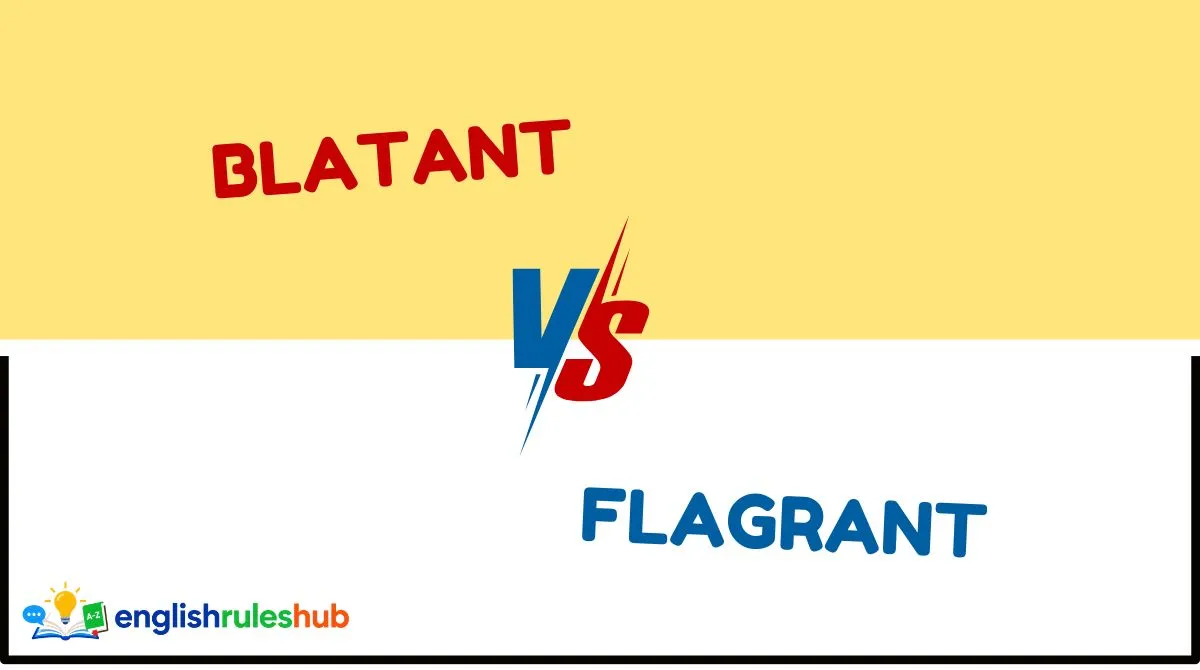
Blatant and flagrant are two English words that often confuse learners because they can describe something very obvious, wrong, or unacceptable.
In some sentences, either word may seem possible. However, they do not always give exactly the same feeling.
For example, we can say “a blatant lie” and “a flagrant violation.” Both expressions describe something clearly wrong.
But English speakers usually choose blatant when they want to stress that something is very obvious, open, or hard to hide.
Flagrant often has a stronger connection with a serious mistake, rule-breaking, or bad behaviour that is clearly and openly wrong.
This small difference is useful in everyday English. You may see these words in news reports, school writing, sports, conversations, books, and formal English.
The good news is that you do not need to memorize a complicated grammar rule. Both words are adjectives, and their main difference is about meaning, emphasis, and common usage.
By the end of this guide, you will know when to use blatant and when to use flagrant.
You will also see simple examples, common mistakes, a memory trick, and practice questions to help you use both words naturally.
What Does “Blatant” Mean?
Blatant is an adjective that means very obvious, open, and easy to see or notice, especially when something is wrong, dishonest, unfair, or unacceptable.
When something is blatant, the person doing it is often not trying very hard to hide it. It is right in front of you.
Think about someone telling an obvious lie while the truth is already clear. You might call it a blatant lie.
The word often carries a negative meaning.
When Do We Use “Blatant”?
We commonly use blatant with things such as:
- lies
- mistakes
- cheating
- discrimination
- unfairness
- attempts to deceive people
- violations
- insults
- disregard for rules
- false claims
The basic idea is:
Blatant = so obvious that it is difficult to ignore.
It does not always mean that something is extremely serious. The main focus is often on how clear or obvious the behaviour is.
Grammar Rule for “Blatant”
Blatant is an adjective.
It can come before a noun:
- a blatant lie
- a blatant mistake
- a blatant attempt
- a blatant example
It can also come after a linking verb:
- His lie was blatant.
- The unfair treatment was blatant.
You can also use its adverb form, blatantly:
- He blatantly ignored the rules.
- She blatantly lied to the teacher.
Examples of “Blatant”
- That was a blatant lie.
The lie was so obvious that nobody believed it. - He made a blatant mistake in the report.
The mistake was very easy to notice. - The company showed blatant disregard for the safety rules.
The company openly ignored the rules. - She was guilty of blatant cheating during the test.
Her cheating was obvious. - It was a blatant attempt to fool the public.
The attempt to deceive people was very clear. - The advertisement contained a blatant false claim.
The false claim was easy to recognize. - His blatant disrespect upset his manager.
His disrespect was open and obvious. - The referee missed a blatant foul.
The foul was extremely obvious.
Notice that blatant often works well when the speaker wants to say, “How could anyone possibly miss this?”
Common Learner Confusion About “Blatant”
Many learners think blatant simply means “bad.” That is not quite right.
For example:
“He made a bad decision.”
This tells us the decision was bad, but it does not tell us that the problem was obvious.
Compare:
“He made a blatant mistake.”
Now the meaning is stronger. The mistake was clearly and obviously wrong.
So remember that obviousness is an important part of blatant.
What Does “Flagrant” Mean?
Flagrant is an adjective used for something that is very obvious and seriously wrong, offensive, or unacceptable.
It is especially common when talking about rules, laws, duties, standards, or accepted behaviour.
For example, a person who openly breaks an important rule may be accused of a flagrant violation.
The word often suggests that the wrongdoing is not only obvious but also serious or shocking.
A simple way to remember it is:
Flagrant = openly and clearly wrong, often in a serious way.
When Do We Use “Flagrant”?
You will often see flagrant with words such as:
- violation
- offence
- breach
- disregard
- abuse
- error
- foul
- misconduct
- discrimination
- wrongdoing
It is particularly common in formal English, news writing, legal discussions, sports, and serious criticism.
One very familiar expression is:
a flagrant foul
In basketball, a flagrant foul is a serious type of foul. The word fits because the action is considered clearly unacceptable and more serious than an ordinary foul.
Grammar Rule for “Flagrant”
Like blatant, flagrant is an adjective.
It can appear before a noun:
- a flagrant violation
- a flagrant offence
- a flagrant error
- a flagrant foul
It can also come after a linking verb:
- The violation was flagrant.
- His behaviour was flagrant.
The adverb form is flagrantly:
- The rule was flagrantly ignored.
- The law was flagrantly violated.
Examples of “Flagrant”
- The company committed a flagrant violation of the law.
The violation was obvious and serious. - The player received a penalty for a flagrant foul.
The foul was considered especially serious. - This is a flagrant breach of the agreement.
The breach is clear and serious. - The report contained a flagrant error.
The error was very obvious and serious. - His actions showed a flagrant disregard for safety.
He openly ignored an important safety concern. - The official was accused of a flagrant abuse of power.
The misuse of power was serious and obvious. - It was a flagrant violation of the students’ rights.
The violation was clearly unacceptable. - The court described the behaviour as a flagrant offence.
The behaviour was openly and seriously wrong.
Common Learner Confusion About “Flagrant”
A common mistake is thinking that flagrant is just a more formal version of blatant.
They overlap, but they are not perfect replacements.
Blatant mainly highlights obviousness and openness.
Flagrant often highlights obvious wrongdoing plus seriousness or offensiveness.
That is why flagrant violation is a very natural expression, while blatant violation is also possible but can put more focus on how obvious the violation is.
Difference Between Blatant and Flagrant
The easiest way to understand the difference is to look at the main idea behind each word.
| Word | Main idea | Common meaning | Common combinations | Style |
|---|---|---|---|---|
| Blatant | Very obvious or open | Easy to see, often clearly wrong | blatant lie, blatant mistake, blatant cheating | Common and formal |
| Flagrant | Clearly and seriously wrong | Openly unacceptable or offensive | flagrant violation, flagrant offence, flagrant foul | More formal |
Both words can describe something that is clearly wrong. The difference is the focus.
1. Blatant Focuses on Obviousness
When you use blatant, you often want to point out that something is impossible or difficult to miss.
For example:
“That is a blatant lie.”
The listener understands that the lie is very obvious.
Maybe the speaker says, “I was at home all day,” but several people saw him somewhere else. The lie is not carefully hidden.
2. Flagrant Often Focuses on Serious Wrongdoing
With flagrant, the action is usually not just obvious. It is also clearly unacceptable or serious.
For example:
“It was a flagrant violation of the rules.”
The sentence tells us that the rule was clearly broken and that the violation was serious enough to deserve strong criticism.
3. Blatant Can Be More General
You can use blatant for many kinds of obvious behaviour:
- a blatant lie
- a blatant mistake
- blatant cheating
- blatant discrimination
- blatant advertising
- blatant hypocrisy
The word is flexible.
4. Flagrant Is Often Connected to Rules and Standards
Flagrant commonly appears when a rule, law, agreement, duty, or accepted standard has been seriously broken.
For example:
- a flagrant violation of the law
- a flagrant breach of the contract
- a flagrant abuse of power
- a flagrant foul
This makes the word especially useful in formal writing.
5. They Can Sometimes Be Used in the Same Sentence
There are cases where both words work.
For example:
“The company showed blatant disregard for the rules.”
and
“The company showed flagrant disregard for the rules.”
Both are grammatically correct.
However, the second sentence can sound stronger and more serious.
The first stresses how openly the company ignored the rules.
The second stresses that the disregard was clearly serious and unacceptable.
6. Sentence Structure Is Almost the Same
There is no major grammar difference between the two words because both are adjectives.
You can use:
adjective + noun
- a blatant lie
- a flagrant violation
You can also use:
noun + linking verb + adjective
- The lie was blatant.
- The violation was flagrant.
You can also use the adverb forms:
- He blatantly ignored the warning.
- He flagrantly violated the rule.
The important difference is therefore meaning and natural usage, not sentence structure.
Grammar Rules You Must Remember
Rule #1: Both “Blatant” and “Flagrant” Are Adjectives
Both words describe nouns.
For example:
That was a blatant mistake.
That was a flagrant violation.
Do not treat either word as a verb.
Incorrect:
He blatant the rules.
Correct:
He blatantly ignored the rules.
Rule #2: Use “Blatant” for Something Clearly Obvious
When the main idea is that something is open, obvious, or impossible to hide, blatant is often the better choice.
Example:
That was a blatant lie.
The lie was obvious to everyone.
Another example:
Her blatant attempt to change the subject was funny.
The attempt was easy to notice.
Rule #3: Use “Flagrant” for Clearly Serious Wrongdoing
When something is openly and seriously wrong, especially when a rule, law, or standard has been broken, flagrant is often a strong choice.
Example:
The driver committed a flagrant violation of the traffic rules.
The sentence focuses on the seriousness of the violation.
Rule #4: Do Not Assume They Are Always Interchangeable
Although the words overlap, replacing one with the other can change the feeling.
For example:
a blatant lie
is a very natural expression.
a flagrant lie
is possible, but it sounds more formal and strongly critical.
On the other hand:
a flagrant foul
is a very familiar expression in sports.
a blatant foul
can be understood, but it is not normally the standard expression when referring to the special sports category.
The safest approach is to learn common word combinations, not just dictionary definitions.
Common Mistakes Students Make
Mistake 1: Thinking “Blatant” Means Only “Bad”
Some learners use blatant whenever they want to say something is bad.
For example:
Incorrect idea:
“Blatant” = bad.
That is too simple.
A blatant problem is usually obvious, often in a negative way.
Compare:
He made a bad mistake.
This tells us the mistake was bad.
He made a blatant mistake.
This tells us the mistake was clearly and obviously wrong.
Mistake 2: Using “Flagrant” for Every Obvious Thing
Not every obvious thing is flagrant.
You would not normally say:
“The blue sky is flagrant.”
That makes no sense.
Flagrant usually carries a negative meaning connected to wrongdoing, offence, or unacceptable behaviour.
Mistake 3: Forgetting the Negative Meaning
Both words are usually used for negative situations.
You would not normally say:
“She gave me a blatant gift.”
If you mean that the gift was easy to see, use another word such as obvious or clearly visible.
Mistake 4: Confusing the Adjective and Adverb Forms
Remember:
blatant → blatantly
flagrant → flagrantly
For example:
He blatantly ignored the warning.
They flagrantly broke the rules.
Do not write:
He blatant ignored the warning.
The adjective cannot directly modify the verb.
Mistake 5: Choosing “Flagrant” Only Because It Sounds Formal
Some students think a difficult-looking word is always better in formal English.
That is not true.
If you mean an obvious lie, “blatant lie” is simple and natural.
If you mean a serious violation, “flagrant violation” is a strong and natural choice.
Good English is not about using the most complicated word. It is about using the right word.
Easy Trick to Remember the Difference
Here is a simple memory trick:
Blatant = Barely hidden
Think:
Blatant things are out in the open.
A blatant lie is a lie that is almost impossible to hide.
A blatant mistake is a mistake that everyone can see.
A blatant act of cheating is obvious to other people.
Now remember:
Flagrant = Clearly and seriously wrong
Think of a person who openly breaks an important rule and does not seem to care.
That is a good situation for flagrant.
You can remember it this way:
Blatant → “I can clearly see it.”
Flagrant → “I can clearly see that it is seriously wrong.”
This is not a perfect dictionary definition, but it is a very useful learning trick.
A Simple Real-Life Comparison
Imagine a student is taking an exam.
The student secretly looks at a small note under the desk. Nobody notices.
That is cheating, but it is not necessarily blatant because the action is hidden.
Now imagine the student takes out a large book and starts reading it in front of the teacher.
That is blatant cheating because it is obvious.
If the student is deliberately and openly breaking a very important examination rule, you could also describe the behaviour as flagrant misconduct.
The key difference is the focus:
Blatant → obvious and open.
Flagrant → obvious, serious, and unacceptable.
Daily Life Examples
Here are some natural examples you may hear or use in real conversations.
Example 1: A Lie
A: “Did Tom really say he finished the work?”
B: “Yes, but it was a blatant lie. I checked the file, and he had not even started.”
Here, blatant works because the lie was very obvious.
Example 2: Cheating
Teacher: “You cannot use your phone during the test.”
Student: “I know.”
Teacher: “Then why are you looking at it?”
Student: “Sorry.”
The teacher could later say:
“It was blatant cheating.”
The cheating was easy to see.
Example 3: Breaking a Rule
A: “Why was the company fined?”
B: “Because it committed a flagrant violation of the safety rules.”
Here, flagrant sounds natural because a serious rule was broken.
Example 4: Sports
Commentator: “That was a flagrant foul. The player made dangerous contact.”
This is a common type of sports usage.
Example 5: Obvious Discrimination
A: “Why did the manager receive so much criticism?”
B: “People accused him of blatant discrimination.”
The word highlights the fact that the unfair treatment was very obvious.
Example 6: Ignoring Safety
A: “Why did the inspector close the building?”
B: “There was a blatant disregard for basic safety rules.”
The problem was openly visible.
Example 7: A Serious Violation
A: “What happened to the business?”
B: “It was accused of a flagrant breach of the agreement.”
Flagrant fits because the breach was serious and clearly unacceptable.
Example 8: An Obvious Mistake
A: “Did you check the final report?”
B: “Yes. There is a blatant error on page five.”
Here, the mistake is extremely easy to notice.
Example 9: Abuse of Power
A: “Why are people angry with the official?”
B: “They believe he showed a flagrant abuse of power.”
The phrase sounds formal and serious.
Example 10: Changing the Subject
A: “Did you break the vase?”
B: “No.”
A: “I saw you break it.”
B: “Well, anyway, what are we having for dinner?”
A: “That was a blatant attempt to change the subject!”
The attempt was obvious.
Practice Section
Choose blatant or flagrant in each sentence.
1. That was a ______ lie. Everyone knew the truth.
a) blatant
b) flagrant
2. The player was punished for a ______ foul.
a) blatant
b) flagrant
3. The report contains a ______ error that anyone can see.
a) blatant
b) flagrant
4. The company committed a ______ violation of the law.
a) blatant
b) flagrant
5. His ______ disregard for the rules shocked everyone.
a) blatant
b) flagrant
Answers
1. blatant — The sentence focuses on how obvious the lie was.
2. flagrant — “Flagrant foul” is a common sports expression for a serious foul.
3. blatant — The error is clearly visible and easy to notice.
4. flagrant — A serious and obvious violation is naturally described as flagrant.
5. Both can work depending on the intended emphasis.
“Blatant disregard” stresses that the disregard was open and obvious. “Flagrant disregard” gives it a stronger sense of serious wrongdoing.
FAQs
What is the difference between blatant and flagrant?
Blatant usually means very obvious, open, and difficult to hide, especially when something is wrong.
Flagrant also means very obvious, but it often adds the idea of serious, offensive, or unacceptable wrongdoing.
For example, we commonly say “a blatant lie” and “a flagrant violation.”
Can blatant and flagrant be used interchangeably?
Sometimes they can, especially when describing obvious wrongdoing.
For example, both “blatant disregard” and “flagrant disregard” are possible.
However, they do not always sound equally natural. Blatant focuses more on obviousness, while flagrant often suggests a more serious offence or violation.
Is blatant formal or informal?
Blatant can be used in both everyday and formal English.
You can say “That was a blatant lie” in normal conversation. You can also see phrases such as “blatant discrimination” in formal writing and news reports.
It is a common and useful English adjective.
Is flagrant more formal than blatant?
Generally, flagrant can sound more formal or strongly critical than blatant.
It is especially common in legal, official, news, and sports language.
For example, “flagrant violation,” “flagrant breach,” and “flagrant abuse of power” have a formal tone.
Can we use blatant and flagrant with questions?
Yes. Both words can appear in questions.
For example:
“Was that a blatant lie?”
“Was that a flagrant violation of the rules?”
The question structure does not change because these words are adjectives.
Which is correct: blatant lie or flagrant lie?
“Blatant lie” is usually the more natural choice when you mean an obvious lie.
“Flagrant lie” is possible, but it sounds stronger and more formal. It may suggest that the lie was not only obvious but also particularly offensive or unacceptable.
For everyday English, blatant lie is usually the safer choice.
Final Conclusion
The difference between blatant and flagrant becomes much easier when you focus on the main idea behind each word.
Blatant describes something that is very obvious, open, or difficult to hide. It is often used with words such as lie, mistake, cheating, discrimination, and disregard.
Flagrant also describes something obvious, but it usually adds a stronger sense of serious wrongdoing, offence, or unacceptable behaviour. It is especially common with violation, breach, foul, offence, and abuse.
Remember the simple trick: blatant means “clearly visible,” while flagrant means “clearly and seriously wrong.” They can overlap, so context matters.
The best way to learn these words is to notice their common combinations and use them in your own sentences.
Once you see phrases such as “a blatant lie” and “a flagrant violation” several times, the difference will start to feel natural.

I am Benjamin Clark, an English language writer passionate about simplifying grammar, vocabulary, and word meanings. I create clear, accurate, and practical content to help learners improve their English skills with confidence every day.