Unlawful and illegal look almost identical because both words are connected with something that is not allowed by law.
That is why English learners often use them as if they were always interchangeable. In many everyday sentences, they can be. However, there are some useful differences in meaning, tone, and usage that are worth knowing.
For example, you may hear someone say, “It is illegal to park here.” You may also hear, “The police said the search was unlawful.”
Both sentences talk about something that goes against the law, but the second sentence can sound more formal and legal.
The word illegal is very common in everyday English. We use it when we simply want to say that an action, activity, or thing is against the law.
Unlawful is also used for things that are not permitted by law, but it is especially common in legal writing, official statements, and formal speech.
There is another small point that can confuse learners: unlawful does not always sound exactly the same as illegal. Sometimes it focuses on whether something is legally authorized or permitted, while illegal often gives the direct idea of breaking a law.
After reading this guide, you will understand when to use each word, how their grammar works, where they overlap, and how native speakers use them in real-life situations.
What Does “Unlawful” Mean?
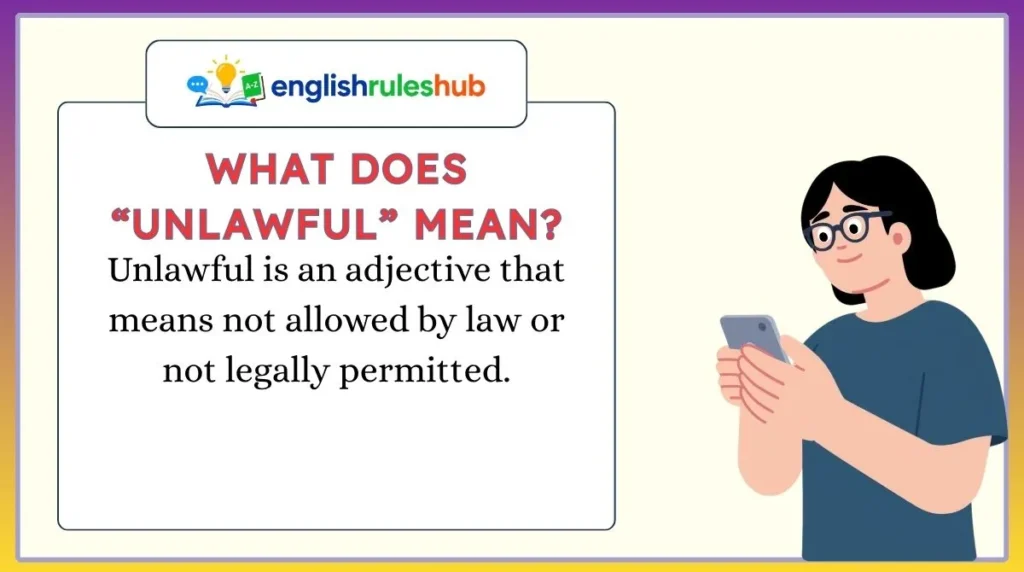
Unlawful is an adjective that means not allowed by law or not legally permitted.
The word is formed from un- + lawful. The prefix un- often gives the meaning “not,” so unlawful literally means “not lawful.”
We usually use unlawful when talking about an action, decision, behavior, order, search, arrest, agreement, or other matter that is not permitted under the law.
It is especially common in formal and legal English.
For example:
- The court declared the arrest unlawful.
- The workers were accused of taking unlawful action.
- The police were investigating an unlawful attack.
- The company was ordered to stop the unlawful practice.
- The judge said the search was unlawful.
- The government cannot make an unlawful decision.
- The organization was accused of using unlawful methods.
- The court ruled that the detention was unlawful.
Notice that unlawful normally comes before a noun because it is an adjective.
When Should You Use “Unlawful”?
Use unlawful when you want to describe something as not legally permitted, especially in a formal context.
It is common in phrases such as:
- unlawful arrest
- unlawful detention
- unlawful search
- unlawful discrimination
- unlawful conduct
- unlawful action
- unlawful entry
- unlawful use
- unlawful possession
- unlawful activity
These expressions are often found in legal documents, court decisions, government reports, and formal news writing.
For example, a lawyer might say:
“The defendant argues that the search was unlawful.”
A friend talking casually might be more likely to say:
“The police searched the house illegally.”
Both sentences can communicate a similar basic idea, but the first has a more legal and formal tone.
A Grammar Point About “Unlawful”
Because unlawful is an adjective, you can put it before a noun:
unlawful + noun
- unlawful behavior
- unlawful activity
- unlawful decision
You can also use it after a linking verb:
- The action was unlawful.
- The arrest was unlawful.
- His behavior was unlawful.
A common mistake is to treat unlawful as an adverb. It is not.
You would not normally say:
- “He acted unlawful.”
Instead, say:
- “He acted unlawfully.”
The adverb form is unlawfully.
Common Learner Confusion
Many students think unlawful always means something extremely serious. That is not necessarily true.
The word simply tells us that something is not lawful or not legally permitted. The seriousness depends on the situation.
For instance:
- The court found the detention unlawful.
- The company was accused of unlawful discrimination.
The first sentence does not automatically tell us what punishment occurred. It simply describes the legal status of the detention.
Another important point is that unlawful is not normally used for every kind of “wrong” behavior. Something can be rude, unfair, or dishonest without necessarily being unlawful.
What Does “Illegal” Mean?
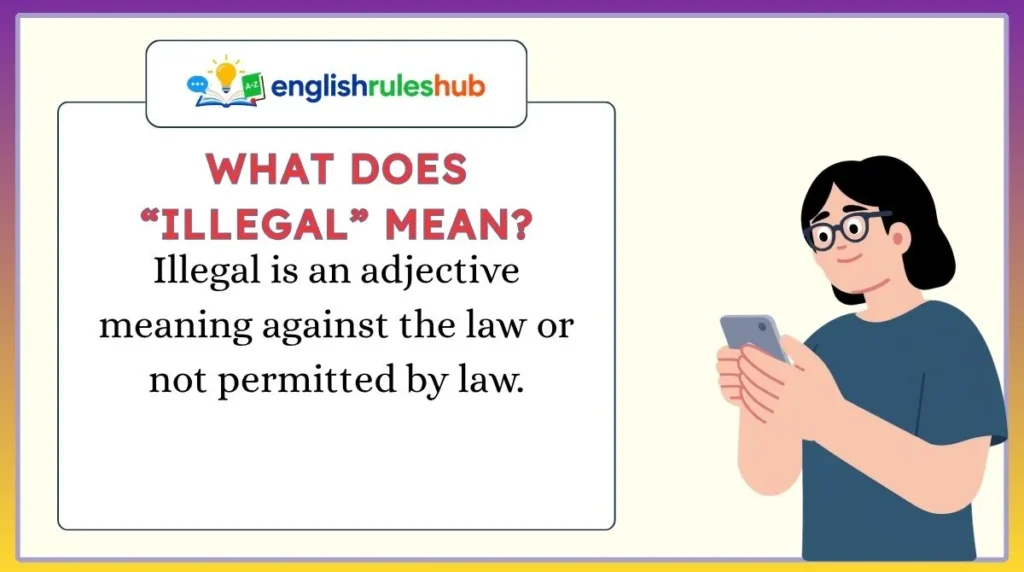
Illegal is an adjective meaning against the law or not permitted by law.
It is one of the most common words English speakers use when talking about activities that break the law.
For example:
- It is illegal to steal.
- The police found an illegal weapon.
- They were involved in an illegal business.
- The company was accused of illegal activity.
- It is illegal to drive without a valid license in many places.
- The government banned the illegal sale of the product.
- He was arrested for illegal possession.
- The company was fined for illegal dumping.
When Should You Use “Illegal”?
Use illegal when you want to say clearly and directly that something breaks the law.
It is common in both everyday English and formal English.
For example, in ordinary conversation, you might say:
“Is it illegal to park here?”
This sounds completely natural.
You could also say:
“The company was involved in illegal activity.”
This works in a more formal setting too.
That wide range of use makes illegal a very useful word for English learners.
A Grammar Point About “Illegal”
Like unlawful, illegal is an adjective.
It can come before a noun:
- illegal activity
- illegal parking
- illegal trade
- illegal entry
- illegal payment
It can also come after a linking verb:
- The activity is illegal.
- The payment was illegal.
- The practice became illegal.
The adverb form is illegally.
So:
- He acted illegally.
- They entered the building illegally.
Do not say:
- “He acted illegal.”
Say:
- “He acted illegally.”
“Illegal” in Questions
Students often ask whether illegal can be used in questions. Yes, absolutely.
Here are some natural questions:
- Is this illegal?
- Is it illegal to park here?
- Is it illegal to record someone without permission?
- Was the payment illegal?
- Is selling this product illegal?
- Why is this activity illegal?
These are normal English sentences.
Common Learner Confusion
Some learners believe that illegal should only be used for major crimes. That is not correct.
The word can describe any action or activity that the law does not allow, whether the situation is large or small.
For example:
“Illegal parking can result in a fine.”
The word does not mean that the person committed a serious crime. It simply says the parking was against the applicable law or rule.
Difference Between Unlawful and Illegal
The easiest way to understand the difference is this:
Illegal usually gives the direct idea of breaking the law.
Unlawful usually gives the idea of not being lawful or not being legally authorized, and it often sounds more formal.
In many situations, the two words can be used with almost the same meaning.
Comparison Table
| Point | Unlawful | Illegal |
|---|---|---|
| Basic meaning | Not lawful or not legally permitted | Against the law |
| Part of speech | Adjective | Adjective |
| Everyday use | Less common | Very common |
| Legal use | Very common | Also common |
| Tone | Often formal | Neutral and direct |
| Common with | Arrest, detention, search, conduct | Activity, action, trade, parking |
| Adverb | Unlawfully | Illegally |
| Opposite | Lawful | Legal |
| Main idea | Not legally authorized/permitted | Against the law |
1. Difference in Tone
The biggest practical difference for learners is often tone.
Illegal is direct and common:
“It is illegal to sell this product without a license.”
Unlawful can sound more formal:
“The court found the sale to be unlawful.”
Neither sentence is automatically more correct. The choice depends on the context.
2. Difference in Everyday English
If you are speaking with a friend, illegal is usually the more natural choice.
For example:
“Is it illegal to park here?”
This sounds very normal.
You could say:
“Is it unlawful to park here?”
It is grammatically possible, but it sounds more formal and less natural in ordinary conversation.
3. Difference in Legal English
Unlawful is very common in legal language.
You may see expressions such as:
- unlawful detention
- unlawful arrest
- unlawful search
- unlawful discrimination
- unlawful conduct
Legal writing often needs to describe whether an action was lawful or not, and unlawful fits naturally into that style.
4. Meaning Is Not Always Exactly the Same
Although dictionaries often define both words in similar ways, legal systems can give particular words more specific meanings.
This is important.
You should not assume that unlawful and illegal are always perfectly interchangeable in every legal document. A court, statute, lawyer, or legal authority may use a particular term for a specific reason.
For normal English learning, however, the useful rule is:
Illegal = against the law.
Unlawful = not lawful or not legally permitted.
5. Sentence Structure
Both words work as adjectives.
Before a noun:
- an illegal activity
- an unlawful activity
After “be”:
- The activity is illegal.
- The activity is unlawful.
With an adverb:
- They acted illegally.
- They acted unlawfully.
So the basic grammar is almost identical.
Grammar Rules You Must Remember
Rule #1: Both “Unlawful” and “Illegal” Are Adjectives
Use these words to describe a noun or to give information about a subject.
Examples:
- That is an illegal activity.
- That is an unlawful activity.
- The arrest was unlawful.
- The payment was illegal.
Do not use them as adverbs.
Incorrect:
He entered the building illegal.
Correct:
He entered the building illegally.
Rule #2: Use “Illegal” More Often in Everyday Conversation
When you simply want to say that something breaks the law, illegal is usually the easiest and most natural word.
For example:
“Is it illegal to park here?”
“Selling fake tickets is illegal.”
“They were caught doing something illegal.”
These sentences sound natural in ordinary conversation.
Rule #3: “Unlawful” Is Common in Formal and Legal Contexts
Use unlawful when the context is formal, legal, official, or closely connected with questions of legal authority.
Examples:
“The judge ruled that the detention was unlawful.”
“The company was accused of unlawful discrimination.”
“The court found the search unlawful.”
This does not mean unlawful is only a legal word. It can appear elsewhere, but its formal tone makes it especially common in legal contexts.
Rule #4: Use “Illegally” and “Unlawfully” When You Need an Adverb
If the word describes how someone does something, you need the adverb form.
Adjective:
The activity was illegal.
Adverb:
They carried out the activity illegally.
Adjective:
The arrest was unlawful.
Adverb:
The officers acted unlawfully.
Remember:
illegal → illegally
unlawful → unlawfully
This small grammar rule can prevent many common mistakes.
Common Mistakes Students Make
Mistake 1: Thinking the Words Have Completely Different Meanings
Some learners spend too much time trying to find a huge difference between the two words.
In many ordinary situations, they have very similar meanings.
For example:
The activity was illegal.
The activity was unlawful.
Both sentences say that the activity was not permitted by law.
The main difference may be the style or legal context, rather than the basic idea.
Mistake 2: Using “Unlawful” in Every Casual Sentence
A sentence such as:
“Is it unlawful to park here?”
is understandable, but it can sound overly formal.
A more natural everyday sentence is:
“Is it illegal to park here?”
Easy tip: In casual conversation, choose illegal when you simply mean “against the law.”
Mistake 3: Using “Illegal” When Talking About Legal Authority
In a formal legal context, unlawful may be the more natural choice.
For example:
The court declared the detention unlawful.
This sounds natural in legal English.
A student might write:
The court declared the detention illegal.
This may still communicate the basic idea, but depending on the legal context, the original wording may be more precise.
Mistake 4: Confusing Adjectives and Adverbs
Incorrect:
The company operated illegal.
Correct:
The company operated illegally.
Incorrect:
The officers acted unlawful.
Correct:
The officers acted unlawfully.
The reason is simple: operated and acted need an adverb to describe how the action happened.
Mistake 5: Thinking “Unlawful” Means “Unfair”
These words are not the same.
Something can be unfair without being unlawful.
For example, a decision may feel unfair to you, but that does not automatically mean the decision breaks the law.
So avoid using unlawful simply to mean “bad,” “unfair,” or “wrong.”
Mistake 6: Assuming Every Rule Is a Law
This is another useful distinction.
If your teacher says:
“You are not allowed to use your phone during the exam.”
that may be a school rule.
It does not automatically mean:
“It is illegal to use your phone during the exam.”
Not allowed is a much broader expression than illegal.
Something can be against a rule without being against the law.
Easy Trick to Remember the Difference
Here is a simple memory trick:
Illegal = against the law.
Think of the word illegal as the quick, direct everyday choice.
“Is it illegal?”
means:
“Does the law allow it?”
Now remember:
Unlawful = not lawful.
Think about the two words:
lawful → lawful behavior
unlawful → not lawful behavior
This makes unlawful especially useful when talking about whether something was legally permitted, authorized, or valid.
A Simple Real-Life Trick
Imagine you are talking to two different people.
You ask your friend:
“Is it illegal to park here?”
That sounds natural.
Now imagine you are reading a court decision:
“The court determined that the parking restriction was unlawful.”
The situation is more formal, so unlawful fits better.
You do not need to memorize dozens of difficult rules. Just remember:
Everyday and direct → illegal
Formal or legal style → unlawful
This is not an absolute rule, but it is an excellent guide for English learners.
Daily Life Examples
Here are some examples that show how native speakers may use these words in real situations.
Example 1: Parking
Ali: Can I park my car here?
Sara: I don’t think so. It may be illegal to park here.
Here, illegal is natural because this is an ordinary conversation.
Example 2: A Court Case
Lawyer: The judge found the arrest unlawful.
This sounds formal and legal. Unlawful fits naturally in this setting.
Example 3: Selling Products
Customer: Can I sell these products without a license?
Shop owner: No. That could be illegal.
The speaker is giving a simple warning about the law.
Example 4: Police Search
Reporter: The court ruled that the police search was unlawful.
The formal word unlawful works well in a news or legal context.
Example 5: Online Activity
Friend: Why did the website remove his account?
Sam: He was using it for illegal activities.
This is normal everyday English.
Example 6: Company Behavior
Manager: We need to make sure our company does not engage in unlawful conduct.
The formal workplace context makes unlawful a natural choice.
Example 7: Driving
A: Can I drive without a license?
B: No. Driving without the required license is illegal.
This is a straightforward use of illegal.
Example 8: A Legal Decision
News reporter: The court said the government’s action was unlawful.
The formal style makes unlawful suitable.
Example 9: Buying Something
A: Where did you get those tickets?
B: I bought them from an illegal seller.
The word illegal is direct and easy to understand.
Example 10: Formal Complaint
The document stated that the company had engaged in unlawful discrimination.
This is formal language, so unlawful sounds more appropriate than the everyday word illegal.
Practice Section
Choose illegal or unlawful in each sentence. Think about the meaning and the situation before checking the answers.
1. Is it ______ to park your car in front of this gate?
2. The court ruled that the detention was ______.
3. The police arrested him for an ______ activity.
4. The lawyer argued that the search was ______.
5. The company was accused of ______ discrimination.
Answers
1. illegal
“Is it illegal to park your car in front of this gate?” sounds natural in everyday English.
2. unlawful
“The court ruled that the detention was unlawful” has a formal legal style.
3. illegal
“An illegal activity” is a very common expression.
4. unlawful
“The lawyer argued that the search was unlawful” fits formal legal language.
5. unlawful
“Unlawful discrimination” is a common formal and legal expression.
Remember that some sentences can accept both words grammatically. The answer often depends on tone, context, and the exact legal meaning.
FAQs
What is the difference between unlawful and illegal?
Both words can mean that something is not permitted by law. Illegal is more common and direct in everyday English, while unlawful often sounds more formal or legal. In some legal contexts, the two terms may have different technical meanings, so context matters.
Is unlawful more formal than illegal?
Usually, yes. Unlawful is especially common in legal documents, court decisions, official statements, and formal writing. Illegal is common in both everyday conversation and formal writing, so it is generally the easier choice for ordinary situations.
Can I use illegal and unlawful interchangeably?
Sometimes you can, especially when you simply mean “against the law.” For example, “illegal activity” and “unlawful activity” can communicate a similar basic idea. However, do not assume they are technically identical in every legal context.
Is illegal an adjective or an adverb?
Illegal is an adjective. You use it to describe a person, thing, action, or activity. The adverb is illegally. For example: “The activity was illegal” but “They acted illegally.”
Is unlawful an adjective or an adverb?
Unlawful is an adjective, while unlawfully is the adverb. For example: “The arrest was unlawful” and “The officers acted unlawfully.” This difference is important when building correct English sentences.
Which word is better in everyday English: illegal or unlawful?
Illegal is usually the better choice in everyday conversation because it is common, clear, and direct. For example, “Is it illegal to park here?” sounds more natural in casual speech than “Is it unlawful to park here?” In formal legal writing, unlawful may be preferred.
Is “unlawful” the opposite of “lawful”?
Yes. Lawful means permitted by law, while unlawful means not permitted by law. For example, “The action was lawful” means the action was legally permitted, while “The action was unlawful” means it was not lawful.
Is “illegal” the opposite of “legal”?
Yes. Legal generally means allowed by law, while illegal means against the law. For example, “The sale is legal” and “The sale is illegal.” However, specific legal systems can give these words more precise meanings in particular contexts.
Final Conclusion
Unlawful and illegal are very close in meaning, but they are not always used in exactly the same way.
The simplest rule is to remember that illegal usually means against the law, and it is very common in everyday English. Unlawful also means not permitted by law, but it often sounds more formal and legal.
For casual questions, illegal is usually the natural choice:
“Is it illegal to park here?”
For legal or official writing, unlawful is often a better fit:
“The court found the arrest unlawful.”
Also remember the grammar forms: illegal → illegally and unlawful → unlawfully.
Do not worry about finding a difference in every single sentence. In many situations, the two words overlap. Focus first on the basic meaning, then think about the tone and context.
The more examples you read and hear, the easier this choice becomes. With regular practice, you will soon know which word sounds natural without having to stop and think about it.

I am Benjamin Clark, an English language writer passionate about simplifying grammar, vocabulary, and word meanings. I create clear, accurate, and practical content to help learners improve their English skills with confidence every day.