English has many words that look almost the same but have very different meanings. Some words are correct, while others are simply spelling mistakes.
One common example is herself, herselves, and her self. These three forms often confuse English learners because they look very similar. Many students wonder if all of them are correct or if only one should be used.
The confusion becomes even greater because people sometimes see her self written as two words on social media, in old books, or in informal writing.
Others believe that herselves is the plural form of herself. As a result, learners may use the wrong form in speaking, writing, school assignments, or English exams.
Understanding the difference is very important because herself is a correct English reflexive pronoun, while herselves is not a standard English word, and her self is almost always considered incorrect in modern English.
Using the wrong form can make your writing look unprofessional and may confuse your readers.
After reading this guide, you will clearly know when to use “herself,” why “herselves” is incorrect, whether “her self” is ever acceptable, and how to avoid common grammar mistakes.
You will also learn simple grammar rules, real-life examples, memory tricks, and practice exercises that will help you use these words with confidence in everyday English.
What Does “Herself” Mean?
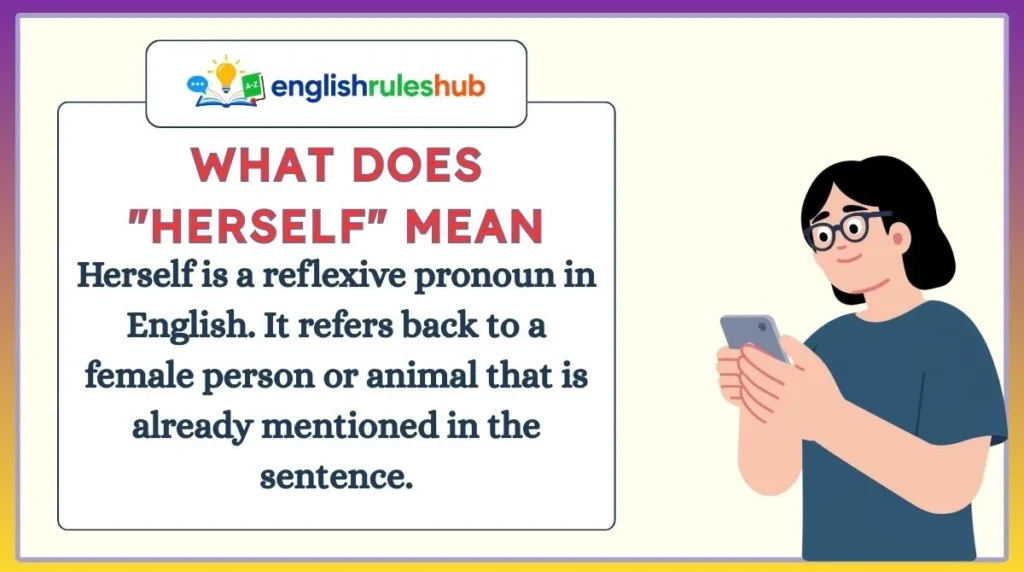
Herself is a reflexive pronoun in English. It refers back to a female person or animal that is already mentioned in the sentence. In simple words, the person who does the action and the person who receives the action are the same person.
It is also used as an intensive pronoun to add emphasis. In this case, it simply stresses that the woman did something on her own.
Simple Definition
Herself means the same woman or girl who is already the subject of the sentence.
For example:
- Sarah looked at herself in the mirror.
- Emma made the cake herself.
In the first sentence, Sarah is looking at Sarah. In the second sentence, the word herself emphasizes that Emma made the cake without anyone else’s help.
When Do We Use “Herself”?
You should use herself when:
- A woman does an action to herself.
- You want to emphasize that she did something alone.
- The subject of the sentence is she, and the object refers to the same person.
Grammar Rule
Use herself after a singular female subject like she, or after a singular female noun.
Pattern:
She + verb + herself
or
Female noun + verb + herself
Examples of “Herself”
Here are some easy examples:
- She introduced herself to the new students.
- Maria taught herself how to play the guitar.
- My sister blamed herself for the mistake.
- Anna bought herself a new dress.
- The little girl dressed herself before school.
- She reminded herself to call her mother.
- Jennifer cleaned the room herself.
- The queen herself welcomed the visitors.
Notice how every sentence talks about one female person. The word herself always refers back to that same person.
“Herself” as a Reflexive Pronoun
A reflexive pronoun is used when the subject and object are the same.
Examples:
- Lisa hurt herself while running.
- She saw herself in the photo.
- Emily asked herself an important question.
Without herself, these sentences would not have the same meaning.
“Herself” as an Intensive Pronoun
Sometimes herself is not necessary for the grammar of the sentence. Instead, it adds emphasis.
Compare these sentences:
- The manager signed the report.
- The manager herself signed the report.
The second sentence emphasizes that the manager personally signed it, not someone else.
More examples:
- She herself answered the phone.
- The actress herself greeted the fans.
- My grandmother herself cooked dinner.
Common Learner Confusion
Many English learners make these mistakes:
❌ She did the work her self.
✅ She did the work herself.
❌ She blamed herselves.
✅ She blamed herself.
Another common mistake is using herself for more than one woman.
For example:
❌ The girls introduced herself.
✅ The girls introduced themselves.
Remember, herself is always singular. If you are talking about two or more women or girls, use themselves, not herself.
Key Point to Remember
Whenever you are talking about one female person doing something to the same person or doing something without help, herself is the correct word. It is a standard English word used in everyday conversation, formal writing, books, newspapers, and exams. Using herself correctly will make your English sound natural, clear, and grammatically correct.
What Does “Herselves” Mean?
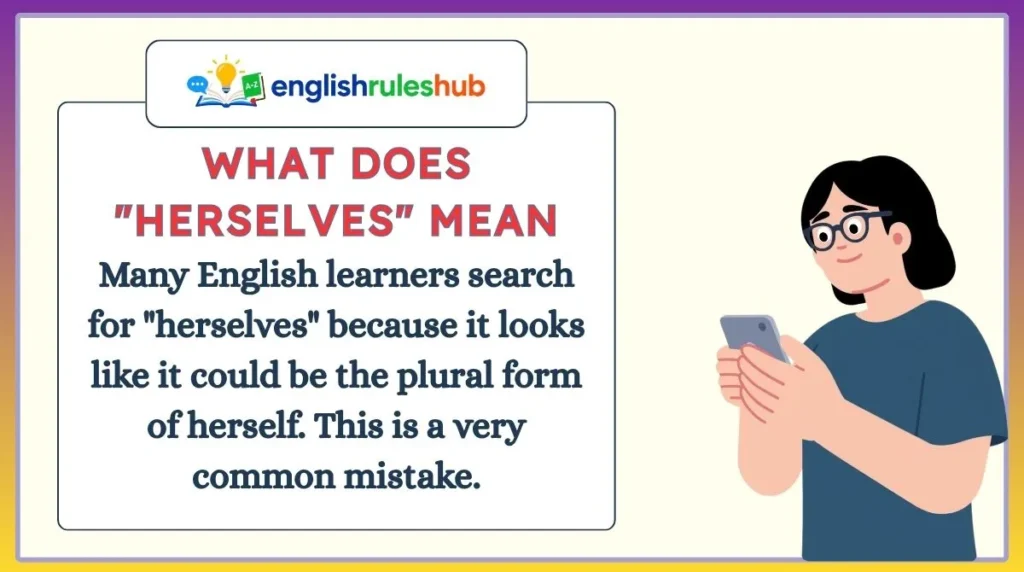
Many English learners search for “herselves” because it looks like it could be the plural form of herself. This is a very common mistake. The good news is that the rule is simple.
Herselves is not a standard English word. Modern English dictionaries and grammar books do not accept it as the correct plural form of herself. If you use herselves in school, business writing, exams, or everyday English, it will usually be marked as a grammar mistake.
Simple Definition
Herselves has no accepted meaning in standard English because it is not a correct English word.
If you want to refer to more than one woman or girl, you should use themselves, not herselves.
When Should You Use “Herselves”?
The simple answer is you should not use it in standard English.
Instead, choose the correct reflexive pronoun based on the subject:
| Subject | Correct Reflexive Pronoun |
|---|---|
| She | herself |
| He | himself |
| It | itself |
| They | themselves |
| We | ourselves |
| You | yourself / yourselves |
| I | myself |
As you can see, there is no place for “herselves” in the list.
Grammar Rule
A reflexive pronoun must match the subject.
- She → herself ✅
- They → themselves ✅
- She → herselves ❌
The word herselves breaks this grammar rule because English already has the correct plural reflexive pronoun: themselves.
Examples Showing the Correct Usage
Instead of writing:
❌ The girls introduced herselves.
Write:
✅ The girls introduced themselves.
Instead of:
❌ My sisters bought herselves new shoes.
Write:
✅ My sisters bought themselves new shoes.
Instead of:
❌ The women blamed herselves.
Write:
✅ The women blamed themselves.
Here are more correct examples:
- The girls enjoyed themselves at the party.
- The women prepared themselves for the interview.
- The players congratulated themselves after the match.
- My daughters taught themselves French.
- The friends introduced themselves to the teacher.
- The nurses protected themselves with safety equipment.
- The sisters encouraged themselves to keep trying.
- The students challenged themselves to improve every day.
Notice that every plural subject uses themselves, never herselves.
Why Do Learners Think “Herselves” Is Correct?
There are several reasons why this mistake is common.
1. It follows a pattern that seems logical.
Learners often think:
- himself → herselves
- yourself → yourselves
Since yourselves is a real word, they assume herselves must also exist. However, English does not work that way. The plural of herself is not herselves. English uses themselves instead.
2. Direct translation from other languages
Some languages create plural reflexive pronouns differently. When learners translate directly into English, they may accidentally invent the word herselves.
3. Typing and spelling mistakes
Sometimes people simply type herselves by accident because it looks similar to other English pronouns.
Is “Herselves” Ever Correct?
In modern standard English, the answer is no.
You may occasionally find herselves in very old books, historical texts, or discussions about regional dialects. In those cases, it reflects older or non-standard language, not modern grammar. For everyday English, academic writing, exams, and professional communication, you should avoid using it.
Common Learner Confusion
Many students ask these questions:
Is “herselves” the plural of “herself”?
No. The correct plural reflexive pronoun is themselves.
Can I write “herselves” if everyone is female?
No. Even if the group includes only women or girls, English still uses themselves.
Will native speakers use “herselves”?
Standard English speakers do not use herselves in normal speech or writing. They naturally say themselves.
Key Point to Remember
Whenever you are talking about one female person, use herself.
Whenever you are talking about two or more people, including a group made up entirely of women or girls, use themselves.
Never use “herselves” in standard English. Remembering this simple rule will help you avoid one of the most common grammar mistakes made by English learners.
What Does “Her Self” Mean?
Another form that often confuses English learners is her self written as two separate words. Many people think it is another correct spelling of herself, but that is not true in modern English.
In almost every situation, her self is considered incorrect. The correct spelling is herself as one word.
Simple Definition
Her self is not the normal spelling of the reflexive pronoun. In modern English, you should write herself as a single word.
Compare these examples:
- ✅ She looked at herself in the mirror.
- ❌ She looked at her self in the mirror.
The first sentence is correct because herself is the standard English reflexive pronoun.
When Should You Use “Her Self”?
For everyday English, the answer is simple:
You should almost never use “her self” as two words.
Whether you are writing an email, an essay, a school assignment, or a social media post, the correct form is herself.
Grammar Rule
Reflexive pronouns in English are written as one word.
Examples include:
- myself
- yourself
- himself
- herself
- itself
- ourselves
- yourselves
- themselves
Notice that every reflexive pronoun is written as a single word, not two separate words.
Correct Examples with “Herself”
Use these sentences as models:
- She taught herself to swim.
- Emma introduced herself to the class.
- My mother cooked dinner herself.
- Sarah blamed herself for the mistake.
- The little girl dressed herself.
- She asked herself an important question.
- My aunt bought herself a new handbag.
- Lisa reminded herself to finish her homework.
Each sentence uses herself correctly as one word.
Why Do Some People Write “Her Self”?
There are several reasons for this mistake.
1. They split the word by accident
Some learners think her and self should be written separately because they can see two smaller words inside herself.
2. Confusion with other English phrases
English has many two-word combinations like:
- her book
- her phone
- her bag
Because of this pattern, learners sometimes assume her self should also be two words.
3. Old or literary writing
In some very old English texts, you may occasionally see her self written separately. English spelling was less consistent hundreds of years ago. Modern English grammar has standardized the spelling as herself.
Today, dictionaries, grammar guides, schools, and publishers all recommend writing herself as one word.
Is “Her Self” Ever Correct?
There is one rare situation where her self may appear naturally, but it is not functioning as a reflexive pronoun.
For example:
- She wanted to understand her true self.
- She finally accepted her real self.
In these examples:
- her is a possessive adjective.
- self is a noun.
Together, they form a noun phrase, not the reflexive pronoun herself.
Similarly:
- He discovered his true self.
- They expressed their authentic selves.
Here, self means a person’s character, identity, or personality.
Common Learner Confusion
Many students ask:
Is “her self” just another spelling of “herself”?
No. The correct reflexive pronoun is herself.
Can I separate the word when writing?
No. Modern English always joins the two parts into one word when you mean the reflexive pronoun.
What about “her true self”?
That is different because self is a noun, not part of the reflexive pronoun.
Compare these examples:
- ✅ She hurt herself while running. (Reflexive pronoun)
- ✅ She found her true self after traveling. (Possessive adjective + noun)
- ❌ She hurt her self while running.
Key Point to Remember
If you mean the same woman or girl who performs or receives the action, always write herself as one word.
If self is being used as a noun with words like true, real, inner, or best, then writing her self as two separate words may be grammatically correct because her describes the noun self.
A simple way to remember this is:
- Herself = reflexive or intensive pronoun (one word). ✅
- Her self = her + self (possessive adjective + noun), used only in special contexts such as her true self or her real self.
Difference Between Herself, Herselves, and Her Self (Detailed)
These three forms look very similar, but they are not used in the same way. In fact, only herself is a standard reflexive pronoun in modern English. Herselves is not accepted in standard English, and her self is only correct when self is a separate noun, such as in the phrase “her true self.”
Once you understand this difference, it becomes much easier to avoid common grammar mistakes.
Comparison Table
| Feature | Herself | Herselves | Her Self |
|---|---|---|---|
| Is it a correct English word? | ✅ Yes | ❌ No | ⚠️ Only in special noun phrases |
| Part of speech | Reflexive or intensive pronoun | Not a standard English word | Possessive adjective + noun |
| Used for one woman or girl | ✅ Yes | ❌ No | ⚠️ Not as a reflexive pronoun |
| Used for more than one woman | ❌ No | ❌ No | ❌ No |
| Common in modern English | ✅ Very common | ❌ Never | ⚠️ Rare and only in special meanings |
| Example | She blamed herself. | ❌ She blamed herselves. | She accepted her true self. |
Meaning Difference
The biggest difference is their meaning and grammatical function.
Herself refers back to the same female person mentioned earlier in the sentence. It shows that the subject and the object are the same person.
Example:
- Emma introduced herself.
- She taught herself to cook.
In both sentences, the action begins and ends with the same person.
Herselves has no accepted meaning in standard English because it is not a correct English word.
Incorrect example:
- ❌ The girls enjoyed herselves.
Correct version:
- ✅ The girls enjoyed themselves.
Even if every person in the group is female, English still uses themselves.
Her self usually means her + self, where self is an ordinary noun meaning a person’s identity, personality, or inner character.
For example:
- She finally understood her true self.
- Meditation helped her discover her inner self.
Here, self is not a pronoun. It is simply a noun.
Usage Difference
Understanding when to use each form is much easier if you remember their purpose.
Use herself when:
- One woman performs an action on herself.
- You want to emphasize that she did something personally.
- You need a reflexive or intensive pronoun.
Examples:
- Sarah cut herself while cooking.
- My sister painted the room herself.
- The doctor introduced herself.
Do not use herselves in any standard English sentence.
Wrong:
- ❌ The women congratulated herselves.
Correct:
- ✅ The women congratulated themselves.
Use her self only when self is a separate noun.
Examples:
- She accepted her real self.
- She expressed her authentic self.
- Therapy helped her understand her inner self.
Notice that words like real, true, inner, and authentic describe the noun self.
Grammar Logic
English reflexive pronouns follow a fixed pattern.
| Subject | Reflexive Pronoun |
|---|---|
| I | myself |
| You | yourself |
| He | himself |
| She | herself |
| It | itself |
| We | ourselves |
| You (plural) | yourselves |
| They | themselves |
This table shows why herselves is incorrect. English already has the plural reflexive pronoun themselves, so there is no need for another word.
Similarly, every reflexive pronoun is written as one word, which explains why herself is correct and her self is usually incorrect when you mean the reflexive pronoun.
Sentence Structure Difference
Each form follows a different sentence pattern.
Pattern 1: Herself (Reflexive Pronoun)
Subject + Verb + Herself
Examples:
- She blamed herself.
- Emma introduced herself.
- My mother bought herself a gift.
Pattern 2: Her Self (Possessive + Noun)
Her + Adjective + Self
Examples:
- She discovered her true self.
- She accepted her real self.
- She expressed her authentic self.
Here, self acts as a noun, not a pronoun.
Pattern 3: Herselves
There is no correct sentence pattern because herselves is not a standard English word.
Side-by-Side Examples
Look at these pairs carefully.
Correct
- She looked at herself in the mirror.
Incorrect
- She looked at her self in the mirror.
Correct
- The girls enjoyed themselves.
Incorrect
- The girls enjoyed herselves.
Correct
- She finally accepted her true self.
Incorrect
- She finally accepted herself. (This changes the meaning because it no longer refers to her identity.)
Which Form Should You Choose?
Ask yourself these simple questions:
Are you talking about one woman doing something to herself?
➡️ Use herself.
Are you talking about two or more people?
➡️ Use themselves, not herselves.
Are you talking about someone’s identity or personality?
➡️ You can use her self only when self is a noun, usually in phrases like her true self, her real self, or her inner self.
Quick Summary
Remember these three simple rules:
- ✅ Herself is the correct reflexive and intensive pronoun for one female person.
- ❌ Herselves is not a standard English word. Always use themselves for plural subjects.
- ⚠️ Her self is not another spelling of herself. It is only correct when self is a separate noun referring to a person’s identity, such as her true self or her inner self.
Learning these differences will help you write clearer, more natural English and avoid one of the most common mistakes made by English learners.
Grammar Rules You Must Remember
Learning a few simple grammar rules can help you use herself, avoid herselves, and understand when her self is correct. These rules are easy to remember and will make your English more natural and accurate.
Rule #1: Use “Herself” for One Female Person
Use herself when the subject is one woman or one girl and the action comes back to the same person. This is the most common use of the word.
Pattern:
She + verb + herself
Examples:
- She introduced herself to the class.
- Emma bought herself a new laptop.
- My sister blamed herself for the mistake.
- Sarah taught herself how to bake.
- The little girl dressed herself before school.
Remember: If the subject is she or a singular female noun, herself is usually the correct reflexive pronoun.
Rule #2: Never Use “Herselves” in Standard English
Many learners think herselves is the plural form of herself, but this is incorrect. English already has the plural reflexive pronoun themselves.
Wrong:
- ❌ The girls enjoyed herselves.
- ❌ The women introduced herselves.
- ❌ My sisters blamed herselves.
Correct:
- ✅ The girls enjoyed themselves.
- ✅ The women introduced themselves.
- ✅ My sisters blamed themselves.
Easy Tip: Whenever the subject is plural, think of they, and use themselves.
Rule #3: Write “Herself” as One Word
Reflexive pronouns in English are always written as one word. Do not separate her and self when you mean the reflexive pronoun.
Wrong:
- ❌ She looked at her self.
- ❌ Emma introduced her self.
- ❌ She reminded her self to study.
Correct:
- ✅ She looked at herself.
- ✅ Emma introduced herself.
- ✅ She reminded herself to study.
This rule also applies to other reflexive pronouns:
- myself
- yourself
- himself
- itself
- ourselves
- yourselves
- themselves
All of these are written as single words.
Rule #4: Use “Her Self” Only When “Self” Is a Noun
Sometimes self is not part of a reflexive pronoun. Instead, it is an ordinary noun that means a person’s identity, personality, or inner character.
In this case, her is a possessive adjective, and self is the noun.
Examples:
- She accepted her true self.
- Meditation helped her discover her inner self.
- She became confident enough to show her real self.
- The book encouraged readers to understand their authentic selves.
Notice that words such as true, real, inner, and authentic describe the noun self.
If you remove the adjective, the meaning often changes. That is why these phrases are different from the reflexive pronoun herself.
Bonus Grammar Tip
A quick way to choose the correct word is to ask yourself this question:
Is the action happening to the same woman who is doing it?
- Yes → Use herself.
- No, I’m talking about her identity or personality → Use her self only if self is a separate noun (for example, her true self).
- I’m talking about more than one person → Use themselves, never herselves.
Quick Review
Before you finish writing a sentence, check these four rules:
- ✅ Use herself for one female person.
- ❌ Never use herselves in standard English.
- ✅ Write herself as one word.
- ✅ Use her self only when self is a separate noun referring to identity or personality.
Keeping these rules in mind will help you write clear, correct English and avoid mistakes that many learners make.
Common Mistakes Students Make
Many English learners make mistakes with herself, herselves, and her self because these forms look very similar. Some mistakes happen because of spelling, while others happen because learners try to follow grammar patterns that do not exist in English.
The good news is that these mistakes are easy to fix once you understand the rules.
Mistake #1: Using “Herselves” as the Plural of “Herself”
This is the most common mistake.
Many students think that if yourself becomes yourselves, then herself should become herselves. However, English does not work this way.
Wrong:
- ❌ The girls enjoyed herselves.
- ❌ My sisters introduced herselves.
- ❌ The women blamed herselves.
Correct:
- ✅ The girls enjoyed themselves.
- ✅ My sisters introduced themselves.
- ✅ The women blamed themselves.
Why does this mistake happen?
Learners try to create a plural form by adding -ves, but English already has the correct plural reflexive pronoun: themselves.
Easy Tip:
If the subject is they, always use themselves.
Mistake #2: Writing “Her Self” Instead of “Herself”
Another common mistake is separating the word into two parts.
Wrong:
- ❌ She taught her self English.
- ❌ Emma looked at her self in the mirror.
- ❌ Sarah reminded her self to study.
Correct:
- ✅ She taught herself English.
- ✅ Emma looked at herself in the mirror.
- ✅ Sarah reminded herself to study.
Why does this mistake happen?
Students often think her and self should be written separately because they are two different words. However, when they form a reflexive pronoun, they become one word.
Easy Tip:
If the word means the same woman or girl, always write herself as one word.
Mistake #3: Using “Herself” with a Plural Subject
Some learners correctly know the word herself, but they use it with more than one person.
Wrong:
- ❌ The girls enjoyed herself.
- ❌ My sisters introduced herself.
- ❌ The women prepared herself.
Correct:
- ✅ The girls enjoyed themselves.
- ✅ My sisters introduced themselves.
- ✅ The women prepared themselves.
Why does this mistake happen?
Students remember herself but forget that reflexive pronouns must agree with the subject.
Easy Tip:
Singular subject → herself
Plural subject → themselves
Mistake #4: Using “Herself” When No Reflexive Pronoun Is Needed
Sometimes learners add herself even though the sentence is already complete.
Wrong:
- ❌ She herself likes coffee every morning. (Possible but unnecessary if there is no emphasis.)
- ❌ Emma herself is happy today. (Correct only if you want to emphasize Emma.)
Better:
- ✅ She likes coffee every morning.
- ✅ Emma is happy today.
If you want to add emphasis, then herself is perfectly correct.
For example:
- ✅ The manager herself answered the phone.
- ✅ The teacher herself checked the homework.
Here, herself stresses that the person personally did the action.
Mistake #5: Confusing “Herself” with “Her True Self”
These expressions have different meanings.
Wrong:
- ❌ She finally accepted herself. (This usually means she accepted herself as a person.)
- ❌ She discovered herself after years of travel. (This has a different meaning.)
Correct (when talking about identity):
- ✅ She accepted her true self.
- ✅ She discovered her real self.
- ✅ She expressed her authentic self.
Here, self is a noun, not a reflexive pronoun.
Quick Correction Tips
Whenever you write one of these words, ask yourself these simple questions:
- Am I talking about one woman or girl? → Use herself.
- Am I talking about two or more people? → Use themselves, not herselves.
- Am I talking about someone’s identity or personality? → You may use her self only when self is a separate noun, such as her true self or her inner self.
- Am I writing a reflexive pronoun? → Always write herself as one word.
Common Errors at a Glance
| Incorrect | Correct |
|---|---|
| ❌ herselves | ✅ themselves |
| ❌ her self (as a reflexive pronoun) | ✅ herself |
| ❌ The girls blamed herself. | ✅ The girls blamed themselves. |
| ❌ She introduced her self. | ✅ She introduced herself. |
| ❌ My sisters enjoyed herselves. | ✅ My sisters enjoyed themselves. |
By avoiding these common mistakes, your English will sound more natural and grammatically correct. With a little practice, choosing between herself, herselves, and her self will become easy and automatic.
FAQs
1. What is the difference between herself, themselves, and her self?
Herself is a reflexive pronoun used for one female person, while themselves is used for two or more people. Her self means “her own identity or inner person” and is usually used when talking about someone’s character or identity.
2. Is herselves a correct word?
No. Herselves is not standard English. For one female person, use herself. For more than one person, use themselves.
- ❌ She did it herselves.
- ✅ She did it herself.
- ✅ They did it themselves.
3. When should I use herself?
Use herself when referring back to a female person who is the subject of the sentence. It can also be used for emphasis.
- She hurt herself.
- Maria made the cake herself.
- She herself answered the question.
4. What does her self mean?
Her self refers to a woman’s own identity, personality, feelings, or inner nature. It is different from the normal pronoun herself.
- She wanted to be true to her self.
- After the experience, she discovered a new self.
However, her self is much less common than herself in everyday English.
5. Is her self the same as herself?
No. Herself is one word and is normally a reflexive or emphatic pronoun. Her self consists of the possessive word her + the noun self, so it has a different grammatical function.
Compare:
- She blamed herself.
- She wanted to understand her self better.
6. Can I say She did it herselves?
No. Herselves is incorrect in standard English. Because she refers to one female person, the correct reflexive pronoun is herself.
✅ She did it herself.
❌ She did it herselves.
7. Should I use herself or themselves?
Use herself for one female person and themselves for a plural subject.
- She prepared it herself.
- They prepared it themselves.
The form should match the subject in number.
Conclusion
Understanding herself, themselves, and her self becomes much easier when you remember their basic roles.
Herself is a reflexive pronoun used when a female subject and object refer to the same person, while themselves is used for two or more people.
Her self is different because it refers to a woman’s own identity, personality, or inner nature and is usually used when talking about the person’s sense of self.
The key is to look at the meaning and the sentence structure. If you are talking about an action done to the same woman, use herself.
If the action involves a group of people, use themselves. When you mean a woman’s own identity or inner personality, her self may be appropriate.
With a little practice, these forms will become much easier to recognize and use correctly.

I am Benjamin Clark, an English language writer passionate about simplifying grammar, vocabulary, and word meanings. I create clear, accurate, and practical content to help learners improve their English skills with confidence every day.