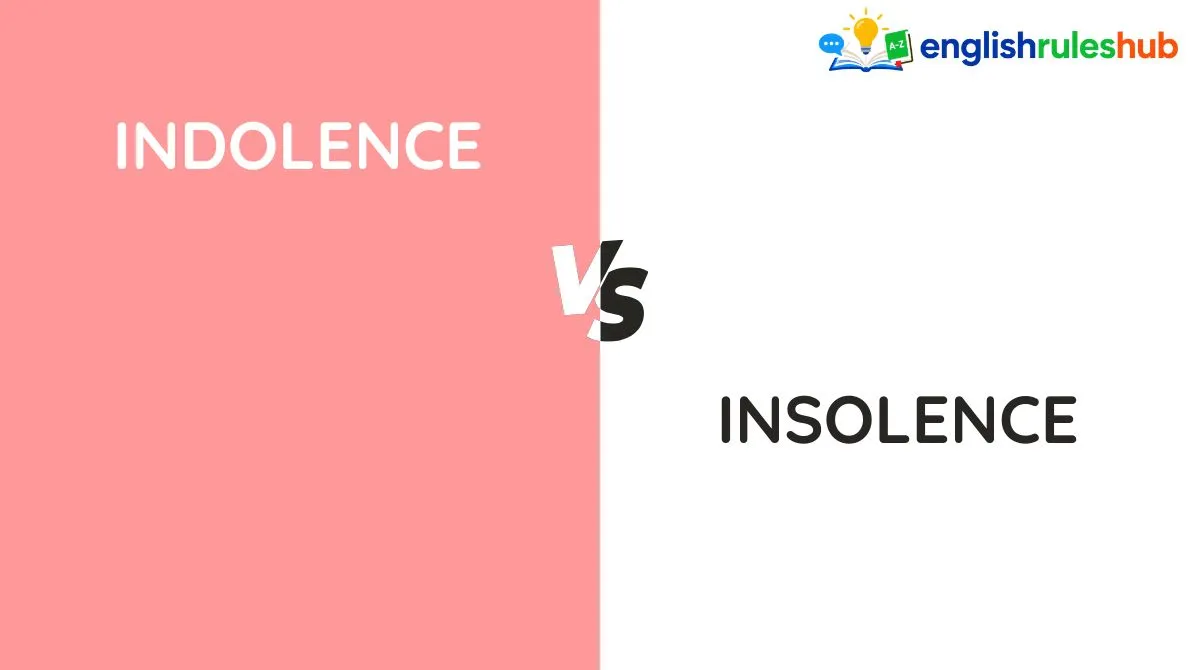
Some English words look almost the same, but they have completely different meanings. Indolence and insolence are perfect examples.
They differ by only one letter, so many English learners think they are related. In reality, they describe two very different behaviors.
You may see these words in books, newspapers, classrooms, or even in everyday conversations. If you mix them up, your sentence can sound confusing or even change its meaning.
For example, calling someone indolent means they are lazy, while calling someone insolent means they are rude or disrespectful. Those are two very different ideas.
Understanding this difference is important because both words describe people and behavior.
They often appear in school writing, formal English, stories, and workplace communication. Learning the correct meaning will help you speak and write with more confidence.
The good news is that the difference is easy to remember once you know what each word means and how it is used.
Small spelling changes can create big meaning changes, and this pair is a great example of that.
By the end of this guide, you will clearly understand what indolence means, what insolence means, when to use each word, and how to avoid one of the most common vocabulary mistakes made by English learners.
What Does “Indolence” Mean?
Indolence is a noun that means laziness, idleness, or a habit of avoiding work or effort. A person who shows indolence prefers resting instead of working, studying, or completing responsibilities.
The adjective form is indolent.
Simple Definition
Indolence = laziness or unwillingness to work.
It describes someone’s attitude toward work or activity rather than their personality in general.
When Do We Use “Indolence”?
Use indolence when talking about:
- Laziness
- Avoiding work
- Lack of effort
- Idle behavior
- Low motivation
It is mostly used in formal English, literature, education, and professional writing. In everyday conversation, people often use simpler words like laziness instead.
Grammar Rule
Indolence is an uncountable noun.
Correct:
- His indolence caused many problems.
- The teacher warned students against indolence.
Incorrect:
- ❌ He has many indolences.
Since it is usually uncountable, we normally do not use it in the plural form.
Common Sentence Patterns
- indolence + verb
- because of indolence
- due to indolence
- show indolence
- overcome indolence
- encourage indolence
Examples of “Indolence”
- His indolence kept him from finishing the project.
- The coach disliked any sign of indolence during practice.
- She fought her indolence and completed her homework.
- Years of indolence affected his career.
- Parents should not encourage indolence in children.
- The manager noticed the employee’s indolence.
- Success rarely comes through indolence.
- Morning exercise helped him overcome his indolence.
Common Learner Confusion
Many learners think indolence means being rude because it sounds similar to insolence.
Remember this:
- Indolence is about not wanting to work.
- It has nothing to do with manners or respect.
Someone can be lazy but very polite.
For example:
- Tom is polite, but his indolence keeps him from completing his tasks.
Here, Tom is respectful. His only problem is laziness.
Synonyms of Indolence
These words have similar meanings:
- Laziness
- Idleness
- Inactivity
- Sluggishness
- Inertia
- Lethargy
- Slackness
Each synonym has a slightly different meaning, but they all relate to a lack of effort or activity.
Antonyms of Indolence
The opposite of indolence includes:
- Hard work
- Diligence
- Industry
- Energy
- Activity
- Motivation
- Productivity
For example:
- Diligence leads to success, while indolence often causes missed opportunities.
Real-Life Situations Using “Indolence”
Imagine these situations:
At school
A student spends the whole evening watching videos instead of studying. The teacher says:
“Your indolence is affecting your grades.”
At work
An employee keeps delaying simple tasks.
The manager says:
“Your indolence is slowing down the whole team.”
At home
A parent notices their child refuses to clean their room.
They might say:
“You need to stop this indolence and help around the house.”
In all these examples, the problem is laziness, not bad manners.
Tips for Using “Indolence” Correctly
- Use it when discussing lack of effort.
- It is more common in formal writing than casual speech.
- Think of it as a stronger word for laziness.
- Do not use it when talking about rude behavior.
Quick Summary of “Indolence”
| Feature | Explanation |
|---|---|
| Part of speech | Noun |
| Meaning | Laziness or unwillingness to work |
| Used for | Lack of effort |
| Tone | Mostly formal |
| Adjective form | Indolent |
| Opposite | Diligence, hard work |
What Does “Insolence” Mean?
Insolence is a noun that means rude, disrespectful, or impolite behavior toward someone, especially a person in authority. It describes a lack of respect shown through words, actions, or attitude.
The adjective form is insolent.
Simple Definition
Insolence = rude or disrespectful behavior.
It is about bad manners, not laziness.
When Do We Use “Insolence”?
Use insolence when someone:
- Speaks disrespectfully
- Answers back rudely
- Shows no respect to parents, teachers, managers, or elders
- Acts in an offensive or impolite way
This word is common in formal English, literature, school rules, workplace policies, and historical writing.
Grammar Rule
Like indolence, insolence is usually an uncountable noun.
Correct:
- His insolence shocked everyone.
- The teacher punished the student’s insolence.
Incorrect:
- ❌ She showed many insolences.
Most of the time, it stays singular because it refers to a quality or type of behavior.
Common Sentence Patterns
- show insolence
- punish insolence
- tolerate insolence
- respond with insolence
- act with insolence
- display insolence
Examples of “Insolence”
- His insolence offended the teacher.
- The manager would not tolerate insolence.
- The child apologized for his insolence.
- Speaking with insolence can damage relationships.
- Everyone noticed her insolence during the meeting.
- The coach warned the player about his insolence.
- The principal dealt firmly with the student’s insolence.
- Her insolence surprised even her close friends.
Common Learner Confusion
Some learners think insolence means laziness because its spelling is close to indolence.
That is incorrect.
Remember this simple idea:
- Insolence is about respect.
- It has nothing to do with working hard or being lazy.
A person may work very hard but still be insolent if they speak rudely to others.
For example:
- Sarah is an excellent worker, but her insolence toward customers created problems.
Here, the issue is not her work ethic. It is her disrespectful attitude.
What Does “Insolence” Mean? (Continued)
Synonyms of Insolence
These words have meanings that are close to insolence, although each has its own small difference.
- Rudeness
- Disrespect
- Impudence
- Impertinence
- Arrogance
- Boldness
- Cheek (informal)
- Discourtesy
For example:
- The teacher did not accept the student’s rudeness or insolence.
- His impudence surprised everyone in the office.
While these words are similar, insolence usually suggests showing open disrespect, especially toward someone who deserves respect or has authority.
Antonyms of Insolence
The opposite of insolence includes:
- Respect
- Politeness
- Courtesy
- Good manners
- Humility
- Obedience
- Civility
For example:
- Everyone appreciated her courtesy instead of insolence.
- Respect always leaves a better impression than insolence.
Real-Life Situations Using “Insolence”
Understanding words becomes easier when you see them in everyday situations.
At School
A student rolls his eyes and argues loudly with the teacher.
The teacher says:
“Your insolence is not acceptable in this classroom.”
The problem is disrespect, not poor grades.
At Work
An employee speaks rudely to the company manager during a meeting.
The manager responds:
“Your insolence will not be tolerated.”
The issue is the employee’s attitude.
At Home
A teenager answers their parents in a rude voice.
A parent might say:
“Please stop this insolence and speak respectfully.”
Again, the concern is bad manners.
In Public
Someone shouts at a police officer without reason.
People watching may describe the behavior as insolence because it shows open disrespect.
Tips for Using “Insolence” Correctly
Keep these simple points in mind:
- Use insolence only for rude or disrespectful behavior.
- It usually refers to how someone speaks or acts toward another person.
- It is more common in formal English than in everyday conversation.
- Never use it to describe laziness.
Quick Summary of “Insolence”
| Feature | Explanation |
|---|---|
| Part of speech | Noun |
| Meaning | Rude or disrespectful behavior |
| Used for | Bad manners and disrespect |
| Tone | Mostly formal |
| Adjective form | Insolent |
| Opposite | Respect, courtesy, politeness |
Difference Between Indolence and Insolence (Detailed)
Although these two words look almost identical, they describe completely different qualities. Confusing them can change the meaning of your sentence.
The easiest way to understand the difference is to ask yourself one question:
Am I talking about laziness or disrespect?
If the answer is laziness, use indolence.
If the answer is disrespect, use insolence.
Comparison Table
| Feature | Indolence | Insolence |
|---|---|---|
| Meaning | Laziness or unwillingness to work | Rude or disrespectful behavior |
| Focus | Lack of effort | Lack of respect |
| Part of speech | Noun | Noun |
| Adjective | Indolent | Insolent |
| Common topic | Work, study, responsibility | Manners, attitude, behavior |
| Opposite | Diligence | Respect |
| Used in | Formal writing, education | Formal writing, education, workplace |
| Describes | Work habits | Social behavior |
Meaning Difference
The biggest difference is what each word describes.
Indolence describes how someone feels about work or activity.
Example:
- His indolence stopped him from reaching his goals.
Here, he does not want to work hard.
Insolence describes how someone treats other people.
Example:
- His insolence upset the entire class.
Here, he behaved rudely.
One word is about effort.
The other is about respect.
Usage Difference
Use indolence when discussing:
- Homework
- Jobs
- Chores
- Responsibilities
- Productivity
- Motivation
Examples:
- Indolence caused him to fail the exam.
- Her indolence delayed the project.
Use insolence when discussing:
- Teachers
- Parents
- Managers
- Police officers
- Customers
- Friends
Examples:
- His insolence offended the manager.
- The student’s insolence shocked the principal.
Grammar Logic
Both words are abstract nouns.
That means you cannot touch or see them directly. They describe qualities or behaviors.
Notice these patterns:
Indolence
- because of indolence
- due to indolence
- overcome indolence
- fight indolence
Insolence
- show insolence
- tolerate insolence
- punish insolence
- display insolence
These common word combinations make your English sound more natural.
Sentence Structure Difference
Both nouns often appear after articles or possessive adjectives.
Examples with indolence
- His indolence worried his parents.
- Their indolence affected the whole team.
- Constant indolence leads to poor results.
Examples with insolence
- Her insolence surprised everyone.
- Their insolence angered the teacher.
- Such insolence cannot be ignored.
The grammar is similar, but the meanings are completely different.
Meaning Comparison Through Examples
Look at these pairs.
Example 1
❌ His insolence made him fail the exam.
✅ His indolence made him fail the exam.
Failing because you did not study is about laziness.
Example 2
❌ The teacher punished his indolence after he shouted at her.
✅ The teacher punished his insolence after he shouted at her.
Shouting at a teacher is disrespect.
Example 3
❌ The lazy worker was known for his insolence.
✅ The lazy worker was known for his indolence.
Being lazy is not the same as being rude.
Example 4
❌ Everyone admired her indolence toward customers.
✅ Everyone disliked her insolence toward customers.
Customers expect polite behavior.
Can Someone Be Both Indolent and Insolent?
Yes.
A person can be both lazy and rude at the same time.
For example:
The employee’s indolence slowed down the team’s work, and his insolence toward the manager made the situation even worse.
In this sentence:
- Indolence describes his lack of effort.
- Insolence describes his disrespect.
Each word has its own job.
Which Word Is More Common?
In everyday conversation, native speakers usually choose simpler words.
Instead of indolence, they often say:
- laziness
- idle
- lazy
Instead of insolence, they often say:
- rudeness
- disrespect
- rude
However, both words are still useful because they appear in:
- novels
- newspapers
- academic writing
- exams
- speeches
- workplace documents
Learning them helps you understand advanced English with greater confidence.
Grammar Rules You Must Remember
Knowing the meanings is helpful, but remembering a few grammar rules will help you avoid common mistakes.
Rule #1: Both Words Are Nouns
Both indolence and insolence are nouns.
Correct:
- His indolence caused problems.
- Her insolence shocked everyone.
Incorrect:
- ❌ He indolence every day.
- ❌ She insolence the teacher.
A noun names a quality or thing. It does not act as the verb.
Rule #2: Use the Adjective Forms to Describe People
When describing a person directly, use indolent or insolent, not the noun.
Correct:
- He is indolent.
- She is insolent.
Correct:
- His indolence is a problem.
- Her insolence upset the class.
Notice the difference:
- Indolent = adjective
- Indolence = noun
- Insolent = adjective
- Insolence = noun
Rule #3: Never Exchange Their Meanings
This is the mistake learners make most often.
Remember:
- Indolence = laziness
- Insolence = disrespect
Example:
❌ His insolence kept him from doing his homework.
✅ His indolence kept him from doing his homework.
Homework is about effort, not manners.
Rule #4: Both Words Are Usually Uncountable
Normally, these nouns stay singular.
Correct:
- Her insolence shocked the audience.
- His indolence affected his future.
Incorrect:
- ❌ Many indolences
- ❌ Several insolences
Treat them like other abstract nouns such as kindness, honesty, or patience.
Common Mistakes Students Make
Because indolence and insolence look and sound alike, many English learners mix them up. This happens even to advanced students. The good news is that once you understand what each word describes, these mistakes become much easier to avoid.
Here are the most common errors and simple ways to fix them.
Mistake #1: Using “Insolence” When You Mean Laziness
This is the most common mistake.
Wrong:
❌ His insolence stopped him from studying for the test.
Correct:
✅ His indolence stopped him from studying for the test.
Why?
The student did not study because of laziness, not because he was rude.
Easy Tip:
If the problem is not working, choose indolence.
Mistake #2: Using “Indolence” for Rude Behavior
Some learners think indolence means bad manners.
Wrong:
❌ The teacher punished the student’s indolence after he shouted in class.
Correct:
✅ The teacher punished the student’s insolence after he shouted in class.
Why?
Shouting at a teacher is disrespectful behavior. That is insolence.
Easy Tip:
If someone is being rude, use insolence.
Mistake #3: Confusing the Noun and Adjective Forms
Many students accidentally use the noun where an adjective is needed.
Wrong:
❌ He is very indolence.
Correct:
✅ He is very indolent.
Wrong:
❌ She is always insolence.
Correct:
✅ She is always insolent.
Remember:
| Noun | Adjective |
|---|---|
| Indolence | Indolent |
| Insolence | Insolent |
Mistake #4: Thinking Both Words Describe Personality
These words describe different qualities.
Someone can be:
- Hard-working but rude.
- Lazy but polite.
- Hard-working and polite.
- Lazy and rude.
Examples:
- Emma is hardworking, but her insolence upsets her coworkers.
- Jack is polite, but his indolence affects his grades.
Do not assume one word automatically means the other.
Mistake #5: Choosing the Word Only Because It Sounds Right
Many learners rely on spelling instead of meaning.
Compare these sentences:
- His indolence delayed the project.
- His insolence offended the manager.
Although the words look similar, the situations are completely different.
Always think about the meaning first.
Quick Correction Tips
Ask yourself these questions before choosing a word:
- Is the problem laziness?
- ✅ Use indolence.
- Is the problem rudeness?
- ✅ Use insolence.
This simple habit can prevent most mistakes.
Easy Trick to Remember the Difference
Sometimes a small memory trick is all you need.
Memory Trick #1: Think About the Letter “D”
InDolence
The letter D can remind you of Doing nothing.
Doing nothing = Laziness = Indolence
Think:
D = Doing nothing
Whenever you see indolence, remember someone avoiding work or effort.
Memory Trick #2: Think About the Letter “S”
InSolence
The letter S can remind you of Speaking rudely.
Speaking rudely = Insolence
Think:
S = Speaking disrespectfully
Whenever you hear insolence, imagine someone talking back to a teacher or manager.
Memory Trick #3: Ask One Simple Question
Before using either word, ask yourself:
“Is this about work or manners?”
If it is about:
- Work → Indolence
- Manners → Insolence
This question works almost every time.
Real-Life Logic
Imagine two classmates.
Student A
He never studies.
He skips homework.
He sleeps during lessons.
His problem is indolence.
Student B
She studies hard.
She always finishes her homework.
But she argues with teachers and speaks disrespectfully.
Her problem is insolence.
Now imagine Student C.
He never studies and talks rudely to everyone.
Student C shows both indolence and insolence.
Thinking about real people makes the meanings much easier to remember.
A One-Line Memory Formula
Keep this simple sentence in your mind:
Indolence is about effort. Insolence is about respect.
If you remember only this line, you will rarely confuse these words again.
Daily Life Examples (Very Important)
The best way to learn new vocabulary is to see it in everyday conversations. Here are some simple examples that sound natural in real life.
- My brother’s indolence keeps him from finishing his homework on time.
- The teacher did not accept the student’s insolence during class.
- Because of his indolence, he missed an important deadline.
- Her insolence toward customers hurt the company’s reputation.
- We should fight indolence by staying active every day.
- Parents usually teach children to avoid insolence and speak politely.
- His indolence made group projects difficult for everyone.
- The manager warned the employee about his insolence in the meeting.
- Laziness may begin as indolence, but hard work can change that habit.
- Good manners leave a better impression than insolence.
Short Conversation Examples
Conversation 1
Ali: Why didn’t Tom finish the report?
Sara: His indolence got in the way again.
Conversation 2
Teacher: Why did the principal call James?
Student: Because of his insolence toward another teacher.
Conversation 3
Mother: Your room is still messy.
Son: I’ll clean it today.
Mother: Good. Don’t let indolence become a habit.
Conversation 4
Manager: Please speak respectfully.
Employee: I’m sorry for my insolence.
These examples show how each word naturally fits into different situations.
Practice Section
Choose the correct word: indolence or insolence.
Question 1
The employee lost his job because of his ________ toward the manager.
A. indolence
B. insolence
Question 2
Years of ________ prevented him from reaching his goals.
A. indolence
B. insolence
Question 3
The teacher would not tolerate the student’s ________.
A. indolence
B. insolence
Question 4
His ________ kept him from completing his college assignments.
A. indolence
B. insolence
Question 5
Speaking rudely to customers is an example of ________.
A. indolence
B. insolence
Answers
- B. Insolence
- A. Indolence
- B. Insolence
- A. Indolence
- B. Insolence
Practice Tip
If you answered all five correctly, you have understood the difference very well. If you missed any, go back and remember the simple rule:
- Indolence = laziness
- Insolence = disrespect
These two ideas will help you choose the correct word in almost every situation.
FAQs
1. What is the difference between indolence and insolence?
The main difference is their meaning. Indolence means laziness or a lack of effort, while insolence means rude or disrespectful behavior. Although the words look similar, they describe completely different actions. Think of indolence as a work habit and insolence as a manners problem.
2. Can I use indolence and insolence in the same sentence?
Yes. If a person is both lazy and rude, you can use both words together.
Example:
The employee’s indolence slowed the project, while his insolence toward the manager made the situation even worse.
In this sentence, each word keeps its own meaning.
3. Can indolence and insolence be used in questions?
Yes. Both words can appear naturally in questions.
Examples:
- Was his indolence the reason he failed the exam?
- Why did the teacher punish her insolence?
- How can parents reduce indolence in children?
- Should schools tolerate insolence from students?
The grammar does not change when these words are used in questions.
4. Are indolence and insolence formal or informal words?
Both are mostly formal English words. They often appear in books, newspapers, academic writing, workplace documents, and speeches.
In everyday conversations, native speakers usually choose simpler words.
For example:
- Indolence → laziness
- Insolence → rudeness or disrespect
Learning the formal words is still useful because you will often see them in reading materials and English exams.
5. What are the adjective forms of indolence and insolence?
The adjective forms are:
- Indolent → lazy or unwilling to work
- Insolent → rude or disrespectful
Examples:
- The indolent student rarely finished his homework.
- The insolent employee argued with the manager.
Remember that indolence and insolence are nouns, while indolent and insolent are adjectives.
6. Why do English learners confuse indolence and insolence?
Learners often confuse these words because they have almost the same spelling and pronunciation. Only one letter is different, but their meanings are completely unrelated.
A simple way to avoid confusion is to remember this rule:
- Indolence = lack of effort
- Insolence = lack of respect
Once you connect each word with its main idea, choosing the correct one becomes much easier.
Final Conclusion
Many English words look alike, but indolence and insolence remind us that similar spelling does not always mean similar meaning.
Learning the difference between these two words will make your English more accurate and help you avoid a common vocabulary mistake.
The easiest way to remember them is to focus on what they describe. Indolence is about laziness, inactivity, and avoiding work, while insolence is about rude, disrespectful behavior toward others. One word is connected to effort, and the other is connected to respect.
As you read books, watch English videos, or have conversations, pay attention to how these words are used.
Try making your own sentences and include them in your daily practice. The more often you use them correctly, the more natural they will become.

I am Benjamin Clark, an English language writer passionate about simplifying grammar, vocabulary, and word meanings. I create clear, accurate, and practical content to help learners improve their English skills with confidence every day.