Many English learners feel confused when they hear people say “math” and “maths.” Both words look almost the same, and both are connected to numbers, calculations, and the subject taught in schools.
The confusion becomes bigger when learners watch English videos, read books, or talk with people from different countries.
A student in the United States may say, “I love math,” while a student in the United Kingdom may say, “I love maths.”
This makes many learners wonder: Which one is correct? Is one word wrong? Should I use math or maths in English conversations?
The good news is that both words are correct. The difference is not about grammar rules or meaning. It is mainly about where the speaker uses English.
Understanding this small difference can help you sound more natural when speaking or writing in English.
Knowing the difference between these two words is useful because English is spoken in many countries, and different regions often have their own vocabulary choices. A learner who understands these variations can communicate more confidently.
After reading this explanation, you will understand why some people say math, why others say maths, where each word is used, and how to choose the right word for your situation.
You will also learn common mistakes and simple tricks to remember the difference.
What Does “Math” Mean?
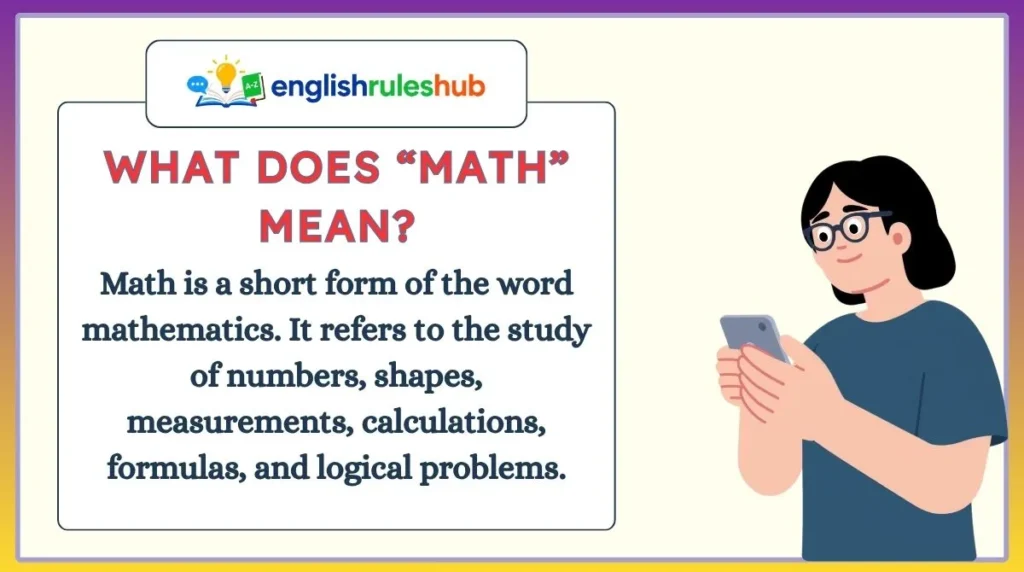
Math is a short form of the word mathematics. It refers to the study of numbers, shapes, measurements, calculations, formulas, and logical problems.
The word math is mainly used in American English. People in the United States and some other places usually say “math” when they talk about this school subject.
For example, an American student may say:
- “I have a math test tomorrow.”
- “Math is my favorite subject.”
- “I need help with my math homework.”
The full word mathematics is a general term, but in daily conversations, many American English speakers shorten it to math.
When Do We Use “Math”?
We use math when talking about:
- A school subject
- Numbers and calculations
- Mathematical skills
- Problems involving figures or equations
It can be used in different situations, such as school, work, and everyday conversations.
Grammar Rule for “Math”
Math is an uncountable noun when it means the subject of mathematics.
This means we usually do not say:
❌ “I study a math.”
✅ “I study math.”
We also do not normally make it plural:
❌ “I like maths” (in American English)
✅ “I like math”
However, remember that math is a regional choice. In American English, it is the natural form.
Examples of “Math” in Sentences
- I am good at math because I practice every day.
- My brother does not enjoy math classes.
- She wants to become a math teacher.
- We learned a difficult math formula at school today.
- I need a calculator for this math problem.
- Math helps us solve many real-life problems.
- He spends two hours studying math every evening.
- This math question is harder than the last one.
Common Learner Confusion About “Math”
Many learners think math is incorrect because mathematics contains many different topics, such as algebra, geometry, and statistics. They think the word should be plural because there are many parts.
However, English speakers treat the subject as one general field, just like:
- Science
- History
- English
- Music
For example:
✅ “I like science.”
✅ “I like math.”
We do not usually think about the individual parts when we talk about the whole subject.
Another confusion happens because learners hear both math and maths online. They may think one is a mistake. Actually, both are accepted forms; the difference comes from regional English.
What Does “Maths” Mean?
Maths is also a short form of mathematics. It has exactly the same meaning as math. The only difference is that maths is mainly used in British English and many other varieties of English.
People in countries such as the United Kingdom, Australia, New Zealand, and India commonly use maths.
For example:
- “I have a maths exam next week.”
- “Maths is my strongest subject.”
- “I need to finish my maths homework.”
A British English speaker would usually find maths more natural than math.
When Do We Use “Maths”?
We use maths when talking about:
- The subject of mathematics
- School lessons
- Mathematical activities
- Calculations and formulas
It is common in everyday speech and writing in British English.
Grammar Rule for “Maths”
Like math, maths is also treated as an uncountable noun when referring to the subject.
We say:
✅ “I study maths.”
✅ “Maths is difficult for me.”
We do not usually say:
❌ “I study a maths.”
The “s” at the end of maths does not make it a normal plural noun. It is simply part of the shortened form of mathematics.
Examples of “Maths” in Sentences
- I have a maths lesson after lunch.
- My sister loves maths and science.
- Maths can be challenging, but practice makes it easier.
- Our maths teacher explains problems clearly.
- I used maths to calculate the total cost.
- He is preparing for his maths exam.
- Many students find maths interesting.
- She studies maths every morning before school.
Common Learner Confusion About “Maths”
Some learners believe that maths must be plural because it ends with “s.” This is a common misunderstanding.
The “s” in maths does not mean there are many maths subjects. It comes from shortening the word mathematics.
The same idea appears in some other words:
- News → “The news is interesting.”
- Physics → “Physics is my favorite subject.”
Even though these words end with “s,” they can act like singular nouns.
Another common problem is using maths in American English conversations. It is not grammatically wrong, but it may sound unusual to many American speakers.
For example:
A person from the US may say:
“I have a math class.”
A person from the UK may say:
“I have a maths class.”
Both sentences have the same meaning.
Difference Between Math and Maths (Detailed)
The biggest point to remember is that math and maths have the same meaning. They both refer to mathematics, the subject that deals with numbers, calculations, patterns, and problem-solving.
The difference is mainly about regional English. The word you choose depends on the type of English you are using.
A person from the United States will usually say math, while a person from the United Kingdom will usually say maths.
Neither word is more correct than the other. They are both natural in their own regions.
Comparison Table: Math vs Maths
| Point | Math | Maths |
|---|---|---|
| Full form | Mathematics | Mathematics |
| Meaning | The study of numbers and calculations | The study of numbers and calculations |
| Commonly used in | American English | British English |
| Used in countries like | USA, Canada (mostly) | UK, Australia, New Zealand, India, and many other countries |
| Grammar | Uncountable noun | Uncountable noun |
| Example | “I have a math class.” | “I have a maths class.” |
Usage Difference
The main difference is not meaning. It is where the word is commonly used.
American English:
- “I am studying math.”
- “Math is difficult for some students.”
- “My math teacher is very helpful.”
British English:
- “I am studying maths.”
- “Maths is difficult for some students.”
- “My maths teacher is very helpful.”
Both speakers are talking about the same subject.
Grammar Logic Behind the Difference
Many learners ask:
“Why does British English use maths with an ‘s’?”
The answer is connected to the original word mathematics.
The full word ends in -s, so British English speakers shortened it to maths.
American English speakers shortened it differently and removed the “s,” creating math.
Over time, both forms became normal in their own regions.
This is similar to other language differences:
American English:
- apartment
- elevator
- truck
British English:
- flat
- lift
- lorry
The words are different, but the meaning is the same.
Sentence Structure Difference
There is no difference in sentence structure.
Both words follow the same grammar rules.
Examples:
American English:
Subject + verb + math
- I like math.
- She studies math every day.
- They are learning math at school.
British English:
Subject + verb + maths
- I like maths.
- She studies maths every day.
- They are learning maths at school.
The only change is the word choice.
Meaning Comparison
The meaning of both words is exactly the same.
| Sentence | Meaning |
|---|---|
| I enjoy math. | I enjoy the subject of mathematics. |
| I enjoy maths. | I enjoy the subject of mathematics. |
There is no difference in:
- Difficulty
- Level
- Formality
- Importance
- Grammar
The difference is only based on location and English variety.
Which One Should English Learners Use?
The best choice depends on your audience.
If you are:
- Writing for American readers → use math
- Writing for British readers → use maths
- Speaking with American people → math sounds natural
- Speaking with British people → maths sounds natural
If you are an international student, either word is understandable. The important thing is to be consistent.
For example, avoid mixing both forms in the same piece of writing:
❌ “My math teacher gave me a maths homework task.”
Better:
✅ “My math teacher gave me a math homework task.” (American English)
or
✅ “My maths teacher gave me a maths homework task.” (British English)
Grammar Rules You Must Remember
Understanding a few simple rules will help you use math and maths correctly.
Rule #1: Both Words Mean the Same Thing
The first rule is simple: math and maths are two versions of the same word.
They both mean mathematics.
Examples:
American English:
- “Math helps us understand numbers.”
British English:
- “Maths helps us understand numbers.”
Both sentences have the same meaning.
Do not think that one describes a different subject. They are simply different regional forms.
Rule #2: Use the Correct Regional Form
Choose the word that matches the English style you are using.
Use math for American English.
Example:
- “I need help with my math homework.”
Use maths for British English.
Example:
- “I need help with my maths homework.”
Using the wrong regional form will not cause a serious communication problem, but using the local form makes your English sound more natural.
Rule #3: Do Not Treat “Maths” as a Normal Plural Word
The ending “s” can confuse learners.
Some students think:
“Maths has an s, so it must be plural.”
That is not true.
Maths is the name of a subject.
Correct:
✅ “Maths is my favorite subject.”
Incorrect:
❌ “Maths are my favorite subject.”
The verb should be singular because the subject is considered one field of study.
Rule #4: Do Not Add Articles Incorrectly
Because math and maths are subjects, we usually do not use a before them.
Incorrect:
❌ “I study a math.”
Correct:
✅ “I study math.”
Incorrect:
❌ “She likes a maths.”
Correct:
✅ “She likes maths.”
However, we can use words like class, lesson, problem, or question.
Examples:
✅ “I have a math class today.”
✅ “This maths problem is difficult.”
Common Mistakes Students Make
Many English learners make small mistakes when choosing between math and maths. These mistakes usually happen because they try to translate directly from their first language or they do not know about regional English differences.
Understanding these common errors will help you avoid them.
Mistake #1: Thinking One Word Is Wrong
Some learners believe that maths is incorrect because it has an extra “s.” Others think math is incomplete.
Both ideas are wrong.
Incorrect thinking:
“Maths must be wrong because mathematics is not plural.”
Correct understanding:
“Maths is a common British English short form of mathematics.”
Mistake #2: Mixing American and British Forms
Using both forms together can sound unnatural.
Wrong:
❌ “I have a maths class, but my math teacher is absent.”
This sentence mixes two styles.
Better:
American style:
✅ “I have a math class, but my math teacher is absent.”
British style:
✅ “I have a maths class, but my maths teacher is absent.”
Mistake #3: Adding “A” Before Math or Maths
Because many subjects can have “a” before them, learners sometimes make this mistake.
Wrong:
❌ “I have a math today.”
Correct:
✅ “I have math today.”
However, when talking about a specific lesson, we can say:
✅ “I have a math class today.”
or
✅ “I have a maths lesson today.”
Mistake #4: Making Maths Plural
The final “s” creates confusion.
Wrong:
❌ “Maths are very interesting.”
Correct:
✅ “Maths is very interesting.”
Think of maths as the name of one school subject, not many separate things.
Easy Correction Tips
Here are some simple ways to avoid mistakes:
Tip 1: Remember the country.
- USA → math
- UK → maths
Tip 2: Remember that both have the same meaning.
Do not waste time trying to find a meaning difference.
Tip 3: Be consistent.
Choose one style and use it throughout your writing.
Tip 4: Listen to native speakers.
Watching videos and listening to conversations can help you notice which form people use.
Easy Trick to Remember the Difference
Many learners try to memorize complicated grammar rules, but this difference is much easier than it looks. You only need to remember one simple idea:
The country decides the word.
Think of it like this:
MATH = American English 🇺🇸
MATHS = British English 🇬🇧
The extra “s” in maths can remind you of places where British English is commonly used.
For example:
- A student in America says: “I have math homework.”
- A student in Britain says: “I have maths homework.”
Both students are talking about the same homework.
Another easy way to remember it is to think about your audience.
If you are writing an email to an American company, math may sound more natural.
If you are writing for a British school website, maths may be the better choice.
The most important thing is not choosing the “perfect” word. The most important thing is understanding that English changes from place to place.
Just like people say:
- “color” in American English
- “colour” in British English
or:
- “favorite” in American English
- “favourite” in British English
we also have:
- “math” in American English
- “maths” in British English
Once you connect the word with the region, remembering it becomes much easier.
Daily Life Examples (Very Important)
Seeing these words in real conversations will help you understand how native speakers use them naturally.
Example 1: Talking About School
Anna: What is your favorite subject?
John: I like math because I enjoy solving problems.
(American English)
Anna: What is your favorite subject?
John: I like maths because I enjoy solving problems.
(British English)
Both conversations have the same meaning.
Example 2: Talking About Homework
Student: Did you finish your math homework?
(American English)
or:
Student: Did you finish your maths homework?
(British English)
The speaker is asking about homework related to mathematics.
Example 3: Talking About Difficulty
Ali: How was your exam today?
Sara: It was difficult. The math questions were very hard.
(American English)
or:
Sara: It was difficult. The maths questions were very hard.
(British English)
Example 4: Talking About a Teacher
Tom: My math teacher explains everything clearly.
(American English)
Tom: My maths teacher explains everything clearly.
(British English)
The meaning does not change.
Example 5: Talking About Future Plans
Emma: What do you want to study at university?
Liam: I want to study math.
(American English)
or:
Liam: I want to study maths.
(British English)
Example 6: Talking About Skills
David: I am good at math.
(American English)
David: I am good at maths.
(British English)
Both sentences mean the person has strong mathematical skills.
Example 7: Asking for Help
Student: Can you help me with this math problem?
(American English)
Student: Can you help me with this maths problem?
(British English)
The word changes, but the sentence structure stays the same.
Example 8: Talking About School Subjects
Teacher: Today we are going to learn about algebra in math.
(American English)
Teacher: Today we are going to learn about algebra in maths.
(British English)
Example 9: Talking About Exams
Mother: Are you ready for your math test?
(American English)
Mother: Are you ready for your maths test?
(British English)
Example 10: Talking About Personal Feelings
Student: I used to hate math, but now I enjoy it.
(American English)
Student: I used to hate maths, but now I enjoy it.
(British English)
Practice Section
Choose the correct word: math or maths.
Remember: Both can be correct. Choose the one that matches the English style mentioned.
1. (American English)
I have a ______ test tomorrow.
a) maths
b) math
2. (British English)
She loves studying ______ at school.
a) math
b) maths
3. (American English)
My brother is very good at ______.
a) math
b) maths
4. (British English)
Our ______ teacher gave us homework.
a) maths
b) math
5. (General English)
______ helps students develop problem-solving skills.
a) Math
b) Maths
Answers
1. Math
I have a math test tomorrow.
American English normally uses math.
2. Maths
She loves studying maths at school.
British English normally uses maths.
3. Math
My brother is very good at math.
This is the common American form.
4. Maths
Our maths teacher gave us homework.
This follows British English.
5. Both
Math helps students develop problem-solving skills.
or:
Maths helps students develop problem-solving skills.
Both are correct depending on the variety of English.
FAQs
1. What is the difference between math and maths?
There is no difference in meaning. Both words are short forms of mathematics. The difference is based on regional English. American English usually uses math, while British English usually uses maths.
2. Is math or maths more correct?
Both forms are correct. Neither word is better or more grammatical than the other. The correct choice depends on the type of English you are using.
For American English, use math. For British English, use maths.
3. Can we use math in British English?
Yes, people will understand it, but it may sound more American. In British English, most speakers naturally say maths.
For example, a British student would usually say:
“I have a maths lesson.”
4. Can we use maths in American English?
Yes, Americans will understand the word, but it may sound unusual. Most American speakers prefer math.
For example, an American student usually says:
“I have a math class.”
5. Is maths a plural word because it ends with “s”?
No. The “s” in maths does not make it plural. It is simply part of the shortened form of mathematics.
We say:
✅ Maths is interesting.
Not:
❌ Maths are interesting.
6. Should English learners use math or maths?
English learners should choose based on their audience.
If they communicate mostly with American speakers, math is a good choice.
If they communicate mostly with British speakers, maths is a better choice.
The most important thing is to understand both forms.
Final Conclusion
Understanding the difference between math and maths is simple once you know the main rule. Both words mean the same thing: the study of numbers, calculations, and mathematical ideas. The only real difference is where they are used.
Math is common in American English, while maths is common in British English and many other countries. Neither form is wrong, and both are accepted in English.
For English learners, the best approach is to notice the type of English you are learning and stay consistent. If you are watching American videos or studying American English, use math. If you are learning British English, use maths.
Small vocabulary differences like this are normal in English. Learning them helps you communicate more naturally and understand native speakers better.
Keep practicing, keep listening, and do not worry when you find different forms of the same word. Understanding these differences is a sign that your English is improving.

I am Benjamin Clark, an English language writer passionate about simplifying grammar, vocabulary, and word meanings. I create clear, accurate, and practical content to help learners improve their English skills with confidence every day.