Many English learners get confused when they hear people say “I too” and “me too.” Both expressions seem similar because they show agreement with another person. However, they are not always used in the same way.
Imagine someone says, “I like pizza.” Another person replies, “Me too!” This sounds natural and is very common in everyday English.
But what about “I too”? Is it correct? When should you use it? Why do native speakers usually say one more than the other?
These questions often confuse students because both expressions can have a similar meaning.
They both show that another person feels, thinks, likes, or experiences the same thing. The difference is mainly in grammar, sentence structure, and style.
Understanding these small differences can help you speak and write more naturally. It can also prevent common mistakes that many learners make in conversations, exams, emails, and daily communication.
By the end of this guide, you will clearly understand when to use “I too” and when to use “me too.”
You will also learn useful grammar rules, easy memory tricks, common mistakes, and real-life examples that will help you use both expressions confidently.
What Does “I Too” Mean?
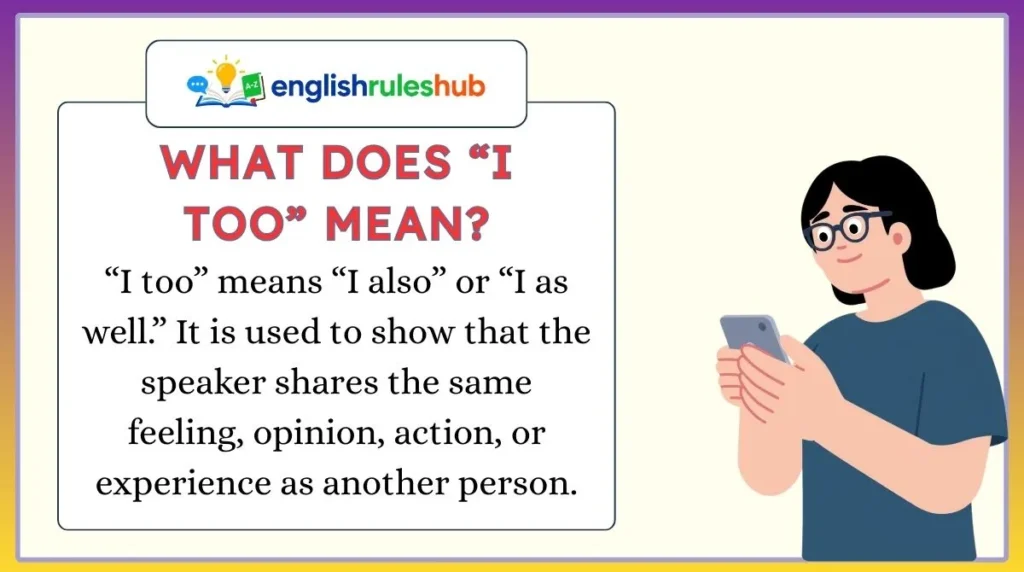
“I too” means “I also” or “I as well.” It is used to show that the speaker shares the same feeling, opinion, action, or experience as another person.
The word “too” means “also” or “in addition.”
“I too” is grammatically correct, but it is less common in everyday spoken English. It often sounds more formal, literary, or emphatic than “me too.”
When to Use “I Too”
Use “I too” when:
- You want to sound more formal.
- You are writing rather than speaking.
- You want to emphasize yourself as part of a group.
- It appears inside a complete sentence.
Grammar Rule
“I” is a subject pronoun.
Subject pronouns usually perform the action in a sentence.
Examples of subject pronouns:
- I
- You
- He
- She
- We
- They
Because “I” is a subject pronoun, “I too” often appears before a verb or within a complete sentence.
Examples of “I Too”
- I too enjoy reading books.
- I too believe that honesty is important.
- I too want to visit London someday.
- I too felt nervous before the exam.
- I too have experienced this problem.
- I too appreciate your help.
- I too think the movie was excellent.
- I too agree with your decision.
Common Learner Confusion
Many students think “I too” can always replace “me too.”
For example:
- Friend: “I love coffee.”
- You: “I too.”
Although this is not completely wrong, it sounds unusual in casual conversation.
Most native speakers would say:
- “Me too!”
So, “I too” is correct, but it is usually used inside a longer sentence rather than as a short reply.
What Does “Me Too” Mean?
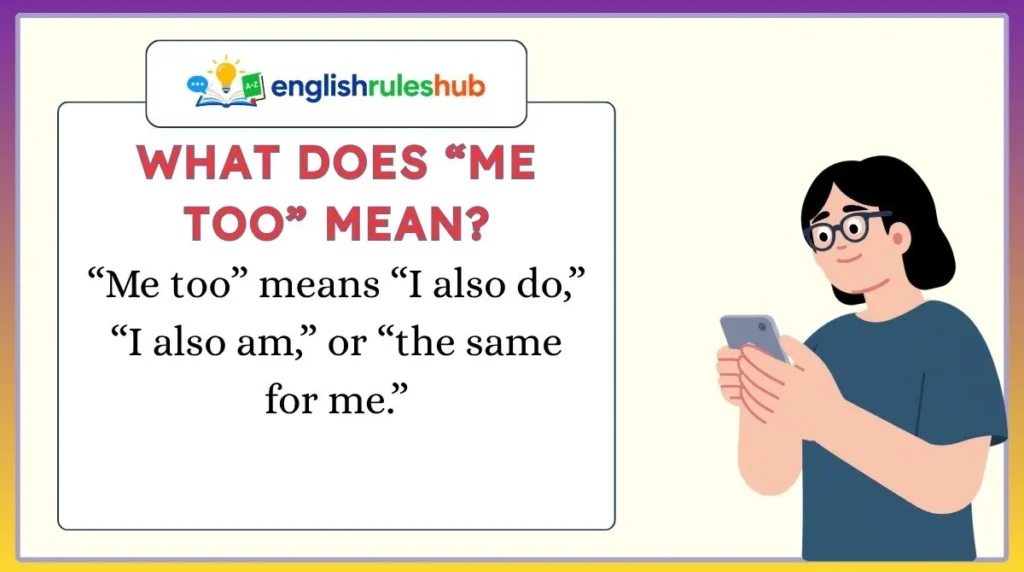
“Me too” means “I also do,” “I also am,” or “the same for me.”
It is one of the most common expressions in spoken English. People use it every day to agree with someone or show that they share the same feeling or experience.
When to Use “Me Too”
Use “me too” when:
- Agreeing with someone.
- Having the same opinion.
- Sharing the same feeling.
- Responding in casual conversation.
Grammar Rule
“Me” is an object pronoun.
Object pronouns include:
- Me
- Him
- Her
- Us
- Them
Traditionally, grammar rules suggest using complete sentences. However, “me too” is an accepted conversational expression and is widely used by native speakers.
Examples of “Me Too”
- I love chocolate.
- Me too!
- I am tired today.
- Me too!
- I enjoyed the concert.
- Me too!
- I want a new phone.
- Me too!
- I like your idea.
- Me too!
- I watched that movie yesterday.
- Me too!
- I feel excited about the trip.
- Me too!
- I miss my friends.
- Me too!
Common Learner Confusion
Some learners think “me too” is grammatically incorrect because “me” is an object pronoun.
In formal grammar, a complete sentence such as “I do too” may be preferred.
However, in real-life English, “me too” is extremely common and completely natural in conversations.
Native speakers use it every day.
Difference Between I Too and Me Too
Although both expressions show agreement, they are used differently.
| Feature | I Too | Me Too |
|---|---|---|
| Meaning | I also | I also / Same for me |
| Pronoun Type | Subject pronoun | Object pronoun |
| Formality | More formal | Informal and conversational |
| Common in Speech | Less common | Very common |
| Used as Quick Reply | Rarely | Yes |
| Writing Style | Formal writing | Casual speech and writing |
| Natural Conversation | Less natural | Very natural |
Usage Difference
“I too” is usually part of a complete sentence.
Example:
- I too enjoy playing football.
“Me too” is often a short response.
Example:
- I enjoy playing football.
- Me too!
Grammar Logic
“I” functions as a subject.
Example:
- I too enjoy music.
“Me” functions as an object but is commonly used in short conversational replies.
Example:
- I enjoy music.
- Me too!
Sentence Structure Difference
Structure of “I too”:
- I + too + verb
Examples:
- I too agree.
- I too understand.
- I too remember.
Structure of “Me too”:
- Statement
- Me too!
Examples:
- I am hungry.
- Me too!
Meaning Comparison
The meanings are almost identical.
Compare:
- I too love cats.
- Me too!
Both show agreement.
The main difference is how they are used in grammar and conversation.
Grammar Rules You Must Remember
Rule #1: Use “Me Too” for Quick Agreement
When someone says something and you feel the same way, use “me too.”
Example:
- I like ice cream.
- Me too!
This is the most natural choice in conversation.
Rule #2: Use “I Too” Inside a Complete Sentence
“I too” usually appears within a full sentence.
Example:
- I too enjoy learning English.
This sounds more formal and polished.
Rule #3: “Too” Means “Also”
The word “too” adds the meaning of “also.”
Example:
- She likes tennis.
- I too like tennis.
The meaning is:
- She likes tennis.
- I also like tennis.
Rule #4: Consider the Situation
Use “me too” in daily conversations.
Example:
- I’m excited.
- Me too!
Use “I too” in formal writing or speeches.
Example:
- I too share your concerns about the issue.
Common Mistakes Students Make
Many English learners make mistakes because both expressions seem similar.
Mistake 1: Using “I Too” as a Casual Reply
Wrong:
- I love pizza.
- I too.
Better:
- I love pizza.
- Me too!
Mistake 2: Using “Me Too” in Very Formal Writing
Less Formal:
- Me too agree with this idea.
Correct:
- I too agree with this idea.
Or:
- I also agree with this idea.
Mistake 3: Forgetting the Verb
Wrong:
- I too happy.
Correct:
- I too am happy.
A complete sentence needs a verb.
Mistake 4: Mixing Structures
Wrong:
- Me too enjoy football.
Correct:
- I too enjoy football.
Or:
- Me too! I enjoy football.
Easy Correction Tips
- Quick reply → Use “me too.”
- Complete sentence → Use “I too.”
- Formal writing → Prefer “I too” or “I also.”
- Everyday conversation → Prefer “me too.”
Easy Trick to Remember the Difference
A simple memory trick can help.
Think About Conversation Speed
When people speak quickly, they often use short expressions.
Example:
- I am hungry.
- Me too!
It is short, fast, and natural.
Think About Complete Sentences
When writing or speaking formally, people often use full sentences.
Example:
- I too appreciate your support.
Easy Memory Formula
Remember:
Me too = Quick reply
I too = Complete sentence
If you remember this simple rule, you will choose the correct expression most of the time.
Daily Life Examples
Here are some real-life conversations that show how native speakers use these expressions.
Example 1
A: I love summer.
B: Me too!
Example 2
A: I’m feeling tired.
B: Me too.
Example 3
A: I want to learn Spanish.
B: Me too!
Example 4
A: I enjoyed the party.
B: Me too.
Example 5
A: I can’t wait for the weekend.
B: Me too!
Example 6
Teacher: I believe practice is important.
Student: I too believe practice is important.
Example 7
Speaker: I support this project.
Manager: I too support this project.
Example 8
A: I like watching cartoons.
B: Me too!
Example 9
A: I feel nervous before interviews.
B: Me too.
Example 10
Author: I too have faced many challenges in life.
This example sounds more formal and reflective.
Practice Section
Choose the correct option.
Question 1
A: I love reading novels.
B: _____
a) I too enjoy reading novels.
b) Me too!
Question 2
_____ appreciate your kindness.
a) Me too
b) I too
Question 3
A: I’m excited about the trip.
B: _____
a) Me too!
b) I too excited.
Question 4
_____ agree with your opinion.
a) I too
b) Me too
Question 5
A: I like chocolate cake.
B: _____
a) Me too!
b) I too cake.
Answers
- b) Me too!
- b) I too
- a) Me too!
- a) I too
- a) Me too!
FAQs
What is the difference between I too and me too?
Both expressions show agreement. “Me too” is usually used as a short reply in conversation, while “I too” is more common in complete sentences and formal situations.
Can we use me too in questions?
No. “Me too” is normally used as a response to a statement, not as a question. It expresses agreement with what someone has said.
Is me too grammatically correct?
Yes. Although it is not a complete sentence, it is a standard and widely accepted English expression. Native speakers use it every day.
Is I too formal or informal?
“I too” generally sounds more formal than “me too.” It often appears in writing, speeches, articles, and formal discussions.
Which expression is more common in daily English?
“Me too” is much more common in everyday conversation. Most native speakers naturally choose it when agreeing with someone.
Can I replace I too with I also?
In many cases, yes. Both expressions often have the same meaning. For example, “I too agree” and “I also agree” are usually interchangeable.
Final Conclusion
The difference between “I too” and “me too” is easier than many learners think. Both expressions show agreement and indicate that you share the same feeling, opinion, or experience as another person.
The biggest difference is how they are used. “Me too” is the natural choice for everyday conversations and quick responses. It is short, friendly, and extremely common among native speakers.
“I too” is more formal and usually appears in complete sentences, especially in writing, speeches, or professional situations.
A simple rule can help you remember: Use “me too” for quick replies and “I too” for complete sentences.
The more English conversations you listen to, the more naturally these expressions will feel. Try using them in your daily speaking and writing practice.
With a little repetition, choosing the correct expression will soon become automatic, and your English will sound much more natural and confident.

I am Benjamin Clark, an English language writer passionate about simplifying grammar, vocabulary, and word meanings. I create clear, accurate, and practical content to help learners improve their English skills with confidence every day.