Concurrent and simultaneous are two English words that are very close in meaning. Both can describe things that happen at the same time, so it is easy for English learners to wonder which word they should use.
For example, you may hear someone say, “The two events were simultaneous.” You may also hear, “The two projects were concurrent.”
Both sentences talk about things happening during the same period, but the meaning is not exactly the same.
The small difference is important. Simultaneous usually focuses on things happening at exactly the same time.
Concurrent often focuses on two or more things happening during the same period, even if they do not start or finish at exactly the same moment.
You will see these words in many areas of English. They are common in business, education, news, science, law, technology, and everyday conversations.
Understanding the difference can help you choose a more natural word and avoid confusing your readers or listeners.
The good news is that the basic idea is simple. Think about whether you are talking about exact timing or overlapping periods.
Once you understand that difference, choosing between these words becomes much easier.
What Does “Concurrent” Mean?
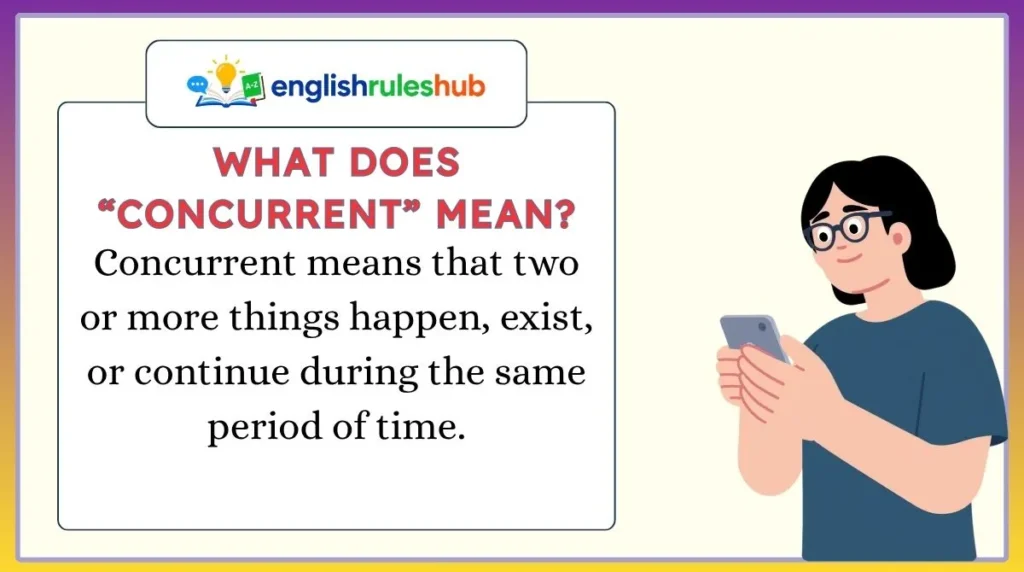
Concurrent means that two or more things happen, exist, or continue during the same period of time.
The important point is that they do not always have to happen at exactly the same moment. Their time periods can overlap.
For example:
I have two concurrent projects at work.
This means the two projects are active during the same period. It does not necessarily mean that you are working on both projects at the exact same second.
Another example is:
She took two concurrent courses at university.
The courses happened during the same semester or period. They may have had different class times.
When should you use “concurrent”?
Use concurrent when you want to show that two or more activities, events, conditions, or processes are happening during an overlapping period.
It is especially common when talking about:
- projects
- courses
- events
- activities
- processes
- duties
- situations
- periods of work
- legal cases
- computer processes
The word often sounds a little more formal than everyday alternatives such as “at the same time” or “overlapping.”
Grammar rule for “concurrent”
Concurrent is an adjective.
It normally comes before a noun:
concurrent projects
concurrent events
concurrent activities
It can also come after a linking verb such as be:
The two projects are concurrent.
A common structure is:
concurrent + plural noun
For example:
The company is managing concurrent projects.
Examples of “concurrent”
- The company is working on three concurrent projects.
- She had two concurrent jobs for several months.
- The students attended concurrent courses during the summer.
- The city held several concurrent events.
- We are facing two concurrent problems.
- The software can process several tasks concurrently.
- He managed concurrent responsibilities at work and home.
- The two investigations were conducted concurrently.
Notice that these examples do not necessarily mean that everything happened at exactly the same second. The focus is usually on overlapping time periods.
A common confusion with “concurrent”
Many learners think concurrent always means exactly at the same moment.
That is not the best way to understand it.
Imagine that Project A runs from Monday to Friday and Project B runs from Wednesday to Sunday. These projects are concurrent because their active periods overlap from Wednesday to Friday.
They are not necessarily simultaneous because they did not start or finish at exactly the same time.
That is the key idea.
What Does “Simultaneous” Mean?
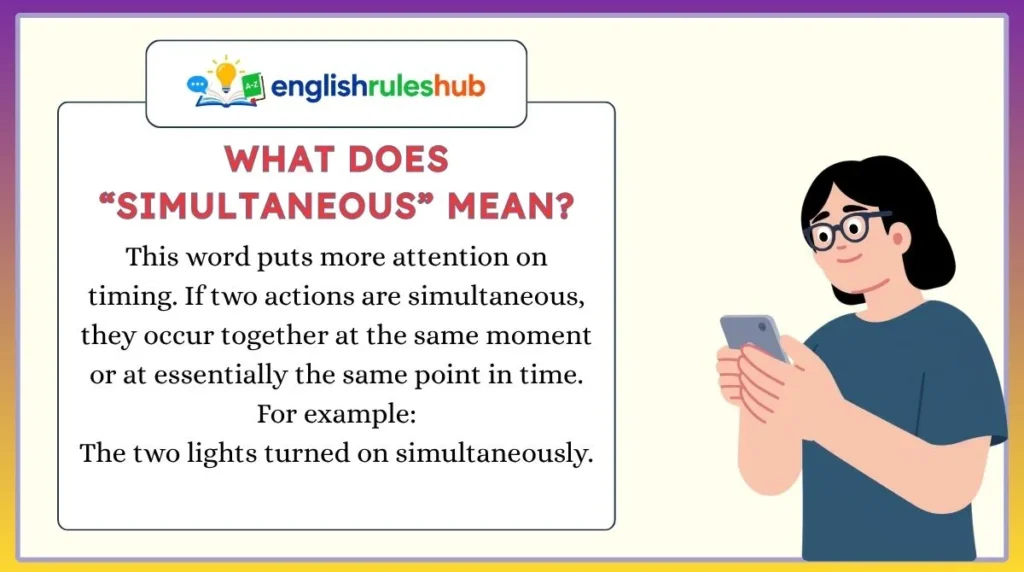
Simultaneous means that two or more things happen or exist at exactly the same time.
This word puts more attention on timing. If two actions are simultaneous, they occur together at the same moment or at essentially the same point in time.
For example:
The two lights turned on simultaneously.
This tells us that both lights turned on at the same time.
Another example:
They gave simultaneous answers.
The people answered at the same moment.
When should you use “simultaneous”?
Use simultaneous when the exact timing matters.
It is useful for talking about:
- actions
- movements
- sounds
- events
- reactions
- announcements
- changes
- activities
- communication
You can use it when two or more things happen together at one point in time.
Grammar rule for “simultaneous”
Simultaneous is also an adjective.
It normally comes before a noun:
simultaneous actions
simultaneous changes
simultaneous events
It can also come after be:
The movements were simultaneous.
You will also often see the adverb simultaneously.
For example:
The doors opened simultaneously.
Here, simultaneously tells us how or when the doors opened.
Examples of “simultaneous”
- The two doors opened simultaneously.
- The students gave simultaneous answers.
- There was a simultaneous increase in prices.
- The two players made simultaneous moves.
- The audience laughed simultaneously.
- The alarms went off simultaneously.
- Both teams received the news simultaneously.
- The machines stopped simultaneously.
These examples focus strongly on the fact that the events happened at the same moment.
A common confusion with “simultaneous”
Learners sometimes use simultaneous when they only mean that two activities happen during the same period.
For example:
I have simultaneous projects this month.
This sounds less natural if you simply mean that both projects are active during the month.
A better choice is:
I have concurrent projects this month.
If, however, you mean that two actions happen at exactly the same moment, simultaneous is the better word.
Difference Between Concurrent and Simultaneous
The easiest way to understand the difference is this:
Concurrent = happening during the same period, with overlapping time.
Simultaneous = happening at exactly the same time or moment.
Both words are connected with time, but they look at time in slightly different ways.
Comparison Table
| Feature | Concurrent | Simultaneous |
|---|---|---|
| Basic meaning | Happening during the same period | Happening at the same moment |
| Main focus | Overlapping periods | Exact timing |
| Exact same moment required? | No | Usually yes |
| Common with projects? | Very common | Less common |
| Common with actions? | Yes | Very common |
| Formality | Often formal | Neutral to formal |
| Adverb | Concurrently | Simultaneously |
| Main idea | Same time period | Same moment |
Example to make the difference clear
Imagine two meetings.
Meeting A: 9:00–10:00
Meeting B: 9:30–10:30
These meetings are concurrent because they happen during an overlapping period from 9:30 to 10:00.
But they are not necessarily simultaneous because they did not begin at the same time.
Now imagine two people press two buttons at exactly 10:00.
Their actions are simultaneous because both actions happen at the same moment.
Concurrent focuses on a period
When you use concurrent, you are often looking at a larger section of time.
For example:
The company had two concurrent projects.
The projects may have lasted for weeks or months. The important fact is that their timelines overlapped.
Another example:
She was studying and working concurrently.
The two activities happened during the same general period of her life.
They did not need to happen at the exact same minute.
Simultaneous focuses on a moment
With simultaneous, the exact timing is much more important.
For example:
The two runners crossed the finish line simultaneously.
The sentence suggests that they crossed at essentially the same moment.
You can picture one point in time rather than a long period.
Grammar logic
Both words are adjectives, so they can describe nouns.
Concurrent + noun
concurrent meetings
concurrent projects
concurrent activities
Simultaneous + noun
simultaneous movements
simultaneous events
simultaneous reactions
Both can also be changed into adverbs.
Concurrent → concurrently
The two projects were running concurrently.
Simultaneous → simultaneously
The two alarms rang simultaneously.
The adverb forms are useful when you want to describe how or when an action happens.
Sentence structure difference
The structures are very similar.
Concurrent:
Two or more things + happen/exist/work + concurrently.
Example:
The two systems operated concurrently.
Simultaneous:
Two or more things + happen + simultaneously.
Example:
The two machines stopped simultaneously.
The difference comes from the meaning, not from a completely different grammar structure.
Meaning comparison
Consider these two sentences:
The company launched two concurrent campaigns.
This means the campaigns were active during the same period.
Now compare:
The company made two simultaneous announcements.
This means the announcements were made at the same time.
The first sentence is about overlapping periods.
The second sentence is about one shared moment.
Can they sometimes be interchangeable?
Yes, sometimes.
If two events truly happen at exactly the same time, they may be described as both concurrent and simultaneous.
For example:
The two meetings occurred concurrently.
The two meetings occurred simultaneously.
However, the second sentence gives a stronger impression that the meetings happened at the exact same time.
The first sentence can simply mean that their time periods overlapped.
So, the words can overlap in meaning, but they are not perfect synonyms.
Grammar Rules You Must Remember
Rule #1: Use “concurrent” for overlapping time periods
When two or more activities happen during the same general period, concurrent is usually a good choice.
Example:
I am managing two concurrent projects.
The projects are active during the same period. They do not have to happen at the same moment.
Rule #2: Use “simultaneous” for the same moment
When two actions happen at exactly the same time, use simultaneous.
Example:
The two phones rang simultaneously.
Both phones rang at the same moment.
Rule #3: Both words are adjectives
You can place both words before a noun.
Concurrent:
concurrent tasks
Simultaneous:
simultaneous actions
Do not treat them as verbs.
Incorrect:
The two events concurrent.
Correct:
The two events were concurrent.
Rule #4: Remember the adverb forms
The adverbs are:
- concurrently
- simultaneously
Use concurrently when activities happen during the same period.
The workers handled the tasks concurrently.
Use simultaneously when actions happen at the same moment.
The lights turned off simultaneously.
Learning these four rules will solve most everyday questions about these words.
Common Mistakes Students Make
These words cause problems because both are connected with the idea of “same time.” Learners often know the general meaning but miss the small difference.
Mistake 1: Thinking concurrent always means exact timing
Incorrect:
The two projects started concurrently at different times.
This sentence can sound contradictory if the writer means that the projects started at exactly the same moment.
If the projects simply ran during the same period, you could say:
The two projects ran concurrently.
If they started at exactly the same time:
The two projects started simultaneously.
Mistake 2: Using simultaneous for long overlapping activities
Suppose you study English from January to June and work at a shop from March to September.
You could say:
I studied English and worked at the shop concurrently.
The two activities overlapped for several months.
Using simultaneously may suggest that you were studying and working at the exact same moment, which is probably not what you mean.
Mistake 3: Confusing “concurrent” with “consecutive”
These words are very different.
Concurrent means happening during the same period.
Consecutive means following one after another without a break.
For example:
She took two concurrent courses.
Both courses happened during the same period.
But:
She worked for five consecutive days.
She worked one day after another for five days.
Do not confuse these words simply because they look similar.
Mistake 4: Forgetting the adverb form
Incorrect:
The two systems operated simultaneous.
Correct:
The two systems operated simultaneously.
Because operated is a verb, you need an adverb here.
You could also say:
The two systems were simultaneous.
Here, simultaneous is an adjective.
Mistake 5: Using “simultaneously” when “at the same time” is easier
There is nothing wrong with simultaneously, but it can sound more formal.
In everyday speech, you might simply say:
They spoke at the same time.
In a formal report, you might write:
They spoke simultaneously.
Both are correct. The best choice depends on the situation and the style of writing.
Easy Trick to Remember the Difference
Here is a simple memory trick:
Concurrent = Calendar
Think about a calendar. You can have two projects on your calendar during the same week. Their time periods overlap.
Simultaneous = Same second
Think about two things happening at one exact moment.
So remember:
Concurrent = same period.
Simultaneous = same moment.
Here is another easy example.
Imagine you are taking an English course and a computer course from March to June.
They are concurrent courses because both happen during the same period.
Now imagine your teacher and your friend both say “Hello!” at exactly 10:00:00.
Their greetings are simultaneous.
A useful question to ask yourself is:
“Do I care about the whole time period, or do I care about the exact moment?”
If you care about the overlapping period, choose concurrent.
If you care about the exact moment, choose simultaneous.
This little question can help you make the right choice quickly.
Daily Life Examples
The difference becomes much easier when you see the words in natural situations.
1. Work
Manager: How many projects are you handling?
Employee: I’m handling three concurrent projects.
Here, the projects are active during the same period.
2. Two phones ringing
Both phones started ringing simultaneously.
The important detail is that they rang at the same moment.
3. University courses
Ali is taking two concurrent courses this semester.
The courses are part of the same semester. They do not have to take place at exactly the same time.
4. People speaking
Everyone started speaking simultaneously.
This means several people began speaking at the same moment.
5. Family responsibilities
She has several concurrent responsibilities at home and at work.
Her responsibilities exist during the same period.
6. Traffic lights
The two warning lights flashed simultaneously.
The lights flashed together at the same moment.
7. Business activities
The company is running several concurrent marketing campaigns.
The campaigns overlap in time.
8. Online classes
Three online classes were held concurrently.
The classes were taking place during overlapping time periods. They may have been scheduled for different parts of that period.
9. A sudden reaction
The audience gave a simultaneous reaction.
The people reacted at about the same moment.
10. Everyday conversation
Friend: Why are you so busy these days?
You: I have two concurrent projects, and I’m also studying for an exam.
This sounds natural because the projects and studying are ongoing during the same general period.
Practice Section
Choose concurrent or simultaneous in each sentence.
1.
The two alarms went off __________.
- concurrent
- simultaneous
2.
She is working on two __________ projects this month.
- concurrent
- simultaneous
3.
The players made __________ moves.
- concurrent
- simultaneous
4.
The company is managing several __________ tasks.
- concurrent
- simultaneous
5.
The two lights turned green __________.
- concurrent
- simultaneous
Answers
1. simultaneously
The alarms went off at the same moment.
2. concurrent
The projects are active during the same month.
3. simultaneous
The players made their moves at the same moment.
4. concurrent
The tasks are being handled during the same period.
5. simultaneously
The lights changed at the same moment.
A good way to practice is to explain why each answer is correct. Do not only memorize the answer. Ask whether the sentence is talking about an overlapping period or an exact moment.
FAQs
What is the difference between concurrent and simultaneous?
Concurrent usually means that two or more things happen during the same period, so their timelines overlap. Simultaneous means that two or more things happen at exactly the same time. Concurrent focuses more on an overlapping period, while simultaneous focuses more on one shared moment.
Can concurrent and simultaneous be used as synonyms?
Sometimes they can overlap in meaning, especially when two events truly happen at the same time. However, they are not always interchangeable. Concurrent can describe activities that overlap for a period, while simultaneous normally suggests that they occur at the same moment.
Is concurrent formal English?
Yes, concurrent can sound somewhat formal, especially in business, academic, technical, and professional writing. It is still a normal English word and is not incorrect in everyday English. In casual conversation, people often say “at the same time” or “during the same period” instead.
Is simultaneous formal or informal?
Simultaneous is a standard English word and can be used in both everyday and formal English. However, it often sounds more formal than “at the same time.” For example, “They spoke at the same time” is very natural in conversation, while “They spoke simultaneously” sounds more polished or formal.
Can we use concurrent and simultaneous in questions?
Yes. Both words can be used in questions.
For example:
Were the two events concurrent?
And:
Did the two events happen simultaneously?
The choice depends on what you want to ask. The first question can focus on whether their time periods overlapped, while the second focuses on whether they happened at the same moment.
What is the difference between concurrently and simultaneously?
Concurrently is the adverb form of concurrent. It usually means that activities happen during an overlapping period.
Simultaneously is the adverb form of simultaneous. It normally means that actions happen at exactly the same time.
For example:
The two projects were running concurrently.
The two alarms sounded simultaneously.
Final Conclusion
Concurrent and simultaneous both connect ideas with time, but they are not exactly the same.
The easiest difference to remember is that concurrent usually describes things that happen during the same period, while simultaneous describes things that happen at the same moment.
Think about two projects that run for several weeks. They can be concurrent because their timelines overlap.
Now think about two lights turning on at exactly 8:00. Their actions are simultaneous.
Also remember their adverb forms: concurrently and simultaneously. These forms are useful when you describe how two or more actions happen.
When you are unsure, ask yourself one simple question: Am I talking about an overlapping period or an exact moment? That question will usually point you to the right word.
With a little practice, this difference will become natural. Try using both words in your own sentences, especially when talking about work, school, schedules, and everyday events.

I am Benjamin Clark, an English language writer passionate about simplifying grammar, vocabulary, and word meanings. I create clear, accurate, and practical content to help learners improve their English skills with confidence every day.