
Last updated on September 26th, 2026 at 06:56 am
Many English learners get confused when they see hasn’t and haven’t. Both are short forms of has not and have not, so they look very similar. The problem is that they do not work with the same subjects.
For example, we say, “She hasn’t finished her work,” but we say, “They haven’t finished their work.” The verb changes because the subject changes.
This small difference is very important in everyday English. You will hear these forms in conversations, see them in text messages, and use them when talking about things that have not happened.
If you choose the wrong one, your sentence may sound unnatural or grammatically incorrect.
The good news is that the rule is quite simple once you understand which subject goes with has and which subject goes with have.
By the end of this guide, you will know exactly when to use hasn’t and when to use haven’t.
You will also learn how these forms work in present perfect sentences, questions, negative statements, and common expressions such as hasn’t been, haven’t been, hasn’t finished, and haven’t finished.
You will see plenty of simple examples from everyday English, so the difference becomes easier to remember and use naturally.
What Does “Hasn’t” Mean?
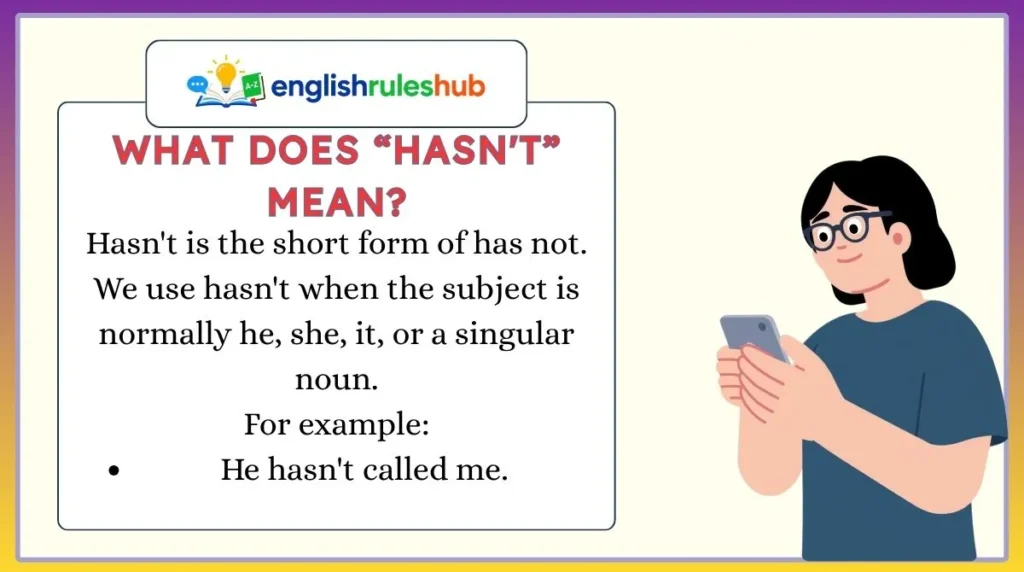
Hasn’t is the short form of has not.
We use hasn’t when the subject is normally he, she, it, or a singular noun.
For example:
- He hasn’t called me.
- She hasn’t arrived yet.
- It hasn’t stopped raining.
- Ali hasn’t finished his homework.
In each sentence, the subject is singular, so we use hasn’t.
The basic pattern is:
Singular subject + hasn’t + past participle
For example:
She + hasn’t + finished.
The word after hasn’t is often a past participle when we are using the present perfect tense.
When Do We Use “Hasn’t”?
We commonly use hasn’t to say that something has not happened up to now.
Look at this example:
He hasn’t eaten breakfast.
This means he has not eaten breakfast yet. The action was expected or possible before now, but it has not happened.
Another example is:
My sister hasn’t arrived.
She may arrive later, but at this moment, she is not here.
This is why hasn’t appears very often with words such as:
- yet
- ever
- never
- already
- today
- this week
- so far
For example:
She hasn’t called me yet.
He hasn’t finished the project so far.
8 Examples of “Hasn’t”
- She hasn’t finished her homework yet.
- He hasn’t called me today.
- My brother hasn’t eaten lunch.
- The bus hasn’t arrived yet.
- It hasn’t stopped raining.
- Sarah hasn’t seen that movie.
- The baby hasn’t woken up.
- My teacher hasn’t checked our work.
Notice that each subject is singular.
She → hasn’t
He → hasn’t
My brother → hasn’t
The bus → hasn’t
It → hasn’t
Sarah → hasn’t
The baby → hasn’t
My teacher → hasn’t
“Hasn’t” With a Singular Noun
You do not have to use he, she, or it. A singular noun can also take hasn’t.
For example:
The dog hasn’t eaten.
John hasn’t replied.
My car hasn’t started.
The computer hasn’t worked properly.
The important thing is not whether the subject is a person’s name, an object, or an animal. The important point is that the subject is singular.
A Common Confusion About “Hasn’t”
Many learners think they should choose hasn’t simply because the sentence is negative.
That is not the rule.
Both hasn’t and haven’t make a sentence negative. The choice depends mainly on the subject.
Compare:
She hasn’t arrived.
They haven’t arrived.
Both sentences are negative. The only important difference is the subject.
She is singular, so we use hasn’t.
They is plural, so we use haven’t.
That simple idea will help you avoid many mistakes.
What Does “Haven’t” Mean?
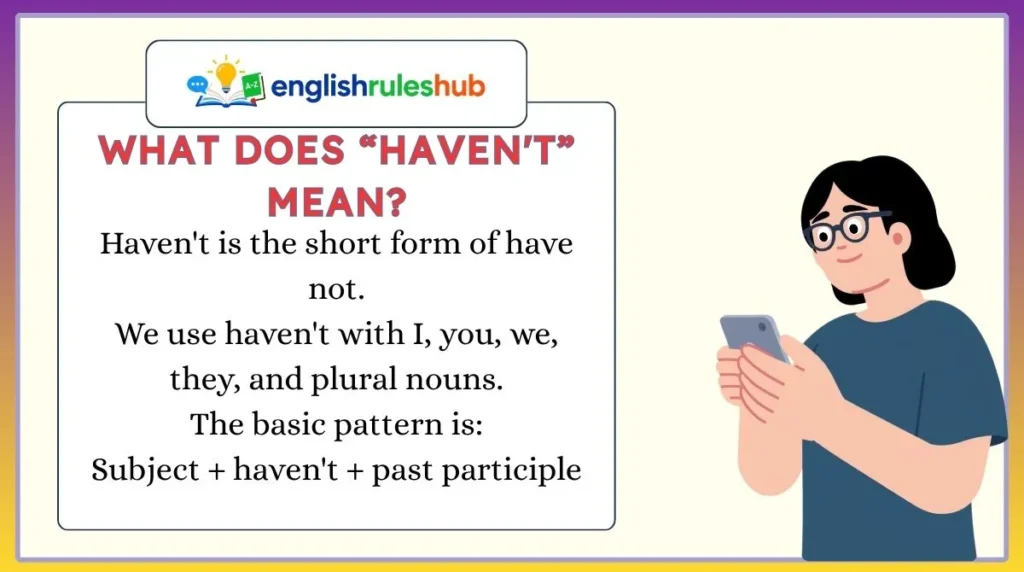
Haven’t is the short form of have not.
We use haven’t with I, you, we, they, and plural nouns.
The basic pattern is:
Subject + haven’t + past participle
For example:
They + haven’t + arrived.
I + haven’t + finished.
We + haven’t + eaten.
When Do We Use “Haven’t”?
Like hasn’t, haven’t is often used to say that something has not happened up to now.
For example:
I haven’t finished my work.
This means the work is still unfinished.
Another example:
They haven’t arrived yet.
They are expected to arrive, but they are not here at the moment.
The form haven’t is very common in everyday spoken English because people often use contractions when speaking.
Instead of:
I have not seen him.
People usually say:
I haven’t seen him.
8 Examples of “Haven’t”
- I haven’t finished my work yet.
- You haven’t answered my question.
- We haven’t eaten dinner.
- They haven’t arrived yet.
- My friends haven’t called me.
- The students haven’t completed the test.
- I haven’t seen that film.
- We haven’t visited that place before.
Notice the subjects:
I → haven’t
You → haven’t
We → haven’t
They → haven’t
My friends → haven’t
The students → haven’t
“Haven’t” With Plural Nouns
Plural nouns usually take haven’t.
For example:
The children haven’t come home.
My parents haven’t arrived.
The players haven’t started the game.
Those books haven’t been used.
The noun does not need to be a person. Any plural subject can use haven’t.
What About “I”?
One important point for beginners is that I uses have, not has.
So we say:
I haven’t finished.
Not:
I hasn’t finished.
Even though I refers to one person, English grammar treats I with have.
This is one of the forms you should simply remember:
I have → I haven’t
Hasn’t vs Haven’t With Collective Nouns
Collective nouns can sometimes confuse learners because they refer to a group, but the grammar can depend on how the group is being viewed. Words such as team, family, company, class, and government can refer to several people while still being treated as a singular noun in many varieties of English.
For example:
The team hasn’t finished the project yet.
The company hasn’t announced the results.
Here, team and company are being treated as singular subjects, so hasn’t is used.
Compare this with a clearly plural noun:
The players haven’t finished the training.
The employees haven’t received their emails.
A useful point for learners is that you should look at the grammatical subject, not simply count the people involved. A group can contain many people but still take hasn’t when the group itself is treated as one unit.
Difference Between Hasn’t and Haven’t (Detailed)
The main difference is very easy:
Hasn’t = has not
Haven’t = have not
The choice depends on the subject.
| Subject | Correct Form | Example |
|---|---|---|
| I | haven’t | I haven’t finished. |
| You | haven’t | You haven’t called. |
| He | hasn’t | He hasn’t arrived. |
| She | hasn’t | She hasn’t eaten. |
| It | hasn’t | It hasn’t stopped. |
| We | haven’t | We haven’t decided. |
| They | haven’t | They haven’t come. |
| Singular noun | hasn’t | Tom hasn’t replied. |
| Plural noun | haven’t | The boys haven’t replied. |
The easiest way to see the difference is to compare similar sentences.
He hasn’t finished his work.
They haven’t finished their work.
The verb finished stays the same. Only the auxiliary changes.
Another pair:
She hasn’t seen the message.
We haven’t seen the message.
Again, the subject controls the choice.
The Grammar Logic
The words has and have are forms of the verb to have. In the present perfect tense, they work as helping verbs.
The present perfect usually has this structure:
Subject + has/have + past participle
To make it negative, add not:
Subject + has not/have not + past participle
Then we often shorten the forms:
has not → hasn’t
have not → haven’t
So:
He has finished.
becomes:
He hasn’t finished.
And:
They have finished.
becomes:
They haven’t finished.
Sentence Structure
With hasn’t:
He/She/It + hasn’t + past participle
Examples:
She hasn’t gone home.
He hasn’t called.
It hasn’t changed.
With haven’t:
I/You/We/They + haven’t + past participle
Examples:
I haven’t gone home.
You haven’t called.
We haven’t changed our plans.
They haven’t finished.
Meaning Comparison
Usually, hasn’t and haven’t do not have different basic meanings.
They both mean “has not” or “have not.”
The difference is grammatical, not a completely different meaning.
Compare:
David hasn’t eaten.
David and Tom haven’t eaten.
The first sentence talks about one person.
The second sentence talks about two people.
That is why the helping verb changes.
Compare These Sentences
The student hasn’t finished the test.
The students haven’t finished the test.
This is a very useful pair to remember.
student = one → hasn’t
students = more than one → haven’t
Another pair:
My friend hasn’t arrived.
My friends haven’t arrived.
The extra s changes the noun from singular to plural, so the helping verb changes too.
Hasn’t vs Haven’t in Short Answers
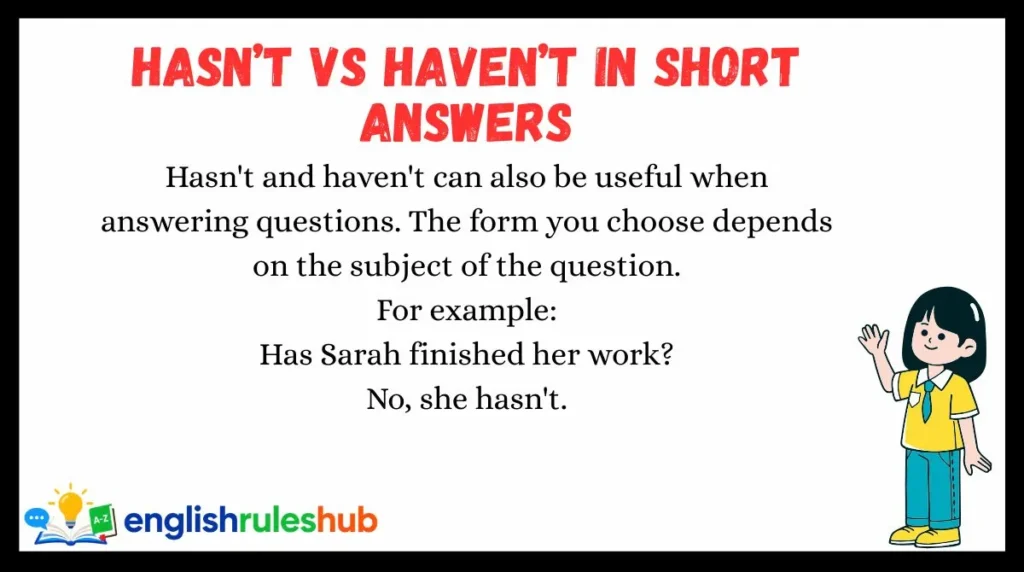
Hasn’t and haven’t can also be useful when answering questions. The form you choose depends on the subject of the question.
For example:
Has Sarah finished her work?
No, she hasn’t.
Because Sarah becomes she, we use hasn’t.
Now compare:
Have the students finished their work?
No, they haven’t.
Because the students becomes they, we use haven’t.
You can also answer questions about yourself:
Have you eaten?
No, I haven’t.
The same subject rule remains important even when the sentence is very short:
He / She / It → hasn’t
I / You / We / They → haven’t
Learning these short answers is useful because they appear frequently in natural conversations. They also help you build the correct subject-and-verb pattern without having to repeat the entire sentence.
Grammar Rules You Must Remember
Rule #1: Use “Hasn’t” With He, She, and It
When the subject is he, she, or it, use hasn’t.
Examples:
He hasn’t finished his work.
She hasn’t called yet.
It hasn’t started.
Do not say:
He haven’t finished.
She haven’t called.
These forms are incorrect in standard English.
Rule #2: Use “Haven’t” With I, You, We, and They
These subjects use haven’t.
Examples:
I haven’t seen him.
You haven’t told me.
We haven’t decided.
They haven’t arrived.
A useful line to memorize is:
I, you, we, they → haven’t
Rule #3: Singular Nouns Usually Take “Hasn’t”
If the subject is one person, one animal, one object, or one thing, use hasn’t.
Examples:
The cat hasn’t eaten.
My phone hasn’t charged.
John hasn’t replied.
The shop hasn’t opened yet.
Think of a singular noun as a subject that can be replaced by he, she, or it in many cases.
Rule #4: Plural Nouns Take “Haven’t”
If the subject is plural, use haven’t.
Examples:
The children haven’t arrived.
My parents haven’t called.
The cars haven’t moved.
Those students haven’t finished.
A simple test is to ask yourself:
Is the subject one or more than one?
One → usually hasn’t
More than one → usually haven’t
Remember that I is the special form that uses haven’t even though it refers to one person.
Common Mistakes Students Make
Learners often make mistakes with these forms because they focus on the verb after the contraction instead of the subject.
For example, they may see finished and think only about the past form. But the important choice comes before it.
Mistake 1: “He Haven’t”
Wrong:
He haven’t finished his homework.
Correct:
He hasn’t finished his homework.
Why?
He goes with has, so the negative form is hasn’t.
Mistake 2: “They Hasn’t”
Wrong:
They hasn’t arrived yet.
Correct:
They haven’t arrived yet.
Why?
They goes with have, so we need haven’t.
Mistake 3: “I Hasn’t”
Wrong:
I hasn’t seen that movie.
Correct:
I haven’t seen that movie.
This mistake is common because I refers to one person.
However, English uses:
I have
not:
I has
So the negative is:
I haven’t
Mistake 4: Forgetting the Past Participle
Wrong:
She hasn’t go home.
Correct:
She hasn’t gone home.
After hasn’t or haven’t in the present perfect, we normally use the past participle.
For example:
hasn’t eaten
hasn’t gone
hasn’t seen
haven’t finished
haven’t written
Not:
hasn’t ate
hasn’t went
haven’t saw
Mistake 5: Using “Hasn’t” Because the Noun Is a Person
Some learners think every person’s name should use hasn’t.
That is not always true.
A singular name does normally take hasn’t:
Ahmed hasn’t arrived.
But a plural group of people takes haven’t:
Ahmed and Bilal haven’t arrived.
So look at the whole subject, not just the fact that it refers to people.
Easy Correction Tip
Before choosing the contraction, underline the subject mentally.
Ask:
Who or what hasn’t/haven’t done the action?
Then choose:
He / She / It / one thing → hasn’t
I / You / We / They / more than one → haven’t
This quick check can prevent most mistakes.
Easy Trick to Remember the Difference
Here is a simple classroom trick:
HAS = He, She, It
Think of the three words he, she, it whenever you see hasn’t.
So:
He hasn’t
She hasn’t
It hasn’t
Then remember:
HAVE = I, You, We, They
So:
I haven’t
You haven’t
We haven’t
They haven’t
You can make a short memory line:
He, she, it — HAS.
I, you, we, they — HAVE.
This works for many present-tense sentences, not only negative ones.
For example:
She has finished.
She hasn’t finished.
They have finished.
They haven’t finished.
The positive and negative forms follow the same subject rule.
Use the “One or More” Trick
If you forget the pronoun rule, look at the noun.
Ask:
Is it one?
If yes, use hasn’t.
The dog hasn’t eaten.
The teacher hasn’t arrived.
If it is more than one, use haven’t.
The dogs haven’t eaten.
The teachers haven’t arrived.
There is one important exception to the simple “one or more” trick:
I → haven’t
So remember:
I → haven’t
even though I means one person.
Daily Life Examples (Very Important)
These examples show how people actually use these forms in normal conversations.
Example 1: Talking About Work
A: Has John finished the report?
B: No, he hasn’t finished it yet.
Here, he is singular, so we use hasn’t.
Example 2: Talking About Friends
A: Have your friends arrived?
B: No, they haven’t arrived yet.
Because friends is plural, we use haven’t.
Example 3: Talking About Dinner
A: Have you eaten?
B: No, I haven’t eaten yet.
Notice that I uses haven’t.
Example 4: Talking About a Bus
A: Is the bus here?
B: No, it hasn’t arrived yet.
The subject is it, so we use hasn’t.
Example 5: Talking About Parents
A: Have your parents called?
B: No, they haven’t called today.
Parents is plural, so haven’t is correct.
Example 6: Talking About a Sister
A: Has your sister seen the message?
B: No, she hasn’t seen it yet.
She takes hasn’t.
Example 7: Talking About Plans
A: Have you decided where to go?
B: No, we haven’t decided yet.
We takes haven’t.
Example 8: Talking About a Phone
A: Why isn’t your phone working?
B: It hasn’t worked properly all morning.
It takes hasn’t.
Example 9: Talking About Students
Teacher: Have the students completed the exercise?
Student: No, they haven’t completed it yet.
Because students is plural, use haven’t.
Example 10: Talking About One Student
Teacher: Has Ali completed the exercise?
Student: No, he hasn’t completed it yet.
Ali is one person, so hasn’t is correct.
These everyday examples show an important point: you do not need to think about complicated grammar every time you speak. First identify the subject, then choose the correct helping verb.
Practice Section
Choose hasn’t or haven’t in each sentence.
1. She ______ finished her homework.
a) hasn’t
b) haven’t
2. They ______ arrived at the station.
a) hasn’t
b) haven’t
3. I ______ seen this movie before.
a) hasn’t
b) haven’t
4. The baby ______ woken up yet.
a) hasn’t
b) haven’t
5. We ______ decided what to do.
a) hasn’t
b) haven’t
Answers
1. hasn’t
She hasn’t finished her homework.
2. haven’t
They haven’t arrived at the station.
3. haven’t
I haven’t seen this movie before.
4. hasn’t
The baby hasn’t woken up yet.
5. haven’t
We haven’t decided what to do.
A good way to practice is to cover the answers and say each complete sentence aloud. Speaking the sentences can help the correct form become automatic.
FAQs
What is the difference between hasn’t and haven’t?
Hasn’t means has not and is used with he, she, it, and singular nouns. Haven’t means have not and is used with I, you, we, they, and plural nouns.
For example, “She hasn’t arrived” is correct, while “They haven’t arrived” is correct.
Can we use hasn’t and haven’t in questions?
Yes. Both forms can appear in questions, especially in negative questions.
For example:
Hasn’t she arrived yet?
Haven’t you finished your work?
Hasn’t he called you?
Haven’t they left yet?
These questions often show surprise, expectation, or concern.
Is hasn’t formal or informal?
Hasn’t is a contraction of has not and is very common in normal conversation and everyday writing.
In more formal writing, some writers may prefer the full form has not, especially when they want a more formal tone.
Both forms are grammatically correct.
Is haven’t the same as have not?
Yes. Haven’t is simply the contracted form of have not.
For example:
I have not finished.
and
I haven’t finished.
have the same basic meaning. The contraction is much more common in everyday speech.
Why do we say “I haven’t” but “he hasn’t”?
English uses different forms of have depending on the subject.
We say:
I have
but:
He has
Therefore, their negative forms are:
I haven’t
and:
He hasn’t
This is a basic subject-verb agreement rule.
Should I say “The students hasn’t” or “The students haven’t”?
You should say:
The students haven’t finished.
The noun students is plural, so it takes have, not has.
If the noun were singular, you would use hasn’t:
The student hasn’t finished.
Is “hasn’t been” correct?
Yes. Hasn’t been is a very common and correct expression.
For example:
She hasn’t been to London.
He hasn’t been feeling well.
The shop hasn’t been open today.
Because the subject is singular, hasn’t is used.
Is “haven’t been” correct?
Yes. Haven’t been is also correct.
For example:
I haven’t been there before.
We haven’t been to that restaurant.
They haven’t been home today.
The subjects I, we, and they take haven’t.
Final Conclusion
The difference between hasn’t and haven’t becomes much easier when you focus on the subject.
Use hasn’t for he, she, it, and singular nouns. Use haven’t for I, you, we, they, and plural nouns.
Remember these two groups:
He, she, it → hasn’t
I, you, we, they → haven’t
Then check the noun. One person or thing normally takes hasn’t, while a plural subject takes haven’t.
For example:
She hasn’t arrived.
They haven’t arrived.
The child hasn’t eaten.
The children haven’t eaten.
The more you read and speak these sentences, the more natural the difference will feel. You do not need to memorize hundreds of examples.
Start with the subject rule, practice a few everyday sentences, and pay attention to how native speakers use these forms.
Once hasn’t and haven’t become familiar, you will find many other present perfect sentences much easier to understand and use.

I am Benjamin Clark, an English language writer passionate about simplifying grammar, vocabulary, and word meanings. I create clear, accurate, and practical content to help learners improve their English skills with confidence every day.


9 thoughts on “Hasnt vs Havent: Easy Grammar Guide With Examples (Updated 2026)”