Last updated on September 26th, 2026 at 07:19 am
Unaccessible and inaccessible look almost identical. Both seem to mean “not accessible,” so it is natural for English learners to wonder which one they should use.
If you have ever written a sentence such as “The website is unaccessible,” you are not alone. This is a common word-choice problem.
The good news is that the answer is simple: inaccessible is the standard and preferred word in modern English.
Major learner dictionaries define inaccessible as something that is very difficult or impossible to reach, get, use, or understand.
But there is an interesting detail. Unaccessible has existed in English, and some dictionaries still record it as a rare form meaning the same thing as inaccessible.
For example, WordWeb labels it “rare,” while older dictionary records show that inaccessible had already become the usual form many years ago.
So, should you ever write unaccessible? For normal modern English, especially in schoolwork, exams, professional writing, websites, and formal communication, it is much safer to choose inaccessible.
By the end of this guide, you will know the meaning of both forms, why inaccessible is preferred, how to use it correctly, what mistakes to avoid, and how to remember the difference easily.
What Does “Unaccessible” Mean?
Unaccessible is an adjective that means not accessible, or difficult or impossible to reach, enter, use, obtain, or understand.
The important point, however, is its modern usage. Although unaccessible can be found in dictionaries and historical texts, it is rare and nonstandard or outdated in much ordinary modern English. WordWeb, for example, lists it as a rare form of inaccessible.
You may also find unaccessible in older books or on websites written by people who are unsure about the correct form. Older dictionary evidence is especially interesting. Noah Webster’s 1828 dictionary included unaccessible but immediately said that inaccessible was the form then being used.
So, while the word is understandable, it is not the form you should normally choose when writing modern English.
When might you see “unaccessible”?
You may come across unaccessible in a few situations:
- An old or historical text
- A rare dictionary entry
- Informal online writing
- A spelling mistake
- Writing by someone who has formed the word naturally from un- + accessible
For example:
The mountain was unaccessible after the heavy snow.
Most readers will understand the sentence. However, in modern standard English, you should write:
The mountain was inaccessible after the heavy snow.
The second version sounds natural and is the better choice.
The grammar of “unaccessible”
Unaccessible is an adjective.
It can describe a place, object, person, website, file, idea, service, or anything else that cannot easily be reached, entered, used, or understood.
Examples:
- The remote village was unaccessible during the winter.
- The old building was unaccessible to visitors.
- The information was unaccessible to ordinary users.
- The website became unaccessible after the server failed.
- The room was unaccessible without a special key.
- The professor’s explanation was unaccessible to beginners.
- The road was unaccessible because of flooding.
- The documents remained unaccessible to the public.
These sentences are understandable, but for modern standard English, replace unaccessible with inaccessible.
Why does “unaccessible” seem correct?
This is where many learners get confused.
English often uses un- to make the opposite of an adjective:
- happy → unhappy
- clear → unclear
- fair → unfair
- safe → unsafe
- available → unavailable
- comfortable → uncomfortable
So a learner may naturally think:
accessible → unaccessible
That looks perfectly logical.
The problem is that English does not always create negative words by simply adding un-. English has borrowed words from many languages and has kept different negative prefixes. In the case of accessible, the established negative form is inaccessible.
That means you should not always create a new word just because the prefix un- seems possible.
For example:
- correct: inaccurate
- not normally: unaccurate
- correct: incomplete
- not normally: unincomplete
- correct: inaccessible
- not normally: unaccessible
This is an important lesson for English learners: word formation is not always predictable.
What Does “Inaccessible” Mean?
Inaccessible is the standard adjective meaning difficult or impossible to reach, enter, obtain, use, or understand.
It is the word you should normally use when you mean that something cannot be accessed easily.
Cambridge gives several common meanings. Something can be inaccessible because it is difficult or impossible to reach physically, difficult to obtain or use, or difficult to understand. It can even describe a person who is difficult to approach or talk to.
Collins gives similar meanings, including something that is difficult or impossible to reach, something that cannot be seen or used, and something that is difficult to understand or appreciate.
When should you use “inaccessible”?
Use inaccessible when something is not easy or possible to access.
It can describe many different situations.
1. A place that is difficult to reach
The village is inaccessible by road.
This means cars cannot easily reach the village.
2. A building that cannot easily be entered
The upper floor is inaccessible to wheelchair users.
The building does not provide a practical way for wheelchair users to reach that floor.
3. Information that cannot be obtained
The records are inaccessible to the public.
People cannot access or view the records.
4. A website or computer system that cannot be used
The website is currently inaccessible.
The website cannot be reached or used at the moment.
5. An idea that is difficult to understand
The book is inaccessible to young readers.
The language or ideas are too difficult for many young readers.
6. A person who is difficult to approach
The manager seemed inaccessible.
This can mean that the manager was difficult to approach or talk to.
7. A service that people cannot easily obtain
Good healthcare remains inaccessible to some communities.
Some people cannot easily get the healthcare they need.
8. A resource that is difficult to use
The database is inaccessible without a password.
You cannot use the database unless you have the required password.
Common grammar patterns with “inaccessible”
One very useful pattern is:
inaccessible + to + person/thing
Examples:
The building is inaccessible to people with disabilities.
The information is inaccessible to most students.
The island is inaccessible to tourists during winter.
Another useful pattern is:
inaccessible + by + method of travel
Examples:
The village is inaccessible by car.
The area is inaccessible by road.
Cambridge specifically records patterns such as inaccessible to someone/something and inaccessible by road/car/vehicle.
Inaccessible can have several meanings
Do not think that inaccessible only means “far away.”
It can mean:
Hard to reach
The mountain path is inaccessible in winter.
Hard to get or use
The files are inaccessible without permission.
Hard to understand
The academic paper is inaccessible to beginners.
Hard to approach
The actor seemed inaccessible to his fans.
This flexibility is one reason why inaccessible is such a useful English word.
Inaccessible in Technology and Online English
The word inaccessible is very common when talking about websites, apps, files, accounts, and other digital services. In these situations, it usually means that something cannot be reached, opened, viewed, or used.
For example:
The website is currently inaccessible.
This means users cannot reach or use the website.
You can also say:
The file is inaccessible without a password.
Here, the file exists, but the user cannot open or use it without permission.
Other natural examples include:
- The online form is inaccessible from my phone.
- The database is inaccessible to unauthorized users.
- Some pages became inaccessible after the update.
- The account is temporarily inaccessible.
- The information is inaccessible to people without an internet connection.
In all these examples, inaccessible focuses on the lack of access. This is why it is a useful word in technical, business, and everyday digital communication.
Difference Between Unaccessible and Inaccessible (Detailed)
The biggest difference is not really the basic meaning. Both forms have been used to express the idea of something being not accessible.
The important difference is standard modern usage.
| Word | Meaning | Modern usage | Best choice? |
|---|---|---|---|
| unaccessible | Not accessible | Rare, unusual, sometimes historical | No |
| inaccessible | Not accessible; difficult or impossible to reach, use, obtain, or understand | Standard and common | Yes |
1. Meaning difference
In most cases, there is no important meaning difference.
If someone uses unaccessible, they usually mean exactly what inaccessible means.
For example:
The road is unaccessible.
and
The road is inaccessible.
are intended to communicate the same basic idea.
However, the second sentence is the natural modern English choice.
2. Usage difference
This is the most important difference.
Inaccessible is widely accepted and used in modern English. Major dictionaries define it as a normal adjective.
Unaccessible, on the other hand, is much less common. Some dictionaries list it as a rare word or variant, but it is not the normal choice for everyday modern writing.
So if you are taking an English exam, writing an email, preparing an academic paper, or creating website content, choose inaccessible.
3. Grammar logic
At first glance, unaccessible seems to follow a normal English pattern:
accessible → unaccessible
But English vocabulary contains many words whose negative forms developed through Latin or French rather than through the productive un- prefix.
Inaccessible comes from the Latin-based form inaccessibilis, and modern dictionaries trace the word to Latin through French.
You do not need to memorize the history to use the word correctly.
Simply remember:
accessible → inaccessible
4. Sentence structure
Both words, when used, function as adjectives.
You can put them after a linking verb:
The road is inaccessible.
The website became inaccessible.
Or before a noun:
We found an inaccessible road.
They live in an inaccessible area.
You can also use to after the adjective:
The service is inaccessible to many people.
The information is inaccessible to the public.
5. Meaning compared with “unreachable”
There is another useful distinction.
Inaccessible and unreachable are close in meaning, but they are not always identical.
Unreachable can mean something cannot be physically reached, contacted, or achieved. Merriam-Webster, for example, includes meanings such as impossible to get to, impossible to contact, and impossible to achieve.
Compare:
The mountain village is inaccessible by road.
This focuses on access.
The manager was unreachable by phone.
This focuses on communication.
His dream seemed unreachable.
This focuses on achievement.
So choose your word according to the exact meaning you want.
Inaccessible vs Unavailable vs Unreachable
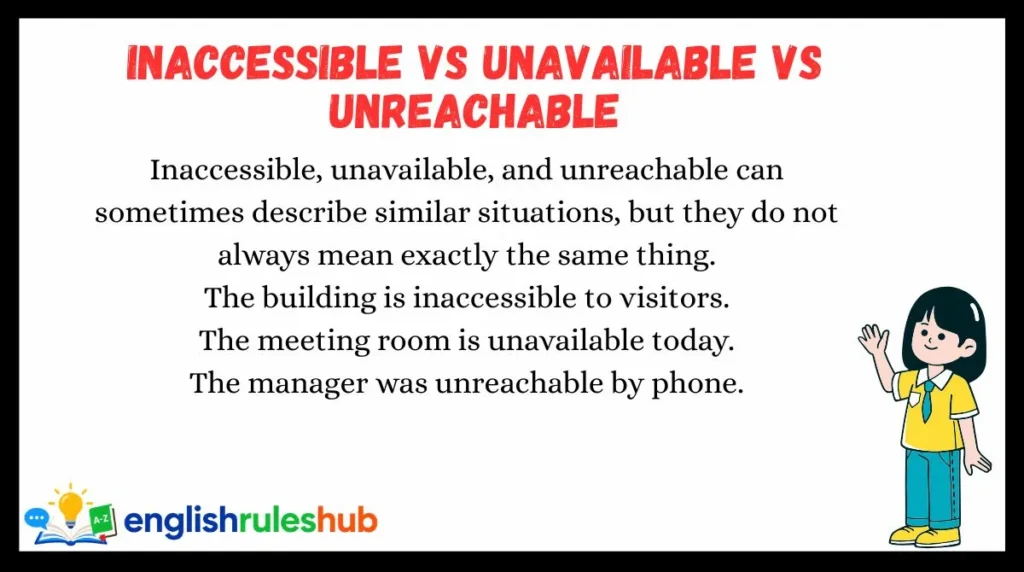
Inaccessible, unavailable, and unreachable can sometimes describe similar situations, but they do not always mean exactly the same thing.
Inaccessible focuses on access. Something cannot be reached, entered, used, or understood easily.
The building is inaccessible to visitors.
Unavailable usually means something cannot currently be obtained, used, or provided.
The meeting room is unavailable today.
Unreachable often focuses on contact or physical reach. It can describe a person who cannot be contacted or a place that cannot be reached.
The manager was unreachable by phone.
The village was unreachable because the bridge had collapsed.
A useful question can help you choose the right word:
Can I access it? → inaccessible
Can I get or use it right now? → unavailable
Can I reach or contact it? → unreachable
These meanings can overlap, so always consider the exact situation before choosing the word.
Grammar Rules You Must Remember
Rule #1: Use “inaccessible” in standard modern English
If you need the normal adjective meaning “not accessible,” choose inaccessible.
The road is inaccessible after the storm.
Avoid using unaccessible in normal formal or educational writing.
Rule #2: “Inaccessible” is an adjective
It describes a noun or comes after a linking verb.
Before a noun:
We found an inaccessible location.
After a linking verb:
The location was inaccessible.
You should not treat inaccessible as a verb.
Incorrect:
We inaccessible the building.
Correct:
We could not access the building.
Rule #3: Use “inaccessible to” when you name who cannot access something
This is a very common structure:
inaccessible to + person/group/thing
Examples:
The museum is inaccessible to wheelchair users.
The information is inaccessible to most readers.
The road is inaccessible to large vehicles.
The service is inaccessible to poor families.
Cambridge gives inaccessible to someone/something as a standard collocation.
Rule #4: Use “inaccessible by” when you talk about a method of reaching something
Use by when you are talking about a vehicle, route, or method.
Examples:
The village is inaccessible by car.
The island is inaccessible by road.
The area is inaccessible by train.
You can also say:
The village is inaccessible to cars.
The choice depends on the structure of your sentence.
Common Mistakes Students Make
Mistake 1: Choosing “unaccessible” because “un-” means “not”
This is the most common reason for the mistake.
A learner sees:
accessible = able to be reached
and thinks:
unaccessible = not able to be reached
The logic makes sense, but English vocabulary does not always work that way.
Correction:
❌ The website is unaccessible.
✅ The website is inaccessible.
Mistake 2: Thinking both forms are equally common
They are not.
Although unaccessible can be found in some dictionaries and historical sources, it is rare compared with inaccessible.
For learners, the safest rule is simple:
Use inaccessible.
Mistake 3: Writing “inaccessable”
This is a spelling mistake that sometimes appears because learners pronounce the word incorrectly or connect it with access + able.
The correct spelling is:
inaccessible
Not:
❌ inaccessable
Notice the ending:
-ible, not -able.
Mistake 4: Confusing “inaccessible” with “unavailable”
These words can overlap, but they are not always the same.
Inaccessible often means something cannot be reached, entered, used, or understood.
Unavailable often means something cannot currently be obtained or used, or that a person is not available.
Compare:
The mountain is inaccessible by road.
The meeting room is unavailable today.
The website is inaccessible because the server is down.
The manager is unavailable right now.
Merriam-Webster defines unavailable with meanings including not possible to get or use and unable or unwilling to do something.
Mistake 5: Using “inaccessible” when “unreachable” is better
Sometimes the issue is not access but contact.
❌ I called him, but he was inaccessible by phone.
This sounds unusual if you simply mean that you could not contact him.
Better:
✅ I called him, but he was unreachable by phone.
Merriam-Webster includes “impossible to contact or communicate with” as a meaning of unreachable.
Easy correction tip
When you are unsure, ask yourself:
“Am I talking about access?”
If yes, inaccessible is probably the word you need.
If you mean “cannot be contacted,” unreachable may be better.
If you mean “cannot currently be obtained or used,” unavailable may be better.
Easy Trick to Remember the Difference
Here is the easiest trick:
Accessible → Inaccessible
Think of the pair as one vocabulary family.
You do not need to spend time deciding whether un- could logically work. Just memorize the standard pair:
accessible / inaccessible
You can also remember the first letters:
Accessible = Access is possible
Inaccessible = It cannot be accessed easily
Another helpful trick is to think about common words you already know:
- visible → invisible
- possible → impossible
- regular → irregular
- legal → illegal
- accessible → inaccessible
The negative prefix in- is already common with many words.
And remember one more thing: English is not a mathematical system. A word may look as if it should be formed one way, but the established form may be different.
For example, learners do not normally say:
unpossible
They say:
impossible
In the same way, the standard choice is:
inaccessible
not:
unaccessible
If you see unaccessible, do not panic. You can understand it. Just avoid it in your own modern standard English.
Daily Life Examples (Very Important)
Here are some natural examples you may hear or use in everyday English.
Example 1: Talking about a road
Ali: Can we drive to the village?
Hamza: No. The road is inaccessible after the rain.
Here, inaccessible means the road cannot be reached or used easily.
Example 2: Talking about a website
Sara: Can you open the school website?
Mina: No. It is inaccessible at the moment.
The website cannot currently be reached or used.
Example 3: Talking about a building
Customer: Can I go upstairs?
Worker: I’m sorry. That area is inaccessible to visitors.
The area cannot be entered by visitors.
Example 4: Talking about information
Student: Can I see those records?
Teacher: No. They are inaccessible to students.
The students are not allowed or able to access them.
Example 5: Talking about a mountain
The top of the mountain was inaccessible because of heavy snow.
The snow made it extremely difficult or impossible to reach the top.
Example 6: Talking about technology
User: Why can’t I open the file?
Support worker: The file is inaccessible because you don’t have permission.
The user cannot access the file.
Example 7: Talking about difficult language
Student: I read the book, but I understood almost nothing.
Teacher: The language may be too inaccessible for beginners.
Here, inaccessible means difficult to understand.
Example 8: Talking about public services
Some basic services remain inaccessible to people in remote areas.
The services are difficult for those people to obtain or use.
Example 9: Talking about a person
The director seemed inaccessible, so I was afraid to ask him a question.
Here, it means difficult to approach or talk to.
Example 10: Talking about transportation
The village is inaccessible by car, so we had to walk.
This is a very natural use of the word.
Notice that these examples cover several meanings: physical access, digital access, information, understanding, services, and people.
Practice Section
Choose the better word in each sentence.
1. The mountain road became ______ after the heavy snowfall.
A. unaccessible
B. inaccessible
2. The online records are ______ to the public.
A. inaccessible
B. unaccessible
3. The village is ______ by car during the rainy season.
A. inaccessible
B. unaccessible
4. I could not contact John all day. He was ______ by phone.
A. inaccessible
B. unreachable
5. The lecture was so difficult that it felt ______ to new students.
A. inaccessible
B. unaccessible
Answers
1. B — inaccessible
The mountain road became inaccessible after the heavy snowfall.
2. A — inaccessible
The online records are inaccessible to the public.
3. A — inaccessible
The village is inaccessible by car during the rainy season.
4. B — unreachable
I could not contact John all day. He was unreachable by phone.
5. A — inaccessible
The lecture was so difficult that it felt inaccessible to new students.
The main lesson is clear: inaccessible is the normal modern form. When the meaning is “cannot be reached,” “cannot be accessed,” or “difficult to understand,” it is usually the right choice.
FAQs
What is the difference between unaccessible and inaccessible?
Both forms are intended to mean “not accessible,” but inaccessible is the standard and much more common form in modern English. Unaccessible is rare and may appear in older or nonstandard usage. For normal writing, use inaccessible.
Is “unaccessible” a correct English word?
It has existed in English and is still listed in some dictionaries, but it is rare and is not the normal modern choice. Historical dictionary evidence even shows that inaccessible had already become the preferred form long ago. For school, work, exams, and professional writing, choose inaccessible.
Is inaccessible formal or informal?
Inaccessible works in both formal and informal English. You can use it in everyday conversation, academic writing, business documents, websites, and reports. It is a normal standard adjective, not a word limited to formal English.
Can we use inaccessible in questions?
Yes. There is no grammar problem with using inaccessible in a question.
For example:
Why is this website inaccessible?
Is the road inaccessible by car?
Why is the information inaccessible to students?
The word is simply an adjective describing the subject.
Should I write “The website is unaccessible”?
It is better to write:
The website is inaccessible.
Although readers will probably understand unaccessible, it is not the standard choice in modern English. Using inaccessible makes your writing sound natural and avoids unnecessary word-choice problems.
Is “inaccessible to” correct?
Yes. Inaccessible to is one of the most common structures with this adjective.
Examples:
The building is inaccessible to wheelchair users.
The information is inaccessible to the public.
The service is inaccessible to many families.
Cambridge specifically lists inaccessible to someone/something as a standard collocation.
Final Conclusion
When you compare unaccessible vs inaccessible, the safest answer for modern English is simple: use inaccessible.
Unaccessible has appeared in English, and some dictionaries still record it as a rare form. However, it is not the normal word choice today.
Historical dictionary evidence also shows that inaccessible had already become the preferred form many years ago.
Inaccessible can describe a place that is difficult to reach, a website that cannot be opened, information that cannot be obtained, a service that is difficult to use, or an idea that is hard to understand.
It commonly appears with to, as in “inaccessible to students,” and with by, as in “inaccessible by road.”
So keep this simple pair in your memory:
accessible → inaccessible
If you see unaccessible somewhere, you do not need to be confused. Understand what the writer means, but when you write your own sentence, choose inaccessible.
A small word choice like this can make your English sound much more natural and confident.

I am Benjamin Clark, an English language writer passionate about simplifying grammar, vocabulary, and word meanings. I create clear, accurate, and practical content to help learners improve their English skills with confidence every day.