Many English learners get confused by unsecure and insecure because both words seem very similar.
They both contain the idea of something that is not secure, so it is easy to think they mean exactly the same thing.
The confusion becomes even bigger when people see both words online, in books, at work, or in technology-related topics.
One website may use unsecure, while another uses insecure. As a result, students often wonder which word is correct.
The good news is that understanding the difference is not difficult once you know how English word formation works.
Both words are related to the adjective secure, which means safe, protected, stable, or confident. However, insecure is much more common in modern English and has several meanings that unsecure does not usually have.
This difference matters because using the wrong word can make your sentence sound unnatural or confusing to native speakers.
After reading this guide, you will clearly understand:
- What unsecure means
- What insecure means
- When each word should be used
- Which word is more common
- Common mistakes learners make
- Easy ways to remember the difference
By the end, you will be able to choose the correct word with confidence in both writing and everyday conversation.
What Does “Unsecure” Mean?
Simple Definition
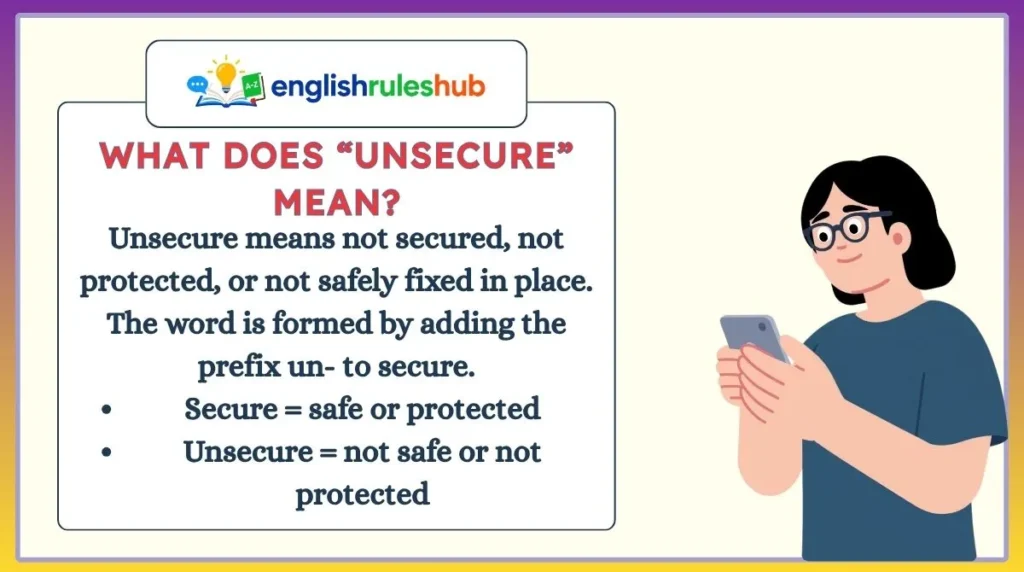
Unsecure means not secured, not protected, or not safely fixed in place.
The word is formed by adding the prefix un- to secure.
- Secure = safe or protected
- Unsecure = not safe or not protected
Although unsecure exists in English, it is less common than insecure.
When to Use It
Use unsecure when talking about something that has not been properly protected, locked, fastened, or secured.
It is often used in:
- Technology
- Computer security
- Physical objects
- Safety situations
Grammar Rule
Unsecure is an adjective.
Structure:
Subject + be verb + unsecure
Examples:
- The door is unsecure.
- The network is unsecure.
- The package is unsecure.
It can also appear before nouns:
- an unsecure connection
- an unsecure building
- an unsecure attachment
However, many native speakers prefer insecure in these situations.
Example Sentences
- The gate was left unsecure overnight.
- This website has an unsecure connection.
- The ladder feels unsecure.
- The documents were stored in an unsecure location.
- An unsecure password is easy to guess.
- The fence remained unsecure after the storm.
- The equipment was unsecure during transport.
- The server was considered unsecure by the IT team.
Common Learner Confusion
Many learners think unsecure and insecure are always interchangeable.
In some situations they are very close in meaning:
- The network is unsecure.
- The network is insecure.
Both may communicate the idea that the network is not safe.
However, insecure is the word most native speakers naturally choose.
That is why learners often sound more natural when using insecure instead of unsecure.
What Does “Insecure” Mean?
Simple Definition
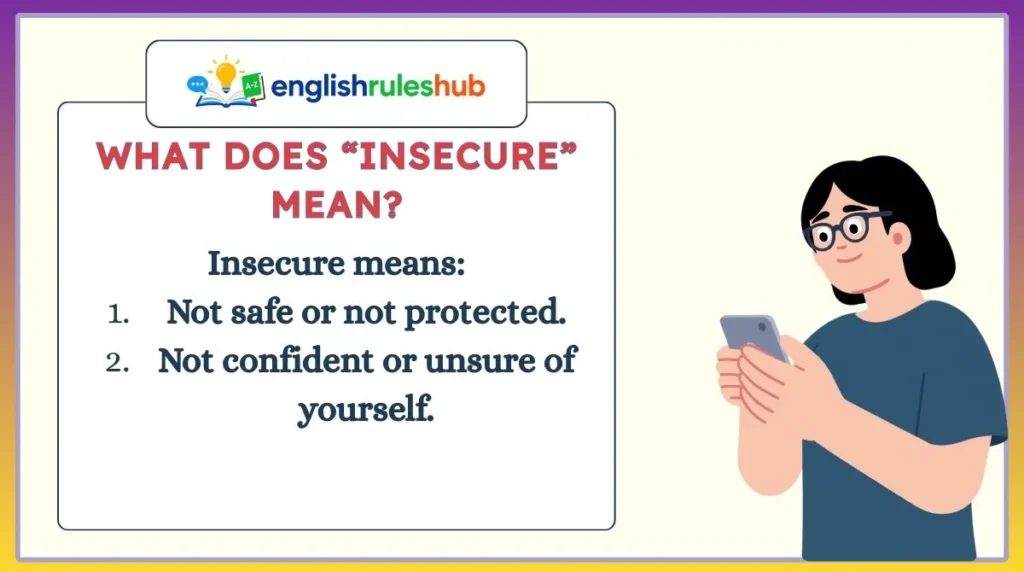
Insecure means:
- Not safe or not protected.
- Not confident or unsure of yourself.
This second meaning is what makes insecure much more common and useful than unsecure.
When to Use It
Use insecure when talking about:
Safety
- insecure systems
- insecure buildings
- insecure data
Confidence
- insecure people
- insecure students
- insecure feelings
This emotional meaning is extremely common in daily English.
Grammar Rule
Insecure is also an adjective.
Structure:
Subject + be verb + insecure
Examples:
- She is insecure.
- The connection is insecure.
- The building is insecure.
Example Sentences
- The website is insecure.
- His account became insecure after the password leak.
- The bridge looks insecure.
- She feels insecure about speaking English.
- Many teenagers become insecure about their appearance.
- The company found several insecure systems.
- He sounded insecure during the interview.
- The old lock makes the house insecure.
Common Learner Confusion
The biggest mistake learners make is thinking insecure only refers to emotions.
Actually, it has two major meanings:
Meaning 1: Not safe
- The network is insecure.
- The account is insecure.
Meaning 2: Lacking confidence
- She is insecure.
- He feels insecure.
Because it works in both situations, insecure is much more widely used than unsecure.
Difference Between Unsecure and Insecure
Understanding the difference becomes easier when you compare them side by side.
| Feature | Unsecure | Insecure |
|---|---|---|
| Meaning | Not secured or protected | Not secure, unsafe, or lacking confidence |
| Common in modern English | Less common | Very common |
| Used for emotions | No | Yes |
| Used for safety | Yes | Yes |
| Sounds natural to native speakers | Sometimes | Usually |
| Common in conversation | Rare | Frequent |
Usage Difference
Unsecure
Focuses on something that has not been properly secured.
Example:
- The gate is unsecure.
The idea is that nobody secured it correctly.
Insecure
Focuses on the lack of safety or stability.
Example:
- The gate is insecure.
The idea is that the gate is unsafe or vulnerable.
The meanings are very close, but insecure sounds more natural in most situations.
Grammar Logic
English uses several negative prefixes:
- un-
- in-
- im-
- ir-
- il-
Sometimes more than one form exists.
Examples:
- possible → impossible
- legal → illegal
- regular → irregular
- secure → insecure
Over time, one version often becomes more popular.
For the word secure, the form that became dominant is insecure.
Sentence Structure Difference
With Unsecure
- The network is unsecure.
- The door remains unsecure.
With Insecure
- The network is insecure.
- The door remains insecure.
Both structures are grammatically possible.
However, native speakers usually prefer the second version.
Meaning Comparison
Look at these pairs:
Safety
- The website is unsecure.
- The website is insecure.
Both mean the website is not safe.
Confidence
- She is unsecure. ❌
- She is insecure. ✔
Only insecure works here.
That is a very important difference.
Grammar Rules You Must Remember
Rule #1: Use “Insecure” for Feelings and Confidence
When talking about emotions, confidence, self-esteem, or personality, use insecure.
Examples:
- She feels insecure about her accent.
- He is insecure around strangers.
- Many students feel insecure before exams.
Never use unsecure in these situations.
Incorrect:
- She feels unsecure. ❌
Correct:
- She feels insecure. ✔
Rule #2: Both Words Can Describe Safety
When something is not safe or protected, both words may be possible.
Examples:
- The account is insecure.
- The account is unsecure.
Even so, insecure is generally preferred.
Rule #3: Insecure Is More Common in Modern English
If you are unsure which word to choose, insecure is usually the safer option.
Examples:
- insecure connection ✔
- insecure network ✔
- insecure password ✔
These expressions appear much more often in everyday English.
Rule #4: Check the Meaning of the Sentence
Ask yourself:
“Am I talking about safety or confidence?”
If confidence is involved, the answer is easy.
Use insecure.
Example:
- She is insecure about her English skills.
Since this sentence describes feelings, insecure is the only correct choice.
Common Mistakes Students Make
Mistake 1: Using “Unsecure” for Emotions
Wrong:
- I feel unsecure when speaking English.
Correct:
- I feel insecure when speaking English.
Why It Happens
Students see the prefix un- and think it can replace in- everywhere.
English does not always work that way.
Easy Tip
Feelings = insecure.
Mistake 2: Thinking Both Words Are Equally Common
Wrong Idea:
- Native speakers use both words all the time.
Reality:
- Insecure is far more common.
Better Choice
Instead of:
- The website is unsecure.
Prefer:
- The website is insecure.
Mistake 3: Forgetting the Confidence Meaning
Some learners know only the safety meaning.
Example:
- She feels insecure about her appearance.
This does not mean she is unsafe.
It means she lacks confidence.
Mistake 4: Translating Directly From Another Language
Many languages build negatives using a simple prefix.
Learners may assume:
- secure → unsecure
must always be the correct opposite.
But English usage is based on both grammar and tradition.
That is why insecure became the standard word.
Easy Correction Tips
- Learn the phrase feel insecure.
- Remember that emotions use insecure.
- Use insecure when uncertain.
- Read examples from real English conversations.
These habits quickly improve accuracy.
Easy Trick to Remember the Difference
Here is a simple memory trick.
Think About People
Can a person be insecure?
Yes.
- She is insecure.
- He feels insecure.
Can a person be unsecure?
Not naturally.
Native speakers almost never say that.
Because insecure works for people and feelings, it becomes the word you hear most often.
Real-Life Logic
Imagine a student giving a speech.
You would say:
- The student feels insecure.
You would never normally say:
- The student feels unsecure.
Now think about a website.
- The website is insecure.
Since the same word works in both situations, it is the stronger and more useful choice.
Quick Memory Formula
People = insecure
Feelings = insecure
Safety = usually insecure
This simple formula will help you remember the difference.
Daily Life Examples
Here are some natural examples you may hear in everyday English.
- I feel insecure when I speak in front of a large group.
- This password is insecure and easy to guess.
- She became insecure after reading negative comments online.
- The old lock makes the apartment insecure.
- He is insecure about his pronunciation.
- The website warns users about an insecure connection.
- Some children feel insecure on their first day at school.
- The fence is still unsecure after the repair work.
- The company found several insecure computer systems.
- She looked insecure during the interview.
These examples show that insecure appears much more often in normal conversation.
Practice Section
Choose the correct word: unsecure or insecure.
1.
She feels ______ about her English speaking skills.
2.
The website has an ______ connection.
3.
The gate remained ______ after the storm.
4.
Many teenagers feel ______ about their appearance.
5.
The password is ______ and needs to be changed.
Answers
1.
insecure ✔
2.
insecure ✔
3.
unsecure or insecure ✔
(Both are possible, but insecure is more common.)
4.
insecure ✔
5.
insecure ✔
FAQs
What is the difference between unsecure and insecure?
Both words can mean “not secure” or “not safe.” However, insecure is much more common in modern English. It can also describe a lack of confidence, while unsecure cannot.
Can we use insecure in questions?
Yes. It works naturally in questions.
Examples:
- Why do you feel insecure?
- Is this website insecure?
Both are correct.
Is unsecure a real English word?
Yes. It is a real English word and appears in dictionaries. However, it is used much less often than insecure in everyday English.
Is insecure formal or informal?
It can be used in both formal and informal situations. You may hear it in conversations, academic writing, business communication, and technology discussions.
Can insecure describe a person?
Yes. This is one of its most common uses.
Examples:
- He is insecure.
- She feels insecure.
It means the person lacks confidence or feels uncertain.
Which word should English learners use most of the time?
Most learners should choose insecure because it is more common, more natural, and accepted in a wider range of situations. Native speakers use it far more frequently than unsecure.
Final Conclusion
The difference between unsecure and insecure is smaller than many learners expect, but it is still important to understand.
Both words can describe something that is not safe, protected, or secure. However, insecure is the word most native speakers use in everyday English.
It is common in conversations, writing, technology, education, and business communication.
Another key point is that insecure can describe a person’s feelings, confidence, or self-esteem. In those situations, unsecure is not normally used.
A helpful rule is simple: when talking about emotions, always choose insecure. When talking about safety, both words may work, but insecure usually sounds more natural.
The best way to master the difference is through practice. Read English regularly, listen to native speakers, and pay attention to how these words appear in real situations. Over time, choosing the correct word will become automatic and effortless.

I am Benjamin Clark, an English language writer passionate about simplifying grammar, vocabulary, and word meanings. I create clear, accurate, and practical content to help learners improve their English skills with confidence every day.