Many English learners know the words amount, quantity, and number, but using them correctly can be confusing.
You may see phrases such as “the amount of money,” “the quantity of rice,” and “the number of students” and wonder why English uses different words for things that all seem to mean “how much” or “how many.”
The confusion becomes even greater when the noun can be counted or measured. For example, we can say the number of books, but we normally say the amount of water.
What about the quantity of water? Is that correct too? Yes, it can be correct, but it has a slightly different feel and use.
These expressions are important because they appear everywhere in spoken English, school writing, business English, reports, emails, and everyday conversations.
Choosing the wrong one may not always make your sentence impossible to understand, but it can make your English sound unnatural.
The good news is that the basic rule is quite simple. Number normally goes with countable nouns, while amount normally goes with uncountable nouns.
Quantity can be used with both, but it is more common in formal, technical, or careful language.
By the end, you will know exactly when to use each expression and how to avoid common mistakes.
What Does “Amount of” Mean?
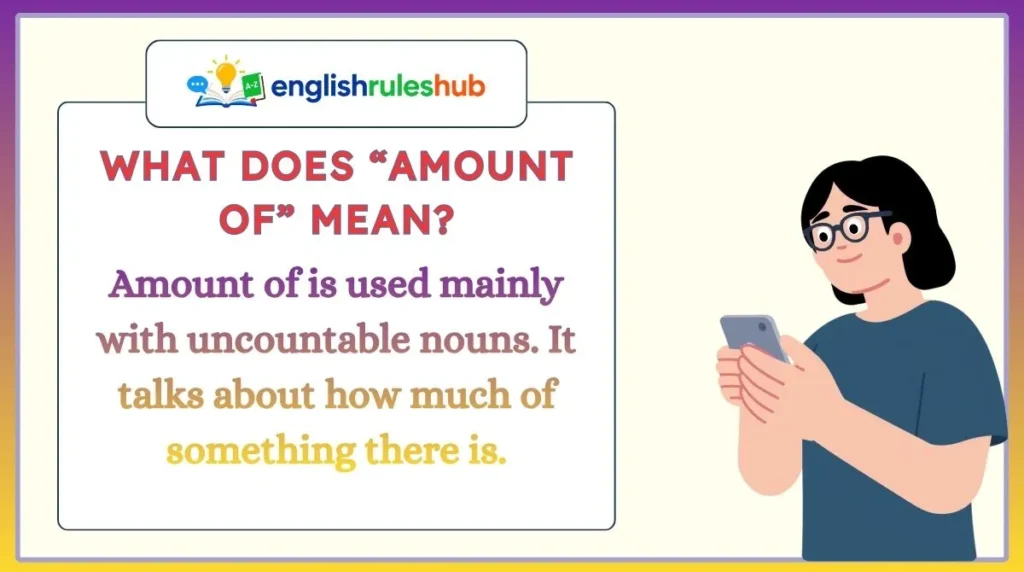
Amount of is used mainly with uncountable nouns. It talks about how much of something there is.
Uncountable nouns are things that we do not normally count as separate individual items. Examples include water, money, time, information, advice, sugar, milk, traffic, work, and energy.
For example:
- The amount of water in the bottle is small.
- I was surprised by the amount of money he spent.
- We need a large amount of information.
- The amount of sugar in this drink is too high.
- She spends a lot of time studying.
- The amount of traffic on this road is increasing.
- He has a small amount of free time.
- The amount of work is difficult to manage.
The basic pattern is:
amount of + uncountable noun
You can also use a determiner before “amount”:
- a large amount of money
- a small amount of water
- a huge amount of work
- a certain amount of time
- the amount of information
Notice something important: we do not normally say:
the amount of books
when we mean individual books.
We say:
the number of books
because books are countable.
Amount of in everyday English
“Amount of” is especially common when we are talking about money, time, substances, and abstract ideas.
For example, a friend might say:
“I didn’t expect to spend that amount of money.”
A teacher might say:
“You need to spend a certain amount of time practicing.”
A doctor might talk about:
“the amount of water you drink each day.”
So, although the rule sounds like a grammar-book rule, you hear this structure in normal everyday English.
A common learner confusion
Learners sometimes think amount means “a lot.” It does not.
“Amount” simply refers to how much there is.
Compare:
- The amount of water is small.
- The amount of water is large.
Both sentences are correct. The word “amount” itself does not tell us whether the quantity is big or small.
What Does “Quantity of” Mean?
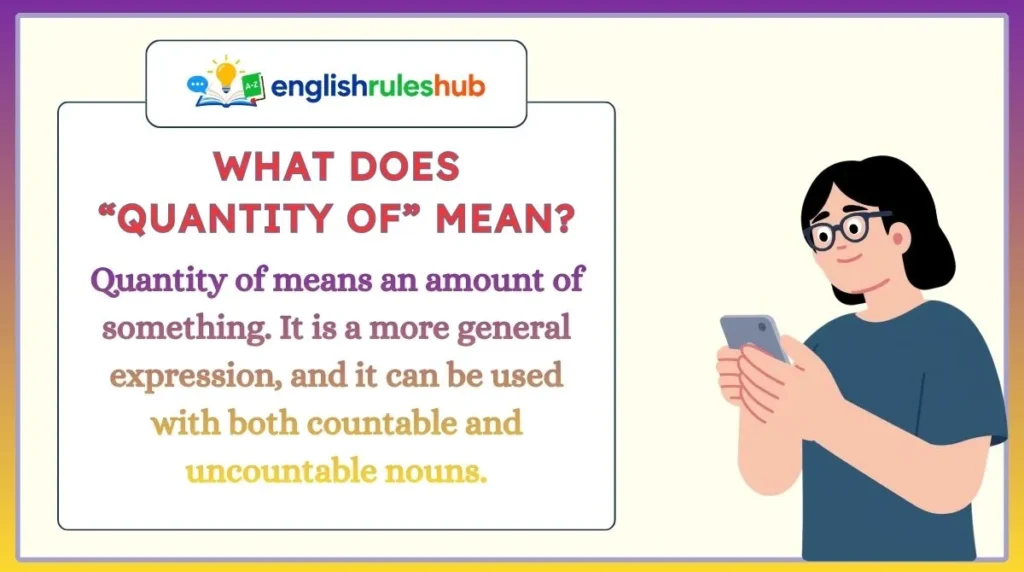
Quantity of means an amount of something. It is a more general expression, and it can be used with both countable and uncountable nouns.
For example:
- a large quantity of water
- a small quantity of sugar
- a large quantity of products
- a limited quantity of goods
- a huge quantity of materials
- a certain quantity of food
- a large quantity of books
- a small quantity of chemicals
This makes “quantity” different from “amount.”
The basic pattern is:
quantity of + noun
The noun can be countable or uncountable.
Quantity with uncountable nouns
We can use “quantity” with things that cannot normally be counted individually.
For example:
The factory uses a large quantity of water.
Water is uncountable, so “amount of water” is also natural:
The factory uses a large amount of water.
Both sentences are grammatically possible.
However, quantity can sound more formal or technical. It may be more common in writing about manufacturing, science, cooking, trade, storage, or measurements.
Quantity with countable nouns
“Quantity” can also be used with plural countable nouns:
The company ordered a large quantity of computers.
This is grammatically correct, but in everyday English, number of computers may sound more natural if we are simply talking about how many computers there are.
Compare:
The company bought a large number of computers.
This focuses on how many individual computers were bought.
The company bought a large quantity of computers.
This sounds more like a statement about the volume or supply of goods, often in a formal or business context.
Quantity often sounds formal
Imagine a friend asking:
“How many apples did you buy?”
You probably would not answer:
“I bought a large quantity of apples.”
It sounds too formal for a simple conversation.
You would normally say:
“I bought a lot of apples.”
But in a business report, this could sound perfectly natural:
“The supplier delivered a large quantity of apples to the warehouse.”
So, “quantity” is not wrong. It simply has a different style and purpose.
Difference Between Amount of, Quantity of, and Number of
The easiest way to understand these three expressions is to focus on the noun that follows them.
| Expression | Main use | Example | Common style |
|---|---|---|---|
| amount of | Uncountable nouns | amount of water | Everyday and general |
| quantity of | Countable or uncountable nouns | quantity of goods | Often formal or technical |
| number of | Countable nouns | number of students | Everyday and formal |
Amount of vs. number of
This is the most important difference.
Use amount of with an uncountable noun:
the amount of money
Use number of with a countable noun:
the number of coins
Money is treated as an uncountable noun when we mean money generally.
Coins are individual objects that can be counted:
one coin, two coins, three coins
Therefore:
The amount of money in my account has changed.
But:
The number of coins in the box has changed.
Quantity of vs. number of
Both can sometimes be used with plural countable nouns.
For example:
a large number of cars
and:
a large quantity of cars
The first is more natural when the main idea is how many cars there are.
The second can sound more formal and may focus on a large supply or group of goods.
Compare:
The police saw a large number of cars on the road.
This focuses on the count of cars.
The factory received a large quantity of cars.
This sounds like a formal description of a shipment or supply.
Amount of vs. quantity of
These two are closer because both can be used with uncountable nouns.
For example:
a large amount of water
a large quantity of water
Both are correct.
However, amount is usually the more natural choice in ordinary English.
“Quantity” often appears when the speaker wants to sound precise, formal, technical, or businesslike.
For example:
Drink a small amount of water.
sounds normal.
Add a small quantity of water.
is possible, but it sounds more like a recipe, laboratory instruction, or technical direction.
Grammar logic
Think of the three expressions like this:
Amount → how much of an uncountable thing
Number → how many individual things
Quantity → how much or how many, often with a formal sense of measurement or supply
This simple idea will help you make the right choice most of the time.
Sentence structure
The normal structures are:
the amount of + uncountable noun
The amount of water is low.
the number of + plural countable noun
The number of students is high.
the quantity of + noun
The quantity of water is limited.
The quantity of products is limited.
Notice that the noun after number of is normally plural:
number of students
number of cars
number of houses
But after amount of, the noun is normally uncountable:
amount of water
amount of money
amount of information
Grammar Rules You Must Remember
Rule #1: Use “amount of” with uncountable nouns
When you cannot normally count something as individual units, amount of is usually the best choice.
Correct:
The amount of water is enough.
Correct:
We need a small amount of sugar.
Incorrect in standard English:
The amount of books is increasing.
Better:
The number of books is increasing.
Remember: amount = how much.
Rule #2: Use “number of” with countable plural nouns
If you can count the things one by one, use number of.
For example:
The number of students is growing.
You can count the students:
one student, two students, three students.
Other examples include:
the number of houses
the number of questions
the number of cars
the number of mistakes
the number of employees
Remember: number = how many.
Rule #3: “Quantity” can be used with both types of nouns
Unlike “amount” and “number,” quantity has wider use.
You can say:
a quantity of water
and:
a quantity of books
However, grammatical possibility does not always mean that a phrase is the most natural choice.
In everyday English, “number of” is normally better for ordinary countable items:
a large number of students
rather than:
a large quantity of students
Rule #4: Choose according to meaning and context
Grammar is not only about whether a sentence is possible. It is also about what sounds natural in a particular situation.
For example:
We have a large number of customers.
This is natural because customers are individuals.
But:
The warehouse contains a large quantity of goods.
This sounds natural because “quantity” fits a formal discussion of stored products.
Ask yourself:
Am I counting individual things, measuring something, or talking about a supply?
That question often gives you the answer.
Common Mistakes Students Make
Mistake 1: Using “amount” with countable nouns
A common error is:
The amount of students in my class is twenty.
A better sentence is:
The number of students in my class is twenty.
Students are individual people, so they are countable.
Mistake 2: Using “number” with uncountable nouns
Another common mistake is:
The number of water in the tank is low.
This is incorrect because water is not normally counted as individual “waters” in this meaning.
Say:
The amount of water in the tank is low.
Mistake 3: Thinking “quantity” is always better
Because “quantity” can work with both countable and uncountable nouns, some learners use it everywhere.
For example:
I have a large quantity of friends.
This sounds unnatural in normal conversation.
A much better sentence is:
I have a large number of friends.
Or, more naturally:
I have a lot of friends.
Mistake 4: Forgetting that “number of” takes a plural noun
Do not say:
the number of student
Say:
the number of students
Similarly:
the number of cars
the number of books
the number of people
The noun after “number of” is normally plural because we are talking about multiple countable items.
Mistake 5: Confusing “amount” with “number” when talking about money
Money creates a special problem because we can count individual units of currency, but money itself is normally uncountable.
We say:
The amount of money I have is limited.
But if we are counting individual notes:
The number of banknotes in my wallet is small.
The same basic rule still works.
Easy Trick to Remember the Difference
Here is a simple classroom trick.
Ask yourself:
Can I count it one by one?
If the answer is yes, think NUMBER.
number of books
number of students
number of cars
number of chairs
If the answer is no, think AMOUNT.
amount of water
amount of money
amount of time
amount of information
Then remember that QUANTITY is the flexible one.
It can work with both:
quantity of water
quantity of products
But it often sounds more formal than the other choices.
You can also remember it with three questions:
How many? → number
How much? → amount
How much/how many in a measured or formal sense? → quantity
For everyday conversation, this shortcut works very well.
If you are talking about people, books, cars, questions, or other individual items, number will usually be your safest choice.
If you are talking about water, money, time, information, or other uncountable things, amount will usually be your safest choice.
Daily Life Examples
Here are some natural examples you might hear or use in real life.
Example 1: Talking about money
A: How much money do we need?
B: We need a certain amount of money for the trip.
“Money” is uncountable, so “amount” is natural.
Example 2: Talking about students
Teacher: The number of students in this class is thirty.
“Students” are countable, so we use “number.”
Example 3: Talking about water
A: Is there enough water?
B: Yes, we have a good amount of water left.
“Amount” works naturally with uncountable “water.”
Example 4: Talking about books
A: How many books did you buy?
B: I bought a large number of books.
The books can be counted individually.
Example 5: Talking about time
A: Do you have enough time?
B: I don’t have much amount of time.
This sentence is not natural. A better sentence is:
I don’t have much time.
Or:
I don’t have a large amount of time.
This shows that grammar also depends on the complete structure, not just on choosing “amount.”
Example 6: Talking about products
The store received a large quantity of products this week.
This sounds natural in a business or supply context.
Example 7: Talking about information
We need a small amount of information before we make a decision.
“Information” is uncountable.
Example 8: Talking about mistakes
The number of mistakes in your homework is much lower now.
Mistakes are individual things that can be counted.
Example 9: Talking about food
Add a small amount of salt to the soup.
Salt is uncountable in this meaning.
Example 10: Talking about goods
The company exported a large quantity of goods.
“Quantity” sounds natural here because the sentence has a formal business context.
Practice Section
Choose the best expression: amount of, quantity of, or number of.
1. The ______ students in the class has increased.
A. amount of
B. number of
C. quantity of
2. Please add a small ______ sugar to the tea.
A. number of
B. amount of
C. number
3. The company ordered a large ______ products.
A. number of
B. amount of
C. amount
4. We don’t have enough ______ information.
A. number of
B. amount of
C. number
5. The ______ cars on the road is increasing.
A. amount of
B. number of
C. amount
Answers
1. B — number of
Students are countable.
2. B — amount of
Sugar is uncountable.
3. A — number of
Products are countable. “Quantity of products” can also be correct in a formal supply context, but “number of products” is the clearer general choice.
4. B — amount of
Information is uncountable. However, the most natural everyday sentence would simply be:
We don’t have enough information.
5. B — number of
Cars are countable individual objects.
FAQs
What is the difference between amount of and number of?
Use amount of mainly with uncountable nouns, such as money, water, time, and information. Use number of with plural countable nouns, such as students, books, and cars.
A simple way to remember it is: amount = how much; number = how many.
Can I use “quantity of” with countable nouns?
Yes. Quantity of can be used with both countable and uncountable nouns.
For example, “a quantity of water” and “a quantity of goods” are both possible. However, “number of” is usually more natural when you are simply counting individual items.
Is “quantity of” formal or informal?
“Quantity of” is grammatically normal, but it often sounds more formal, technical, or businesslike than “amount of” or “number of.”
You may see it in reports, instructions, manufacturing, science, trade, and descriptions of goods.
Is “amount of people” correct?
In standard English, number of people is normally preferred.
For example:
The number of people at the event was surprising.
“People” refers to individuals who can be counted, so “number” is the natural choice.
Should I say “amount of books” or “number of books”?
Say number of books.
Books are countable:
one book, two books, three books
Therefore:
The number of books on the shelf is twenty.
For everyday English, “a lot of books” is also very natural.
Can “quantity” replace “amount” and “number” everywhere?
No. Although “quantity” has broad grammatical use, it is not always the most natural choice.
For everyday English, use amount with uncountable nouns and number with countable nouns. Use quantity when the context is more formal, technical, measured, or focused on a supply.
Final Conclusion
The difference between amount of, quantity of, and number of becomes much easier when you look at the noun that follows the expression.
Use amount of mainly with uncountable nouns:
amount of water
amount of money
amount of time
Use number of with plural countable nouns:
number of students
number of books
number of cars
Quantity of is more flexible. It can be used with both countable and uncountable nouns, but it often has a more formal, technical, or business-like feel.
The best shortcut is simple: “How much?” → amount. “How many?” → number. “Quantity” → a flexible and often formal choice.
Do not worry if you make mistakes at first. Start by checking whether the noun can be counted individually. With a little practice, choosing the right expression will become automatic.
The goal is not to memorize hundreds of rules. Just understand the basic idea and notice how native speakers use these expressions in real situations.

I am Benjamin Clark, an English language writer passionate about simplifying grammar, vocabulary, and word meanings. I create clear, accurate, and practical content to help learners improve their English skills with confidence every day.