English learners often get confused when two sentences have almost the same meaning but use different word patterns.
“Has long been” and “has been for a long time” are good examples. Both can talk about something that started in the past and is still true now, but they are not used in exactly the same way.
For example, you might hear someone say, “She has long been a good friend of mine.” You can also say, “She has been a good friend of mine for a long time.” The basic meaning is very similar, but the style and focus are a little different.
This difference matters because both expressions are common in English. One may sound more natural in everyday conversation, while the other can sound more formal or written.
The good news is that the grammar is not difficult once you understand the pattern. “Has long been” puts the idea of a long period directly into the sentence. “Has been for a long time” gives the time expression separately.
By the end of this guide, you will know when to use each expression, how their sentence structures work, and how they sound in everyday English. You will also see many simple examples that make the difference easier to remember.
What Does “Has Long Been” Mean?
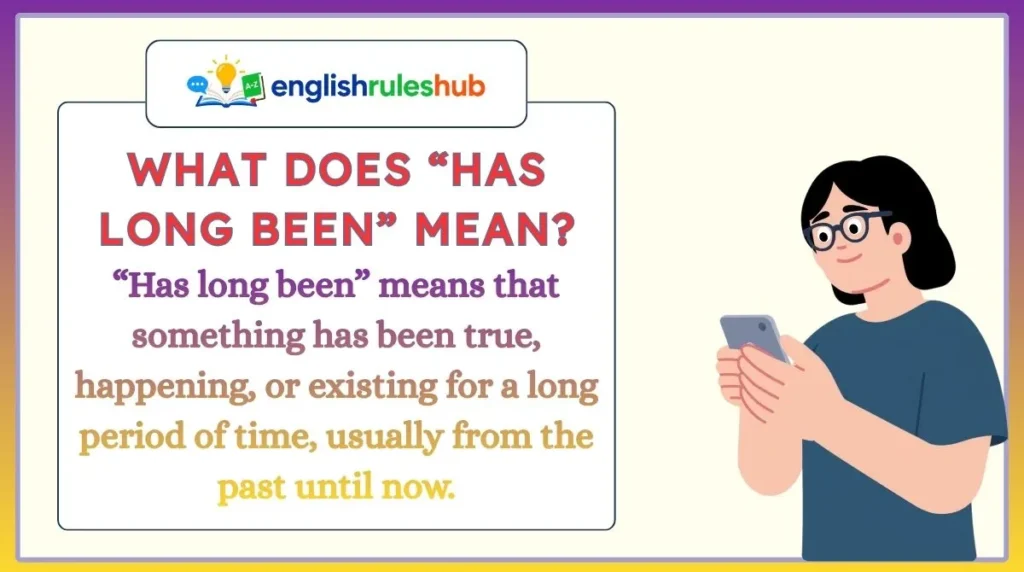
“Has long been” means that something has been true, happening, or existing for a long period of time, usually from the past until now.
The word “long” here means for a long time. It is placed between has and been.
The basic pattern is:
Subject + has + long + been + complement
For example:
- She has long been a trusted teacher.
- He has long been interested in history.
- This city has long been famous for its food.
The expression is often used when we want to show that a situation is not new. It has been true for quite a while.
When Should You Use “Has Long Been”?
We commonly use “has long been” when talking about a person, place, thing, belief, situation, or fact that has existed or remained true for a long time.
It is especially common in formal writing, news writing, books, essays, reports, and careful speech.
For example:
The town has long been known for its beautiful gardens.
This means the town has been known for its beautiful gardens for a long period of time.
Another example is:
She has long been interested in science.
This tells us that her interest in science started some time ago and has continued.
The Grammar Behind “Has Long Been”
The structure uses the present perfect:
has + been
The word long is inserted between them:
has + long + been
“Been” is the past participle of be.
So:
- has been
- has long been
Both use the present perfect. The addition of long simply emphasizes the duration.
We normally use has with he, she, it, or a singular noun.
For example:
- He has long been…
- She has long been…
- The company has long been…
- This place has long been…
With I, you, we, and they, use have:
- I have long been…
- They have long been…
- We have long been…
Examples of “Has Long Been”
- She has long been one of the best teachers at the school.
- He has long been interested in photography.
- The restaurant has long been popular with local families.
- This road has long been an important route for travelers.
- The city has long been famous for its old buildings.
- He has long been a supporter of the project.
- English has long been an important language in international business.
- The book has long been considered a classic.
Notice that “has long been” does not normally tell us the exact length of time.
It does not tell us whether something has continued for five years, ten years, or fifty years. It simply gives the idea of a long period.
A Common Learner Confusion
Many learners think “has long been” is incorrect because they expect long to come after “been.”
They may write:
She has been long a teacher. ❌
That is not the normal structure.
Instead, say:
She has long been a teacher. ✅
Or:
She has been a teacher for a long time. ✅
Both correct sentences express a similar idea.
What Does “Has Been for a Long Time” Mean?
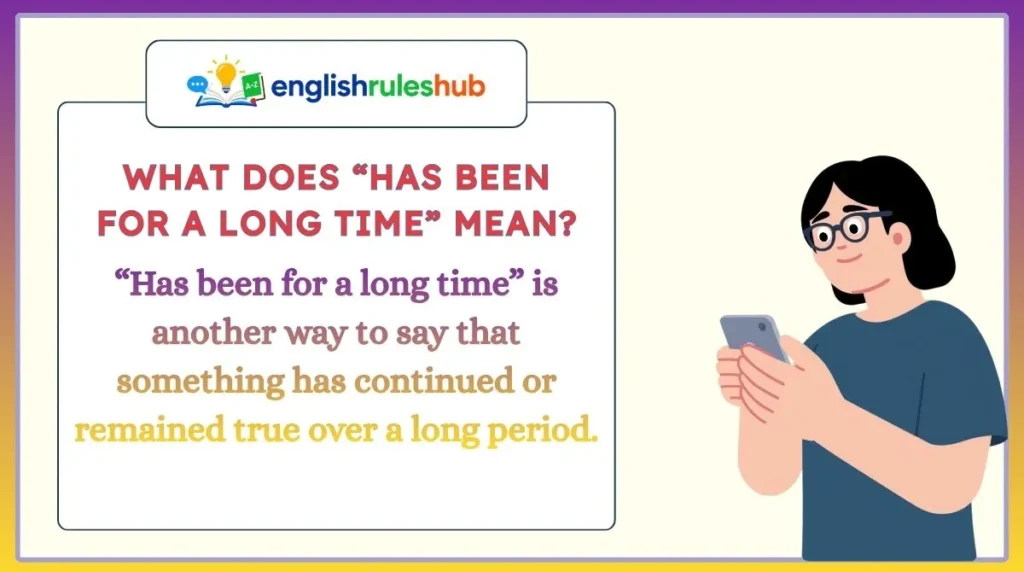
“Has been for a long time” is another way to say that something has continued or remained true over a long period.
The important difference is that “for a long time” is a time expression. It tells us the duration of the situation.
A common structure is:
Subject + has + been + complement + for a long time
For example:
She has been a teacher for a long time.
This means she became a teacher in the past and has continued to be a teacher until now.
Another example:
He has been interested in music for a long time.
The interest started in the past and has continued for a long period.
When Should You Use “Has Been for a Long Time”?
This pattern is very useful in everyday English and normal conversation.
If you are talking to a friend, family member, classmate, or colleague, “has been … for a long time” will often sound very natural.
For example:
He has been my friend for a long time.
This is simple and conversational.
You could also say:
He has long been my friend.
This is grammatically correct, but it can sound more formal or literary.
That is an important point for learners:
“Has long been” is often more formal or written, while “has been … for a long time” is often more natural in everyday speech.
The Grammar Behind “Has Been for a Long Time”
The basic verb form is again the present perfect:
has + been
Then we add:
for + a period of time
The word for is used to talk about duration.
For example:
- for two years
- for three months
- for a week
- for a long time
- for many years
So:
She has been a doctor for a long time.
The sentence tells us how long the situation has continued in a general way.
Examples of “Has Been for a Long Time”
- She has been my best friend for a long time.
- He has been interested in cars for a long time.
- The shop has been closed for a long time.
- This problem has been with us for a long time.
- She has been a teacher for a long time.
- The house has been empty for a long time.
- He has been worried about his exam for a long time.
- The two families have been friends for a long time.
The last example uses have rather than has because the subject is plural.
A Common Learner Confusion
Some students think “for a long time” must always come at the beginning or end of the sentence.
It can often go at the end:
She has been here for a long time.
That is the most natural form.
You can sometimes move a time phrase for emphasis, but beginners should usually keep the structure simple.
Difference Between “Has Long Been” and “Has Been for a Long Time”
The two expressions are very close in meaning. In many sentences, they can be used to communicate essentially the same idea.
Compare:
She has long been a successful businesswoman.
She has been a successful businesswoman for a long time.
Both tell us that she has been a successful businesswoman for many years or a long period.
The main difference is style, position, and emphasis.
Comparison Table
| “Has long been” | “Has been for a long time” |
|---|---|
| More compact | More direct |
| Often more formal | Often more conversational |
| Common in writing | Very common in speech |
| “Long” comes before “been” | “For a long time” usually comes later |
| Does not give a specific duration | Expresses duration directly |
| Can sound polished or formal | Can sound natural and relaxed |
1. Difference in Style
Has long been often sounds more formal.
For example:
The university has long been respected for its research.
This sounds suitable for a report, article, or formal presentation.
In everyday conversation, you might say:
The university has been respected for a long time.
The second version feels more direct and conversational.
2. Difference in Sentence Structure
The structures are different.
Has long been:
Subject + has + long + been + complement
Example:
He has long been a supporter of the team.
Has been for a long time:
Subject + has + been + complement + for a long time
Example:
He has been a supporter of the team for a long time.
The first structure puts long inside the verb phrase.
The second puts for a long time after the main information.
3. Difference in Emphasis
Has long been can emphasize the fact that the situation has been true for a long period.
For example:
This has long been a problem.
This can sound like the speaker is pointing out that the problem is old or well established.
Compare:
This has been a problem for a long time.
This is also correct, but it sounds more like a simple statement about duration.
4. Difference in Formality
Consider these two sentences:
Education has long been an important part of society.
Education has been an important part of society for a long time.
Both are correct.
The first sounds more polished and formal. The second is easier and more conversational.
Neither is “better” in every situation. The best choice depends on your audience and the type of English you are using.
5. Meaning Comparison
In many cases, the meaning is almost identical.
The building has long been empty.
The building has been empty for a long time.
Both mean that the building became empty in the past and has remained empty for a long period.
The first is shorter and slightly more formal.
The second makes the duration clearer and sounds very natural in conversation.
Grammar Rules You Must Remember
Rule #1: Use “has” with a singular subject
Use has with he, she, it, and singular nouns.
Examples:
She has long been interested in art.
The company has long been successful.
The city has been popular for a long time.
Do not say:
She have long been interested in art. ❌
Say:
She has long been interested in art. ✅
Rule #2: Use “have” with plural subjects
With I, you, we, and they, use have.
Examples:
They have long been friends.
We have been here for a long time.
I have long been interested in languages.
So the pattern changes from:
has long been
to:
have long been
The same change happens with the longer expression:
They have been friends for a long time.
Rule #3: “For a long time” describes duration
For is commonly used when we talk about how long something continues.
Examples:
She has lived here for ten years.
He has worked there for a long time.
The shop has been closed for three months.
You can replace a specific period with a long time when you do not want to give an exact number.
Rule #4: Do not put “for a long time” in the same place as “long”
Do not combine the two expressions unnecessarily:
She has long been a teacher for a long time. ❌
This sounds repetitive because both long and for a long time express duration.
Choose one:
She has long been a teacher. ✅
Or:
She has been a teacher for a long time. ✅
This is an easy rule to remember: use one duration expression, not both.
Common Mistakes Students Make
Learners often make mistakes with these expressions because the meaning feels so similar.
Mistake 1: Wrong Word Order
Incorrect:
She has been long a teacher. ❌
Correct:
She has long been a teacher. ✅
Or:
She has been a teacher for a long time. ✅
Remember that long comes before been in this pattern.
Mistake 2: Using “For” with “Has Long Been”
Incorrect:
He has long been a doctor for a long time. ❌
Correct:
He has long been a doctor. ✅
Or:
He has been a doctor for a long time. ✅
The first version already contains the idea of a long period.
Mistake 3: Forgetting “Been”
Incorrect:
She has long a teacher. ❌
Correct:
She has long been a teacher. ✅
Because the expression is based on the present perfect form of be, we need been.
Mistake 4: Using “Have” with “She” or “He”
Incorrect:
He have long been interested in sports. ❌
Correct:
He has long been interested in sports. ✅
Always check the subject before choosing has or have.
Mistake 5: Thinking the Two Forms Are Completely Different
They are not completely different.
For example:
The town has long been famous for its market.
and
The town has been famous for its market for a long time.
The main idea is the same.
The difference is mostly about sentence structure and style, not a completely different meaning.
Easy Trick to Remember the Difference
Here is a simple trick:
“Long” goes inside the verb phrase.
“For a long time” tells the duration separately.
Think of these two patterns:
has + long + been
and
has + been + … + for a long time
For example:
She has long been happy here.
Think: long is inside.
She has been happy here for a long time.
Think: the time phrase comes later.
There is also a useful real-life trick.
If you are talking casually with a friend, “has been … for a long time” is often an easy and natural choice.
If you are writing an article, report, essay, or formal statement, “has long been” can sound smoother.
For example:
My brother has been interested in football for a long time.
This sounds natural in conversation.
But:
Football has long been an important part of British culture.
This sounds more formal and written.
You do not need to memorize dozens of rules. Just remember:
Long = short and formal.
For a long time = longer and conversational.
This is not an absolute rule, but it is a useful guide for learners.
Daily Life Examples
These examples show how native and fluent speakers might use both patterns in real situations.
Example 1: Talking About a Friend
A: How long have you known Sarah?
B: I have known her for years. She has long been one of my closest friends.
In casual speech, you could simply say:
She has been one of my closest friends for a long time.
Example 2: Talking About a Job
A: Does your brother still work at that company?
B: Yes. He has been an engineer there for a long time.
This sounds very natural in everyday conversation.
A more formal version would be:
He has long been an engineer at the company.
Example 3: Talking About a Restaurant
A: Is that restaurant popular?
B: Yes. It has long been popular with local people.
You could also say:
It has been popular with local people for a long time.
Both are correct.
Example 4: Talking About a City
This city has long been famous for its beautiful parks.
This sounds like something you might read in a travel article or hear in a formal description.
In conversation:
This city has been famous for its parks for a long time.
Example 5: Talking About a Problem
A: Is the traffic problem new?
B: No. It has long been a problem here.
This answer shows that the problem is not new at all.
You could also say:
It has been a problem here for a long time.
Example 6: Talking About Interest
She has long been interested in cooking.
Or:
She has been interested in cooking for a long time.
Both sentences tell us that her interest started in the past and continues now.
Example 7: Talking About a House
A: Why isn’t anyone living in that house?
B: It has been empty for a long time.
This is very natural in everyday English.
A more formal version could be:
The house has long been empty.
Example 8: Talking About a Teacher
Mr. Khan has long been a respected teacher at the school.
Or:
Mr. Khan has been a respected teacher at the school for a long time.
The first version sounds more formal.
Example 9: Talking About a Hobby
A: Does your sister still play tennis?
B: Yes. She has been interested in tennis for a long time.
You could also say:
She has long been interested in tennis.
The second version sounds a little more polished.
Example 10: Talking About a Belief
Many people have long believed that exercise is important.
Notice that we can use have long believed, not only has long been.
The same idea applies: long can come between the helping verb and the past participle.
Practice Section
Choose the correct answer in each sentence.
1. She _____ interested in music.
A. has long been
B. has been for a long time
Both can work, but which complete sentence is correctly formed?
Answer: Both are possible:
She has long been interested in music.
She has been interested in music for a long time.
2. The building _____ empty.
A. has long been
B. has long been for a long time
Answer: A
Correct:
The building has long been empty.
Do not add for a long time because long already gives the idea of duration.
3. He _____ my friend for a long time.
A. has long been
B. has been
Answer: B
Correct:
He has been my friend for a long time.
The phrase for a long time already follows the sentence.
4. The town _____ famous for its market.
A. has long been
B. has been long
Answer: A
Correct:
The town has long been famous for its market.
5. They _____ friends for a long time.
A. has been
B. have been
Answer: B
Correct:
They have been friends for a long time.
The subject they needs have, not has.
FAQs
What is the difference between “has long been” and “has been for a long time”?
Both expressions can describe something that has been true or continued for a long period. “Has long been” is shorter and often sounds more formal. “Has been for a long time” is very common in everyday English and states the duration more directly.
Can we use “has long been” in questions?
Yes, although it is more common in formal or careful English.
For example:
Has this always been the case?
You can also ask:
Has this long been a problem?
However, in everyday conversation, speakers may prefer:
Has this been a problem for a long time?
The second question often sounds more natural to learners.
Is “has long been” formal or informal?
It can be used in both, but it is more common in formal or written English.
You may see it in newspapers, reports, essays, books, and official descriptions.
In casual conversation, “has been … for a long time” is often more natural.
Can “has long been” and “has been for a long time” always replace each other?
Not always in exactly the same sentence structure, but they can often express the same basic idea.
For example:
She has long been a good leader.
She has been a good leader for a long time.
Both work.
You must still make sure the grammar around the expression fits the sentence.
Which one should beginners use?
For everyday speaking, “has been … for a long time” is a very safe choice.
For example:
He has been my teacher for a long time.
Once you are comfortable with that structure, you can use “has long been” when you want a shorter or more formal style.
Can we use “have long been” too?
Yes. The choice between has and have depends on the subject.
Use has with singular subjects:
She has long been…
Use have with I, you, we, and they:
They have long been…
For example:
They have long been close friends.
The same rule applies to the longer form:
They have been close friends for a long time.
Final Conclusion
“Has long been” and “has been for a long time” are two useful ways to talk about something that started in the past and has continued for a long period.
The main difference is not the basic meaning. It is mostly the sentence structure and style. With “has long been,” the word long comes between has and been. This form is short and often sounds more formal.
With “has been for a long time,” the time expression comes after the main information. This form is very common in everyday English and is often easier for beginners to use.
Remember these two patterns:
has + long + been
has + been + … + for a long time
For example:
She has long been interested in art.
She has been interested in art for a long time.
Both are correct.
The best way to become comfortable with this difference is to notice the expressions when you read and hear English, then use them in your own sentences. After a little practice, choosing between them will feel much easier.

I am Benjamin Clark, an English language writer passionate about simplifying grammar, vocabulary, and word meanings. I create clear, accurate, and practical content to help learners improve their English skills with confidence every day.