Many English learners feel confused when they see the phrases “in the past few years” and “over the past few years.” At first, they seem to mean the same thing.
In many conversations, people even use them in similar situations. Because of this, students often wonder if one phrase is correct and the other is wrong.
The good news is that both phrases are correct English. However, they are not always used in exactly the same way. Each one has a small difference in meaning and style. Knowing that difference can make your English sound much more natural.
You will hear these expressions in everyday conversations, news reports, business meetings, classrooms, and English exams. Native speakers use them when talking about changes, progress, experiences, or events that happened during a recent period of time.
If you understand when to choose each phrase, your speaking and writing will become clearer and more confident.
Small grammar differences can make a big difference in communication. Learning these expressions is not only useful for exams but also for daily life.
After reading this guide, you will understand what each phrase means, when to use it, how the grammar works, and how to avoid common mistakes.
You will also see plenty of easy examples that help you remember the difference without memorizing difficult grammar rules.
What Does “In” Mean?
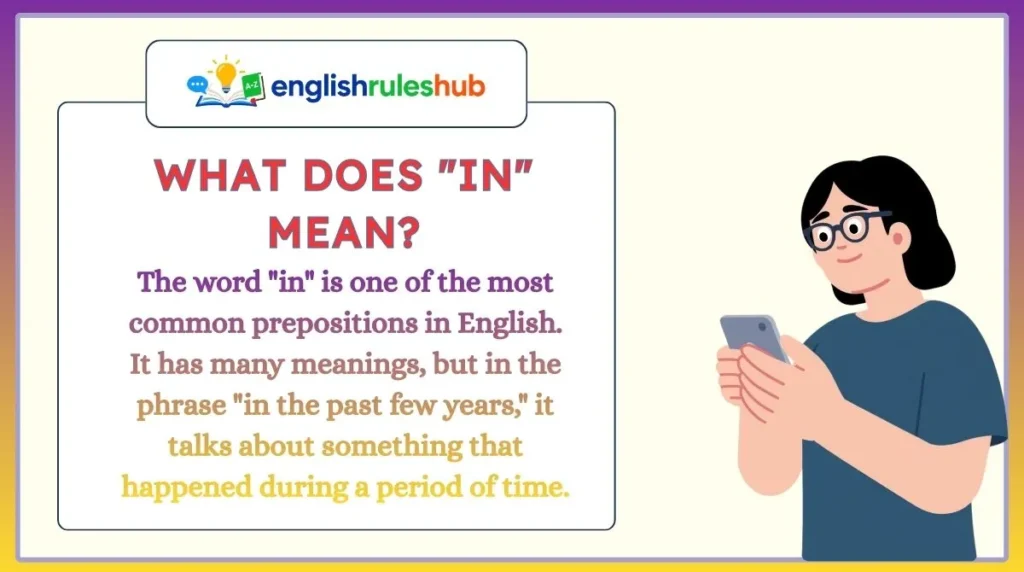
The word “in” is one of the most common prepositions in English. It has many meanings, but in the phrase “in the past few years,” it talks about something that happened during a period of time.
It points to events, actions, or changes that took place within a recent number of years leading up to the present. The exact starting point is not important. Instead, the focus is on what happened during that time.
Simple Definition
“In the past few years” means:
During the last few years until now.
It tells us that something happened sometime within that recent period.
When to Use It
Use “in the past few years” when you want to talk about:
- Things that have changed recently
- Events that happened during recent years
- Experiences from recent years
- Improvements or problems that appeared recently
- General facts about recent time
The phrase is common in both speaking and writing.
Grammar Rule
The phrase “in the past few years” usually appears with the present perfect tense because the action started in the past and is still connected to the present.
Pattern:
Subject + has/have + past participle + in the past few years.
Examples:
- She has learned a lot in the past few years.
- They have built many new schools in the past few years.
Sometimes it can also appear with other tenses if the meaning fits the context, but the present perfect is the most common choice.
Example Sentences
Here are some easy examples.
- I have made many new friends in the past few years.
- My English has improved in the past few years.
- Our town has changed a lot in the past few years.
- Scientists have discovered many new things in the past few years.
- She has become more confident in the past few years.
- Many people have started working online in the past few years.
- Technology has developed very quickly in the past few years.
- We have visited this park many times in the past few years.
Notice that every sentence talks about recent time leading up to now.
Common Learner Confusion
Many learners think “in the past few years” only means something happened one time during recent years.
That is not true.
The phrase can describe:
- One event
- Many events
- Ongoing changes
- Repeated actions
- Long-term development
For example:
- My reading skills have improved in the past few years.
This does not describe one single moment. It describes a gradual change over time.
Another mistake is using the simple past.
❌ I improved my English in the past few years.
✅ I have improved my English in the past few years.
The present perfect works better because the improvement still affects the present.
What Does “Over” Mean?
The word “over” has many meanings in English. It can mean above, across, or more than, but in the phrase “over the past few years,” it has a different meaning.
Here, “over” means during the whole period of time from the past until now.
Instead of simply saying something happened during recent years, it highlights that the action or change happened throughout that time.
Simple Definition
“Over the past few years” means:
Throughout the last few years until now.
The focus is on the entire time period rather than just events inside it.
When to Use It
Use “over the past few years” when you want to emphasize:
- Continuous change
- Progress
- Development
- Growth
- Trends
- Long-term improvement
- Ongoing situations
This phrase is especially common in:
- News articles
- Academic writing
- Business reports
- Professional presentations
It also sounds natural in everyday conversation.
Grammar Rule
Like “in the past few years,” this phrase usually goes with the present perfect tense.
Pattern:
Subject + has/have + past participle + over the past few years.
Examples:
- Sales have increased over the past few years.
- Our company has grown over the past few years.
The action is connected to the present and covers the whole period.
Example Sentences
- Our city has grown rapidly over the past few years.
- Her confidence has increased over the past few years.
- Technology has changed our lives over the past few years.
- Students have become more interested in online learning over the past few years.
- Prices have risen over the past few years.
- The company has expanded its business over the past few years.
- My pronunciation has become much better over the past few years.
- Healthcare has improved over the past few years.
These examples show changes that happened steadily during the whole period.
Common Learner Confusion
Some students believe “over the past few years” always means the action happened every day.
That is incorrect.
It simply emphasizes the time period as a whole.
For example:
- The population has increased over the past few years.
This does not mean the population increased every single day. It means there has been an overall increase during that period.
Another misunderstanding is thinking that “over” always means above or higher than.
In this grammar expression, “over” has nothing to do with physical position.
Instead, it means during or throughout a period of time.
Difference Between “In the Past Few Years” and “Over the Past Few Years”
Both phrases talk about recent years leading up to the present, so they are often interchangeable. However, there is a small difference in emphasis.
| Feature | In the Past Few Years | Over the Past Few Years |
|---|---|---|
| Basic meaning | During recent years | Throughout recent years |
| Focus | Events within the time period | Changes across the whole period |
| Emphasis | Time when something happened | Progress or development over time |
| Common tense | Present perfect | Present perfect |
| Everyday speaking | Very common | Very common |
| Formal writing | Common | Slightly more common |
| Sounds more continuous | Sometimes | Yes |
Usage Difference
The biggest difference is emphasis.
When you say:
I have read many books in the past few years.
You simply mean that you read many books during recent years.
When you say:
I have become a much better reader over the past few years.
You emphasize the progress that happened across the whole period.
The first sentence focuses on the activity.
The second sentence focuses on gradual improvement.
Grammar Logic
Both expressions describe a time period that starts in the past and continues until now.
That is why they commonly appear with:
- Present perfect
- Present perfect continuous
Examples:
- She has worked hard in the past few years.
- She has worked hard over the past few years.
Both are correct.
However, if you want to stress continuous development, “over” often sounds a little more natural.
For example:
- The internet has changed dramatically over the past few years.
Here, “over” highlights the gradual change from the beginning of the period until today.
Sentence Structure Difference
The grammar pattern is almost identical.
In the past few years
Subject + has/have + past participle + in the past few years
Example:
- Our school has added new classrooms in the past few years.
Over the past few years
Subject + has/have + past participle + over the past few years
Example:
- Our school has grown quickly over the past few years.
Only the preposition changes. The sentence structure remains the same.
Meaning Comparison
Compare these examples.
In the past few years, I have traveled to five countries.
The sentence reports experiences during recent years.
Over the past few years, I have become more confident while traveling.
The sentence highlights personal growth during the entire period.
Another comparison:
Many restaurants have opened in the past few years.
Focus: new restaurants appeared.
The food industry has changed over the past few years.
Focus: the industry’s overall development.
Although both phrases often work in similar situations, choosing the right one helps your English sound more natural and more precise.
Grammar Rules You Must Remember
Rule #1: Use the Present Perfect for Recent Time Connected to the Present
The most common tense with both phrases is the present perfect because the action started in the past but still matters now.
Example:
- I have learned many new words in the past few years.
- Our neighborhood has become safer over the past few years.
Avoid using the simple past unless the time period is completely finished.
Rule #2: Use “In” for Events During the Time Period
Choose “in the past few years” when you simply want to say something happened during recent years.
Example:
- We have watched many great movies in the past few years.
- She has met many interesting people in the past few years.
Here, the focus is on the events, not on continuous progress.
Rule #3: Use “Over” to Emphasize Change or Development
Use “over the past few years” when talking about gradual improvement, growth, or long-term change.
Example:
- My writing has improved over the past few years.
- The company has expanded over the past few years.
The reader naturally thinks about progress across the entire period.
Rule #4: Both Expressions Usually Refer to Time Up to the Present
Both phrases connect the past with now. They are not normally used for a completely finished period that has no connection to the present.
Example:
- Scientists have made important discoveries over the past few years.
- Our family has created many happy memories in the past few years.
These actions still matter today, which is why the present perfect fits so well.
Common Mistakes Students Make
Even advanced learners sometimes confuse “in the past few years” and “over the past few years.” The good news is that most mistakes are easy to fix once you understand the meaning behind each phrase.
Mistake #1: Using the Simple Past Instead of the Present Perfect
The biggest mistake is choosing the wrong tense.
❌ I improved my English in the past few years.
✅ I have improved my English in the past few years.
The present perfect is the better choice because the improvement started in the past and is still true today.
Another example:
❌ She learned a lot over the past few years.
✅ She has learned a lot over the past few years.
Mistake #2: Thinking Both Phrases Always Mean Exactly the Same Thing
The two expressions are very close in meaning, but they do not always sound the same.
Compare these sentences:
- Many new shops have opened in the past few years.
- The shopping area has changed over the past few years.
The first sentence talks about events that happened during the time.
The second sentence highlights the overall change during the whole period.
Mistake #3: Using “Over” When Talking About One Short Event
Remember that “over” often suggests development across time.
Less natural:
❌ I lost my keys over the past few years.
Better:
✅ I have lost my keys several times in the past few years.
If you are talking about repeated events or something that happened during the period, “in” usually sounds more natural.
Mistake #4: Forgetting That the Time Continues Until Now
These expressions usually connect the past with the present.
Wrong:
❌ I graduated over the past few years.
Better:
✅ I have gained many useful skills over the past few years.
Graduation happened at one finished moment, but gaining skills is a process that continued.
Easy Correction Tips
Keep these simple tips in mind.
- Use have/has + past participle most of the time.
- Choose in for events during the time.
- Choose over for gradual change.
- Think about whether the action still matters today.
If the answer is yes, the present perfect is probably the correct tense.
Easy Trick to Remember the Difference
Many students try to memorize grammar rules. A simple memory trick is much easier.
Think about these two words:
In = Inside
Imagine a box. The box is the last few years.
Anything that happened inside that box can be described with in the past few years.
Example:
- I have read many books in the past few years.
The books were read during that time.
Now think about another picture.
Over = Across
Imagine walking across a bridge.
You start at one side and move all the way to the other side.
That is how over the past few years works.
It shows something that developed or changed across the whole period.
Example:
- My confidence has grown over the past few years.
The growth happened little by little.
Another Simple Way to Remember
Ask yourself one question.
Am I talking about events or progress?
If the answer is events, in is often the better choice.
If the answer is progress, over is often the more natural choice.
This trick is not a strict grammar rule, but it helps many English learners choose the right phrase quickly.
Daily Life Examples
Here are some everyday conversations where native speakers naturally use these expressions.
Example 1
A: Your English is excellent now.
B: Thanks. I have practiced every day over the past few years.
Example 2
A: Have you traveled much?
B: Yes. I have visited four countries in the past few years.
Example 3
A: Your city looks different.
B: It has grown a lot over the past few years.
Example 4
A: Why are there so many new cafés?
B: Many businesses have opened in the past few years.
Example 5
A: You seem much happier now.
B: My life has changed a lot over the past few years.
Example 6
Teacher: Have your grades improved?
Student: Yes. I have studied much harder in the past few years.
Example 7
A: Why is everyone using online shopping?
B: People’s shopping habits have changed over the past few years.
Example 8
A: Do you know many people here?
B: I have met lots of friendly neighbors in the past few years.
Example 9
A: Why is this company so successful?
B: It has expanded into many countries over the past few years.
Example 10
A: Have you learned any new hobbies?
B: Yes. I have started gardening and painting in the past few years.
These examples show that both expressions are natural. The choice depends on what you want to emphasize.
Practice Section
Choose the best answer.
1.
My computer skills have improved ________.
A. in the past few years
B. over the past few years
2.
We have visited this museum several times ________.
A. in the past few years
B. over the past few years
3.
Technology has changed a lot ________.
A. in the past few years
B. over the past few years
4.
She has made many new friends ________.
A. in the past few years
B. over the past few years
5.
Our town has developed rapidly ________.
A. in the past few years
B. over the past few years
Answers
- B – The sentence talks about gradual improvement.
- A – It refers to repeated events during the time.
- B – It emphasizes overall change.
- A – It describes experiences during the period.
- B – It highlights development across time.
FAQs
What is the difference between “in the past few years” and “over the past few years”?
Both expressions refer to recent years leading up to the present. “In the past few years” usually focuses on events or experiences during that period, while “over the past few years” often emphasizes gradual change, growth, or development throughout the whole period.
Can we use “in the past few years” and “over the past few years” with the present perfect tense?
Yes. The present perfect is the most common tense with both expressions because it connects past actions with the present. It shows that the action or change is still important now.
Can we use these phrases in questions?
Yes. They are very common in questions.
Examples:
- Have you traveled much in the past few years?
- How has your life changed over the past few years?
Both questions sound natural.
Is “over the past few years” more formal?
Not necessarily. Both phrases are used in everyday English. However, “over the past few years” appears a little more often in news reports, business writing, academic articles, and formal presentations because it highlights long-term trends.
Which phrase is better for spoken English?
Both are common in conversations. Native speakers choose the one that best matches the meaning they want to express. If you are talking about experiences, “in the past few years” is often preferred. If you are describing change or progress, “over the past few years” usually sounds more natural.
Can I use the two expressions interchangeably?
In many situations, yes. However, if you want to emphasize gradual development across the entire time period, “over the past few years” is usually the stronger choice. If you simply mean something happened during recent years, “in the past few years” fits better.
Final Conclusion
English has many expressions that look almost identical but carry slightly different meanings. “In the past few years” and “over the past few years” are perfect examples.
Both refer to a recent period that continues up to the present, and both are commonly used with the present perfect tense.
The easiest way to remember the difference is to think about the focus of your sentence.
If you are talking about events, experiences, or actions that happened during recent years, “in the past few years” is usually the natural choice.
If you want to highlight continuous change, progress, growth, or development throughout the whole period, “over the past few years” is often the better option.
Don’t worry if you mix them up at first. Even experienced English learners need practice with small grammar differences.
The more you read, listen, speak, and write, the more natural these expressions will become.
Keep practicing with your own sentences, and soon you’ll be able to choose the right phrase confidently in everyday English.

I am Benjamin Clark, an English language writer passionate about simplifying grammar, vocabulary, and word meanings. I create clear, accurate, and practical content to help learners improve their English skills with confidence every day.