English learners often become confused when two phrases have almost the same meaning. “Strongly recommend” and “highly recommend” are a good example.
Both phrases are common in English, and both can be used when you want to tell someone that you think something is a very good choice.
The confusion usually comes from one simple question: Which phrase sounds more natural?
Should you say, “I strongly recommend this book,” or “I highly recommend this book”? Is one grammatically correct while the other is wrong?
The good news is that both expressions are correct. They are widely used by native English speakers, but they have slightly different feelings and common uses.
“Highly recommend” often sounds like a very positive recommendation. It is especially common when talking about books, movies, restaurants, products, services, courses, and experiences.
“Strongly recommend” can also show a very positive recommendation, but it often gives a stronger feeling of firm advice or personal insistence.
Understanding this small difference can make your English sound much more natural.
You will know which phrase fits better when you are giving advice, writing a review, talking with friends, or recommending something at work.
By the end, you will understand the meaning, grammar, sentence structure, tone, and everyday use of both expressions.
What Does “Strongly Recommend” Mean?
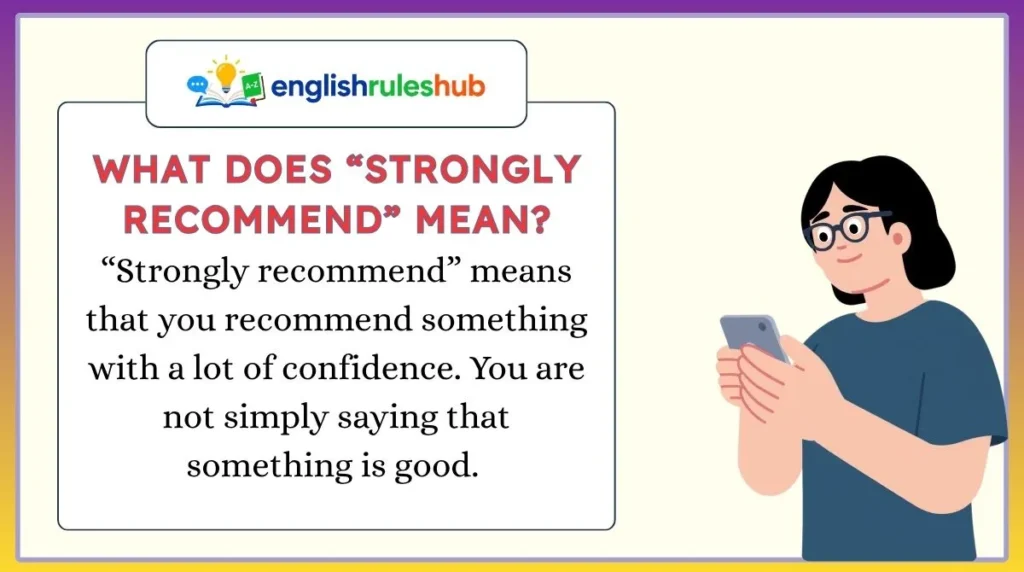
“Strongly recommend” means that you recommend something with a lot of confidence. You are not simply saying that something is good. You are giving a recommendation that you believe is important, serious, or worth following.
The word strongly is an adverb. It tells us how strongly you recommend something.
For example:
I strongly recommend this restaurant.
This means:
I really think you should try this restaurant.
The speaker has a strong positive opinion.
The phrase can be used when you are giving advice about a product, place, person, activity, course, book, service, or decision.
When Do We Use “Strongly Recommend”?
We often use strongly recommend when our recommendation is firm.
Imagine that your friend is looking for a good English grammar book. You have used one yourself and found it very helpful. You might say:
I strongly recommend this grammar book.
You are not just saying, “It is okay.” You are saying that you really believe it is a good choice.
It can also be useful when someone needs advice about an important decision.
I strongly recommend that you arrive early.
Here, the speaker is giving firm advice.
Another common structure is:
strongly recommend + noun
I strongly recommend this hotel.
You can also use:
strongly recommend + -ing
I strongly recommend visiting the museum.
And:
strongly recommend + that + clause
I strongly recommend that you check the details first.
Examples of “Strongly Recommend”
- I strongly recommend this book to beginners.
- She strongly recommended the new restaurant downtown.
- We strongly recommend booking your ticket early.
- My teacher strongly recommended that I practice every day.
- I strongly recommend watching this movie.
- The doctor strongly recommended regular exercise.
- They strongly recommend that visitors carry water.
- I strongly recommend this course if you want to improve your English.
Notice that these examples have a common idea: the speaker has a firm opinion.
A Common Learner Confusion
Some learners think strongly recommend means that the thing being recommended is physically strong or powerful. That is not the meaning.
The word “strongly” describes the strength of the recommendation, not the thing itself.
Compare:
This is a strong product.
Here, “strong” describes the product.
But:
I strongly recommend this product.
Here, “strongly” describes how strongly the speaker recommends it.
That small grammar difference is important.
What Does “Highly Recommend” Mean?
“Highly recommend” means that you recommend something very positively. You think it is excellent, very good, or worth trying.
The word highly is an adverb. In this expression, it gives the idea of a recommendation with a high level of approval.
For example:
I highly recommend this restaurant.
This means:
I think this restaurant is very good, and I think you should try it.
“Highly recommend” is extremely common in everyday English, especially in reviews and personal recommendations.
You may see it in comments about hotels, restaurants, books, movies, teachers, products, websites, courses, and travel experiences.
When Do We Use “Highly Recommend”?
Use highly recommend when you want to give a strong positive opinion.
For example:
I highly recommend this hotel.
This sounds natural when someone is telling another person about a good hotel.
You can also use it when reviewing something online:
I highly recommend this product. The quality is excellent.
It is also common in professional English:
We highly recommend this candidate for the position.
Here, the company or person is giving a very positive opinion about the candidate.
Common Grammar Structures
You can use:
highly recommend + noun
I highly recommend this book.
You can also use:
highly recommend + -ing
I highly recommend visiting the old city.
And:
highly recommend + that + clause
I highly recommend that you read the instructions.
Another useful structure is:
highly recommended
This is the passive form.
This hotel is highly recommended by travelers.
Here, “highly recommended” means that many people have a very positive opinion of the hotel.
Examples of “Highly Recommend”
- I highly recommend this English course.
- She highly recommended the new coffee shop.
- We highly recommend this book for young learners.
- I highly recommend trying the local food.
- My friend highly recommended this movie.
- The hotel is highly recommended by visitors.
- I highly recommend this teacher.
- They highly recommend booking in advance.
The phrase often sounds warm, positive, and enthusiastic.
A Common Learner Confusion
Learners sometimes think “highly recommend” is grammatically unusual because high usually refers to physical position.
For example:
The plane is flying high.
But “highly” has many other meanings. In expressions such as highly recommended, it means very positively or to a great degree.
So:
I highly recommend it.
is completely natural English.
Difference Between Strongly Recommend and Highly Recommend
The most important point is this:
Both “strongly recommend” and “highly recommend” are correct.
In many everyday situations, they can be used almost interchangeably.
For example:
I strongly recommend this book.
and:
I highly recommend this book.
Both tell the listener that the speaker has a very positive opinion of the book.
However, there is a small difference in tone and emphasis.
| Expression | Main idea | Common feeling | Common situations |
|---|---|---|---|
| Strongly recommend | Give a firm recommendation | Strong, serious, firm | Advice, warnings, important decisions |
| Highly recommend | Give a very positive recommendation | Positive, enthusiastic | Reviews, products, services, places |
| Strongly recommended | A firm recommendation is given | Formal or firm | Instructions, professional advice |
| Highly recommended | Something receives very positive approval | Positive, complimentary | Reviews, advertisements, professional writing |
“Strongly Recommend” Focuses on the Strength of Your Advice
When you say:
I strongly recommend that you save a copy.
you are emphasizing the importance of your advice.
It can sound like:
This is something I really think you should do.
For this reason, “strongly recommend” works especially well when the speaker wants the listener to take an action.
For example:
I strongly recommend that you check your passport before traveling.
The speaker is giving firm advice.
“Highly Recommend” Focuses on Positive Approval
When you say:
I highly recommend this hotel.
the main idea is that you have a very positive opinion of the hotel.
It sounds similar to:
This hotel is excellent. I think you should stay there.
That is why “highly recommend” is extremely common in reviews.
You might write:
I highly recommend this restaurant. The food was fresh, and the staff were friendly.
The tone is positive and enthusiastic.
Are They Interchangeable?
Often, yes.
Consider:
I strongly recommend this book.
I highly recommend this book.
Both are natural.
The difference is not a strict grammar rule. Native speakers can choose either phrase depending on what they want to emphasize.
A useful way to think about it is:
Strongly = strong advice
Highly = high praise
This is not a rule that works in every possible sentence, but it is a very useful guide for learners.
Sentence Structure
Both expressions can be followed by a noun:
I strongly recommend this restaurant.
I highly recommend this restaurant.
Both can also be followed by an -ing form:
I strongly recommend taking notes.
I highly recommend taking notes.
They can also be followed by a that-clause:
I strongly recommend that you call first.
I highly recommend that you call first.
However, “strongly recommend that…” is especially natural when giving firm advice.
Meaning Comparison
Compare these two sentences:
I strongly recommend that you wear a seat belt.
This sounds like serious advice. The speaker wants you to follow the advice.
Now:
I highly recommend this seat belt.
This sounds more like a product recommendation. The speaker thinks the seat belt is a very good product.
So context can make the difference clearer.
Grammar Rules You Must Remember
Rule #1: Both “Strongly Recommend” and “Highly Recommend” Are Correct
Do not think one is grammatically wrong.
You can say:
I strongly recommend this book.
You can also say:
I highly recommend this book.
Both sentences are correct.
The choice usually depends on meaning, context, and tone, not basic grammar.
Rule #2: “Recommend” Can Be Followed by a Noun
Both adverbs can come before the verb “recommend.”
The basic pattern is:
Subject + strongly/highly + recommend + noun
Examples:
I strongly recommend this hotel.
I highly recommend this hotel.
She strongly recommended the course.
She highly recommended the course.
This is one of the easiest structures to remember.
Rule #3: Use an -ing Form After “Recommend” in This Structure
When you recommend an activity, the -ing form is often natural.
I highly recommend visiting the museum.
I strongly recommend booking early.
Avoid using “to + verb” directly after recommend in standard English.
For example:
I recommend to visit the museum.
This is generally incorrect.
Say:
I recommend visiting the museum.
Or:
I recommend that you visit the museum.
Rule #4: “Recommend That” Is Correct
You can use a full clause after recommend.
For example:
I strongly recommend that you arrive early.
You can also say:
I highly recommend that you read the instructions.
This structure is useful when the recommendation is about what someone should do.
Common Mistakes Students Make
Mistake 1: Thinking “Strongly Recommend” Is Wrong
Some learners have heard “highly recommend” more often and assume that it is the only correct expression.
That is not true.
Both are standard English:
I strongly recommend this book.
I highly recommend this book.
Correction tip: Remember that both adverbs can naturally modify “recommend.”
Mistake 2: Using “Recommend to Do”
A very common learner mistake is:
I highly recommend to visit this place.
A more natural structure is:
I highly recommend visiting this place.
Or:
I highly recommend that you visit this place.
The problem is not “highly.” The problem is the structure after recommend.
Mistake 3: Confusing “Strongly” With “Highly”
Learners sometimes believe that “strongly” must be used for negative situations and “highly” must be used for positive situations.
That is too simple.
For example:
I strongly recommend this restaurant.
is positive.
And:
I strongly recommend that you avoid this road.
is negative advice.
The word “strongly” tells us that the recommendation is firm, not whether the recommendation itself is positive or negative.
Mistake 4: Saying “Very Recommend”
Do not say:
I very recommend this book.
“Very” does not normally work this way with “recommend.”
Use:
I highly recommend this book.
or:
I strongly recommend this book.
Mistake 5: Using “Strong Recommend”
“Strong” is an adjective, while “strongly” is an adverb.
So:
I strong recommend this book.
is incorrect.
Say:
I strongly recommend this book.
The adverb strongly modifies the verb recommend.
Easy Trick to Remember the Difference
Here is a simple memory trick:
Highly = high praise.
Strongly = strong advice.
Imagine that your friend asks:
“Is that restaurant good?”
You might answer:
“Yes, I highly recommend it.”
You are giving high praise.
Now imagine your friend is going on a long trip, and you want to give important advice:
“I strongly recommend that you check your passport.”
You are giving strong advice.
Of course, the two expressions can overlap. You can say:
I strongly recommend this restaurant.
And you can say:
I highly recommend that you book early.
English is flexible, so do not try to create a rule that native speakers never break.
A better approach is to remember the usual feeling of each phrase.
When you are praising something, highly recommend is a very natural choice.
When you are stressing an important suggestion, strongly recommend is often a good choice.
Daily Life Examples
These expressions appear in everyday conversations more often than many learners realize.
Example 1: Talking About a Restaurant
Ali: Have you tried that new restaurant?
Sara: Yes. I highly recommend it. The food was great.
Here, Sara is giving a positive review.
Example 2: Giving Travel Advice
Tom: What should I do before my trip?
Mike: I strongly recommend checking your documents before you leave.
The recommendation sounds firm because the speaker wants Tom to take the advice seriously.
Example 3: Recommending a Book
Student: Which book should I read to improve my vocabulary?
Teacher: I highly recommend this one. It is easy to understand.
The focus is on the book being a very good choice.
Example 4: Recommending a Course
I highly recommend this English course. The lessons are simple and practical.
This sounds natural in a review or casual conversation.
Example 5: Giving Important Advice
I strongly recommend that you arrive at the airport early.
The speaker wants the listener to follow the advice.
Example 6: Talking About a Movie
Have you seen that movie?
Yes. I highly recommend it. It was really good.
This is a very natural conversational use.
Example 7: Recommending a Product
I highly recommend this phone. The battery lasts all day.
The speaker is giving a positive product recommendation.
Example 8: Giving Workplace Advice
I strongly recommend that we check the report again before sending it.
This sounds professional and firm.
Example 9: Talking About a Place
If you visit the city, I highly recommend the old market.
The speaker is praising the place and encouraging the listener to visit it.
Example 10: Safety or Important Advice
I strongly recommend wearing comfortable shoes for the hike.
The recommendation is firm because the speaker thinks it is important.
Practice Section
Choose strongly recommend or highly recommend in each sentence.
1. I ______ this restaurant. The food is excellent.
2. I ______ that you check your email before the meeting.
3. She ______ this book to anyone learning English.
4. We ______ booking your hotel early.
5. My teacher ______ that I practice speaking every day.
Answers
1. highly recommend
I highly recommend this restaurant. The food is excellent.
“Highly recommend” sounds very natural when praising a restaurant.
2. strongly recommend
I strongly recommend that you check your email before the meeting.
The speaker is giving firm advice.
3. highly recommend
She highly recommends this book to anyone learning English.
This is a positive recommendation about a book.
4. strongly recommend / highly recommend
Both are possible.
We strongly recommend booking your hotel early.
sounds like firm advice.
We highly recommend booking your hotel early.
also works and sounds positive and helpful.
5. strongly recommend
My teacher strongly recommended that I practice speaking every day.
The teacher is giving serious or firm advice.
FAQs
What is the difference between “strongly recommend” and “highly recommend”?
Both mean that you give a very positive or firm recommendation. Highly recommend often sounds like high praise, while strongly recommend can sound more like firm advice. In many everyday sentences, however, they are interchangeable.
Is “I strongly recommend” grammatically correct?
Yes. “I strongly recommend” is completely correct English. The adverb “strongly” modifies the verb “recommend.” For example, “I strongly recommend this book” is a natural sentence.
Is “I highly recommend” grammatically correct?
Yes. “I highly recommend” is also completely correct. It is especially common when giving a positive review or praising something. For example, “I highly recommend this restaurant” sounds very natural.
Can I use “highly recommend” in a question?
Yes, but it is more common to ask someone about their recommendation in a different way. You can say, “Would you highly recommend this hotel?” This is grammatically possible, although “Would you recommend this hotel?” is often simpler and more natural in everyday speech.
Is “strongly recommend” formal or informal?
It can be used in both formal and informal English. You can say it to a friend, but it is also common in professional writing. For example, “We strongly recommend that customers read the instructions” sounds professional.
Can I say “I recommend to visit”?
Usually, no. After “recommend,” English normally uses an -ing form or a that-clause in this type of sentence. Say, “I recommend visiting the museum” or “I recommend that you visit the museum.”
Which is better: “highly recommend” or “strongly recommend”?
Neither is always better. Choose highly recommend when you want to give strong positive praise, especially in reviews. Choose strongly recommend when you want to make your advice sound firm or important. In many situations, either one is correct.
Final Conclusion
Strongly recommend and highly recommend are both correct and useful English expressions. The difference is mainly about tone and emphasis, rather than grammar.
“Highly recommend” often feels like high praise. It is very common when talking about restaurants, hotels, books, movies, products, courses, and other things you enjoyed.
“Strongly recommend” often feels like firm advice. It works especially well when you want someone to take your suggestion seriously, such as when giving travel advice, workplace advice, or important instructions.
Still, remember that these meanings can overlap. Native speakers often use either expression without thinking about a strict difference.
The most important grammar point is what comes after recommend. Use a noun, an -ing form, or a suitable that-clause.
So instead of worrying too much about choosing the “perfect” phrase, focus on the situation.
If you are giving high praise, highly recommend is a great choice. If you want to stress firm advice, strongly recommend works beautifully.
With a little practice, both expressions will soon feel natural.

I am Benjamin Clark, an English language writer passionate about simplifying grammar, vocabulary, and word meanings. I create clear, accurate, and practical content to help learners improve their English skills with confidence every day.