Many English learners feel confused when they see the words deduce and induce. At first glance, they look almost the same.
They even sound a little alike. Because of this, many students think they have the same meaning. But they do not.
These two words are used in different situations. Deduce is about reaching a conclusion by thinking carefully. Induce is about causing something to happen or persuading someone to do something. The meanings are close only in spelling, not in use.
Understanding the difference is important because both words appear in books, news articles, science, business, and everyday conversations. If you use the wrong word, your sentence may sound strange or even change its meaning completely.
The good news is that the difference is not difficult once you learn the basic idea behind each word.
A few simple grammar rules, clear examples, and real-life situations can help you remember them for a long time.
By the end of this guide, you will know when to use deduce, when to use induce, how their grammar works, the mistakes learners often make, and easy tricks to remember the difference. After some practice, choosing the correct word will feel much easier.
What Does “Deduce” Mean?
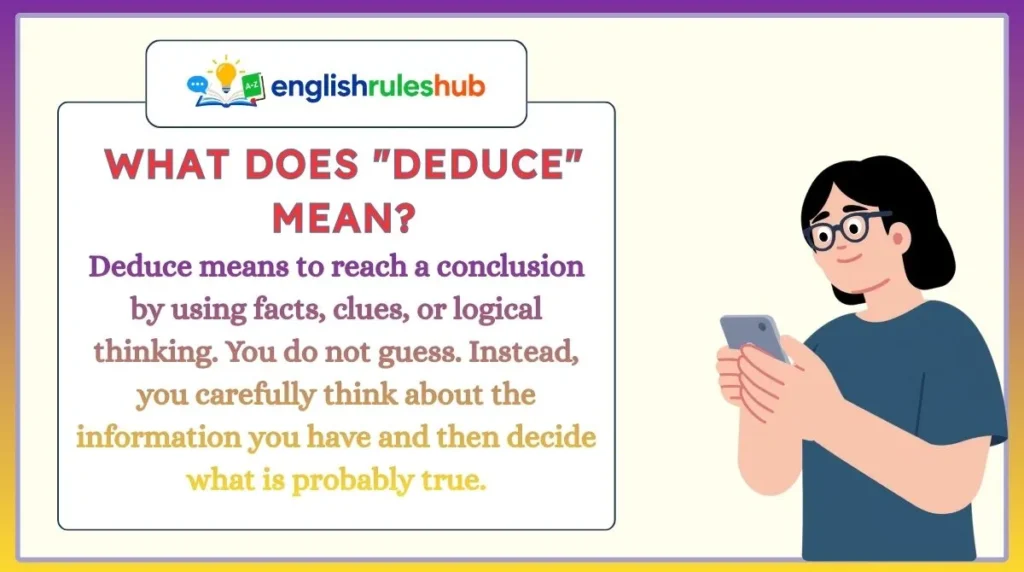
Deduce means to reach a conclusion by using facts, clues, or logical thinking. You do not guess. Instead, you carefully think about the information you have and then decide what is probably true.
Think of a detective solving a mystery. The detective looks at footprints, fingerprints, and other clues. From those clues, the detective deduces who committed the crime.
When Do We Use “Deduce”?
Use deduce when someone:
- Thinks carefully before reaching a conclusion.
- Uses evidence or facts.
- Figures something out through logic.
- Understands something without being told directly.
The idea behind deduce is “reasoning from evidence.”
Grammar Rule for “Deduce”
Deduce is a regular verb.
Basic forms:
- Base form: deduce
- Third person: deduces
- Past tense: deduced
- Past participle: deduced
- Present participle: deducing
Common sentence patterns:
- deduce + noun
- deduce that + clause
- deduce from + noun
Examples:
- I deduced the answer after reading the report.
- She deduced that someone had entered the room.
- We deduced from the evidence that the story was true.
Example Sentences Using “Deduce”
- The teacher deduced that Tom had studied hard.
- I deduced the answer from the clues.
- She deduced that the train had already left.
- We deduced the truth after hearing both sides.
- The police deduced who owned the missing bag.
- He quickly deduced the reason for the delay.
- Scientists deduced that the bones were very old.
- You can deduce a person’s mood from their facial expression.
Common Learner Confusion About “Deduce”
Many learners think deduce simply means guess.
That is not correct.
A guess has little or no evidence.
A deduction is based on facts or clues.
Compare these examples:
❌ I deduced the answer because I picked it randomly.
✅ I deduced the answer after reading all the information.
In the first sentence, there is no logical thinking. That is guessing.
In the second sentence, the speaker uses information to reach a conclusion.
Everyday Situations Where You Can Use “Deduce”
You may use deduce when:
- solving a puzzle
- reading a mystery story
- studying science
- answering exam questions
- understanding someone’s feelings
- analyzing a business report
For example:
Your friend comes to school with wet shoes and an umbrella. Nobody tells you what happened, but you deduce that it rained earlier.
Another example:
Your phone battery suddenly drops from 80% to 20%. After checking your apps, you deduce that one app has been running in the background all day.
These examples show that deduce is all about thinking carefully before reaching a conclusion.
What Does “Induce” Mean?
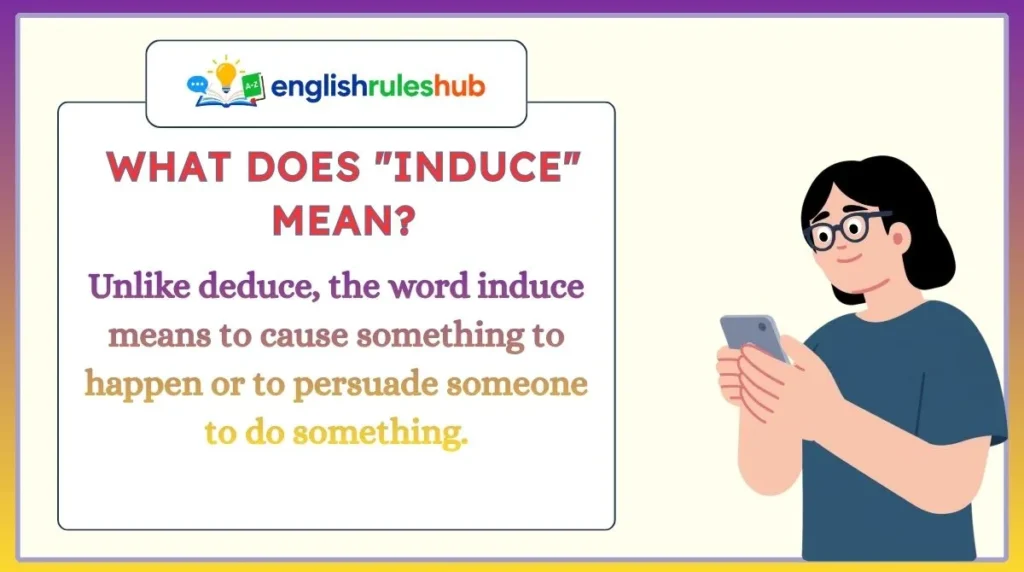
Unlike deduce, the word induce means to cause something to happen or to persuade someone to do something.
Instead of reaching a conclusion, induce is about creating an effect.
For example, medicine can induce sleep.
A manager may induce employees to work harder by offering bonuses.
Rain can induce traffic delays.
In every example, something causes another thing to happen.
When Do We Use “Induce”?
Use induce when someone or something:
- causes an action
- creates a result
- persuades another person
- brings about a condition
- produces an effect
The main idea is cause or persuade.
Grammar Rule for “Induce”
Like deduce, induce is also a regular verb.
Verb forms:
- Base form: induce
- Third person: induces
- Past tense: induced
- Past participle: induced
- Present participle: inducing
Common sentence patterns:
- induce + noun
- induce + someone + to + verb
- induce + effect/state
Examples:
- The medicine induced sleep.
- The coach induced the players to practice more.
- Stress can induce headaches.
Example Sentences Using “Induce”
- The doctor gave medicine to induce sleep.
- Good teachers induce students to ask questions.
- The company induced customers to buy more products.
- Fear can induce panic.
- Exercise can induce happiness.
- The speech induced people to volunteer.
- Bright lights may induce headaches.
- His kind words induced confidence in the team.
Common Learner Confusion About “Induce”
Many students think induce means figure out because it looks like deduce.
That is incorrect.
Compare these examples:
❌ I induced that she was unhappy.
✅ I deduced that she was unhappy.
Here, the speaker reaches a conclusion, so deduce is correct.
Now compare another sentence:
✅ The sad movie induced tears.
The movie caused tears. It did not figure them out.
That is why induce is the correct choice.
Everyday Situations Where You Can Use “Induce”
You can use induce in many real-life situations.
For example:
A relaxing song can induce sleep after a busy day.
A motivational speech can induce people to work harder.
Heavy traffic may induce stress.
Eating too much sugar can induce tooth problems.
Doctors sometimes use medicine to induce labor during childbirth.
Companies often offer discounts to induce customers to make a purchase.
In all these examples, one thing causes another thing to happen.
That simple idea makes induce much easier to remember.
Difference Between Deduce and Induce (Detailed)
Although these two words look similar, they describe completely different actions.
Deduce happens inside your mind. You study facts, clues, or evidence and then reach a logical conclusion.
Induce, on the other hand, happens when one person or thing causes another person or thing to act, feel, or change.
A simple way to think about it is this:
- Deduce = Think → Conclusion
- Induce = Cause → Result
Difference Between Deduce and Induce (Detailed)
Now that you know the basic meanings, it is time to compare these two words side by side. This is where many learners finally understand the difference clearly.
The biggest difference is simple:
- Deduce means to figure something out from evidence.
- Induce means to cause something to happen.
One involves thinking. The other involves causing.
Deduce vs Induce Comparison Table
| Feature | Deduce | Induce |
|---|---|---|
| Basic Meaning | Reach a conclusion from facts | Cause something to happen |
| Main Idea | Reasoning and thinking | Causing or persuading |
| Focus | Conclusion | Result |
| Used With | Evidence, clues, facts | Actions, feelings, conditions |
| Common Contexts | Detective work, research, analysis | Medicine, psychology, business |
| Question It Answers | “What can I figure out?” | “What caused this?” |
| Example | I deduced the answer. | The medicine induced sleep. |
Meaning Difference
Let’s look at the meanings in a very simple way.
Deduce = Figure Out
You see information.
You think about it.
You reach a conclusion.
Example:
- The streets are wet.
- People are carrying umbrellas.
- Dark clouds are in the sky.
You deduce that it rained recently.
Nobody told you directly. You used clues.
Induce = Cause
Something happens because of another thing.
Example:
- A sleeping pill causes sleep.
The pill induces sleep.
The pill creates the result.
Grammar Logic
The grammar logic behind these words is also different.
With deduce, the focus is on the person who is thinking.
Example:
- She deduced the truth.
- We deduced that he was late.
- They deduced the answer from the data.
The subject is using logic.
With induce, the focus is on the thing creating an effect.
Example:
- The medicine induced sleep.
- The speech induced confidence.
- The offer induced customers to buy.
The subject causes something else.
Sentence Structure Difference
Common Structures for Deduce
Deduce + noun
- She deduced the answer.
Deduce that + clause
- We deduced that he was lying.
Deduce from + evidence/clues
- They deduced the truth from the facts.
Common Structures for Induce
Induce + noun
- The drug induced sleep.
Induce + someone + to + verb
- The manager induced workers to stay late.
Induce + condition/result
- Stress can induce anxiety.
Notice the difference:
Deduce usually ends with a conclusion.
Induce usually ends with an action, feeling, or result.
Side-by-Side Examples
Look at these sentence pairs carefully.
Example 1
✅ I deduced that he was tired.
(After observing him.)
✅ The long journey induced tiredness.
(The journey caused tiredness.)
Example 2
✅ The detective deduced who stole the money.
(The detective figured it out.)
✅ The criminal induced fear in the town.
(The criminal caused fear.)
Example 3
✅ Scientists deduced the cause of the problem.
(They reached a conclusion.)
✅ The chemical induced a reaction.
(The chemical caused a reaction.)
Example 4
✅ We deduced that the store was closed.
(We reached this conclusion.)
✅ Bad weather induced delays.
(The weather caused delays.)
A Quick Test
Which word fits?
“The teacher looked at the student’s work and _____ that he understood the lesson.”
Answer: deduced
Why?
The teacher reached a conclusion.
Now try this:
“The teacher’s encouragement _____ the student to work harder.”
Answer: induced
Why?
The encouragement caused the action.
These examples show the real difference between the two words.
Grammar Rules You Must Remember
A few grammar rules can help you avoid mistakes and use these words correctly every time.
Rule #1: Use “Deduce” for Conclusions
If someone reaches a conclusion using facts or clues, use deduce.
Examples:
- I deduced the answer from the evidence.
- She deduced that something was wrong.
- We deduced the truth after reading the report.
Remember:
Evidence → Conclusion = Deduce
Rule #2: Use “Induce” for Causes and Effects
If something causes a result, use induce.
Examples:
- The medicine induced sleep.
- Stress can induce headaches.
- The speech induced excitement.
Remember:
Cause → Result = Induce
Rule #3: “Induce” Often Uses “Someone to Do Something”
A common structure is:
induce + someone + to + verb
Examples:
- The coach induced the team to practice harder.
- The advertisement induced customers to buy.
- The reward induced workers to finish early.
This structure is very common in formal English.
Rule #4: “Deduce” Often Uses “From”
Many sentences use:
deduce + something + from + evidence
Examples:
- We deduced the answer from the clues.
- She deduced his age from the records.
- They deduced the cause from the data.
The word from often appears because deductions come from evidence.
Common Mistakes Students Make
Because the words look alike, students often mix them up.
Here are the most common errors.
Mistake #1: Using “Induce” Instead of “Deduce”
❌ I induced that she was upset.
✅ I deduced that she was upset.
Why?
The speaker reached a conclusion.
No one caused anything.
Correction Tip
Ask yourself:
“Am I figuring something out?”
If yes, use deduce.
Mistake #2: Using “Deduce” Instead of “Induce”
❌ The medicine deduced sleep.
✅ The medicine induced sleep.
Why?
The medicine caused sleep.
It did not reach a conclusion.
Correction Tip
Ask yourself:
“Is something creating a result?”
If yes, use induce.
Mistake #3: Confusing Guessing with Deducing
❌ I deduced the answer randomly.
✅ I guessed the answer randomly.
Why?
A deduction needs evidence.
Random choices are guesses.
Correction Tip
No clues = guess.
Clues and reasoning = deduce.
Mistake #4: Forgetting the “to + verb” Pattern
❌ The reward induced workers work harder.
✅ The reward induced workers to work harder.
The correct structure is:
induce + someone + to + verb
Correction Tip
Always remember the word to before the verb.
Mistake #5: Thinking the Words Are Interchangeable
Many learners believe both words mean the same thing because they look similar.
They do not.
Compare:
✅ I deduced the answer.
✅ The teacher induced confidence.
The meanings are completely different.
Easy Correction Tip
Think:
- Deduce = discover
- Induce = cause
This simple idea prevents many mistakes.
Easy Trick to Remember the Difference
Memory tricks can make learning much easier.
Here is a simple one that many students find helpful.
Deduce = Detective
Notice that both words start with D.
D = Detective
A detective studies clues and reaches conclusions.
A detective deduces.
Example:
- The detective deduced who stole the bike.
Whenever you see deduce, imagine a detective solving a mystery.
Induce = Influence
Notice that both words start with I.
I = Influence
When you influence someone, you cause them to do something.
That is very close to the meaning of induce.
Example:
- The speech induced people to donate money.
The speech influenced people.
One-Sentence Memory Trick
Detectives deduce. Influences induce.
This short sentence helps many learners remember the difference instantly.
Real-Life Logic
Imagine two friends.
Friend A looks at clues and figures something out.
Friend A deduces.
Friend B persuades people to act.
Friend B induces.
One thinks.
One causes.
That is the key difference.
Practice Section
Now it’s your turn. Read each sentence and choose the correct word: deduce or induce.
Question 1
The doctor gave the patient medicine to ______ sleep.
A. deduce
B. induce
Answer: B. induce
Why? The medicine causes sleep, so induce is the correct choice.
Question 2
After reading the email carefully, I could ______ that the meeting had been canceled.
A. deduce
B. induce
Answer: A. deduce
Why? You reached a conclusion by using the information in the email.
Question 3
The exciting speech ______ many students to join the volunteer program.
A. deduce
B. induce
Answer: B. induce
Why? The speech caused the students to take action.
Question 4
The detective ______ from the footprints that only one person had entered the house.
A. deduced
B. induced
Answer: A. deduced
Why? The detective used clues to reach a conclusion.
Question 5
Too much stress can ______ health problems.
A. deduce
B. induce
Answer: B. induce
Why? Stress causes health problems.
Bonus Practice
Choose the correct word.
- We ______ that the shop was closed because all the lights were off.
- The teacher’s kind words ______ confidence in the students.
- I ______ from the report that sales had increased.
- The movie ______ strong emotions.
- Scientists ______ the age of the fossils from careful testing.
Answers
- deduced
- induced
- deduced
- induced
- deduced
If you answered all five correctly, you are already using these words much more confidently.
Frequently Asked Questions (FAQs)
What is the difference between deduce and induce?
The main difference is their meaning. Deduce means to reach a conclusion by using facts, clues, or logical thinking. Induce means to cause something to happen or persuade someone to do something. One is about thinking, while the other is about causing an effect.
Can deduce and induce be used in everyday English?
Yes, but they are used in different situations. Deduce often appears when people talk about solving problems, understanding clues, or making logical conclusions. Induce is common when talking about causes, medicine, science, business, and persuasion.
Can I use deduce in questions?
Yes. Here are some examples:
- Can you deduce the answer from these clues?
- How did you deduce that he was telling the truth?
- What can we deduce from the report?
These questions ask someone to explain how they reached a conclusion.
Is induce formal or informal?
Induce is generally more formal than many everyday verbs like cause or make. You will often see it in medical, scientific, legal, academic, and business writing. However, it is still correct in normal English conversations when it fits the meaning.
Can deduce and guess mean the same thing?
Not exactly. A guess is made without much evidence. Deduce means using facts, clues, or careful thinking to reach a conclusion. Every deduction involves reasoning, but not every guess does.
For example:
- Guess: I think the answer is B.
- Deduce: I read the passage carefully and deduced that the answer is B.
Why do learners confuse deduce and induce?
The two words have similar spelling and pronunciation, so they are easy to mix up. The best way to remember them is to focus on their meanings. Deduce is about finding the answer, while induce is about creating an effect or influencing someone.
Final Conclusion
Although deduce and induce look alike, their meanings are very different. Deduce means to reach a conclusion by using facts, evidence, or logical thinking.
Induce means to cause something to happen or persuade someone to act. Once you understand this simple difference, choosing the correct word becomes much easier.
A helpful way to remember them is this: deduce is connected with a detective who studies clues and finds the truth, while induce is connected with influence, where one thing causes another thing to happen. This small memory trick can help you avoid many common mistakes.
The best way to master these words is through regular practice. Try using deduce when you explain how you reached a conclusion and induce when you describe something that caused an action or result.
Read English books, watch videos, and make your own example sentences. The more you see these words in real situations, the more natural they will become.
Before long, you will be able to use both words confidently and correctly in your speaking and writing.

I am Benjamin Clark, an English language writer passionate about simplifying grammar, vocabulary, and word meanings. I create clear, accurate, and practical content to help learners improve their English skills with confidence every day.