Many English learners stop for a second when they want to congratulate someone. Should you say “Congratulations on your new job” or “Congratulations for your new job”? Both sound possible, so why is one much more common than the other?
This is one of those small grammar points that causes a lot of confusion. You may hear different versions in conversations, read different examples online, or even see both used on social media. That makes it hard to know which one is correct.
The good news is that the rule is not difficult. Once you understand the meaning behind each preposition, choosing the right one becomes much easier. A simple grammar rule can help you avoid this mistake forever.
Whether you are writing an email, sending a text message, speaking with friends, or taking an English exam, using the correct preposition makes your English sound more natural and fluent.
Native speakers almost always follow the same pattern when they congratulate someone.
By the end of this guide, you will understand when to use “congratulations on,” when “congratulations for” is possible, why learners confuse them, common mistakes to avoid, and plenty of real-life examples that you can start using today.
What Does “On” Mean?
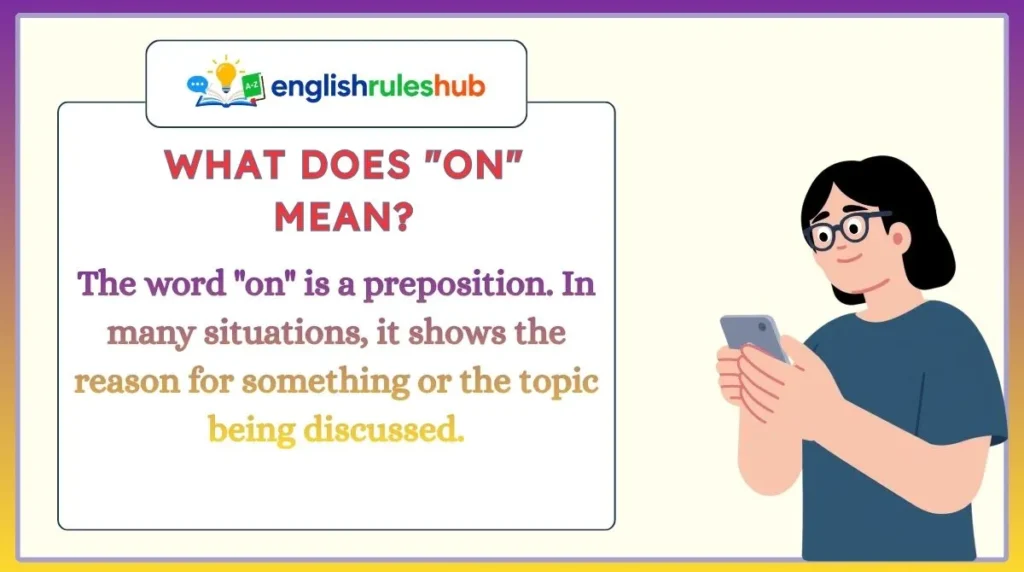
The word “on” is a preposition. In many situations, it shows the reason for something or the topic being discussed.
When we say “Congratulations on…”, we are talking about the achievement, success, event, or good news that someone has experienced.
This is the standard and most natural expression in modern English.
Grammar Rule
Congratulations + on + noun / noun phrase / verb (-ing)
This pattern is used after almost every type of achievement or happy event.
Examples
- Congratulations on your promotion.
- Congratulations on your graduation.
- Congratulations on winning the competition.
- Congratulations on your wedding.
- Congratulations on passing the driving test.
- Congratulations on your new house.
- Congratulations on becoming a father.
- Congratulations on finishing your project.
Each sentence tells us what the congratulations are about.
When to Use “On”
Use on after congratulations for:
- Passing an exam
- Getting a new job
- Winning a prize
- Buying a house
- Getting married
- Having a baby
- Finishing a difficult task
- Receiving an award
- Starting a business
- Completing a degree
Common Learner Confusion
Many learners think for sounds better because they often use for to show a reason.
For example:
- Thank you for your help.
- Sorry for being late.
Because of these patterns, learners naturally try to say:
❌ Congratulations for your success.
However, English treats congratulations differently. The normal expression uses on instead.
What Does “For” Mean?
The preposition “for” usually shows purpose, benefit, reason, or intended use.
Examples include:
- This gift is for you.
- Thank you for coming.
- I paid for dinner.
- This medicine is for headaches.
When people ask about “congratulations for,” the answer is a little more interesting.
Grammar Rule
After the word congratulations, for is not normally used to introduce the achievement.
Instead, for may appear later in the sentence to explain why someone deserves congratulations or as part of another grammatical structure.
Examples
- Congratulations for all the hard work you put into this project. (Less common than “on.”)
- We congratulated her for helping the community.
- Everyone praised him for his honesty.
Notice something important.
The verb congratulate someone for doing something appears more often than the noun congratulations for something.
Compare these:
- I congratulate you for never giving up. ✔ (possible)
- Congratulations on never giving up. ✔ (more common)
- Congratulations for your promotion. ✘ (unnatural)
Common Learner Confusion
Students often think that the noun congratulations follows the same grammar as the verb congratulate.
But English does not always work that way.
Compare these patterns:
- I congratulated him on his success.
- I congratulated him for helping others. (possible in certain contexts)
- Congratulations on your success.
- Congratulations for your success. ✘
That small difference causes confusion for many learners.
Difference Between “On” and “For” (Detailed)
The easiest way to understand the difference is to remember that “on” introduces the achievement, while “for” usually introduces the reason behind an action.
| Feature | Congratulations on | Congratulations for |
|---|---|---|
| Common in modern English | Yes | Rare |
| Sounds natural | Yes | Usually no |
| Used after achievements | Yes | Usually no |
| Used after events | Yes | Usually no |
| Used by native speakers | Very often | Very rarely |
| Best choice in writing | Yes | No |
Usage Difference
Use on when mentioning:
- Success
- Achievement
- Milestone
- Good news
- Happy event
Examples:
- Congratulations on your baby.
- Congratulations on your new home.
- Congratulations on your excellent grades.
Use for only in limited situations, usually after the verb congratulate, especially when praising someone’s action.
Example:
- I congratulated her for standing up for the truth.
Grammar Logic
Think about the sentence this way:
Congratulations on + achievement
The achievement is the topic of the congratulations.
Examples:
- Congratulations on your success.
- Congratulations on winning.
- Congratulations on graduating.
Sentence Structure Difference
Pattern 1:
Congratulations + on + noun
Example:
- Congratulations on your promotion.
Pattern 2:
Congratulate + someone + for + action
Example:
- I congratulated him for helping the elderly.
Although this second pattern exists, many native speakers still prefer on in many situations.
Meaning Comparison
Compare these sentences.
Congratulations on winning the race.
This simply celebrates the victory.
I congratulated her for helping the injured runner.
Here, the focus is not on winning. The focus is on the kind action.
That is why the prepositions change.
Grammar Rules You Must Remember
Rule #1: Use “Congratulations on” for achievements
Correct:
- Congratulations on your graduation.
- Congratulations on your promotion.
Wrong:
- Congratulations for your graduation.
Rule #2: Use “On” before nouns or -ing verbs
Correct:
- Congratulations on finishing the report.
- Congratulations on buying your first car.
Rule #3: The verb “Congratulate” may sometimes use “For”
Examples:
- I congratulated him for helping the children.
- She congratulated me for staying calm.
Even so, many grammar experts still prefer on after congratulate when referring to achievements.
Rule #4: Learn the common expression as a fixed phrase
Native speakers almost automatically say:
- Congratulations on your success.
- Congratulations on your marriage.
- Congratulations on your new job.
Treat this pattern as one complete expression.
Common Mistakes Students Make
English learners often make these mistakes because they translate directly from their own language.
Mistake 1
❌ Congratulations for your birthday.
✔ Congratulations on your birthday.
Mistake 2
❌ Congratulations for passing the exam.
✔ Congratulations on passing the exam.
Mistake 3
❌ Congratulations for your new house.
✔ Congratulations on your new house.
Mistake 4
❌ Congratulations for your marriage.
✔ Congratulations on your marriage.
Mistake 5
❌ Congratulations for winning.
✔ Congratulations on winning.
Why Do These Mistakes Happen?
There are several reasons.
- Learners translate from their native language.
- They confuse for with thank you for.
- They mix the noun congratulations with the verb congratulate.
- They hear incorrect English online.
Easy Correction Tips
- Remember the fixed phrase Congratulations on…
- Read authentic English examples.
- Listen to native speakers.
- Practice writing your own sentences every day.
Easy Trick to Remember the Difference
Here is a simple memory trick.
Think of “on” as sitting on top of an achievement.
When someone reaches a success, your congratulations land on that success.
Example:
Someone gets promoted.
Your congratulations go on the promotion.
Now think about for.
The word for often explains why someone deserves praise.
Example:
I thanked her for helping.
I praised him for being honest.
So remember:
- On = achievement
- For = reason or action
This small trick helps many students remember the rule.
Daily Life Examples
These are the kinds of sentences people actually say every day.
- Congratulations on your new job!
- Congratulations on your beautiful baby.
- Congratulations on passing your driving test.
- Congratulations on buying your first apartment.
- Congratulations on your engagement.
- Congratulations on winning first place.
- Congratulations on completing your master’s degree.
- Congratulations on your excellent presentation.
- Congratulations on reaching one million subscribers.
- Congratulations on opening your new business.
Short Conversation 1
Sarah: I finally passed my exam.
Emma: Congratulations on passing! I knew you could do it.
Short Conversation 2
Ali: We bought our first house.
David: Congratulations on your new home!
Short Conversation 3
Teacher: You scored the highest marks.
Student: Thank you.
Teacher: Congratulations on your excellent work.
Short Conversation 4
Friend: I got promoted yesterday.
You: Congratulations on your promotion! You deserve it.
Practice Section
Choose the correct answer.
1.
Congratulations _____ your graduation.
A. on
B. for
Answer: A
2.
Congratulations _____ winning the match.
A. on
B. for
Answer: A
3.
I congratulated him _____ helping the lost child.
A. on
B. for
Answer: B (possible and acceptable in this context)
4.
Congratulations _____ your new car.
A. on
B. for
Answer: A
5.
Congratulations _____ passing your interview.
A. on
B. for
Answer: A
FAQs
What is the difference between “congratulations on” and “congratulations for”?
Congratulations on is the normal and natural expression used for achievements, success, and happy events. Congratulations for is uncommon after the noun congratulations and is rarely the best choice.
Is “Congratulations for your success” correct?
Not usually. Native English speakers almost always say Congratulations on your success because on is the standard preposition after congratulations.
Can we use “congratulate someone for”?
Yes, sometimes. It is possible when talking about praising someone’s action, especially in certain contexts. However, congratulate someone on something is still more common for achievements.
Is “Congratulations on” formal or informal?
It works in both formal and informal English. You can use it in emails, speeches, greeting cards, business messages, and everyday conversations.
Can “Congratulations on” be used with verbs?
Yes. Use the -ing form of the verb.
Examples:
- Congratulations on winning.
- Congratulations on finishing your work.
- Congratulations on getting your license.
Why do learners confuse “on” and “for”?
The confusion happens because many other English expressions use for, such as thank you for, sorry for, and famous for. Learners naturally try to use the same pattern with congratulations, but English uses on instead.
Final Conclusion
Choosing between “congratulations on” and “congratulations for” is much easier once you know the basic grammar rule.
In almost every everyday situation, “Congratulations on” is the correct and natural expression.
It is the phrase native English speakers use when talking about achievements, milestones, happy events, and personal success.
The word “for” has its own place in English, but it usually does not follow the noun congratulations when you are celebrating someone’s achievement.
Instead, it is more commonly used in other grammar patterns or occasionally with the verb congratulate to emphasize the reason for praise.
The best way to remember the difference is simple: celebrate achievements with “on.” Practice this pattern whenever someone gets a new job, passes an exam, wins a competition, gets married, or reaches an important goal.
The more you use it in real conversations, the more natural it will feel. With regular practice, this common grammar question will soon become one of the easiest parts of your English.

I am Benjamin Clark, an English language writer passionate about simplifying grammar, vocabulary, and word meanings. I create clear, accurate, and practical content to help learners improve their English skills with confidence every day.