English is full of words that look different but have the same meaning. One pair that often confuses learners is humour and humor.
Many students wonder which spelling is correct. Some think one word is wrong, while others believe they have different meanings. The truth is much simpler than that.
You may read humour in a British book but see humor on an American website. This can make learners feel unsure about which spelling to use in school, exams, emails, or everyday writing.
If you are learning English as a second language, this small spelling difference can seem much bigger than it really is.
The good news is that both words are correct. The only real difference is the type of English you are using. Once you understand this rule, choosing the right spelling becomes easy.
Knowing the difference is important because it helps your writing look natural. If you use one style of English, you should keep the same spelling throughout your writing. Mixing British and American spellings can make your work look inconsistent.
By the end of this guide, you will clearly understand what humour and humor mean, when to use each spelling, the grammar rules to remember, and how to avoid common mistakes.
You will also see many simple examples that make the difference easy to remember.
What Does “Humour” Mean?
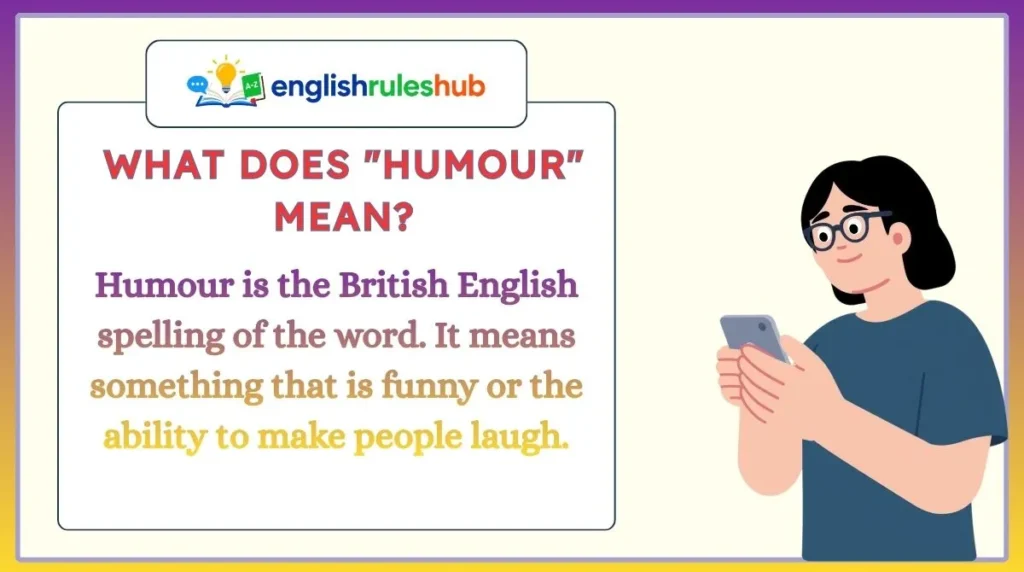
Humour is the British English spelling of the word. It means something that is funny or the ability to make people laugh. It can also describe the quality of being amusing in stories, conversations, books, movies, or daily life.
People in countries such as the United Kingdom, Australia, New Zealand, Ireland, and many Commonwealth nations usually write humour.
When to Use “Humour”
Use humour when you are writing in British English. This spelling is common in British schools, newspapers, magazines, books, and official documents.
If you are writing for a British audience or following British English rules, humour is the correct choice.
Grammar Rule
Humour is mainly used as a noun.
It refers to:
- Something funny
- The ability to laugh or make others laugh
- A style of comedy
- Funny situations or stories
It can also appear in phrases such as:
- sense of humour
- good humour
- dry humour
- black humour
Example Sentences
- Sarah has a wonderful sense of humour.
- British humour is often dry and clever.
- His speech was full of humour.
- The teacher used humour to keep the class interested.
- I enjoy reading books with plenty of humour.
- Her humour made everyone smile.
- Good humour can reduce stress.
- The movie mixes action with British humour.
Common Learner Confusion
Many learners think humour is an old-fashioned spelling. It is not. It is still the standard spelling in British English today.
Another common mistake is believing that humour and humor have different meanings. They do not. The meaning stays exactly the same. Only the spelling changes depending on the variety of English you are using.
What Does “Humor” Mean?
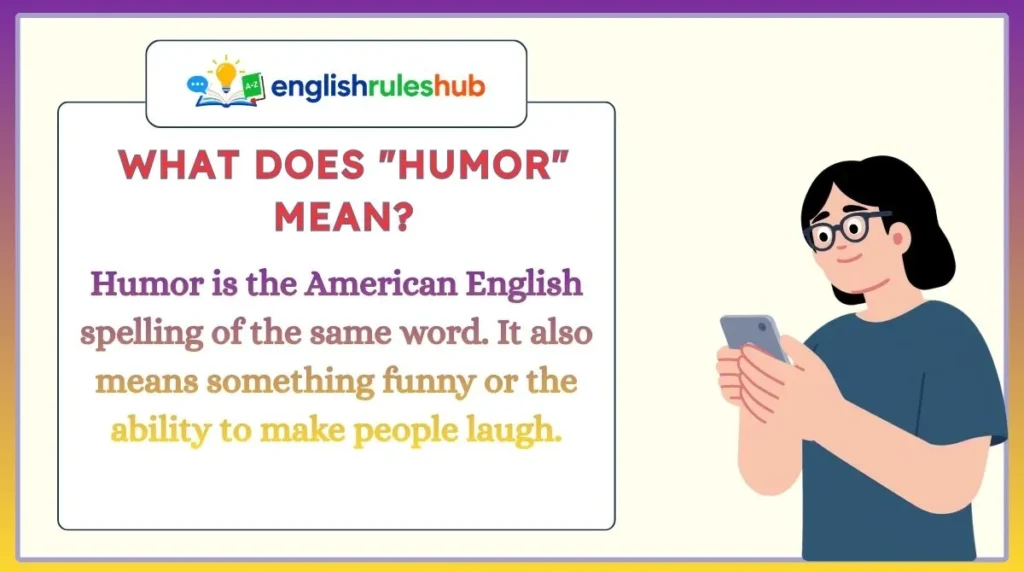
Humor is the American English spelling of the same word. It also means something funny or the ability to make people laugh. Whether you are talking about a funny joke, a comedian, or someone’s personality, humor has the same meaning as humour.
People in the United States almost always use the spelling humor.
When to Use “Humor”
Use humor when writing in American English.
It is the preferred spelling in American schools, newspapers, universities, websites, businesses, and official documents.
If your audience is mainly American, humor is the correct spelling.
Grammar Rule
Like humour, humor is usually used as a noun.
It refers to:
- Funny jokes
- Comedy
- A person’s ability to make others laugh
- Amusing situations
Common expressions include:
- sense of humor
- good humor
- dark humor
- humor writer
Example Sentences
- Jake has a great sense of humor.
- I enjoy movies with smart humor.
- The comedian’s humor made everyone laugh.
- Her writing is full of gentle humor.
- Good humor helps people relax.
- The children loved the teacher’s humor.
- His humor made the meeting less stressful.
- American humor is popular around the world.
Common Learner Confusion
Some students think humor is the modern spelling and humour is incorrect. This is not true.
The spelling humor is simply the American version. It is correct only when you are writing in American English. The meaning remains exactly the same.
Difference Between Humour and Humor
Although humour and humor look different, they have the same pronunciation and meaning. The only real difference is the spelling style used in different parts of the world.
| Feature | Humour | Humor |
|---|---|---|
| English Style | British English | American English |
| Meaning | Something funny or the ability to make people laugh | Something funny or the ability to make people laugh |
| Part of Speech | Noun | Noun |
| Common Countries | United Kingdom, Australia, New Zealand, Ireland | United States |
| Pronunciation | Same | Same |
| Meaning Difference | None | None |
Usage Difference
The biggest difference is location.
If you are writing for readers in Britain, Australia, or another country that follows British English, write humour.
If you are writing for readers in the United States, write humor.
Choosing the correct spelling makes your writing look natural and professional.
Grammar Logic
The grammar does not change at all.
Both words work in the same way. They are nouns and follow the same sentence patterns.
For example:
- She has a great sense of humour. (British English)
- She has a great sense of humor. (American English)
Both sentences are correct. Only the spelling changes.
Sentence Structure Difference
The sentence structure stays exactly the same.
British English:
- His humour makes every meeting enjoyable.
- I like British humour.
- The story is full of humour.
American English:
- His humor makes every meeting enjoyable.
- I like American humor.
- The story is full of humor.
Notice that the grammar, word order, and meaning never change.
Meaning Comparison
There is no meaning difference between humour and humor.
Both words describe:
- Funny jokes
- Comedy
- Amusing situations
- A person’s ability to make others laugh
- Light-hearted entertainment
The only thing you need to decide is whether you are using British English or American English. Once you choose one style, stay consistent throughout your writing. This simple habit will make your English look more accurate and professional.
Grammar Rules You Must Remember
Learning the difference between humour and humor is mostly about choosing the correct spelling for the type of English you are using. The grammar rules are very simple because both words work in the same way. If you remember the following rules, you will rarely make a mistake.
Rule #1: Match the Spelling to the Type of English
The most important rule is to use humour in British English and humor in American English.
If you are writing an essay for a British school or a website that follows British English, choose humour.
If you are writing for an American school, company, or audience, choose humor.
Examples:
- British English: She has a wonderful sense of humour.
- American English: She has a wonderful sense of humor.
Both sentences are correct because each one follows the spelling rules of its variety of English.
Rule #2: Be Consistent in One Piece of Writing
Do not mix British and American spellings in the same article, report, or email.
For example, if you write colour, favourite, and centre, you should also write humour.
If you write color, favorite, and center, you should also write humor.
Correct:
- The book is full of humour and colourful stories.
- The book is full of humor and colorful stories.
Incorrect:
- The book is full of humour and colorful stories.
- The book is full of humor and colourful stories.
Keeping one style makes your writing look neat and professional.
Rule #3: Use the Word as a Noun
Both humour and humor are most commonly used as nouns.
They name a quality, feeling, or type of entertainment.
Examples:
- I enjoy her humour.
- His humor makes everyone laugh.
- The movie has plenty of humour.
- Good humor can improve a difficult day.
In each sentence, the word names something rather than describing an action.
Rule #4: Learn Common Expressions
Many everyday expressions use these words. The spelling changes, but the meaning stays the same.
British English:
- sense of humour
- good humour
- dry humour
- black humour
American English:
- sense of humor
- good humor
- dry humor
- dark humor
When speaking, these expressions sound the same. Only the written spelling changes.
Common Mistakes Students Make
Many English learners make small mistakes because they learn from books, movies, social media, and websites from different countries. Understanding these mistakes will help you avoid them.
Mistake 1: Thinking One Spelling Is Wrong
Some learners believe only humour is correct. Others believe only humor is correct.
Wrong idea:
- Humor is correct. Humour is wrong.
Correct idea:
- Both spellings are correct.
- Choose the one that matches your type of English.
Mistake 2: Mixing British and American English
Students often copy words from different sources without noticing the spelling style.
Incorrect:
- My favourite movie has great humor.
Correct (British English):
- My favourite movie has great humour.
Correct (American English):
- My favorite movie has great humor.
Choose one style and use it from beginning to end.
Mistake 3: Changing the Meaning
Some students think humour means one kind of comedy and humor means another.
This is not true.
Both words describe the same idea. The difference is only the spelling.
Mistake 4: Using the Wrong Spelling in School Work
Some schools ask students to follow either British or American English.
Before you write an assignment, check which style your teacher wants.
Doing this will help you avoid unnecessary spelling mistakes.
Easy Correction Tips
- Decide whether you are writing in British or American English.
- Stay with one spelling style.
- Read your work before submitting it.
- Use a dictionary if you are unsure.
- Practice common expressions such as sense of humour or sense of humor.
Easy Trick to Remember the Difference
A simple memory trick can help you remember the correct spelling.
Think about the letter “U.”
The word humour has the extra letter U.
Many British English words also have this extra U, such as:
- colour
- favourite
- neighbour
- honour
So if you see the extra U, think British English.
Now think about American English.
American English usually removes the extra U.
Examples include:
- color
- favorite
- neighbor
- honor
- humor
This pattern makes the spelling easy to remember.
A Simple Real-Life Example
Imagine two friends.
One lives in London.
One lives in New York.
The friend in London writes:
“I love your sense of humour.”
The friend in New York writes:
“I love your sense of humor.”
Both friends are saying exactly the same thing. Only the spelling changes because they follow different types of English.
Whenever you see the extra U, remember United Kingdom. Both words start with the same letter, making the connection even easier.
Daily Life Examples
The best way to remember new grammar is to see it in everyday conversations. These examples show how both spellings are used naturally.
Conversation 1
A: Your jokes always make me laugh.
B: Thanks! I have a good sense of humor.
Conversation 2
A: I really enjoy British TV shows.
B: Their humour is often clever and dry.
Conversation 3
A: Why does everyone like your teacher?
B: She uses humour in every lesson.
Conversation 4
A: The meeting felt very serious.
B: One funny joke added some humor.
Conversation 5
A: Do you enjoy comedy movies?
B: Yes, I love their light humor.
Conversation 6
A: My grandfather tells funny stories.
B: He has a wonderful sense of humour.
Conversation 7
A: Why is everyone smiling?
B: Ben’s humor made the whole office laugh.
Conversation 8
A: This book is fun to read.
B: It has plenty of humour from beginning to end.
Conversation 9
A: What makes your friend special?
B: Her kind humor always makes people feel happy.
Conversation 10
A: Why do people enjoy that writer?
B: His clever humour makes every story interesting.
These examples show that the sentence structure never changes. The only thing that changes is the spelling, depending on whether you are using British or American English.
Practice Section
Now it’s time to check your understanding. Read each sentence and choose the correct option. Think about whether the sentence is using British English or American English.
Question 1
My teacher has a great sense of ______.
A. humour
B. humor
Answer: A (if you are using British English) / B (if you are using American English)
Question 2
The American newspaper praised the comedian’s ______.
A. humour
B. humor
Answer: B. Since the sentence mentions an American newspaper, humor is the correct spelling.
Question 3
The British magazine is full of funny stories and ______.
A. humour
B. humor
Answer: A. British English uses humour.
Question 4
Choose the correct sentence for American English.
A. My favorite author has a great sense of humour.
B. My favorite author has a great sense of humor.
Answer: B. The word favorite already shows American English, so humor matches it.
Question 5
Choose the correct sentence for British English.
A. My favourite teacher has a wonderful sense of humour.
B. My favourite teacher has a wonderful sense of humor.
Answer: A. The word favourite follows British spelling, so humour is also correct.
Quick Review
If you answered all five questions correctly, you already understand the most important rule:
- Humour = British English
- Humor = American English
Remember, the meaning never changes. Only the spelling does.
FAQs
What is the difference between humour and humor?
There is no difference in meaning. Both words refer to something funny or the ability to make people laugh. The only difference is the spelling. Humour is used in British English, while humor is used in American English.
Which spelling is correct: humour or humor?
Both spellings are correct. The right choice depends on the type of English you are writing. Use humour for British English and humor for American English.
Can I use humour and humor in the same article?
It is better not to. Mixing British and American spellings can make your writing look inconsistent. Choose one style and use it throughout your article, essay, or email.
Is humour more formal than humor?
No. Neither spelling is more formal than the other. Both are standard spellings in their own varieties of English. The level of formality depends on the sentence, not the spelling.
Which spelling should English learners use?
Use the spelling that matches the English you are studying. If your school teaches British English, write humour. If you are learning American English, write humor. The most important thing is to stay consistent.
Why do British and American English have different spellings?
Over time, British and American English developed different spelling conventions. Many British words keep the extra letter “u,” while American English often removes it. This difference appears in many words, such as colour/color, favourite/favorite, honour/honor, and humour/humor.
Final Conclusion
The difference between humour and humor is much simpler than many English learners expect.
Both words have the same meaning, the same pronunciation, and the same grammar. The only difference is the spelling style.
If you are writing in British English, use humour. If you are writing in American English, use humor.
Once you choose one style, keep using it throughout your writing. This simple habit will make your English look more natural and professional.
Learning small spelling differences like this is an important step toward becoming a confident English user.
The more you read books, articles, and newspapers from your chosen variety of English, the easier these differences will become.
Keep practicing by reading, writing, and speaking every day. With regular practice, choosing between humour and humor will soon feel completely natural.
Every new grammar rule you learn brings you one step closer to speaking and writing English with confidence.

I am Benjamin Clark, an English language writer passionate about simplifying grammar, vocabulary, and word meanings. I create clear, accurate, and practical content to help learners improve their English skills with confidence every day.