
Many English learners stop for a moment when they need to choose between “open to” and “open for.” The two expressions look very similar, but they are not used in the same way. A small change in the preposition can change the meaning of the whole sentence.
This confusion is very common because both expressions use the adjective open. Many students think they can replace one with the other in every sentence. Sadly, that often leads to mistakes in speaking and writing.
The good news is that the difference is much easier than it first appears. Once you understand the purpose of each phrase, choosing the correct one becomes almost automatic.
Open to usually talks about accepting ideas, people, opportunities, or possibilities. Open for usually talks about availability, business, services, or specific purposes.
You hear these expressions every day in conversations, workplaces, schools, advertisements, and emails. Learning the correct usage will make your English sound more natural and confident.
By the end of this guide, you will clearly understand the meaning, grammar rules, common mistakes, practical examples, and easy memory tricks that help you use open to and open for correctly in everyday English.
What Does “Open to” Mean?
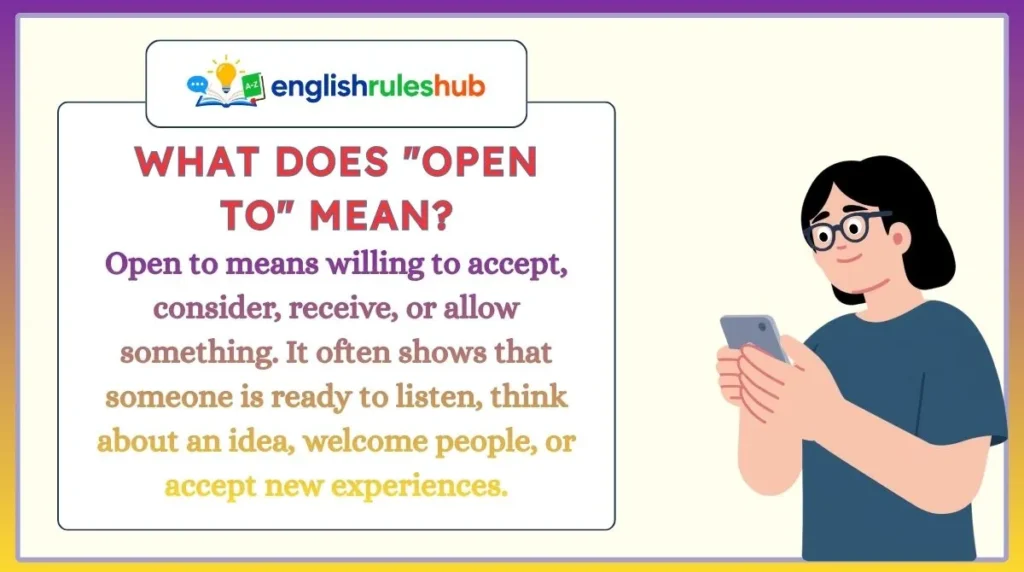
Open to means willing to accept, consider, receive, or allow something. It often shows that someone is ready to listen, think about an idea, welcome people, or accept new experiences.
When to Use “Open to”
Use open to when talking about:
- New ideas
- Suggestions
- Opinions
- Opportunities
- Change
- Discussion
- Visitors
- Possibilities
- Applications
- Feedback
The focus is on acceptance or willingness.
Grammar Rule
The basic structure is:
Subject + be + open to + noun / pronoun / gerund (-ing verb)
Examples:
- I am open to new ideas.
- She is open to learning French.
- We are open to suggestions.
Notice that a noun or an -ing verb usually follows to.
Example Sentences
- I am open to your suggestion.
- She is open to trying new food.
- The manager is open to feedback.
- Our team is open to new members.
- They are open to discussing the problem.
- He is open to changing his schedule.
- The company is open to fresh ideas.
- We are open to hearing everyone’s opinion.
Common Learner Confusion
Many learners think open to means a place is operating.
For example:
❌ The bank is open to customers until 5 p.m.
Although this may sometimes sound acceptable depending on the meaning, if you simply mean the bank is operating during business hours, open for business is more natural.
Remember that open to focuses on accepting people or things, not simply operating.
What Does “Open for” Mean?
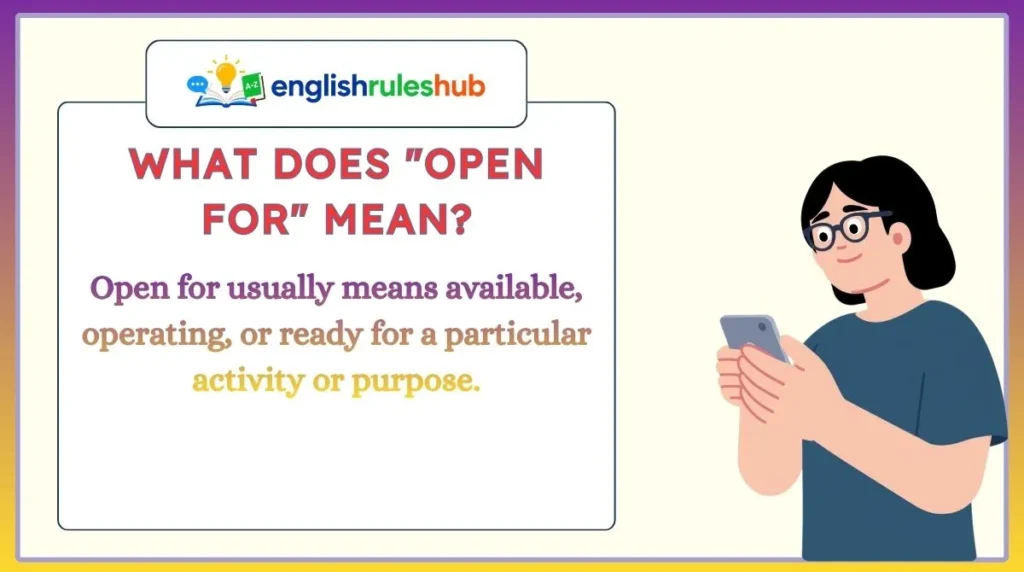
Open for usually means available, operating, or ready for a particular activity or purpose.
It often describes businesses, stores, schools, events, services, registration, booking, and public places.
When to Use “Open for”
Use open for when talking about:
- Business
- Registration
- Applications
- Visitors
- Bookings
- Lunch
- Dinner
- Tours
- Public use
- Service
Grammar Rule
Basic structure:
Subject + be + open for + noun
Examples:
- The museum is open for visitors.
- Registration is open for everyone.
- The shop is open for business.
Unlike open to, open for usually introduces the purpose or activity.
Example Sentences
- The restaurant is open for dinner.
- Registration is open for new students.
- The library is open for study.
- The store is open for business.
- The hotel is open for guests.
- The website is open for bookings.
- The school is open for admissions.
- The hall is open for public events.
Common Learner Confusion
Students sometimes say:
❌ I am open for your idea.
This sounds unnatural because people accept ideas, so we use:
✅ I am open to your idea.
Difference Between Open to and Open for
Although these expressions both begin with open, they answer different questions.
| Open to | Open for |
|---|---|
| Shows willingness | Shows purpose or availability |
| Accepting ideas or people | Operating or ready for something |
| Used with ideas, opinions, discussions | Used with business, events, services |
| Often followed by nouns or -ing verbs | Usually followed by activities or purposes |
| Focus on acceptance | Focus on function |
Usage Difference
Think about these examples.
Open to
“I’m open to your suggestion.”
Meaning:
I am willing to consider it.
Open for
“The office is open for visitors.”
Meaning:
Visitors are allowed because the office is operating.
Grammar Logic
Ask yourself one simple question.
Are you talking about willingness?
Use open to.
Examples:
- open to change
- open to advice
- open to learning
Are you talking about availability or purpose?
Use open for.
Examples:
- open for business
- open for lunch
- open for registration
Sentence Structure Difference
Open to
Subject + be + open to + noun/-ing
Examples
- She is open to change.
- We are open to discussing it.
Open for
Subject + be + open for + noun
Examples
- The café is open for breakfast.
- Registration is open for everyone.
Meaning Comparison
Compare these two sentences.
The company is open to new ideas.
Meaning:
The company welcomes creative suggestions.
The company is open for business.
Meaning:
The company is operating and serving customers.
The word open stays the same, but the meaning changes because of the preposition.
Grammar Rules You Must Remember
Rule #1: Use “Open to” for Acceptance
Whenever someone is willing to accept something, choose open to.
Example:
She is open to learning another language.
Rule #2: Use “Open for” for Purpose
If something is available for a particular activity, choose open for.
Example:
The gym is open for members.
Rule #3: “To” Often Comes Before an -ing Verb
Examples:
- open to improving
- open to changing
- open to working
- open to helping
Correct:
We are open to working together.
Incorrect:
We are open for working together.
Rule #4: Businesses Often Use “Open for”
Common expressions include:
- open for business
- open for visitors
- open for reservations
- open for bookings
- open for applications
Example:
The museum is open for tourists every weekend.
Common Mistakes Students Make
Many learners translate directly from their first language, which causes confusion.
Here are the most common mistakes.
Mistake 1
❌ I am open for suggestions.
✅ I am open to suggestions.
Why?
Suggestions are ideas that you accept.
Mistake 2
❌ The restaurant is open to breakfast.
✅ The restaurant is open for breakfast.
Breakfast is the purpose.
Mistake 3
❌ We are open for discussing the problem.
✅ We are open to discussing the problem.
After to, an -ing verb works naturally here.
Mistake 4
❌ The shop is open to business.
✅ The shop is open for business.
Business is the activity.
Mistake 5
❌ She is open for change.
✅ She is open to change.
Change is something she accepts.
Easy Correction Tips
Whenever you feel confused, ask yourself:
- Am I talking about accepting something?
- Or am I talking about availability?
That simple question usually gives the correct answer.
Easy Trick to Remember the Difference
Here is a simple memory trick.
Think of “To” as Moving Toward Something
When you are open to something, your mind moves toward it.
You welcome it.
You accept it.
Examples:
- open to ideas
- open to advice
- open to friendship
Think of “For” as Purpose
For often tells us why something exists.
Examples:
- open for business
- open for customers
- open for lunch
The building has a purpose.
That makes remembering much easier.
Daily Life Examples
Here are some natural conversations.
Example 1
A: Are you open to trying sushi?
B: Yes, I’d love to.
Example 2
A: Is the bank open for business today?
B: Yes, it opens at 9 a.m.
Example 3
A: Are you open to my idea?
B: Of course. Tell me more.
Example 4
A: Is registration open for new students?
B: Yes, until Friday.
Example 5
A: Are your parents open to having a pet?
B: Maybe. I’ll ask them.
Example 6
A: Is the park open for visitors?
B: Yes, every day.
Example 7
A: Are you open to working from home?
B: Yes, that sounds great.
Example 8
A: Is the café open for breakfast?
B: Yes, from 7 a.m.
Example 9
A: Is your boss open to new ideas?
B: Yes, he always listens.
Example 10
A: Is the hotel open for guests?
B: Yes, rooms are available.
Practice Section
Choose the correct answer.
1.
I am open ___ learning Spanish.
A. to
B. for
2.
The library is open ___ students.
A. to
B. for
3.
The store is open ___ business.
A. to
B. for
4.
She is open ___ new experiences.
A. to
B. for
5.
Registration is open ___ applicants.
A. to
B. for
Answers
- A — to
- B — for
- B — for
- A — to
- B — for
FAQs
What is the difference between open to and open for?
Open to shows willingness to accept, consider, or welcome something. Open for shows that something is available or operating for a particular activity or purpose. The choice depends on the meaning you want to express.
Can we use open to in questions?
Yes. It is very common in everyday English. For example, “Are you open to trying something new?” or “Is your manager open to feedback?” These questions ask whether someone is willing to accept or consider something.
Can we use open for in questions?
Yes. You can ask questions such as “Is the museum open for visitors?” or “Is registration open for international students?” These questions ask about availability or operation.
Is open to formal or informal?
Open to works well in both formal and informal English. You can use it in everyday conversations, emails, meetings, academic writing, and business communication without sounding unnatural.
Is open for formal or informal?
Open for is also suitable for both formal and informal situations. It is commonly used in advertisements, business notices, websites, customer service, schools, and public announcements.
Why do learners confuse open to and open for?
The confusion happens because both expressions begin with the same adjective, open. Learners often focus on the first word and overlook how the preposition changes the meaning. Remember that to points to acceptance, while for points to purpose or availability.
Final Conclusion
Learning the difference between open to and open for may seem difficult at first, but the idea becomes simple once you understand the meaning behind each expression.
Open to is about being willing to accept, consider, or welcome something, such as ideas, advice, changes, or opportunities.
Open for, on the other hand, is about availability, operation, or purpose, such as a shop being open for business or a school being open for admissions.
The best way to remember the difference is to think about what you want to say. If someone is accepting an idea or possibility, use open to. If you are talking about a place, service, event, or activity being available, use open for.
Practice these expressions in your daily conversations, read them in books and articles, and try making your own example sentences.
With regular practice, choosing the correct expression will soon become natural, helping your English sound clearer, more accurate, and more confident.

I am Benjamin Clark, an English language writer passionate about simplifying grammar, vocabulary, and word meanings. I create clear, accurate, and practical content to help learners improve their English skills with confidence every day.

6 thoughts on “Open to or Open for: What’s the Difference? Simple Grammar Guide (2026)”