Many English learners get confused by criteria and criterion because these two words look almost the same. They also have related meanings, but they are not used in the same way. If you choose the wrong one, your sentence may sound strange or even incorrect.
This confusion is common because many English words become plural by adding -s or -es, such as book → books or student → students.
However, criterion and criteria follow a different grammar rule. They come from Greek, so their singular and plural forms are different from most English nouns.
The good news is that the rule is actually very simple once you understand it. Criterion refers to one standard or one rule, while criteria refers to more than one standard or rule.
After learning this difference, you will notice these words in school, business, science, job interviews, and everyday conversations.
Understanding the correct use of these words will make your English clearer and more natural. It will also help you write better essays, answer exam questions correctly, and speak with more confidence.
By the end of this guide, you will know when to use criterion, when to use criteria, how they fit into sentences, the grammar rules behind them, and the common mistakes that many learners make.
What Does “Criteria” Mean?
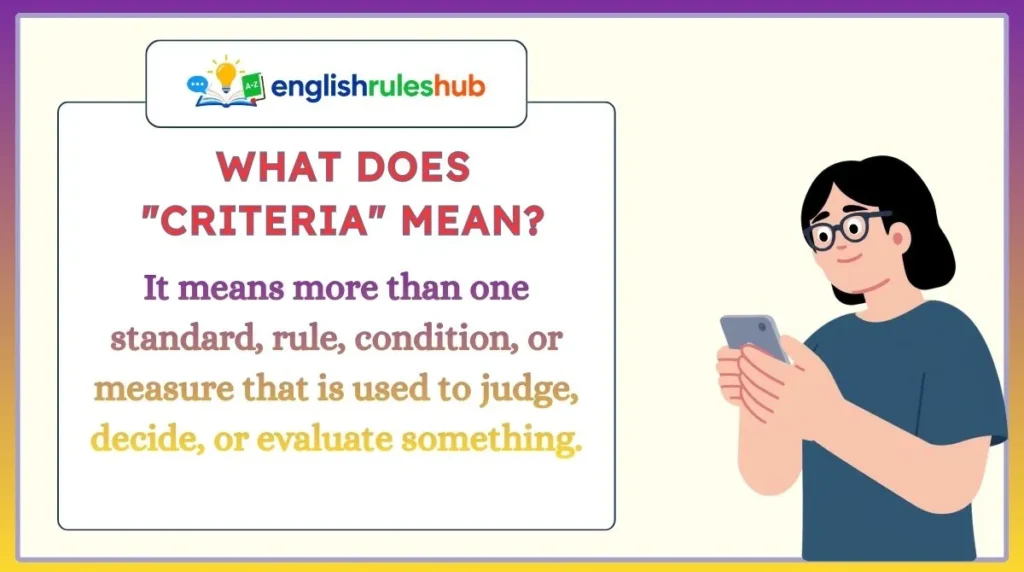
Criteria is the plural form of criterion.
It means more than one standard, rule, condition, or measure that is used to judge, decide, or evaluate something.
Think of criteria as a list of points that must be checked before making a decision.
When Do We Use “Criteria”?
Use criteria whenever you are talking about two or more standards or requirements.
For example:
- Hiring a new employee
- Choosing a winner
- Grading an exam
- Buying a new phone
- Selecting a university
Each decision usually depends on several standards, not just one.
Grammar Rule
Since criteria is plural, it takes:
- plural verbs
- plural pronouns
Correct:
- The criteria are clear.
- These criteria help us choose the best player.
Incorrect:
- The criteria is clear.
- This criteria is important.
Remember:
- Criteria = plural
- Use are, have, these, many
Examples of “Criteria”
- The teacher explained the criteria for the writing competition.
- We must meet all the criteria before applying.
- The company changed its hiring criteria.
- These criteria help us make fair decisions.
- The judges discussed the criteria carefully.
- Admission criteria are different for every college.
- The award criteria include honesty and leadership.
- All the criteria were checked before choosing the winner.
Common Learner Confusion
Many students think criteria is singular because they hear it so often.
For example, people sometimes say:
❌ The criteria is simple.
This is incorrect because criteria is plural.
The correct sentence is:
✅ The criteria are simple.
Another mistake is adding -s to make it plural.
❌ criterias
This word does not exist in standard English.
Always write:
- one criterion
- two or more criteria
What Does “Criterion” Mean?
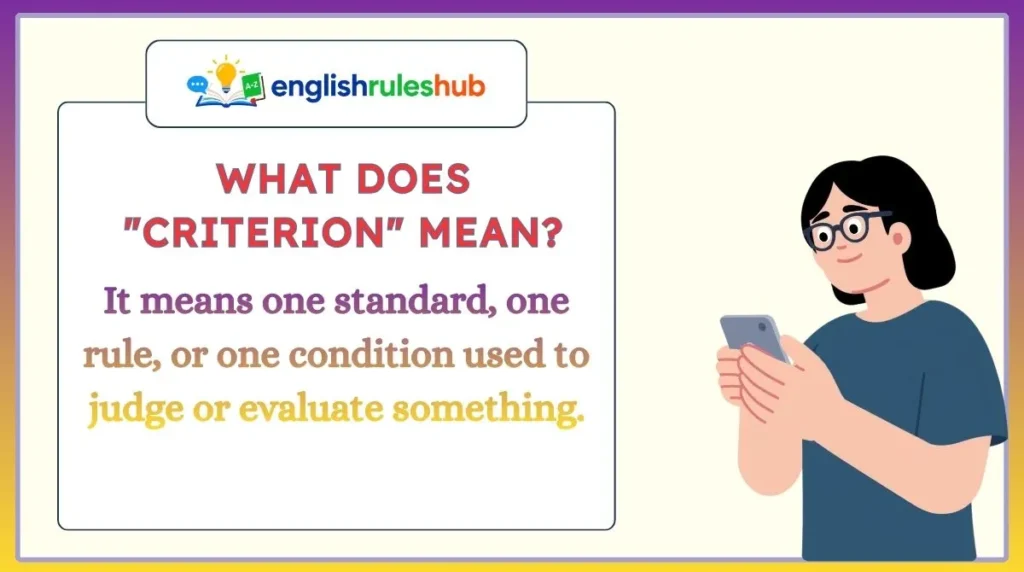
Criterion is the singular form.
It means one standard, one rule, or one condition used to judge or evaluate something.
If only one requirement is being discussed, use criterion.
When Do We Use “Criterion”?
Use criterion whenever you are talking about only one standard.
Examples include:
- One requirement for passing a test
- One condition for joining a club
- One rule for winning a contest
If there is only one measuring point, criterion is the correct choice.
Grammar Rule
Since criterion is singular, it takes:
- singular verbs
- singular pronouns
Correct:
- The criterion is clear.
- This criterion helps us decide.
Incorrect:
- The criterion are easy.
- These criterion matter.
Remember:
- Criterion = singular
- Use is, has, this, one
Examples of “Criterion”
- The main criterion is honesty.
- Cost was the only criterion for the decision.
- This criterion is easy to understand.
- One important criterion is good communication.
- The first criterion focuses on safety.
- Experience is an important criterion for this job.
- That criterion should not be ignored.
- Every applicant must meet this criterion.
Common Learner Confusion
Many learners avoid using criterion because they hear criteria much more often.
Some people even use criteria when they mean only one standard.
Incorrect:
❌ One criteria is attendance.
Correct:
✅ One criterion is attendance.
Ask yourself a simple question:
Am I talking about one rule or several rules?
If the answer is one, choose criterion.
If the answer is more than one, choose criteria.
Difference Between Criteria and Criterion (Detailed)
Although criteria and criterion have the same basic meaning, they are used in different situations. The biggest difference is number. One word is singular, and the other is plural. Once you remember this rule, choosing the correct word becomes much easier.
Many learners make mistakes because they think criteria is a singular noun. In everyday speech, you may even hear native speakers use it incorrectly. However, in correct English grammar, criterion is always singular, and criteria is always plural.
The table below makes the difference easy to understand.
| Feature | Criterion | Criteria |
|---|---|---|
| Number | Singular | Plural |
| Meaning | One standard or rule | Two or more standards or rules |
| Verb | Is, was, has | Are, were, have |
| Determiners | This, that, one, each | These, those, many, several |
| Example | The main criterion is quality. | The selection criteria are clear. |
Meaning Comparison
Both words refer to standards used for judging or making decisions. The only difference is whether you are talking about one standard or more than one.
Look at these examples:
- Criterion: The most important criterion is honesty.
- Criteria: The hiring criteria include honesty, experience, and teamwork.
In the first sentence, only one standard is mentioned.
In the second sentence, several standards are listed.
Usage Difference
Use criterion when your sentence focuses on a single requirement.
Examples:
- Safety is the first criterion.
- Price was the only criterion.
- One important criterion is reliability.
Use criteria when discussing multiple requirements.
Examples:
- The interview criteria include confidence and communication skills.
- The school has strict admission criteria.
- These criteria help teachers grade students fairly.
Grammar Logic
The grammar rule is simple.
If the noun is singular, the verb must also be singular.
- The criterion is important.
- This criterion has changed.
If the noun is plural, the verb must also be plural.
- The criteria are important.
- These criteria have changed.
Matching the noun with the correct verb is one of the easiest ways to avoid mistakes.
Sentence Structure Difference
Notice how the sentence changes depending on whether the noun is singular or plural.
Singular Structure
Subject + criterion + singular verb
Examples:
- The criterion is easy to understand.
- This criterion helps us choose the best product.
- One criterion remains unchanged.
Plural Structure
Subject + criteria + plural verb
Examples:
- The criteria are easy to understand.
- These criteria help us choose the best product.
- Several criteria remain unchanged.
Real-Life Situations
You will often see these words in schools, offices, hospitals, businesses, and government documents.
At school
A teacher may say:
The grading criteria are listed on the first page.
If the teacher talks about only one grading rule, they might say:
The most important criterion is clear writing.
During a job interview
A company may have several hiring criteria, such as education, experience, communication skills, and teamwork.
If the manager talks about just one requirement, they may say:
Experience is our main criterion.
When buying something
Imagine you want to buy a laptop.
Your criteria could be:
- Low price
- Long battery life
- Fast processor
- Lightweight design
If you care only about price, then price becomes your main criterion.
Meaning in Everyday English
People often use these words when making choices.
For example:
- Schools use admission criteria.
- Banks have loan approval criteria.
- Employers use hiring criteria.
- Judges follow competition criteria.
- Teachers explain marking criteria.
Whenever several conditions are checked before making a decision, criteria is usually the correct word.
If someone asks,
“What is the most important requirement?”
the answer often uses criterion.
Example:
The most important criterion is honesty.
Quick Summary
Here is an easy way to remember the difference.
- Criterion = one standard
- Criteria = more than one standard
Think about the number first.
If there is one rule, use criterion.
If there are many rules, use criteria.
This simple habit will help you choose the correct word every time.
Grammar Rules You Must Remember
Learning a few simple grammar rules will help you use criterion and criteria correctly in both speaking and writing. Keep these four rules in mind whenever you use these words.
Rule #1: Use Criterion for One Standard
If you are talking about only one rule, condition, or standard, always use criterion.
Correct examples:
- The main criterion is honesty.
- One criterion was missing.
- This criterion helps us make a fair decision.
Incorrect:
- One criteria is honesty.
Why?
Because one always needs a singular noun.
Rule #2: Use Criteria for More Than One Standard
If you mean two or more standards, use criteria.
Correct examples:
- The selection criteria are fair.
- These criteria help the judges.
- Our hiring criteria have changed.
Incorrect:
- The selection criterion are fair.
Remember:
If you can count more than one requirement, use criteria.
Rule #3: Match the Verb with the Noun
The verb must agree with the noun.
Singular:
- The criterion is clear.
- This criterion has changed.
Plural:
- The criteria are clear.
- These criteria have changed.
Checking the verb is a quick way to catch mistakes before you finish writing.
Rule #4: Never Add an “S” to Criteria
Many learners write criterias, but this is incorrect.
Correct:
- criterion
- criteria
Incorrect:
- criterias
- criterions (in standard English)
Think of it like these words:
- child → children
- person → people
- criterion → criteria
These words have special plural forms, so they do not follow the usual -s rule.
Keeping these four grammar rules in mind will help you use both words naturally and confidently in everyday English.
Common Mistakes Students Make
Many English learners understand the meanings of criterion and criteria, but they still make small grammar mistakes. These errors usually happen because these words do not follow the normal English plural rule. Instead of adding -s, they have special forms that come from Greek.
The good news is that once you know the common mistakes, they become much easier to avoid.
Mistake #1: Using Criteria as a Singular Noun
This is the most common mistake.
❌ Wrong: The criteria is very simple.
✅ Correct: The criteria are very simple.
Why?
Because criteria is always plural, so it needs a plural verb like are, have, or were.
Easy Tip:
If you use criteria, imagine you are talking about a group of rules instead of just one.
Mistake #2: Using Criterion for More Than One Standard
Some students use criterion even when they mean several requirements.
❌ Wrong: The admission criterion include grades and attendance.
✅ Correct: The admission criteria include grades and attendance.
Why?
The sentence mentions grades and attendance, which are two different requirements. That means you need the plural word criteria.
Easy Tip:
If your sentence lists more than one requirement, choose criteria.
Mistake #3: Writing Criterias
Many learners think every plural noun ends with -s, so they write criterias.
❌ Wrong: The teacher explained the criterias.
✅ Correct: The teacher explained the criteria.
The word criteria is already plural.
There is no need to add another -s.
Easy Tip:
Remember these forms:
- One = criterion
- More than one = criteria
Nothing else.
Mistake #4: Using the Wrong Determiner
The words before the noun must also match its number.
❌ Wrong: This criteria is important.
✅ Correct: These criteria are important.
❌ Wrong: These criterion are useful.
✅ Correct: This criterion is useful.
Notice the pattern:
- This + criterion
- These + criteria
Learning these pairs makes your English sound much more natural.
Mistake #5: Choosing the Wrong Verb
Sometimes learners pick the correct noun but use the wrong verb.
❌ Wrong: The criterion are easy to understand.
✅ Correct: The criterion is easy to understand.
❌ Wrong: The criteria has changed.
✅ Correct: The criteria have changed.
Always check if your noun is singular or plural before choosing the verb.
Mistake #6: Forgetting the Meaning of the Sentence
Some people choose a word without thinking about what they are actually saying.
For example:
❌ The only criteria is honesty.
This sentence mentions only one requirement.
The correct sentence is:
✅ The only criterion is honesty.
Now look at this example:
❌ The hiring criterion include education, experience, and communication skills.
Three different requirements are listed, so the correct sentence is:
✅ The hiring criteria include education, experience, and communication skills.
Before writing, ask yourself:
Am I talking about one rule or several rules?
The answer will tell you which word to use.
Easy Correction Tips
Here are a few simple habits that can help you avoid mistakes.
- Count the number of standards before choosing the word.
- Use criterion with is, has, and this.
- Use criteria with are, have, and these.
- Never write criterias.
- Read your sentence aloud. If it sounds odd, check the noun and verb again.
The more you practice these small checks, the more natural your English will become.
Easy Trick to Remember the Difference
Many students worry that they will forget which word is singular and which is plural. Luckily, there is a very easy way to remember them.
Memory Trick #1: Think About the Letter “A”
Look at the endings:
- Criterion
- Criteria
The word criteria ends with “a.”
Imagine the “a” stands for “all.”
Criteria = all the rules together.
If there are many rules or conditions, choose criteria.
If there is just one rule, use criterion.
Memory Trick #2: One vs. Many
Think about choosing a new phone.
If your only concern is the price, then your criterion is price.
If you care about price, battery life, camera quality, screen size, and storage, then those are your criteria.
One point = criterion
Many points = criteria
This simple picture is easy to remember.
Memory Trick #3: Match the Helping Words
Remember these pairs:
Criterion
- this
- one
- is
- has
Criteria
- these
- many
- are
- have
If you remember these word partners, you can usually choose the correct form without thinking too hard.
Memory Trick #4: Ask One Simple Question
Before writing, stop for a second and ask yourself:
“How many standards am I talking about?”
If the answer is one, write criterion.
If the answer is two or more, write criteria.
This question works almost every time.
Real-Life Logic
Imagine your teacher says:
“You must score 80% to pass.”
That is one criterion.
Now imagine your teacher says:
“You must score 80%, attend class regularly, complete your homework, and pass the final exam.”
Now there are several requirements.
These are the criteria.
The idea is exactly the same in schools, companies, sports competitions, and everyday life.
Once you connect the words with real situations, remembering them becomes much easier.
Daily Life Examples (Very Important)
These short conversations show how criterion and criteria are used in everyday English.
- A: What are the hiring criteria for this job?
B: They include experience, communication skills, and teamwork. - A: What is the most important criterion for winning?
B: Creativity is the main one. - The teacher explained the marking criteria before the exam.
- Good attendance is one important criterion for receiving the award.
- Our school changed its admission criteria this year.
- Price is my only criterion when I buy a backpack.
- The judges checked all the competition criteria before announcing the winner.
- Safety is the first criterion when choosing playground equipment.
- The manager reviewed the interview criteria with the hiring team.
- Before buying a house, our family made a list of criteria, including location, price, and size.
These examples show that criterion is used when talking about one standard, while criteria is used when discussing multiple standards. Reading and speaking sentences like these will help you remember the difference naturally.
Practice Section
Now it’s time to test what you have learned. Read each sentence carefully and choose the correct word: criterion or criteria.
Practice Questions
1. The main ________ for choosing the team captain is leadership.
A. criterion
B. criteria
2. The interview ________ include education, work experience, and communication skills.
A. criterion
B. criteria
3. This ________ is easy to understand.
A. criterion
B. criteria
4. The admission ________ are different for every university.
A. criterion
B. criteria
5. Honesty is the only ________ for joining the group.
A. criterion
B. criteria
Answers
1. A. criterion
Only one standard is mentioned, so the singular form is correct.
2. B. criteria
Several requirements are listed, so the plural form is needed.
3. A. criterion
The word this tells us we need the singular noun.
4. B. criteria
The verb are shows that the noun must be plural.
5. A. criterion
The phrase the only refers to one requirement, so criterion is correct.
Challenge Yourself
Can you correct these sentences?
- The criteria is very clear.
- One criteria is punctuality.
- These criterion are important.
- The criterias were explained yesterday.
- This criteria helps us choose the winner.
Correct Answers
- The criteria are very clear.
- One criterion is punctuality.
- These criteria are important.
- The criteria were explained yesterday.
- This criterion helps us choose the winner.
If you answered all of them correctly, you have a strong understanding of how to use criterion and criteria.
Frequently Asked Questions (FAQs)
1. What is the difference between criterion and criteria?
The main difference is that criterion is singular, while criteria is plural. Use criterion when talking about one standard or requirement. Use criteria when talking about two or more standards or requirements.
2. Can I use criteria with the verb is?
No. In standard English, criteria is a plural noun, so it should be used with plural verbs such as are, have, or were.
Correct: The criteria are clear.
Incorrect: The criteria is clear.
3. Is criterion a formal word?
Yes. Criterion is more common in formal English, academic writing, business, research, and professional communication. However, it is still useful in everyday English whenever you are talking about one standard or requirement.
4. Why doesn’t criteria end with -s?
These words come from Greek, not from the usual English noun pattern.
Their forms are:
- Singular: criterion
- Plural: criteria
Just like person → people or child → children, they have special plural forms.
5. Can I say criterias?
No. Criterias is not considered correct in standard English.
Use:
- criterion for one
- criteria for more than one
The word criteria is already plural.
6. How can I remember which word to use?
Ask yourself one simple question:
“Am I talking about one standard or several?”
- One standard → criterion
- Several standards → criteria
This simple question helps you choose the correct word almost every time.
Final Conclusion
The difference between criterion and criteria is much easier than it first appears. The key is to remember that criterion is the singular form, while criteria is the plural form. Once you know this basic rule, most grammar mistakes disappear.
Whenever you write or speak, think about how many standards or requirements you are describing.
If there is only one, use criterion with singular words like is, has, and this. If there are several, use criteria with plural words like are, have, and these.
These words are common in education, business, research, job interviews, competitions, and everyday decision-making.
Using them correctly will make your English sound more accurate and professional.
The best way to remember the difference is through practice. Read real examples, make your own sentences, and pay attention whenever you see these words in books, websites, or conversations.
With a little practice, choosing between criterion and criteria will soon become natural.

I am Benjamin Clark, an English language writer passionate about simplifying grammar, vocabulary, and word meanings. I create clear, accurate, and practical content to help learners improve their English skills with confidence every day.