Many English learners get confused by emend and amend because these two words look and sound very similar.
At first glance, they seem to mean the same thing. Both involve making a change, so it is easy to think they can be used in the same way. However, that is not true.
The biggest difference is that one word is mainly used for correcting written text, while the other is used for changing or improving documents, laws, agreements, and even behavior.
Using the wrong word may not stop people from understanding you, but it can make your English sound unnatural, especially in formal writing.
This difference becomes important if you are writing essays, editing books, studying English grammar, or reading legal and business documents.
Native English speakers usually choose one word over the other depending on the situation. Knowing when to use each one will make your English clearer and more professional.
By the end of this guide, you will understand the meaning of both words, their grammar rules, where they are commonly used, and how to avoid common mistakes.
You will also see plenty of easy examples, learn a simple memory trick, and discover how native speakers naturally use these words in real life.
What Does “Emend” Mean?
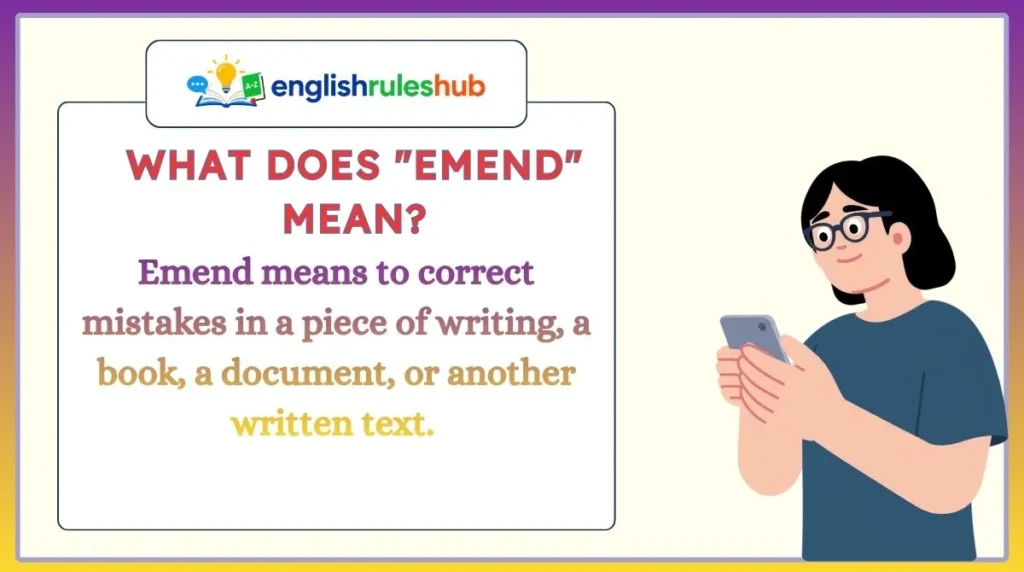
Emend means to correct mistakes in a piece of writing, a book, a document, or another written text. The goal is to improve the text by fixing errors without changing its main meaning.
This word is mostly used in editing, publishing, literature, history, and academic writing. It is much less common in everyday conversation.
Simple Definition
Emend = To correct or improve written text by fixing mistakes.
When someone emends a document, they usually fix spelling, grammar, punctuation, wording, or factual errors.
When Do We Use “Emend”?
Use emend when talking about correcting:
- Books
- Essays
- Research papers
- Historical texts
- Manuscripts
- Articles
- Reports
- Written documents
The focus is on editing the text, not changing rules or policies.
Grammar Rule
Emend is a regular verb.
| Form | Example |
|---|---|
| Base form | emend |
| Third person | emends |
| Past tense | emended |
| Past participle | emended |
| -ing form | emending |
Sentence Pattern
Subject + emend + object
Example:
- The editor emended the article.
You can also use:
Subject + be + emended
Example:
- The manuscript was emended before publication.
Easy Example Sentences
- The editor emended the article before it was printed.
- She emended several grammar mistakes in my essay.
- The teacher emended the student’s report.
- The author emended the second edition of the novel.
- Historians emended the old manuscript after finding new evidence.
- The proofreader emended spelling errors quickly.
- We need to emend this paragraph before sending it.
- The journal emended a few factual mistakes.
Common Learner Confusion
Many students think emend simply means “change.”
That is not correct.
Emend specifically means to correct mistakes in writing.
For example:
✔ The editor emended the manuscript.
This sentence is correct because the editor is correcting written text.
But this sentence sounds unnatural:
✘ The government emended the tax law.
Here, the government is not simply correcting writing. It is changing the law itself. In this case, amended is the correct word.
Where Is “Emend” Commonly Used?
You will often find emend in:
- Academic writing
- Publishing houses
- Libraries
- Universities
- Literary criticism
- Historical research
- Editing work
It is considered a formal word and is not common in casual conversation.
Common Collocations with “Emend”
Native speakers often use emend with these nouns:
- emend a manuscript
- emend a document
- emend an article
- emend a report
- emend a text
- emend a paragraph
- emend a sentence
- emend a draft
These combinations sound natural because they all involve correcting written material.
What Does “Amend” Mean?
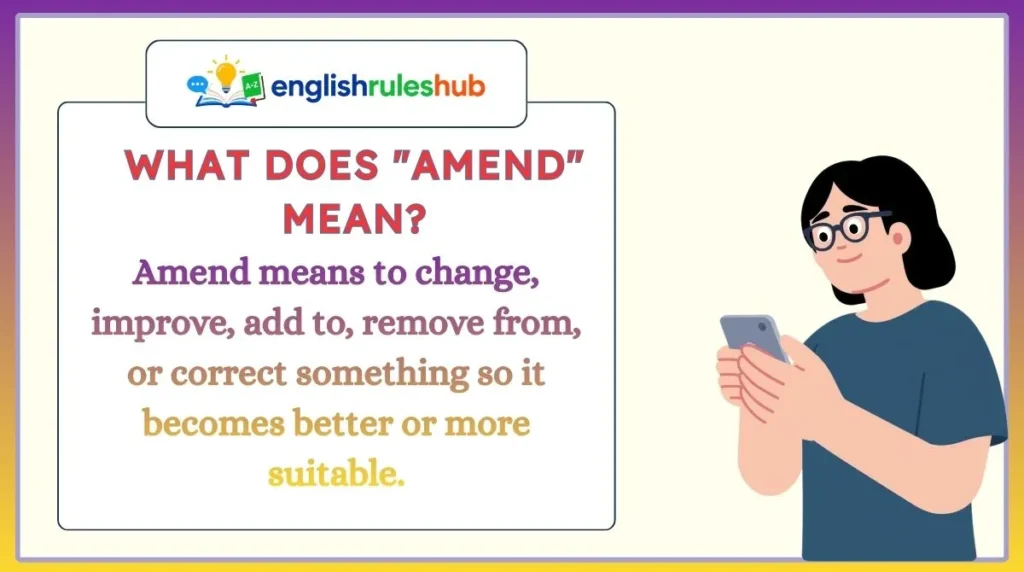
Amend means to change, improve, add to, remove from, or correct something so it becomes better or more suitable.
Unlike emend, this word is much broader. It is commonly used in law, business, government, contracts, rules, policies, constitutions, and formal writing. It can also describe changing your own behavior or correcting something you have done.
Simple Definition
Amend = To change, improve, correct, or update something.
Sometimes the change is small. Sometimes it is a major revision.
When Do We Use “Amend”?
Use amend when talking about:
- Laws
- Rules
- Policies
- Contracts
- Agreements
- Constitutions
- Bills
- Official documents
- Statements
- Personal behavior
The purpose is usually to improve or officially change something.
Grammar Rule
Amend is also a regular verb.
| Form | Example |
|---|---|
| Base form | amend |
| Third person | amends |
| Past tense | amended |
| Past participle | amended |
| -ing form | amending |
Sentence Pattern
Subject + amend + object
Example:
- The company amended its policy.
Passive form:
Subject + be + amended
Example:
- The contract was amended yesterday.
Easy Example Sentences
- The government amended the law.
- They amended the contract before signing it.
- The company amended its hiring policy.
- Parliament amended the constitution.
- We amended the agreement after discussing the problem.
- She amended her report by adding more details.
- The teacher asked me to amend my answer.
- The organization amended its safety rules.
Common Learner Confusion
Some learners believe amend only means correcting mistakes.
That is only part of its meaning.
Often, amend means making improvements or official changes, even if there was no mistake.
For example:
✔ The company amended its vacation policy.
The old policy may not have been wrong. The company simply updated it.
Another example:
✔ The constitution was amended.
The constitution was officially changed or updated.
“Amend” Can Also Mean Improving Your Behavior
This meaning is less common but still important.
Examples:
- He promised to amend his behavior.
- She wants to amend her ways.
- After the mistake, he tried to amend his actions.
Here, amend means to improve yourself or correct what you did.
Common Collocations with “Amend”
Native speakers often say:
- amend a law
- amend a bill
- amend a contract
- amend a policy
- amend a constitution
- amend an agreement
- amend a regulation
- amend a document
- amend a statement
- amend your behavior
These combinations are very common in legal, business, and government English.
Difference Between Emend and Amend (Detailed)
Although emend and amend both involve making changes, they are not interchangeable in most situations. The biggest difference is what is being changed and why it is being changed.
Think of it this way:
- Emend is mainly about correcting mistakes in written text.
- Amend is about changing or improving something, especially rules, laws, contracts, or official documents.
That is why editors usually emend manuscripts, while governments amend laws.
Quick Comparison Table
| Feature | Emend | Amend |
|---|---|---|
| Main meaning | Correct mistakes in writing | Change or improve something |
| Common use | Editing and publishing | Law, business, government |
| Used for books | Yes | Sometimes |
| Used for laws | No | Yes |
| Used for contracts | Rare | Yes |
| Used for policies | No | Yes |
| Used in everyday speech | Rare | Fairly common |
| Formality | Very formal | Formal |
Meaning Comparison
Emend
The purpose is to remove mistakes from written material.
Examples:
- Correcting grammar
- Fixing spelling
- Improving punctuation
- Removing typing errors
Nothing important about the document itself changes. The editor simply makes the writing more accurate.
Example:
- The proofreader emended several spelling mistakes.
Amend
The purpose is to improve or officially change something.
Examples:
- Updating a company policy
- Revising a contract
- Changing a law
- Modifying an agreement
- Improving personal behavior
The change may completely affect how something works.
Example:
- The council amended the city’s parking rules.
Grammar Logic
Ask yourself one simple question:
Am I correcting writing?
If the answer is yes, emend is probably the right word.
Example:
- The editor emended the article.
Now ask another question:
Am I changing a rule, law, agreement, policy, or official document?
If the answer is yes, choose amend.
Example:
- The company amended the employee handbook.
Sentence Structure Difference
Both words usually follow the same grammar pattern:
Subject + verb + object
Examples:
- The editor emended the manuscript.
- The lawyer amended the contract.
They can also be used in passive voice.
Examples:
- The article was emended before publication.
- The agreement was amended last week.
Even though the grammar is the same, the object after the verb tells you which word is correct.
Comparing Similar Sentences
Correct:
- The editor emended the novel.
- The teacher emended my essay.
- The proofreader emended the report.
Correct:
- Parliament amended the law.
- The manager amended the policy.
- The lawyer amended the agreement.
Incorrect:
- ✘ Parliament emended the law.
- ✘ The editor amended the spelling mistakes.
The first sentence is wrong because laws are amended, not emended.
The second is unnatural because spelling mistakes are emended, not amended.
Which Word Do Native Speakers Use More?
Native English speakers use amend much more often than emend.
You will hear amend in:
- News reports
- Business meetings
- Legal discussions
- Government announcements
- Workplace communication
On the other hand, emend mostly appears in:
- Publishing
- Academic research
- Literary studies
- Professional editing
- Historical scholarship
This means that many native speakers know the word emend, but they may not use it very often in everyday conversation.
Grammar Rules You Must Remember
Learning the meanings of emend and amend is only the first step. To use these words naturally, you should also understand the grammar rules behind them. These simple rules will help you choose the correct word every time.
Rule #1: Use emend only when correcting written text
The most important rule is that emend is used for correcting mistakes in writing. The purpose is to make the text more accurate or easier to read without changing its main idea.
Correct examples:
- The editor emended the article before publication.
- The teacher emended several grammar mistakes in my essay.
- The proofreader emended the final draft.
In all of these examples, someone is correcting written material.
Incorrect example:
- ✘ The company emended its policy.
This is incorrect because a policy is being officially changed, not simply edited.
Correct version:
- ✔ The company amended its policy.
Easy tip:
If you are fixing words on a page, choose emend.
Rule #2: Use amend when changing laws, rules, agreements, or official documents
Amend has a wider meaning. It is used when something is revised, updated, improved, or officially changed.
You can amend:
- a law
- a contract
- a constitution
- a policy
- an agreement
- company rules
- regulations
Examples:
- Parliament amended the law.
- They amended the contract yesterday.
- The school amended its attendance policy.
- The organization amended its safety rules.
Notice that these changes affect how something works, not just how it is written.
Easy tip:
If the change affects a rule or system, use amend.
Rule #3: Both words are regular verbs
Luckily, you do not have to memorize irregular forms.
Both verbs follow the regular -ed pattern.
| Base Verb | Past Tense | Past Participle | -ing Form |
|---|---|---|---|
| emend | emended | emended | emending |
| amend | amended | amended | amending |
Examples:
Present:
- She emends old manuscripts.
- The company amends its policies regularly.
Past:
- The editor emended the article.
- The government amended the law.
Present Perfect:
- They have emended the report.
- We have amended the agreement.
Future:
- The publisher will emend the final copy.
- The committee will amend the proposal.
Since both verbs are regular, their grammar is easy to remember.
Rule #4: The noun after the verb helps you choose the right word
Sometimes both words seem possible. The easiest solution is to look at the noun that follows the verb.
Use emend with nouns like:
- manuscript
- essay
- article
- paragraph
- report
- text
- sentence
- book
Examples:
- She emended the manuscript.
- The editor emended the report.
Use amend with nouns like:
- law
- constitution
- contract
- agreement
- policy
- regulation
- rule
- proposal
Examples:
- They amended the contract.
- Parliament amended the constitution.
This simple habit can prevent many mistakes.
Common Mistakes Students Make
Even advanced English learners sometimes confuse emend and amend because both words involve making changes. Here are the most common mistakes and how to avoid them.
Mistake #1: Using emend for laws
Wrong:
- ✘ The government emended the law.
Correct:
- ✔ The government amended the law.
Why?
Governments change laws officially. They do not simply edit the wording.
Mistake #2: Using amend for grammar corrections
Wrong:
- ✘ The editor amended several spelling mistakes.
Correct:
- ✔ The editor emended several spelling mistakes.
Why?
The editor is correcting written errors, so emend is the better choice.
Mistake #3: Thinking the words always mean the same thing
Many students learn that both words mean “change.”
That explanation is too simple.
Remember:
- Emend = correct written mistakes.
- Amend = change or improve something officially.
Once you know this difference, choosing the correct word becomes much easier.
Mistake #4: Avoiding emend completely
Some learners use amend in every situation because it is more common.
Although native speakers use amend more often, emend is still the correct word in editing, publishing, and academic writing.
Using emend correctly shows a stronger vocabulary.
Mistake #5: Forgetting the context
Always think about what is changing.
Ask yourself:
- Is someone correcting writing?
- Or are they changing a rule, policy, agreement, or law?
The answer usually tells you which word to choose.
Easy Correction Tips
Remember these quick questions whenever you write.
Question 1
Am I correcting written words?
➡ Use emend.
Question 2
Am I changing a law, contract, policy, or rule?
➡ Use amend.
This simple habit works almost every time.
Easy Trick to Remember the Difference
Many students remember grammar better with a simple memory trick.
Here is one that works well.
Memory Trick #1
Emend starts with “E.”
Think:
E = Edit
Editors edit books.
Editors emend books.
So whenever you see written text that needs correction, think of an editor.
Editor → Edit → Emend
Memory Trick #2
Amend starts with “A.”
Think:
A = Agreement
Agreements are often amended.
You can also remember:
- Amend a law
- Amend a contract
- Amend a policy
These are all official changes.
Real-Life Logic
Imagine two people at work.
The first person is a book editor.
She fixes grammar, spelling, punctuation, and typing mistakes.
She emends the manuscript.
Now imagine a lawyer.
He changes the wording of a business contract before both companies sign it.
He amends the contract.
One fixes writing.
The other changes official documents.
That picture is easy to remember.
One-Line Reminder
Edit writing? → Emend.
Change rules or documents? → Amend.
If you remember these two short lines, you will rarely make a mistake.
Daily Life Examples (Very Important)
Here are some simple spoken and written English examples. Although emend is less common in everyday conversation, these examples show how both words are naturally used.
- Can you emend this paragraph before I send my homework?
- My teacher emended a few grammar mistakes in my essay.
- The editor emended the article before it appeared online.
- Our company amended its work-from-home policy this month.
- They amended the rental agreement before signing it.
- The city council amended the parking rules.
- We need to amend the meeting schedule because several people are unavailable.
- The publisher emended the second edition of the book.
- The manager amended the office rules after receiving employee feedback.
- Please emend any spelling mistakes before submitting your report.
Notice how emend always refers to correcting written text, while amend refers to changing rules, agreements, or official documents.
Practice Section
Test your understanding by choosing the correct word.
Choose emend or amend.
Question 1
The editor decided to ________ the manuscript before printing it.
A. emend
B. amend
Question 2
The government plans to ________ the tax law next year.
A. emend
B. amend
Question 3
My teacher asked me to ________ several grammar mistakes in my essay.
A. emend
B. amend
Question 4
The company agreed to ________ the employment contract.
A. emend
B. amend
Question 5
The historian carefully ________ the ancient manuscript.
A. emended
B. amended
Answers
- A — emend
The manuscript is written text.
- B — amend
Laws are amended.
- A — emend
Grammar mistakes in writing are emended.
- B — amend
Contracts are amended.
- A — emended
The historian corrected the written manuscript.
FAQs
1. What is the difference between emend and amend?
The main difference is what you are changing. Emend means to correct mistakes in written text, such as a book, essay, or manuscript. Amend means to change, improve, or officially revise something like a law, contract, policy, or agreement. Although both involve making changes, they are used in different situations.
2. Can emend and amend be used interchangeably?
No, they usually cannot. Emend is mainly used for correcting written material, while amend is used for changing official documents, rules, laws, or policies. Using the wrong word may make your sentence sound unnatural, especially in formal English.
3. Is emend a common word in everyday English?
Not really. Emend is a formal word and is mostly used by editors, proofreaders, publishers, teachers, researchers, and historians. In everyday conversation, most people rarely use it because situations that require this word are less common.
4. Is amend formal or informal?
Amend is generally a formal word. It is commonly used in legal, business, academic, and government English. However, you may also hear it in everyday situations when people talk about changing plans, agreements, or rules.
Examples:
- We need to amend the meeting agenda.
- The company amended its leave policy.
5. Can amend be used to talk about behavior?
Yes. Amend can also mean improving your behavior or correcting something you have done wrong. This meaning is less common but still widely accepted.
Examples:
- He promised to amend his behavior.
- She worked hard to amend her mistakes.
- After the argument, he tried to amend his ways.
Here, amend means to make yourself or your actions better.
6. How can I easily remember the difference between emend and amend?
A simple memory trick is:
- Emend = Edit writing
- Amend = Alter rules or agreements
Think of the letter E in emend as Editor, because editors correct written text.
Think of the letter A in amend as Agreement, because agreements, contracts, and laws are usually amended.
This quick trick helps many English learners choose the correct word without confusion.
Final Conclusion
The words emend and amend may look almost identical, but they have different jobs in English. Once you understand their meanings, choosing the correct one becomes much easier.
Remember that emend is mainly used when correcting mistakes in written text. Editors, teachers, proofreaders, and publishers often emend essays, books, reports, and manuscripts to make them more accurate.
On the other hand, amend is used when changing or improving laws, contracts, policies, agreements, rules, or even personal behavior. It focuses on making official or meaningful changes rather than simply fixing writing.
A good way to avoid mistakes is to ask yourself one simple question: Am I correcting written words, or am I changing a rule or official document?
If you are correcting text, choose emend. If you are changing a law, contract, policy, or agreement, choose amend.
The more you read, write, and practice these two words in real sentences, the more natural they will become.
Keep reviewing the examples in this guide, try the practice questions again, and soon you will use emend and amend with confidence in both academic and professional English.

I am Benjamin Clark, an English language writer passionate about simplifying grammar, vocabulary, and word meanings. I create clear, accurate, and practical content to help learners improve their English skills with confidence every day.