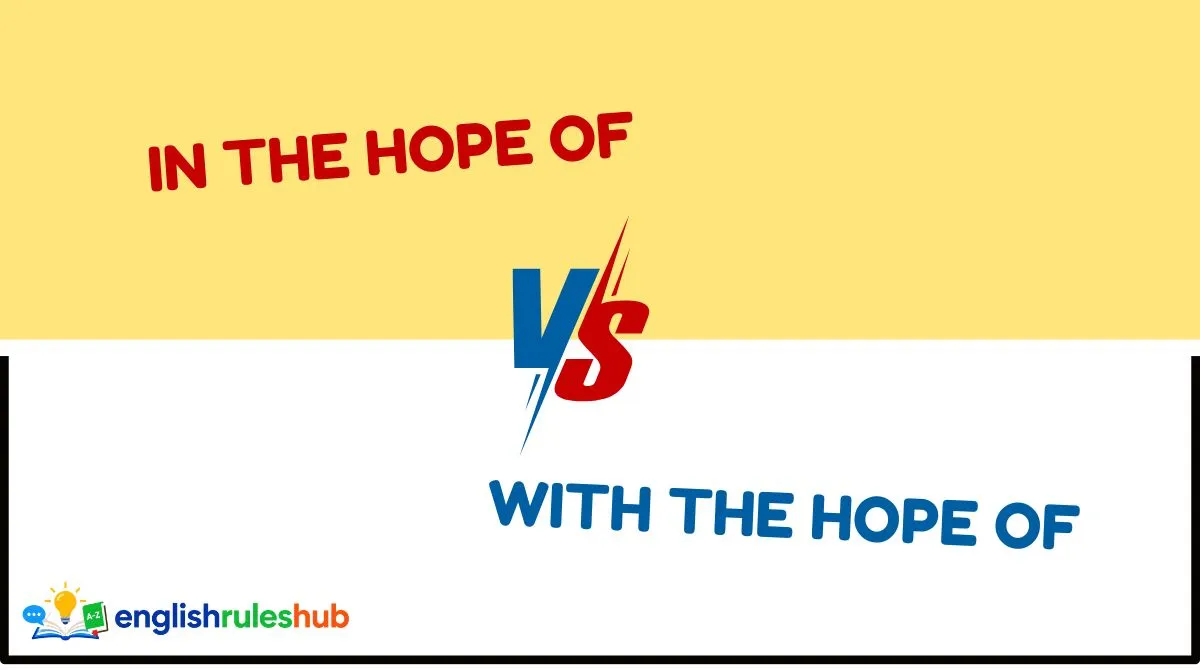
Many English learners get confused when they see the phrases “in the hope of” and “with the hope of.” At first, they look almost the same because both include the word hope.
Both also talk about a person’s wishes, dreams, or expectations. Because of this, many students think they can use these two expressions in exactly the same way.
The truth is a little different. Both phrases are grammatically correct, but they are not equally common. Native English speakers use in the hope of much more often.
With the hope of is possible in some situations, but it usually sounds less natural. Knowing this small difference can make your English sound much smoother and more fluent.
You may hear these expressions in everyday conversations, books, newspapers, business emails, and even academic writing.
Learning when to use each one will help you express your ideas more clearly and avoid common grammar mistakes.
By the end of this guide, you will understand what each phrase means, when to use it, how they differ, the grammar behind them, and which one native speakers usually prefer.
You will also learn easy grammar rules, real-life examples, and simple tips that make these expressions easy to remember.
What Does “In the Hope of” Mean?
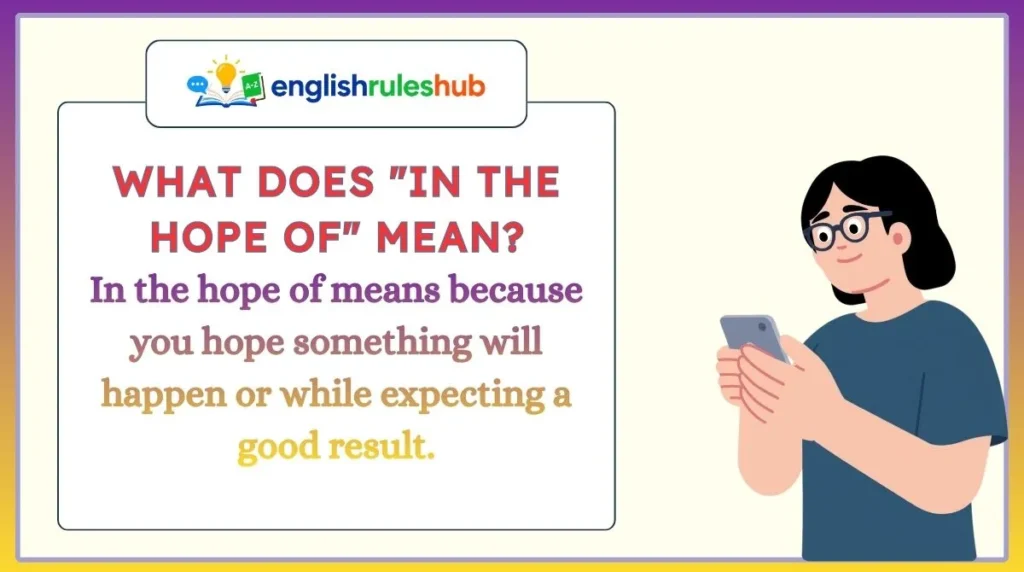
In the hope of means because you hope something will happen or while expecting a good result.
A person does something because they believe it may lead to the result they want. The phrase explains the reason or purpose behind an action.
This is a very common and natural English expression. It appears in both spoken and written English.
Simple Definition
In the hope of = hoping that something good will happen after an action.
When Do We Use “In the Hope of”?
Use in the hope of when someone takes an action to achieve a goal or desired result.
Examples include:
- studying to pass an exam
- saving money to buy a house
- calling someone to get information
- exercising to become healthier
- applying for a better job
The action comes first, and the hope is the reason behind it.
Grammar Rule
The basic structure is:
Subject + verb + in the hope of + noun/pronoun/-ing verb
Examples:
- She studies in the hope of getting a scholarship.
- We invested more money in the hope of increasing profits.
- He called me in the hope of finding an answer.
Notice that after of, we usually use:
- a noun
- a pronoun
- or an -ing verb
Correct:
- in the hope of winning
- in the hope of success
- in the hope of finding a solution
Incorrect:
- in the hope of win
- in the hope of find
Why Is It So Common?
English often uses in the hope of because it clearly shows that the action is done for a hoped-for result.
It sounds natural, smooth, and idiomatic.
That is why you will find it in newspapers, novels, business writing, and everyday speech.
Examples of “In the Hope of”
- She applied for the job in the hope of getting a higher salary.
- They planted more trees in the hope of improving the environment.
- We left early in the hope of avoiding traffic.
- He smiled in the hope of making her feel better.
- I studied every evening in the hope of passing my final exam.
- The company lowered its prices in the hope of attracting more customers.
- She kept calling him in the hope of receiving an answer.
- They practiced every day in the hope of winning the championship.
Common Learner Confusion
Many learners think in the hope of means the same as because.
That is not exactly true.
Compare these:
- I wore a coat because it was cold.
- I wore a coat in the hope of staying warm.
The first sentence gives the reason.
The second sentence explains the goal or expected result.
This small difference is important.
Another common mistake is using an infinitive after of.
❌ He studied in the hope of pass.
✅ He studied in the hope of passing.
Remember that of is followed by a noun or an -ing form.
Similar Expressions
You may also hear these expressions:
- hoping to
- with the aim of
- intending to
- in order to
- for the purpose of
Although they are similar, each has its own style and level of formality.
For example:
- She saved money in the hope of buying a new car.
- She saved money to buy a new car.
Both are correct, but the first one places more attention on the hope rather than simply the purpose.
What Does “With the Hope of” Mean?
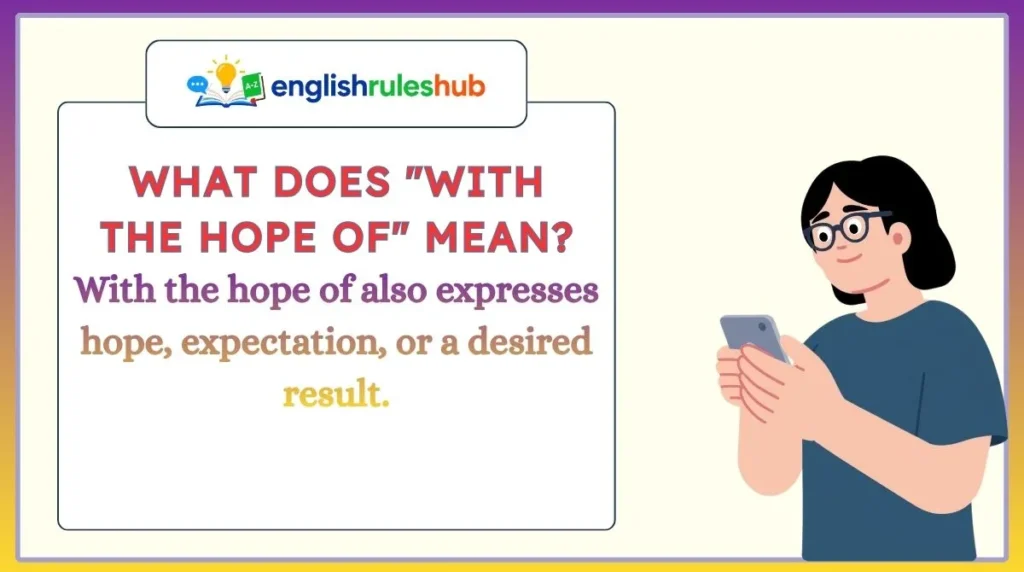
With the hope of also expresses hope, expectation, or a desired result.
However, it is far less common than in the hope of. Native speakers often choose in the hope of because it sounds more natural.
That does not mean with the hope of is wrong. It is grammatically correct, but it usually appears in more formal writing or in situations where the writer wants to emphasize the feeling of hope itself.
Simple Definition
With the hope of = having hope that something will happen while doing something.
When Do We Use It?
Use with the hope of when you want to emphasize that someone carries hope or optimism while taking an action.
It focuses slightly more on the emotional feeling than the purpose.
For example:
- She donated money with the hope of helping poor children.
Here, the sentence highlights the hopeful feeling behind the donation.
Grammar Rule
The structure is almost the same.
Subject + verb + with the hope of + noun/pronoun/-ing verb
Examples:
- He worked harder with the hope of improving his future.
- She waited patiently with the hope of hearing good news.
- They invested carefully with the hope of earning more money.
Again, after of, use a noun or an -ing verb.
Correct:
- with the hope of improving
- with the hope of success
- with the hope of finding
Incorrect:
- with the hope of improve
- with the hope of find
Why Is It Less Common?
English has many natural expressions that speakers prefer.
One of those is in the hope of.
Because of long-term usage, native speakers usually feel that in the hope of sounds smoother.
That is why with the hope of appears much less often in everyday conversation.
You may still find it in:
- speeches
- formal reports
- personal letters
- religious writing
- inspirational writing
Examples of “With the Hope of”
- She wrote the letter with the hope of receiving forgiveness.
- They traveled abroad with the hope of finding better opportunities.
- He saved every dollar with the hope of buying his dream home.
- The charity collected donations with the hope of helping more families.
- We waited quietly with the hope of hearing positive news.
- The teacher encouraged her students with the hope of building their confidence.
- She returned to college with the hope of starting a new career.
- The scientist continued the research with the hope of discovering a cure.
Common Learner Confusion
Many students believe that with the hope of is more correct because it contains the word with.
Actually, that is not true.
Both expressions are correct.
The real difference is naturalness and frequency.
If you want to sound like most native English speakers, in the hope of is usually the better choice.
Another mistake is thinking these phrases can replace every purpose expression.
For example:
✔ She studied to pass the test.
✔ She studied in the hope of passing the test.
Both are natural.
But sometimes a simple infinitive (to + verb) sounds shorter and more conversational.
Good English is not only about grammar. It is also about choosing the expression that sounds the most natural in the situation.
Difference Between “In the Hope of” and “With the Hope of” (Detailed)
Although in the hope of and with the hope of have very similar meanings, they are not used equally often. Both can express a person’s hope or expectation, but one is much more natural in modern English.
If your goal is to sound like a native speaker, it is important to know which phrase fits better in different situations.
Comparison Table
| Feature | In the Hope of | With the Hope of |
|---|---|---|
| Meaning | Doing something because you hope for a result | Doing something while having hope for a result |
| Commonness | Very common | Less common |
| Sounds Natural | Yes | Sometimes less natural |
| Used in Everyday English | Very often | Occasionally |
| Formal Writing | Yes | Yes |
| Spoken English | Very common | Rare |
| Grammar Pattern | In the hope of + noun/-ing verb | With the hope of + noun/-ing verb |
Meaning Difference
Both expressions talk about hope, but they place the focus in slightly different places.
In the hope of focuses on the purpose of the action.
Example:
- She studied in the hope of passing the exam.
The main idea is that she studied because she hoped to pass.
With the hope of focuses a little more on the feeling of hope.
Example:
- She studied with the hope of passing the exam.
This is also correct, but it sounds slightly more formal or literary.
Usage Difference
Native English speakers almost always prefer in the hope of when talking about everyday situations.
Examples:
- We left early in the hope of avoiding traffic.
- He exercised daily in the hope of losing weight.
- They advertised online in the hope of getting more customers.
These sentences sound smooth and natural.
Now compare them:
- We left early with the hope of avoiding traffic.
- He exercised daily with the hope of losing weight.
These are grammatically correct, but many native speakers would naturally choose in the hope of instead.
Grammar Logic
Both expressions follow the same grammar pattern.
Subject + verb + in/with the hope of + noun or -ing verb
Examples:
- She smiled in the hope of making him happy.
- She smiled with the hope of making him happy.
The grammar does not change.
Only the preferred expression changes.
Sentence Structure Difference
Notice these pairs.
Natural
- He invested carefully in the hope of earning more money.
Less Common
- He invested carefully with the hope of earning more money.
Another example:
Natural
- I called you in the hope of getting some advice.
Less Common
- I called you with the hope of getting some advice.
Which One Should You Choose?
If you are unsure, choose in the hope of.
It is:
- more common
- more natural
- widely accepted
- suitable for both speaking and writing
Use with the hope of only when you want to give extra attention to the feeling of hope or when writing in a more formal or literary style.
Grammar Rules You Must Remember
Learning a few simple grammar rules will help you avoid mistakes and make your English sound more natural.
Rule #1: Use an -ing Verb After “Of”
The word of is followed by a noun or a verb ending in -ing.
✅ Correct:
- She waited in the hope of meeting her friend.
- He worked hard with the hope of improving his future.
❌ Incorrect:
- She waited in the hope of meet her friend.
- He worked with the hope of improve his future.
Always remember:
of + verb-ing
Rule #2: Use These Expressions to Show Purpose or Hope
These phrases explain why someone does something.
Example:
- They saved money in the hope of buying a new house.
The action is saving money.
The hoped-for result is buying a house.
Rule #3: “In the Hope of” Is Usually the Better Choice
Even though both expressions are correct, native speakers usually say:
- We arrived early in the hope of getting good seats.
This sounds more natural than:
- We arrived early with the hope of getting good seats.
Rule #4: Don’t Replace Every “To + Verb”
Sometimes a simple infinitive sounds better.
Compare:
- She studied to pass the exam.
- She studied in the hope of passing the exam.
Both are correct.
The second sentence puts more emphasis on the hope behind the action.
Choose the one that best fits your message.
Common Mistakes Students Make
Many learners make small mistakes because both expressions look almost identical.
Here are the most common ones.
Mistake 1: Using the Wrong Verb Form
❌ She practiced in the hope of win.
✅ She practiced in the hope of winning.
Tip:
Always use verb + ing after of.
Mistake 2: Thinking Both Expressions Are Used Equally
Many students write:
- We left early with the hope of catching the train.
Although correct, native speakers usually say:
- We left early in the hope of catching the train.
Tip:
If you are unsure, choose in the hope of.
Mistake 3: Using Them Without a Purpose
These expressions must explain the goal.
❌ She is happy in the hope of.
This sentence is incomplete.
✅ She is waiting in the hope of hearing good news.
Mistake 4: Confusing Them with “Hope to”
Compare these:
- I hope to see you tomorrow.
- I waited in the hope of seeing you.
Both express hope, but the sentence structures are different.
Mistake 5: Forgetting That Simpler English Is Sometimes Better
Sometimes students use long phrases when a short one works well.
Example:
- I called you to ask a question.
This is often more natural than:
- I called you in the hope of asking a question.
Choose the simpler expression when possible.
Easy Trick to Remember the Difference
A simple memory trick can help you remember which phrase sounds more natural.
Think about the word in.
Imagine you are inside your hope while doing something.
You are acting in the hope that something good will happen.
Now think about with.
It sounds as if hope is simply coming along with you.
This is possible, but English speakers usually prefer the first picture.
Another easy trick is this:
- In the hope of = the normal choice.
- With the hope of = the less common choice.
If you remember only one thing, remember this:
When in doubt, use “in the hope of.”
It is the expression that native speakers use most often in everyday English.
Daily Life Examples
These examples show how people naturally use these expressions in everyday conversations.
- I left work early in the hope of beating the traffic.
- She called her sister in the hope of getting some advice.
- We booked our tickets early in the hope of saving money.
- He studied every evening in the hope of passing the driving test.
- They opened another shop in the hope of attracting more customers.
- She waited outside with the hope of meeting her favorite singer.
- The family moved to another city with the hope of finding better jobs.
- We donated clothes with the hope of helping people in need.
- He apologized in the hope of fixing their friendship.
- They planted flowers in the hope of making the garden more beautiful.
These examples show that in the hope of appears much more naturally in everyday speech, while with the hope of is used less often but is still grammatically correct.
Practice Section
Now it’s your turn to practice! Choose the correct phrase in each sentence.
Choose the Correct Answer
1. She saved money ______ buying a new laptop.
a) in the hope of
b) with the hope of
2. We arrived early ______ getting front-row seats.
a) in the hope of
b) with the hope of
3. The charity raised funds ______ helping homeless families.
a) in the hope of
b) with the hope of
4. He continued his research ______ finding a cure for the disease.
a) in the hope of
b) with the hope of
5. I called my teacher ______ getting some extra help before the exam.
a) in the hope of
b) with the hope of
Answers
- a) in the hope of (Most natural choice.)
- a) in the hope of (This is the expression native speakers usually use.)
- a) in the hope of (Although with the hope of is possible, in the hope of sounds more natural.)
- a) in the hope of (The preferred expression in modern English.)
- a) in the hope of (This is the most common and natural wording.)
Bonus Challenge
Rewrite these sentences using in the hope of.
- She exercised to become healthier.
- We left early to avoid traffic.
- They invested more money to increase sales.
Possible Answers
- She exercised in the hope of becoming healthier.
- We left early in the hope of avoiding traffic.
- They invested more money in the hope of increasing sales.
Frequently Asked Questions (FAQs)
Is there a difference between in the hope of and with the hope of?
Yes. Both expressions are grammatically correct and express hope, but in the hope of is much more common and natural. Native English speakers usually choose it in both spoken and written English. With the hope of is less common and often sounds more formal or literary.
Can I use with the hope of in everyday English?
Yes, you can. People will understand what you mean. However, in the hope of is the expression most native speakers naturally use in everyday conversations. If you want your English to sound more fluent, it is usually the better choice.
Can these expressions be used in questions?
Yes. Both phrases can appear in questions.
Examples:
- Did you call him in the hope of getting an answer?
- Were they waiting with the hope of hearing good news?
The grammar stays the same in questions.
Are these expressions formal or informal?
In the hope of works well in both formal and informal English. You can use it in conversations, emails, reports, essays, and newspaper articles. With the hope of is generally more common in formal or literary writing than in casual speech.
What comes after in the hope of?
After of, use a noun or a verb ending in -ing.
Correct:
- in the hope of success
- in the hope of winning
Incorrect:
- in the hope of win
- in the hope of to win
Remember the simple rule:
of + noun or verb-ing
Which expression should English learners use?
For most situations, choose in the hope of. It is more common, sounds more natural, and is accepted in almost every type of English. Once you become more confident, you can also use with the hope of when you want to give extra emphasis to the feeling of hope.
Final Conclusion
The difference between in the hope of and with the hope of is small, but understanding it can make your English sound much more natural.
Both expressions are correct and both describe doing something because you hope for a positive result.
The main difference is that in the hope of is the expression that native speakers use far more often in everyday English.
A good habit is to remember the grammar pattern of + noun or verb-ing. This simple rule will help you avoid many common mistakes.
Also, remember that a shorter expression such as to + verb is sometimes a better choice when you want to keep your sentence simple.
The more you read, listen, and practice, the easier these expressions will become. Try writing your own sentences using in the hope of and with the hope of.
With regular practice, you will soon know which phrase sounds right without even thinking about it.
Small grammar improvements like this can make a big difference in your confidence and fluency.

I am Benjamin Clark, an English language writer passionate about simplifying grammar, vocabulary, and word meanings. I create clear, accurate, and practical content to help learners improve their English skills with confidence every day.