English has many words that look almost the same but have different spellings. One common example is labor and labour.
Many English learners wonder if these words have different meanings or if one of them is wrong.
This confusion becomes even bigger when students read books from different countries or watch videos made by different English speakers.
The good news is that both spellings are correct. The difference is not about grammar or meaning. Instead, it depends on which type of English you are using.
Some countries prefer one spelling, while others use the other. If you do not know this rule, you may think someone has made a spelling mistake when they have not.
Understanding this difference is very important because English is used around the world. You may write emails, school assignments, business reports, or social media posts for people from different countries.
Using the correct spelling for your audience makes your writing look more natural and professional.
Many learners also confuse these words because they appear in common expressions such as labor market, labour market, labor laws, Labour Party, and manual labor.
These examples can make it seem like there is a grammar difference, but there really is not.
After reading this guide, you will clearly understand what labor means, what labour means, why the spellings are different, when to use each one, and how to avoid common mistakes.
You will also see plenty of simple examples from everyday English so you can remember the difference with confidence.
What Does “Labor” Mean?
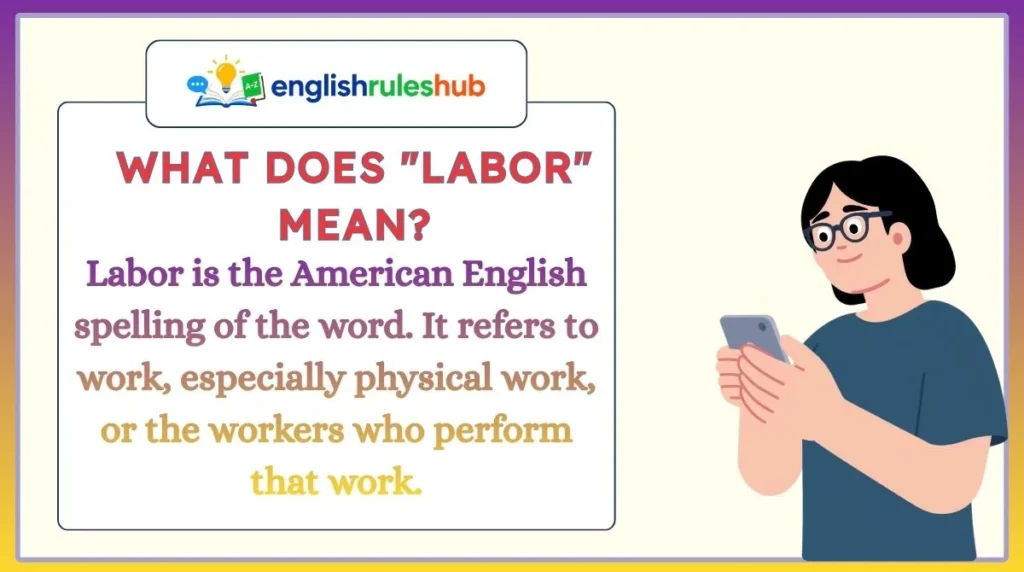
Labor is the American English spelling of the word. It refers to work, especially physical work, or the workers who perform that work. It can also describe the process of giving birth in medical English.
If you are writing for people in the United States, the correct spelling is labor.
When to Use “Labor”
Use labor when:
- You are writing in American English.
- Your audience is mainly in the United States.
- You are following American spelling rules.
- You are writing about work, workers, employment, or childbirth.
Grammar Rule
Labor is mainly used as a noun, but it can also be used as a verb.
As a noun, it means work or workers.
- The project required a lot of labor.
- Farm labor is important during harvest season.
As a verb, it means to work very hard or to struggle.
- They labored for many hours to finish the bridge.
- She labored over her speech until it sounded perfect.
Notice that the verb forms in American English also follow American spelling:
- labor
- labored
- laboring
Examples of “Labor”
- The workers finished the road after weeks of labor.
- My uncle works in the construction labor industry.
- The company needs more skilled labor this year.
- The doctor said she was in labor early this morning.
- Many students study American labor history.
- Physical labor can be very tiring during summer.
- The factory depends on local labor to keep production running.
- They labored day and night to complete the building.
Common Uses of “Labor”
Here are some expressions you will often see in American English.
- labor market
- labor force
- labor union
- labor laws
- Department of Labor
- manual labor
- child labor
These phrases are standard in the United States and should not be changed if you are writing in American English.
Common Learner Confusion
Many learners think labor and labour have different meanings. They do not. They both refer to the same idea of work or childbirth.
For example:
- American English: The country needs more skilled labor.
- British English: The country needs more skilled labour.
Both sentences are correct. The only difference is the spelling.
Another common mistake is mixing spellings in the same document.
❌ The company needs skilled labour, and the Labor Department will help.
This mixes British and American English.
✅ American English:
The company needs skilled labor, and the Department of Labor will help.
✅ British English:
The company needs skilled labour, and the government will help workers.
The best rule is to choose one style of English and use it consistently throughout your writing.
What Does “Labour” Mean?
Labour is the British English spelling of the same word. It has exactly the same meanings as labor. It can refer to work, workers, physical effort, employment, or the process of giving birth.
If you are writing for readers in the United Kingdom, Canada (in most cases), Australia, New Zealand, or many other Commonwealth countries, labour is usually the preferred spelling.
Unlike many confusing English word pairs, labour is not a different word. It is simply the British spelling of labor.
When to Use “Labour”
Use labour when:
- You are writing in British English.
- Your audience is in the UK or another country that follows British spelling.
- You are following British style guides.
- Your school, employer, or publisher prefers British English.
Grammar Rule
Like labor, labour can be both a noun and a verb.
As a noun, it means work, workers, or childbirth.
Examples:
- Skilled labour is difficult to find in some areas.
- She went into labour late at night.
As a verb, it means to work hard or struggle.
Examples:
- They laboured for months to complete the project.
- He laboured over every detail of the report.
British verb forms include:
- labour
- laboured
- labouring
Examples of “Labour”
- The builders completed the house through months of hard labour.
- The farm depends on seasonal labour every summer.
- Skilled labour is valuable in every country.
- She went into labour before sunrise.
- The workers demanded better labour conditions.
- They laboured through the cold weather.
- The company invested in training its labour force.
- Honest labour deserves respect and fair pay.
Common British Expressions
In British English, you may often see phrases such as:
- labour market
- labour force
- labour laws
- manual labour
- cheap labour
- forced labour
- Labour Party
One important point is the Labour Party in the United Kingdom always uses the spelling Labour because it is the official name of the political party.
Common Learner Confusion
Many students believe labour sounds different from labor. In fact, the pronunciation is almost identical. The difference is mainly in the spelling, not the pronunciation.
Another confusion happens when students switch between American and British spelling in one essay.
For example:
❌ The company needs more labor, but skilled labour is difficult to find.
This is inconsistent.
Instead, choose one style.
✅ American English:
The company needs more labor, but skilled labor is difficult to find.
✅ British English:
The company needs more labour, but skilled labour is difficult to find.
Being consistent is one of the easiest ways to make your English writing look natural and professional.
Difference Between Labor and Labour (Detailed)
Many English learners spend a lot of time trying to find a difference in meaning between labor and labour. The truth is simple: there is no difference in meaning. They both refer to work, workers, physical effort, or the process of giving birth.
The only real difference is spelling, and that spelling depends on the type of English you are using.
If you are writing in American English, use labor.
If you are writing in British English, use labour.
Think of it like other spelling pairs:
- Color → Colour
- Honor → Honour
- Neighbor → Neighbour
- Favor → Favour
- Labor → Labour
American English usually removes the letter “u”, while British English keeps it.
Labor vs Labour Comparison Table
| Feature | Labor | Labour |
|---|---|---|
| English style | American English | British English |
| Meaning | Work, workers, childbirth | Work, workers, childbirth |
| Correct spelling | USA | UK, Australia, New Zealand, and most Commonwealth countries |
| Part of speech | Noun and verb | Noun and verb |
| Pronunciation | Almost the same | Almost the same |
| Formal writing | Correct in American English | Correct in British English |
| Informal writing | Correct | Correct |
Usage Difference
The meaning stays the same, but the audience changes.
For example:
American English
- The company needs more skilled labor.
- The patient is in labor.
- Manual labor is physically demanding.
British English
- The company needs more skilled labour.
- The patient is in labour.
- Manual labour is physically demanding.
Notice that only the spelling changes.
Grammar Logic
English has several spelling systems because it is spoken in many countries.
American English follows spelling reforms that made some words shorter.
British English keeps many of the older spellings that include the letter “u.”
This is why you see:
| American English | British English |
|---|---|
| Color | Colour |
| Favorite | Favourite |
| Honor | Honour |
| Neighbor | Neighbour |
| Labor | Labour |
These are spelling differences only.
Sentence Structure Difference
The sentence structure does not change.
American English:
- The factory hired more labor.
- She went into labor yesterday.
British English:
- The factory hired more labour.
- She went into labour yesterday.
The grammar is exactly the same.
Meaning Comparison
Both words can mean:
- Physical work
- Hard work
- Workers
- Employment
- Childbirth
- The act of working hard
There is no special meaning that belongs only to one spelling.
The choice depends only on your spelling style.
Grammar Rules You Must Remember
Learning a few simple rules will help you use these spellings correctly every time.
Rule #1: Match the English Style
Choose American English or British English before you start writing.
✅ American English
- The company hired more labor.
✅ British English
- The company hired more labour.
Do not switch between the two styles in one piece of writing.
Rule #2: Keep the Same Spelling Throughout Your Writing
Consistency is very important.
❌ Incorrect
The country needs skilled labor, but cheap labour is still common.
✅ Correct (American English)
The country needs skilled labor, but cheap labor is still common.
✅ Correct (British English)
The country needs skilled labour, but cheap labour is still common.
Rule #3: Use the Correct Spelling for Official Names
Some organizations have official spellings that never change.
Examples:
- U.S. Department of Labor
- UK Labour Party
Do not change these names.
❌ Department of Labour (when referring to the U.S.)
✅ Department of Labor
❌ Labor Party (when referring to the UK political party)
✅ Labour Party
Always respect official titles.
Rule #4: Remember That Meaning Never Changes
Do not spend time looking for different meanings.
These sentences all mean the same thing.
American English:
- Hard labor built this bridge.
British English:
- Hard labour built this bridge.
The only difference is spelling.
Common Mistakes Students Make
Many learners make small mistakes because they see both spellings online.
Here are the most common ones.
Mistake 1: Mixing American and British English
❌ Wrong
The company needs more labor, and skilled labour is difficult to find.
✅ Correct (American)
The company needs more labor, and skilled labor is difficult to find.
✅ Correct (British)
The company needs more labour, and skilled labour is difficult to find.
Tip: Pick one spelling style before you begin writing.
Mistake 2: Thinking One Spelling Is Wrong
Some students believe only one spelling is correct.
That is not true.
Both spellings are correct.
The only question is:
Who will read your writing?
If your readers are American, use labor.
If your readers are British or follow British English, use labour.
Mistake 3: Changing Official Names
Official names should always stay the same.
❌ Wrong
United States Department of Labour
✅ Correct
United States Department of Labor
❌ Wrong
British Labor Party
✅ Correct
British Labour Party
Mistake 4: Believing the Pronunciation Is Different
Many beginners try to pronounce the words differently.
Actually, native speakers pronounce them almost the same.
Your spelling changes.
Your pronunciation usually does not.
Mistake 5: Forgetting the Audience
A student may write an assignment for a British school using American spelling.
Or they may write for an American company using British spelling.
Neither spelling is incorrect, but matching your audience makes your writing look much more natural.
Easy Trick to Remember the Difference
Here is a simple memory trick.
Think About the Letter “U”
British English loves the extra “U.”
Look at these words:
- Colour
- Favourite
- Honour
- Neighbour
- Labour
American English usually removes the “U.”
- Color
- Favorite
- Honor
- Neighbor
- Labor
So remember this sentence:
Britain keeps the “U.” America usually does not.
That one sentence can help you remember dozens of English spelling differences.
Another Easy Way
Imagine writing a letter.
If you are sending it to someone in New York, write labor.
If you are sending it to someone in London, write labour.
The meaning stays the same.
Only the spelling changes.
This simple habit will help you choose the correct form every time.
Daily Life Examples (Very Important)
The easiest way to remember the difference between labor and labour is to see how these words are used in everyday situations. The examples below sound natural and show how native speakers use the correct spelling depending on the variety of English.
Everyday Conversation Examples
- American English: The company is looking for skilled labor before the busy season starts.
- British English: The factory needs more skilled labour to meet customer demand.
- American English: My uncle does manual labor, and he enjoys working outdoors.
- British English: Many farms hire extra labour during the harvest season.
- American English: The doctor said my sister was in labor, so everyone rushed to the hospital.
- British English: Sarah went into labour early this morning, and the baby arrived a few hours later.
- American English: Rising labor costs have affected many businesses.
- British English: The company is trying to reduce labour costs without cutting jobs.
- American English: The new labor laws protect workers’ rights.
- British English: The government announced new labour policies for employees.
Short Dialogues
Dialogue 1 (American English)
Tom: Why is the factory hiring so many people?
Mike: They need more skilled labor because business is growing.
Dialogue 2 (British English)
Emma: Why are there so many job advertisements?
Lucy: Many companies cannot find enough skilled labour.
Dialogue 3 (American English)
Nurse: The baby will arrive soon.
Father: Is my wife in labor?
Nurse: Yes, everything is going well.
Dialogue 4 (British English)
Doctor: Your wife has gone into labour.
Husband: Thank you. We’ll get ready.
These examples show that the meaning never changes. Only the spelling changes to match American or British English.
Practice Section
Choose the correct word to complete each sentence.
1. The company needs more skilled ________.
a) labor
b) labour
(Assume you are writing in American English.)
2. The patient went into ________ during the night.
a) labor
b) labour
(Assume you are writing in British English.)
3. Manual ________ can be physically demanding.
a) labor
b) labour
(Assume you are writing in British English.)
4. The U.S. Department of ________ announced new rules.
a) Labor
b) Labour
5. Which sentence is consistent?
a) The company needs skilled labor and cheap labour.
b) The company needs skilled labour and cheap labour.
Answers
1. a) labor
2. b) labour
3. b) labour
4. a) Labor
5. b) The company needs skilled labour and cheap labour.
Bonus Tip: If the sentence uses only one variety of English, you have chosen the correct answer.
Frequently Asked Questions (FAQs)
1. What is the difference between labor and labour?
There is no difference in meaning. The only difference is the spelling. Labor is the American English spelling, while labour is the British English spelling. Choose the one that matches the type of English you are using.
2. Which spelling should I use in the United States?
If you are writing for an American audience, always use labor. It is the standard spelling in schools, newspapers, businesses, and government documents across the United States.
3. Which countries use the spelling “labour”?
Labour is commonly used in the United Kingdom, Australia, New Zealand, and many Commonwealth countries. Canada often follows British spelling in formal writing, although both spellings may appear depending on the style guide.
4. Can I use labor and labour in the same document?
It is better not to mix them. Pick either American English or British English and use that spelling consistently from beginning to end. Consistent spelling makes your writing look more professional.
5. Do labor and labour have different pronunciations?
No. They are pronounced almost the same. Native speakers usually do not change the pronunciation because of the spelling. The difference is mainly seen in writing.
6. Is one spelling more formal than the other?
No. Neither spelling is more formal. Both are correct. The right choice depends on your audience and the English style you are following, not on the level of formality.
Final Conclusion
Understanding the difference between labor and labour is much easier than many English learners expect.
These two words have the same meaning, the same grammar, and almost the same pronunciation. The only real difference is the spelling.
Use labor when writing in American English and labour when writing in British English or other varieties that follow British spelling.
The most important rule is to stay consistent throughout your writing. Avoid mixing the two spellings in the same document unless you are quoting or referring to an official name.
A simple way to remember the difference is this: British English usually keeps the letter “u,” while American English often removes it.
Once you remember this pattern, you will also find it easier to spell many other English words correctly.
Keep reading, writing, and practicing with real-life examples. The more you use these spellings in context, the more natural they will become.
With regular practice, choosing between labor and labour will soon become quick, easy, and automatic.

I am Benjamin Clark, an English language writer passionate about simplifying grammar, vocabulary, and word meanings. I create clear, accurate, and practical content to help learners improve their English skills with confidence every day.