Economic and economical look almost the same, so it is easy to mix them up. Both words are connected with money, spending, business, and resources, but they do not have the same meaning.
This small difference can cause big problems for English learners. For example, we say economic growth, but we normally say an economical car.
We can talk about an economic problem, but if we mean that something does not cost much to use, economical is usually the better word.
The confusion becomes even stronger because both words come from the same root, economy. They are also both adjectives. However, they describe different ideas.
The easiest way to understand the difference is to look at what the adjective is describing.
Economic usually relates to the economy, business, trade, money systems, or financial conditions. Economical usually means saving money, time, fuel, energy, or other resources.
Once you understand this basic idea, the difference becomes much easier.
You will learn how to use both words correctly, how their sentence structures differ, which common mistakes to avoid, and how native speakers use them in everyday English.
By the end, you should feel much more confident choosing between economic and economical.
What Does “Economic” Mean?
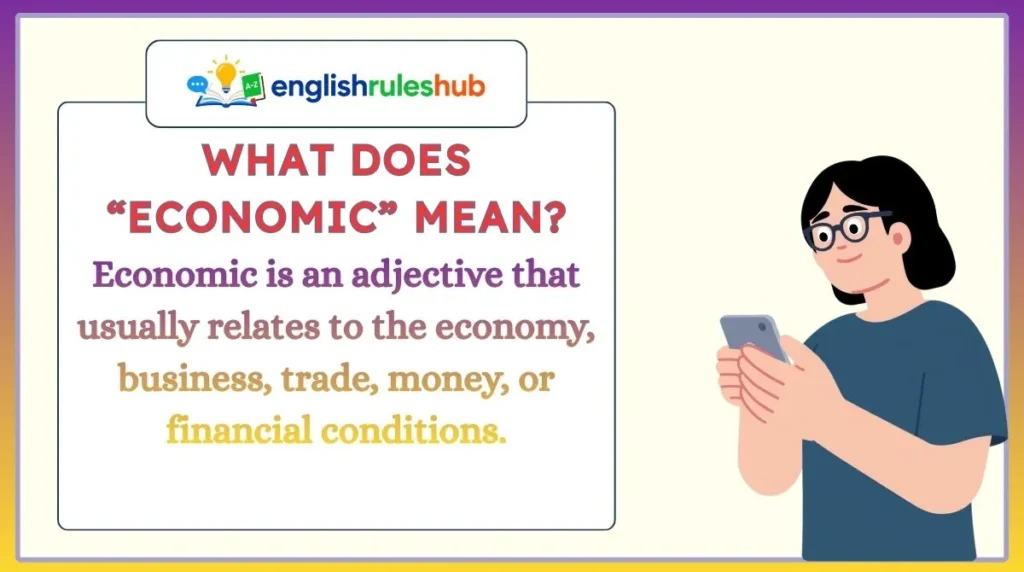
Economic is an adjective that usually relates to the economy, business, trade, money, or financial conditions.
When we use economic, we are often talking about something connected with the larger financial system of a country, region, company, or society.
For example:
- economic growth
- economic problems
- economic development
- economic policy
- economic conditions
- economic crisis
- economic activity
- economic changes
Here, economic does not usually mean “cheap.” It means related to the economy or financial system.
When should you use “economic”?
Use economic when you are talking about the way money, business, trade, jobs, production, or resources affect a country, company, or society.
For example, if a country has more jobs and produces more goods, you might talk about its economic growth.
If prices rise and people have less money to spend, you might talk about economic difficulties.
If a government changes its financial plans, you could call them economic policies.
Grammar rule for “economic”
Economic is an adjective.
It usually comes before a noun:
economic + noun
Examples:
- economic growth
- economic policy
- economic activity
- economic situation
It can also come after a linking verb:
The situation is economic-related. ❌
Be careful here. Economic itself does not normally work in every position where you might want to use it. We usually need a suitable noun after it.
For example:
The country is facing serious economic problems.
The adjective economic describes the noun problems.
Examples of “economic”
- The country is experiencing strong economic growth.
- The government is trying to solve its economic problems.
- Economic conditions have changed over the past year.
- The company is worried about the current economic situation.
- The new policy could support economic development.
- Many families are affected by economic changes.
- The minister spoke about the country’s economic future.
- Economic activity increased after the new businesses opened.
Notice that these examples are not mainly about whether something is cheap or expensive. They are about the economy, business, money systems, and financial conditions.
A common confusion with “economic”
Many learners see the word economic and immediately think of saving money.
That is not usually the meaning.
For example:
This car is economic. ❌
If you mean that the car uses little fuel and costs less to operate, economical is usually the natural choice:
This car is economical. ✅
But:
The country is facing economic problems. ✅
Here, economic is correct because the sentence is about the country’s financial situation.
A useful question to ask yourself is:
“Am I talking about the economy, or am I talking about saving resources?”
If you are talking about the economy, economic is usually the answer.
What Does “Economical” Mean?
Economical is an adjective that usually means using money or resources carefully and avoiding waste.
It can describe something that costs less to operate or use.
For example, an economical car may use less fuel. An economical heating system may use less energy. An economical method may save time or money.
So, economical often carries the idea of efficiency and saving.
When should you use “economical”?
Use economical when you want to say that something is a good way to save money, fuel, energy, time, materials, or other resources.
For example:
- an economical car
- an economical choice
- an economical method
- an economical solution
- an economical way to travel
- an economical use of energy
The important idea is not wasting resources.
Grammar rule for “economical”
Like economic, economical is an adjective.
It can come before a noun:
economical + noun
Examples:
We need an economical solution.
She bought an economical car.
It can also come after a linking verb:
This car is very economical.
Here, economical tells us that the car is inexpensive to run or uses resources efficiently.
Examples of “economical”
- This small car is very economical.
- Taking the train is an economical way to travel.
- We need an economical solution to the problem.
- LED lights are economical because they use less energy.
- Cooking at home is often more economical than eating out.
- She chose an economical washing machine.
- Buying a larger pack can be more economical.
- This method is economical and easy to use.
In these examples, economical suggests saving money or resources.
A common confusion with “economical”
Learners sometimes use economic when they really mean economical.
For example:
My new car is very economic. ❌
If you mean that it uses little fuel, a more natural sentence is:
My new car is very economical. ✅
Similarly:
Walking is an economical way to travel. ✅
This means walking can save money.
But:
Economic transportation is important for a country.
This could refer to transportation as part of a country’s economy, although the intended meaning may need more context.
The two words are close, but economical focuses on saving or avoiding waste, while economic focuses on the economy or financial system.
Difference Between Economic and Economical
The simplest difference is this:
Economic = related to the economy.
Economical = good at saving money or resources.
That one idea will solve most of your problems.
Comparison table
| Word | Main meaning | Usually describes | Example |
|---|---|---|---|
| Economic | Related to the economy or financial system | Growth, policy, problems, conditions, activity | Economic growth |
| Economical | Saving money or resources | Cars, methods, choices, systems, solutions | An economical car |
Usage difference
Compare these two sentences:
The country is facing economic problems.
This car is economical.
The first sentence is about the financial condition of a country.
The second sentence is about saving money or fuel.
This is the key difference.
Economic = the bigger financial picture
Think about a country.
You might discuss:
- economic growth
- economic development
- economic policy
- economic conditions
- economic problems
- economic activity
- economic changes
These all describe things connected with the economy.
For example:
The government wants to encourage economic growth.
The sentence is about the country’s economy.
Economical = saving resources
Now think about a person choosing a car.
They may want a car that:
- uses less fuel
- costs less to operate
- does not waste energy
- is cheaper to maintain
They might say:
I want an economical car.
Here, the focus is on saving resources.
Grammar logic
Both words are adjectives, but they describe different qualities.
Economic answers something like:
“Is this connected with the economy?”
Economical answers:
“Does this save money or resources?”
This simple question is extremely useful.
Sentence structure
Both can appear before nouns.
With economic:
economic + noun
Examples:
economic crisis
economic policy
economic growth
With economical:
economical + noun
Examples:
economical car
economical choice
economical solution
Both structures look similar, which is one reason learners confuse them.
The meaning of the noun, however, gives you a strong clue.
Meaning comparison
Consider these pairs:
Economic policy
A policy related to the economy.
Economical policy
A policy designed to avoid unnecessary spending or waste.
Another pair:
Economic problem
A problem connected with the economy.
Economical solution
A solution that saves money or resources.
So the ending -al in economical helps create the idea of using something carefully and efficiently.
Grammar Rules You Must Remember
Rule #1: Use “economic” for the economy
Use economic when the subject is connected with a country’s, company’s, or society’s economy.
Examples:
The country needs economic reform.
Economic growth has slowed.
We are studying economic policy.
A simple test is:
Can I replace the word with “related to the economy”?
If yes, economic is probably correct.
Rule #2: Use “economical” for saving resources
Use economical when something helps you save money, fuel, time, energy, or materials.
Examples:
This car is economical.
We found an economical way to travel.
The new system is more economical.
Ask yourself:
Does it save resources or avoid waste?
If yes, economical is usually the right word.
Rule #3: “Economic” does not normally mean “cheap”
This is one of the most important rules.
Do not automatically use economic when you mean something is inexpensive.
For example:
This washing machine is economic. ❌
If you mean it uses less electricity and costs less to operate:
This washing machine is economical. ✅
Similarly:
Cooking at home is economical. ✅
It means cooking at home can help you save money.
Rule #4: Look at the noun and the intended meaning
Sometimes both words may appear possible at first glance, but the meaning changes.
Compare:
economic decision
This means a decision connected with economic matters.
economical decision
This means a decision that saves money or avoids waste.
The noun decision can work with either adjective, but the meaning is different.
So do not choose only by looking at the noun. Think about what you want to say.
Common Mistakes Students Make
Mistake 1: Using “economic” for a fuel-saving car
Wrong:
I bought an economic car.
Better:
I bought an economical car.
Why?
Because the speaker is talking about fuel use and running costs, not the country’s economy.
Mistake 2: Using “economical” for national financial problems
Wrong:
The country is facing economical problems.
Better:
The country is facing economic problems.
Why?
The problems are connected with the economy.
Mistake 3: Thinking “economic” always means cheap
This is a very common misunderstanding.
The word economic is connected to the noun economy. It does not normally mean “cheap.”
For example:
economic growth
does not mean “cheap growth.”
It means growth related to the economy.
Mistake 4: Thinking the two words can always replace each other
They cannot.
Compare:
economic development
This means development connected with the economy.
economical development
This would suggest development that is economical or resource-saving, which is a different idea and is not the usual expression in many contexts.
The meaning changes when you change the adjective.
Mistake 5: Choosing based only on spelling
Some learners think:
Economic and economical look almost the same, so they must have almost the same use.
They are related, but English often uses related words for different ideas.
Instead of memorising every expression separately, learn the central meanings:
Economic → economy
Economical → saving
That will help you make new sentences too.
Easy Trick to Remember the Difference
Here is a simple classroom trick.
Think: Economy vs Saving
When you see economic, think:
ECONOMY
When you see economical, think:
SAVE
That is enough for most everyday situations.
Imagine two students.
The first student is reading about a country’s financial situation. He sees words such as:
- inflation
- jobs
- trade
- production
- growth
- government policy
He needs economic.
The second student is shopping for a car. She wants to spend less on fuel.
She needs economical.
So remember:
Economic talks about the economy.
Economical talks about saving.
Another quick memory trick
Look at the extra -al in economical.
You can connect it with the idea:
Economical = efficient use.
An economical person does not like to waste money.
An economical machine does not waste energy.
An economical car does not use too much fuel.
This is not a strict grammar rule, but it is a helpful memory trick.
Daily Life Examples
Here are some natural examples you may hear or use in everyday English.
Example 1: Talking about a car
A: How is your new car?
B: I really like it. It’s very economical.
Here, economical means the car does not use too much fuel or cost too much to run.
Example 2: Talking about travel
A: How are you getting to Manchester?
B: I’m taking the train. It’s more economical than driving.
The speaker means the train is a more money-saving option.
Example 3: Talking about a country
A: Why are food prices rising?
B: There are several economic factors behind it.
Here, economic relates to the wider financial situation.
Example 4: Talking about a family budget
A: We need to reduce our monthly spending.
B: Cooking at home would be more economical.
The idea is saving money.
Example 5: Talking about government policy
A: What was the minister discussing?
B: She was talking about economic policy.
The subject is the country’s economy.
Example 6: Talking about electricity
A: Why did you replace those old lights?
B: The new ones are more economical.
They use resources more efficiently and can reduce electricity costs.
Example 7: Talking about business
A: Why is the company changing its plans?
B: The economic situation has become difficult.
The phrase refers to the wider financial environment.
Example 8: Talking about shopping
A: Should I buy the small packet or the large one?
B: The larger one is more economical if you use it often.
Here, the larger option gives better value and may reduce the cost per unit.
Example 9: Talking about a solution
A: We need to fix the office heating system.
B: I think this is the most economical solution.
The speaker means it will save money or resources.
Example 10: Talking about a country
A: How is the country doing?
B: Its economic situation is improving.
Here, economic describes the country’s financial condition.
Practice Section
Choose economic or economical in each sentence.
1. The country is facing serious ______ problems.
A. economic
B. economical
2. This car is very ______ because it uses little fuel.
A. economic
B. economical
3. The government announced a new ______ policy.
A. economic
B. economical
4. We need a more ______ way to heat the house.
A. economic
B. economical
5. The company is worried about current ______ conditions.
A. economic
B. economical
Answers
1. Economic — The sentence is about the country’s economy.
2. Economical — The car saves fuel and money.
3. Economic — The policy is related to the economy.
4. Economical — The method saves energy or money.
5. Economic — The conditions are related to the financial situation.
A good way to check your answers is to ask:
“Is this about the economy?” → economic
“Is this about saving?” → economical
FAQs
What is the difference between economic and economical?
Economic means related to the economy, business, trade, or financial conditions.
Economical means using money or resources carefully and avoiding waste.
For example, economic growth relates to the economy, while an economical car saves fuel or money.
Can “economical” mean cheap?
Yes, but it is usually more accurate to think of economical as “costing less to use or operate” or “saving resources.”
For example:
This car is economical.
This can mean that the car uses little fuel and costs less to run.
It does not necessarily mean that the car itself was cheap to buy.
Can we use “economic” to describe a car?
Sometimes you may see economic used in particular contexts, but if you mean that a car uses little fuel or costs less to run, economical is the normal choice.
For example:
This is an economical car.
This clearly tells the listener that the car is efficient and does not waste much fuel or money.
Is “economic” formal or informal?
Economic is neither simply formal nor informal. It is a standard English adjective used in everyday speech, education, journalism, business, and academic writing.
You will often hear phrases such as economic growth, economic conditions, and economic problems in both spoken and written English.
Is “economical” only about money?
No. Economical can refer to the careful use of several resources.
It can describe something that saves money, fuel, energy, time, materials, or effort.
For example:
This method is economical.
Depending on the context, it could mean that the method is inexpensive, efficient, or does not waste resources.
Which is correct: “economic car” or “economical car”?
If you mean that the car uses little fuel or is inexpensive to operate, economical car is the better choice.
For example:
I want an economical car for my daily commute.
If you mean something related to the wider economy, then economic may be appropriate, but that would be a different meaning.
Final Conclusion
Economic and economical are closely related words, but they are not interchangeable.
Use economic when you are talking about the economy, business, trade, financial conditions, or economic systems. Common examples include economic growth, economic policy, and economic problems.
Use economical when you mean saving money or using resources without waste. Common examples include an economical car, an economical solution, and an economical way to travel.
If you are ever unsure, stop and ask yourself one simple question:
Am I talking about the economy or about saving?
If the answer is the economy, choose economic. If the answer is saving money or resources, choose economical.
Do not worry if you confuse these words at first. They look very similar, and that is why many learners make the same mistake.
Keep noticing them in real sentences, and try making a few sentences of your own. With a little practice, the difference will start to feel natural.

I am Benjamin Clark, an English language writer passionate about simplifying grammar, vocabulary, and word meanings. I create clear, accurate, and practical content to help learners improve their English skills with confidence every day.