Enquiry vs inquiry is a small English difference that can cause a lot of confusion, especially for learners who use British and American English.
Both words are nouns, both are connected with asking for information, and in many situations they can mean almost the same thing.
So, why are there two spellings?
The main reason is English variety. British English often uses enquiry for a general request for information, while inquiry is more common in American English.
However, British English also uses inquiry, especially when talking about a formal investigation.
This can make things tricky. You may see a sign saying “General Enquiries” in the UK, while an American website may say “General Inquiries.” Neither spelling is automatically wrong.
The difference becomes even more interesting when we look at formal investigations. In British English, inquiry can have a special meaning: an official or detailed investigation into an event or problem.
For example, someone may make an enquiry about train times, but the government may start an inquiry into a serious accident.
After learning the difference, you will know when to use enquiry, when to use inquiry, why both forms appear in English, and how British and American usage can differ.
You will also see simple examples that you can use in everyday conversations, emails, schools, offices, shops, and other real-life situations.
What Does “Enquiry” Mean?
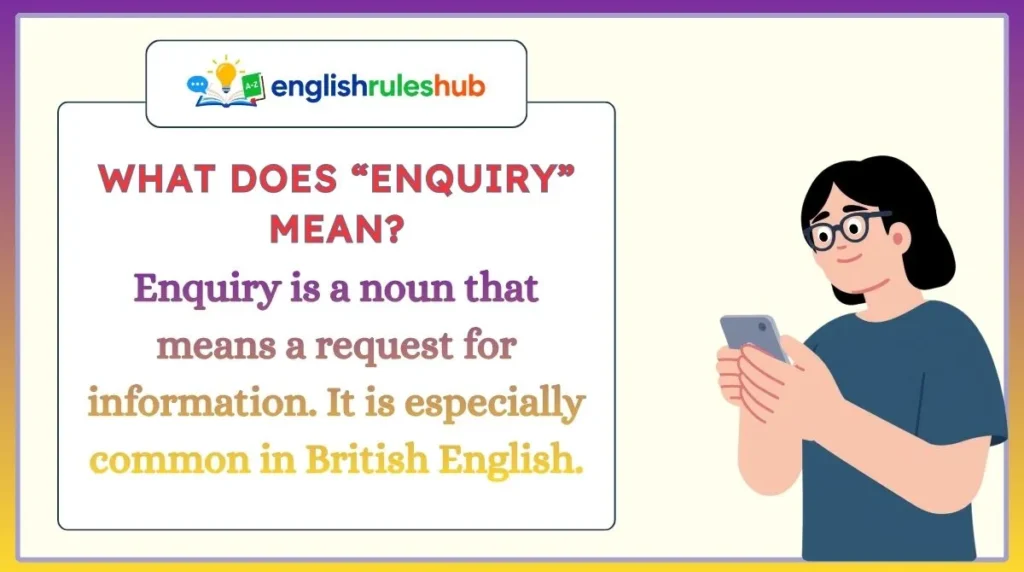
Enquiry is a noun that means a request for information. It is especially common in British English.
When you want to ask someone for information about something, you can make an enquiry.
For example, if you want to know the price of a course, you can make an enquiry about the course. If you want to know when a train leaves, you can make an enquiry about the train time.
The word is often used in everyday and business situations.
When Do We Use “Enquiry”?
We commonly use enquiry when someone wants information about:
- a product
- a service
- a course
- a hotel
- a job
- a booking
- prices
- opening times
- travel arrangements
- an appointment
It is especially natural in British English.
For example:
I made an enquiry about the English course.
This simply means that you asked for information about the course.
Grammar Rule for “Enquiry”
Enquiry is a countable noun.
You can use:
- an enquiry
- the enquiry
- my enquiry
- your enquiry
- several enquiries
- general enquiries
The plural form is enquiries, not enquirys.
For example:
I have an enquiry about my order.
We received several enquiries yesterday.
You will often see “Enquiries” on British websites, signs, and business pages.
Examples of “Enquiry”
- I would like to make an enquiry about your prices.
- She sent an enquiry about the available rooms.
- We received an enquiry from a new customer.
- I called the hotel with an enquiry about breakfast.
- Please contact us if you have any enquiries.
- He made an enquiry about the job vacancy.
- The customer had an enquiry about the delivery date.
- I sent an email to make an enquiry about the course.
These examples all involve asking for information.
A Common Confusion About “Enquiry”
Many learners think that enquiry is the only correct spelling because they learned British English.
That is not true.
Inquiry is also a correct English word. The choice often depends on the type of English being used and, in some cases, the meaning.
In ordinary British English, enquiry is very common for a simple request for information.
For example:
I made an enquiry about the price.
But in American English, you are much more likely to see:
I made an inquiry about the price.
The meaning is basically the same.
So, do not think that one spelling is “right” and the other is “wrong.” English has different varieties, and spelling differences are normal.
What Does “Inquiry” Mean?
Inquiry is also a noun connected with asking for information. It is the spelling that is especially common in American English.
It can also have another important meaning: a formal investigation.
This second meaning is important because it can help you understand why British English sometimes prefers inquiry instead of enquiry.
When Do We Use “Inquiry”?
In American English, inquiry is commonly used for ordinary questions and requests for information.
For example:
I sent an inquiry about the course.
An American speaker would normally use inquiry here rather than enquiry.
The word is also used in formal contexts when people investigate a serious matter.
For example:
The government launched an inquiry into the accident.
Here, the word means more than simply “asking a question.” It suggests a careful investigation.
Grammar Rule for “Inquiry”
Like enquiry, inquiry is a countable noun when it means a request or investigation.
Its forms include:
- an inquiry
- the inquiry
- my inquiry
- your inquiry
- several inquiries
The plural spelling is inquiries.
Notice the change from -y to -ies.
For example:
We received three inquiries this morning.
Examples of “Inquiry”
- I made an inquiry about the new course.
- The customer sent an inquiry by email.
- We received several inquiries about the product.
- She called the office to make an inquiry.
- I have an inquiry about my booking.
- The company is handling customer inquiries.
- The police started an inquiry into the incident.
- An official inquiry was launched after the accident.
The first six examples mainly mean requests for information.
The last two can mean a formal investigation, depending on the context.
“Inquiry” and Formal Investigation
This is one of the most useful points to remember.
When inquiry refers to an official investigation, it is usually followed by into.
For example:
There was an inquiry into the cause of the fire.
The committee began an inquiry into the complaint.
An independent inquiry was ordered.
This type of inquiry may involve collecting evidence, interviewing people, examining documents, and finding out what happened.
So, the context matters.
Compare these two sentences:
I made an inquiry about the hotel.
Here, you simply want information.
The government ordered an inquiry into the accident.
Here, officials are investigating something.
That difference is easy to understand once you look at the situation rather than only the spelling.
Difference Between Enquiry and Inquiry
The simplest answer is this:
Enquiry and inquiry can both mean a request for information, but enquiry is more strongly associated with British English, while inquiry is the standard spelling in American English. In British English, inquiry is also often used for a formal investigation.
Here is a quick comparison.
| Point | Enquiry | Inquiry |
|---|---|---|
| Main meaning | Request for information | Request for information or investigation |
| British English | Very common for general questions | Common for formal investigations |
| American English | Less common | Standard spelling |
| Formal investigation | Less usual | Very common |
| Plural | Enquiries | Inquiries |
| Example | I made an enquiry. | I made an inquiry. |
Usage Difference
If you are writing in British English, you can normally use enquiry when you simply want information.
For example:
I have an enquiry about the course.
If you are writing in American English, use inquiry:
I have an inquiry about the course.
Both sentences are understandable to English speakers.
The spelling difference is similar to other British and American differences, such as colour/color, centre/center, and travelling/traveling.
Grammar Logic
There is no major grammatical difference between the two words.
Both can be used as nouns.
You can say:
an enquiry
or:
an inquiry
Both can also follow verbs such as:
- make
- receive
- send
- handle
- answer
- respond to
Examples:
We received an enquiry from a customer.
We received an inquiry from a customer.
The grammar is the same. The main difference is spelling, regional preference, and context.
Sentence Structure
Both words can appear in similar sentence structures.
make + an enquiry/inquiry + about + topic
I made an enquiry about the price.
I made an inquiry about the price.
have + an enquiry/inquiry + about + topic
I have an enquiry about my booking.
I have an inquiry about my booking.
receive + an enquiry/inquiry + from + person
We received an enquiry from a customer.
We received an inquiry from a customer.
For formal investigations, you will often see:
an inquiry + into + issue
The committee opened an inquiry into the matter.
This structure is especially useful to remember.
Meaning Comparison
There are two main ideas to remember.
Enquiry: usually a request for information in British English.
Inquiry: a request for information in American English, and also a formal investigation in both varieties, especially British English.
The surrounding words usually make the meaning clear.
Compare:
I made an inquiry about the train.
This is simply a question or request for information.
The government started an inquiry into the accident.
This is an investigation.
The difference is not always about the spelling. Context does a lot of the work.
Grammar Rules You Must Remember
Rule #1: Use “Enquiry” for General Questions in British English
When writing British English, enquiry is a natural choice for a normal request for information.
For example:
I am writing to make an enquiry about your services.
This sounds natural in British business English.
You may also see:
For general enquiries, please contact our office.
This wording is very common in the UK.
Rule #2: Use “Inquiry” for General Questions in American English
American English normally uses inquiry for both general questions and formal investigations.
For example:
I am writing to make an inquiry about your services.
The meaning is the same as the British sentence with enquiry.
If you are writing for an American audience, inquiry is usually the safer choice.
Rule #3: Use “Inquiry” for a Formal Investigation
When you are talking about an official investigation, inquiry is the word to remember.
For example:
The government launched an inquiry into the accident.
Another example:
The school held an inquiry into the complaint.
Here, inquiry means that people are carefully examining what happened.
It is not simply someone asking a question.
Rule #4: Remember the Plural Spellings
The plural of enquiry is:
enquiries
The plural of inquiry is:
inquiries
Do not write:
❌ enquiry → enquirys
or:
❌ inquiry → inquiryes
Correct forms are:
enquiries
inquiries
For example:
We received several enquiries.
We received several inquiries.
This spelling change is important in formal writing.
Common Mistakes Students Make
Learners often make mistakes because they assume that one spelling must be correct everywhere.
English does not always work that way.
British English and American English have many spelling differences, and enquiry/inquiry is one of them.
Mistake 1: Thinking “Enquiry” Is Wrong
Some learners see inquiry and think enquiry must be a spelling mistake.
That is incorrect.
Enquiry is a standard word, especially in British English.
Wrong idea:
❌ “Enquiry” is always incorrect.
Better understanding:
“Enquiry” is common in British English for a request for information.
Mistake 2: Thinking “Inquiry” Is Only American
This is also too simple.
Although inquiry is the normal spelling in American English, it is also used in British English, particularly for formal investigations.
For example:
The government ordered an inquiry into the accident.
So, British English does use inquiry.
Mistake 3: Using the Wrong Plural
Some learners write:
❌ We received many enquirys.
The correct form is:
✅ We received many enquiries.
Similarly:
❌ We received many inquiry.
If you mean more than one, write:
✅ We received many inquiries.
Mistake 4: Confusing a Question With an Investigation
Look at these sentences:
I made an enquiry about the price.
The company launched an inquiry into the complaint.
The first is about getting information.
The second suggests investigating a matter.
A simple question does not automatically become an investigation.
Mistake 5: Mixing British and American Style in Formal Writing
Mixing varieties is not always a serious problem, but consistency makes your writing look cleaner.
If your website, school, company, or audience uses British English, enquiry may be the better choice for general requests.
If your audience uses American English, inquiry is normally the better choice.
The important thing is to know which variety you are following.
Easy Trick to Remember the Difference
Here is a simple way to remember it.
Think:
ENQUIRY = everyday information in British English
INQUIRY = information in American English + investigation
Imagine that you are standing at a hotel reception desk in London.
You ask:
“Can I make an enquiry about a room?”
You simply want information.
Now imagine a serious accident has happened, and officials need to find out why.
They may start:
“An inquiry into the accident.”
The first situation is an information request.
The second situation is an investigation.
There is another easy trick.
If you are writing for a British audience and simply asking for information, think of ENQUIRY.
If you are writing for an American audience, think of INQUIRY.
And if you see inquiry into, think:
investigation.
For example:
an inquiry into the accident
an inquiry into the complaint
an inquiry into the cause of the fire
That little word into can be a useful clue.
Daily Life Examples
The best way to learn confusing words is to see them in normal situations.
Example 1: Asking About a Course
Student: I have an enquiry about the evening English course.
Receptionist: Sure. What would you like to know?
In American English, you would normally write:
I have an inquiry about the evening English course.
Example 2: Asking About a Hotel
Customer: I am calling to make an enquiry about your rooms.
Hotel worker: Of course. What dates are you looking for?
Here, the person simply wants information.
Example 3: Customer Service
Customer: I sent an enquiry about my order yesterday.
Staff member: Let me check the details for you.
An American company would usually use inquiry instead.
Example 4: A Job
Applicant: I have an enquiry about the job advertisement.
Manager: Yes, please ask your question.
The person wants more information about the job.
Example 5: A School
Parent: I would like to make an enquiry about school fees.
Office worker: I can give you the current fee information.
Again, this is a normal request for information.
Example 6: An American Website
Customer: I sent an inquiry through your website.
Employee: We received it this morning.
Here, inquiry is the normal American spelling.
Example 7: A Formal Investigation
Reporter: What will happen next?
Official: There will be an inquiry into the incident.
This means officials will investigate the incident.
Example 8: A Workplace Complaint
Manager: We need to start an inquiry into the complaint.
Employee: How long will the process take?
This is more serious than a simple request for information.
Example 9: General Enquiries
Sign: For general enquiries, please contact reception.
This is a very natural British English expression.
Example 10: Several Customers
Manager: We received several enquiries about the new service today.
Assistant: I will reply to them this afternoon.
If the company follows American English, inquiries would normally be used.
Practice Section
Choose the correct word for each sentence. Remember that both spellings can be correct depending on the English variety and meaning.
1. I want to make an ______ about the price.
a) enquiry
b) inquiry
2. The government ordered an ______ into the accident.
a) enquiry
b) inquiry
3. The American company received several customer ______.
a) enquiries
b) inquiries
4. For general ______, please contact our office.
a) enquiries
b) inquiries
5. The committee started an ______ into the complaint.
a) enquiry
b) inquiry
Answers
1. enquiry or inquiry — Both can be correct. Enquiry is common in British English, while inquiry is standard in American English.
2. inquiry — This refers to a formal investigation.
3. inquiries — This is the usual American English plural.
4. enquiries — This is especially natural in British English.
5. inquiry — The phrase suggests a formal investigation.
The most important thing is not simply to memorise one spelling. Learn the variety of English you are using and look at the meaning of the sentence.
FAQs
What is the difference between enquiry and inquiry?
Both words can mean a request for information. Enquiry is especially common in British English for general questions, while inquiry is standard in American English. In British English, inquiry is also often used for a formal investigation.
Is enquiry British or American English?
Enquiry is mainly associated with British English. It is commonly used when someone asks for information about a product, service, course, booking, or another subject. American English normally uses inquiry instead.
Is inquiry British or American English?
Inquiry is the standard spelling in American English. It is also used in British English, particularly when referring to a formal investigation. Therefore, it is not correct to say that inquiry belongs only to American English.
Can I use inquiry for a normal question?
Yes. In American English, inquiry is commonly used for a normal request for information.
For example:
I made an inquiry about the course.
In British English, enquiry may sound more natural for this meaning.
Is “enquiry” more formal than “inquiry”?
Not necessarily. The difference is mainly connected with English variety and meaning, not simply formality. In British English, enquiry is common for general information requests, while inquiry can suggest a formal investigation.
What is the plural of enquiry?
The plural of enquiry is enquiries.
For example:
We received several enquiries today.
The spelling changes from y to ies, just as it does with many other English nouns ending in consonant + y.
What is the plural of inquiry?
The plural of inquiry is inquiries.
For example:
The company received many inquiries.
This is the normal plural spelling in both British and American contexts when the noun inquiry is being used.
Should I write enquiry or inquiry in British English?
For a general request for information, enquiry is a very natural British English choice.
However, inquiry is also used in British English, especially for an official or formal investigation.
For example:
I made an enquiry about the course.
but:
The government launched an inquiry into the accident.
Should I write inquiry or enquiry in American English?
For American English, inquiry is the normal spelling.
For example:
Please send your inquiry by email.
American businesses commonly use phrases such as customer inquiries and general inquiries.
Is “enquiry about” correct?
Yes. Enquiry about is a common structure when someone wants information about something.
For example:
I made an enquiry about the price.
You can also use:
an enquiry about a course
an enquiry about a booking
an enquiry about a job
Is “inquiry into” correct?
Yes. Inquiry into is commonly used when talking about an investigation.
For example:
There was an inquiry into the accident.
The word into often helps show that the inquiry involves examining a problem or event.
Final Conclusion
The difference between enquiry and inquiry is easier than it first appears. Both words can refer to a request for information, but the spelling often depends on the type of English you are using.
In British English, enquiry is very common for everyday requests for information. In American English, inquiry is normally used for the same purpose.
There is one extra point worth remembering: inquiry can also mean a formal investigation. This use is common in British English as well.
So, if you are asking about a hotel, course, product, job, or booking, think about your English variety. If officials are carefully investigating an accident or complaint, inquiry is a useful word to remember.
Do not worry if you see both spellings. Both are real English words. The key is to understand the audience, the variety of English, and the context.
The more you notice these words in real conversations and writing, the easier they will become. After a little practice, choosing between enquiry and inquiry will feel completely natural.

I am Benjamin Clark, an English language writer passionate about simplifying grammar, vocabulary, and word meanings. I create clear, accurate, and practical content to help learners improve their English skills with confidence every day.